
Bolts Cracking During Torque Testing: What Solar EPC Teams Must Understand
Few things create panic onsite like a bolt breaking during torque testing.
Your staff is ready.
Structure positioned.
Wrench clicks…
And the fastener fails.
Not a minor chip —
a full split.
This isn’t a coincidence. It’s a quality warning.
Why Bolts Crack Instead of Tightening
Solar bolts fail during torque mainly due to:
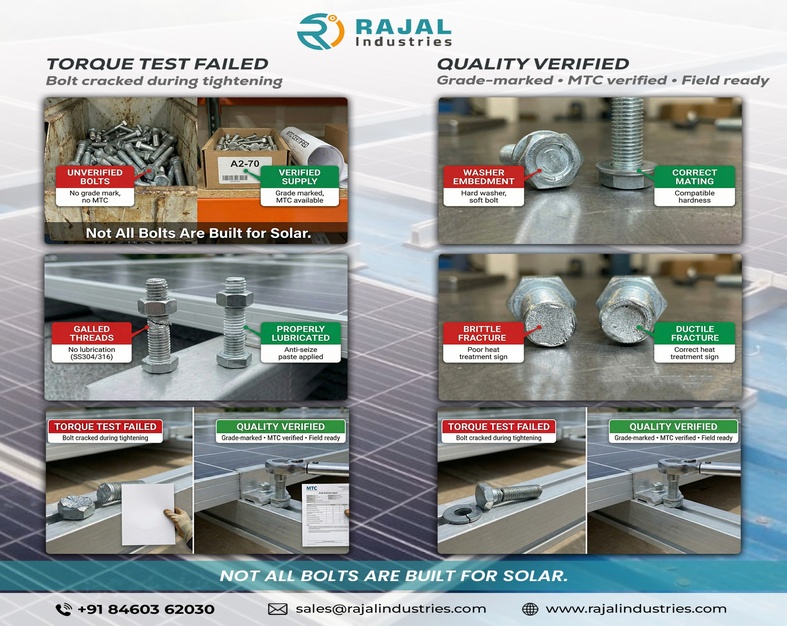
1. Wrong Grade Supplied
- Sometimes bolts are sold as 8.8 but are actually 4.6 or 5.6.
Visually identical.
Structurally weaker.
High torque reveals the truth the stamp didn’t. - 2. Poor Heat Treatment
Improper quenching or tempering leads to:
• Brittle structure
• Micro-cracks inside
• Low fatigue resistance
Externally the bolt looks strong.
Internally it’s ready to fail.
3. Low-Quality Raw Material
- Inconsistent alloy composition leads to:
• Weak tensile strength
• Reduced toughness
• Crack formation under load
If the steel itself is bad — no process can fix it later
4. Hard Washer + Soft Bolt
- Using high-hardness washers with low-grade bolts?
The washer survives.
The bolt absorbs the stress.
And then… fractures.
Typical Sizes Where Torque Failures Are Seen
Based on field experience:
• M10 HDG bolts
• M12 anchor bolts
• SS304 M8/M10 bolts without lubrication
• Mixed-batch fasteners used together
• Stainless bolts used without wax coating
What You Should Always Verify Before Installing
✅ Grade stamped on head (8.8 / A2-70)
✅ MTC with heat number
✅ Supplier QC report
✅ Zinc coating thickness for HDG
✅ Washer compatibility
✅ Storage condition before use
If any of those are missing —
you’re installing blind.
Final Word
When a bolt breaks during torque:
It isn’t just a bad part.
It’s a break in trust.
Solar structures don’t get a second chance after commissioning.
One weak fastener can become a failure point.
If you want reliability in the field —
you need strength at the unit level.