

Every transformer manufacturer knows that a transformer is only as reliable as the quality of its individual components. While cores, windings, insulation systems and bushings receive significant attention, fasteners are often overlooked during the design stage. However, the wrong fastener can lead to loose joints, oil leakage, vibration problems, corrosion, maintenance issues and unexpected downtime.
This is why many OEM companies manufacturing power transformers, distribution transformers, dry type transformers, instrument transformers and package substations specify DIN 6921 Flange Bolts for critical assemblies.
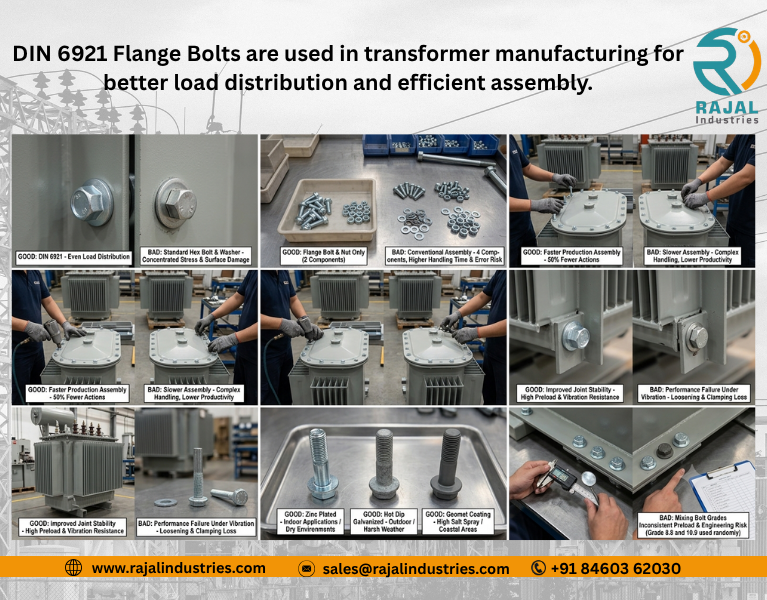
A DIN 6921 Flange Bolt combines a hexagon head with an integrated flange, allowing the clamping force to spread over a larger bearing area. Compared with a conventional hex head bolt and separate washer, this design simplifies assembly while improving joint stability.
At Rajal Industries, we manufacture DIN 6921 Flange Bolts for transformer manufacturers and industrial OEMs requiring bulk production from 50,000+ pieces. Our production supports standard fasteners, customer drawings, multiple material grades and long-term supply programmes.
Quick Answer
Transformer manufacturers prefer DIN 6921 Flange Bolts because they provide:
- Better load distribution
- Faster production assembly
- Reduced component count
- Improved joint stability
- Better performance under vibration
- Consistent clamping force
- Simplified inventory management
- Reliable long-term performance
These advantages make flange bolts a preferred fastening solution for many transformer assemblies.
Why Fastener Selection Is Critical in Transformer Manufacturing
Unlike many industrial products, transformers are expected to operate reliably for 20 to 35 years, often in harsh outdoor environments.
During this period, bolted joints experience:
- Thermal expansion and contraction
- Wind-induced vibration
- Transportation loads
- Installation stresses
- Maintenance activities
- Rain and humidity
- Dust and industrial pollution
- Continuous service loads
Every fastening point must maintain sufficient clamp force throughout the transformer’s operating life.
Poor-quality bolts may contribute to:
- Loose structural joints
- Oil leakage
- Increased maintenance
- Corrosion
- Assembly delays
- Premature component replacement
Selecting the correct flange bolt helps reduce these risks.
What Makes DIN 6921 Different?
Unlike a conventional hex head bolt, a DIN 6921 Flange Bolt has a built-in flange below the bolt head.
This flange performs several important engineering functions.
Better Bearing Area
The larger contact surface spreads the tightening force across a wider area.
Benefits include:
- Reduced local stress
- Better load distribution
- Less damage to painted surfaces
- Improved clamp stability
Reduced Number of Components
A conventional assembly may require:
- Hex Bolt
- Flat Washer
- Spring Washer
A flange bolt can often reduce this to:
- Flange Bolt
- Nut
Reducing loose components improves production efficiency and lowers the chance of assembly errors.
Improved Assembly Speed
For manufacturers assembling hundreds or thousands of transformers annually, even small time savings become significant.
Using flange bolts helps:
- Reduce handling time
- Simplify assembly
- Lower inventory
- Improve operator productivity
- Standardise fastening procedures
Where DIN 6921 Flange Bolts Are Used in Transformers
Transformer manufacturers commonly use flange bolts in several important assemblies.
Transformer Tank Fabrication
The transformer tank forms the main structural enclosure.
Flange bolts are commonly used for:
- Tank reinforcement
- Cover assembly
- Structural brackets
- Inspection covers
- Mounting supports
Proper clamping helps maintain structural integrity throughout transportation and service.
Radiator Mounting
Transformer radiators experience:
- Thermal expansion
- Temperature cycling
- Outdoor weather
- Mechanical vibration
Reliable fastening is essential to maintain alignment and reduce maintenance requirements.
Conservator Support Structures
Conservator assemblies require strong structural joints capable of supporting equipment weight while resisting vibration.
DIN 6921 flange bolts provide:
- Stable clamp force
- Better load distribution
- Easier installation
- Reliable maintenance access
Terminal Box Installation
Terminal boxes require secure fastening while protecting painted surfaces.
The integrated flange reduces concentrated pressure around mounting holes.
Base Frame Assembly
Base frames carry the complete transformer weight during transportation and installation.
Fasteners used in these assemblies should provide:
- High strength
- Dimensional consistency
- Reliable preload
- Long-term durability
Cable Support Systems
Cable trays and support brackets also use flange bolts because they simplify installation and reduce loose hardware during production.
Why OEM Procurement Teams Standardise Flange Bolts
Large transformer manufacturers often standardise fasteners across multiple product ranges.
Benefits include:
- Simplified purchasing
- Reduced inventory
- Better supplier management
- Easier quality inspection
- Standard torque procedures
- Improved spare part availability
- Faster production planning
Using one standard fastener family across multiple transformer models also simplifies training for production and maintenance teams.
Engineering Factors Before Selecting a Flange Bolt
Before releasing a transformer drawing, engineering teams evaluate several technical parameters.
Clamp Load Requirements
The bolt must maintain sufficient preload without overstressing the joint.
Material Selection
The material should provide adequate mechanical strength while matching the operating environment.
Common options include:
- Carbon Steel
- Alloy Steel
- Stainless Steel 304
- Stainless Steel 316
Property Class
Common property classes include:
- 8.8
- 10.9
Selecting a higher property class should always be supported by engineering calculations rather than assumptions.
Surface Protection
Outdoor transformers require coatings capable of resisting long-term corrosion.
Common choices include:
- Hot Dip Galvanized
- Geomet
- Dacromet
- Zinc Plated (for indoor applications)
Industries Beyond Transformer Manufacturing
Although transformer manufacturers are major users, DIN 6921 flange bolts are also widely used in:
- Switchgear Manufacturing
- Electrical Panel Manufacturing
- Battery Energy Storage Systems (BESS)
- EV Charger Manufacturing
- Telecom Cabinet Manufacturing
- Renewable Energy Equipment
- Industrial Machinery
- Material Handling Equipment
- Heavy Fabrication
- Process Equipment
The same engineering principles that benefit transformers also apply to many industrial OEM products.
Grade 8.8 vs Grade 10.9 Flange Bolts for Transformer Applications
One of the most common questions asked by transformer design engineers is whether Grade 8.8 or Grade 10.9 flange bolts should be used.
The answer depends on engineering calculations rather than simply selecting the highest available strength.
| Property | Grade 8.8 | Grade 10.9 |
| Tensile Strength | High | Very High |
| Yield Strength | High | Higher |
| Typical Transformer Applications | Tank Assembly, Radiators, Covers | Heavy Structural Supports, High Load Joints |
| Cost | Lower | Higher |
| Availability | Excellent | Good |
| OEM Usage | Most Common | Selected Applications |
For most transformer assemblies, Grade 8.8 DIN 6921 Flange Bolts provide sufficient mechanical strength while maintaining economical production costs.
Grade 10.9 should only be specified where engineering calculations demonstrate the need for higher preload or mechanical loading.
Surface Coating Selection for Transformer Installations
Transformer operating conditions vary significantly.
Indoor transformers require different corrosion protection compared with outdoor power transformers installed in coastal or industrial environments.
Zinc Plated
Suitable for:
- Indoor electrical rooms
- Dry type transformers
- Control panels
- Indoor switchgear
Advantages:
- Economical
- Good appearance
- Suitable for dry environments
Hot Dip Galvanized (HDG)
Recommended for:
- Outdoor transformers
- Pole mounted transformers
- Distribution transformers
- Substations
- Structural supports
Advantages:
- Excellent corrosion resistance
- Long outdoor service life
- Suitable for harsh weather conditions
Geomet Coating
Commonly selected for:
- Utility equipment
- Renewable energy
- Telecom infrastructure
- Coastal installations
Advantages:
- High salt spray resistance
- Uniform coating
- Environmentally friendly
Dacromet
Used where:
- High corrosion resistance is required
- Heavy industrial environments
- Chemical plants
- Process industries
Advantages:
- Excellent corrosion protection
- Good long-term durability
Common Engineering Mistakes
Many fastening failures occur because of incorrect engineering decisions rather than manufacturing defects.
Selecting Oversized Bolts
Larger bolts increase weight and cost without necessarily improving joint performance.
Ignoring Clamp Load
The bolt’s primary purpose is to generate clamp force.
Selecting a bolt only by tensile strength is incorrect.
Incorrect Torque
Under-tightening can lead to loosening.
Over-tightening may permanently damage the bolt or joint.
Torque values should always follow engineering specifications.
Wrong Coating
Indoor coatings should never be assumed suitable for outdoor transformer installations.
Mixing Bolt Grades
Using different property classes within the same assembly may create inconsistent joint behaviour and maintenance challenges.
Purchasing Without Engineering Review
Procurement should always verify:
- Drawing revision
- Material
- Property class
- Coating
- Manufacturing standard
before approving bulk production.
Quality Inspection Checklist
Before approving production, OEM quality teams should verify:
| Inspection Item | Verify |
| DIN 6921 Standard | ✔ |
| Bolt Diameter | ✔ |
| Bolt Length | ✔ |
| Flange Diameter | ✔ |
| Thread Accuracy | ✔ |
| Material Grade | ✔ |
| Property Class | ✔ |
| Surface Coating | ✔ |
| Coating Thickness | ✔ |
| Mechanical Properties | ✔ |
| Visual Inspection | ✔ |
| Batch Traceability | ✔ |
| Packaging | ✔ |
| Material Test Certificate (if required) | ✔ |
A documented inspection procedure helps reduce assembly problems and ensures consistent production quality.
Why Transformer OEMs Work with Specialised Fastener Manufacturers
Large transformer manufacturers usually qualify suppliers based on much more than price.
They evaluate:
- Production capacity
- Manufacturing process
- Cold forging capability
- Thread rolling quality
- Heat treatment control
- Surface coating quality
- Inspection systems
- Batch traceability
- On-time delivery
- Long-term supply capability
Reliable suppliers help reduce production interruptions and support long-term manufacturing programmes.
Why Rajal Industries?
Rajal Industries manufactures DIN 6921 Flange Bolts for transformer manufacturers and industrial OEMs requiring dependable, high-volume production.
Our capabilities include:
- MOQ from 50,000+ pieces
- DIN 6921 and custom flange bolts
- Carbon Steel, Alloy Steel, SS304 and SS316
- Grade 4.6, 5.6, 8.8 and 10.9
- Zinc, HDG, Geomet, Dacromet and custom surface finishes
- Cold forged manufacturing
- Drawing-based production
- Consistent dimensional accuracy
- Batch traceability
- OEM packaging
- Long-term supply programmes
- Export-ready manufacturing
We support:
- Power Transformer Manufacturers
- Distribution Transformer Manufacturers
- Dry Type Transformer Manufacturers
- Switchgear Manufacturers
- Electrical Panel Manufacturers
- BESS Manufacturers
- EV Charger Manufacturers
- Industrial Machinery OEMs
OEM RFQ Checklist
Before requesting a quotation, confirm:
☐ DIN 6921 standard
☐ Thread size
☐ Bolt length
☐ Property class
☐ Material
☐ Surface coating
☐ Annual quantity
☐ Engineering drawing
☐ Inspection requirements
☐ Packaging requirements
☐ Delivery schedule
Providing complete technical information helps suppliers prepare accurate quotations and reduces production delays.
Key Takeaways
- DIN 6921 flange bolts are widely used in transformer manufacturing because they improve load distribution and simplify assembly.
- Grade 8.8 is suitable for many transformer applications, while Grade 10.9 should be selected only where higher strength is required.
- Surface coating should match the operating environment to maximise service life.
- Standardising flange bolts across transformer models simplifies procurement, inventory management and maintenance.
- Selecting an experienced OEM fastener manufacturer improves production consistency and long-term supply reliability.
Frequently Asked Questions
Why do transformer manufacturers use DIN 6921 flange bolts?
The integrated flange improves load distribution, reduces the need for separate washers and simplifies assembly in high-volume production.
Are flange bolts better than standard hex bolts?
In many transformer applications, flange bolts provide advantages such as better bearing area, fewer components and improved assembly efficiency. The choice should still follow the engineering design.
Which grade is commonly used in transformers?
Grade 8.8 is commonly used for many transformer assemblies, while Grade 10.9 is selected for higher-load applications where required.
Which coating is recommended for outdoor transformers?
Hot Dip Galvanized (HDG), Geomet or Dacromet coatings are commonly selected depending on the environmental conditions and engineering requirements.
Can DIN 6921 flange bolts be manufactured according to customer drawings?
Yes. Rajal Industries manufactures both standard and custom flange bolts based on customer drawings and specifications.
What industries besides transformers use flange bolts?
Switchgear, electrical panels, telecom cabinets, EV chargers, Battery Energy Storage Systems (BESS), industrial machinery, renewable energy equipment and heavy fabrication industries.
What is your minimum order quantity?
Rajal Industries primarily supports OEM production from 50,000+ pieces, depending on the product and manufacturing process.
Conclusion
DIN 6921 Flange Bolts have become a preferred fastening solution for transformer manufacturers because they combine efficient assembly, reliable clamping performance and long-term durability. Their integrated flange improves load distribution, reduces loose components and supports consistent production quality.
For manufacturers of power transformers, distribution transformers, dry type transformers, switchgear, electrical panels, BESS systems and industrial equipment, selecting the correct DIN 6921 flange bolt specification helps improve reliability, reduce maintenance and simplify manufacturing.
If your company requires DIN 6921 flange bolts, drawing-based manufacturing or bulk production from 50,000+ pieces, Rajal Industries can support your engineering, procurement and long-term OEM manufacturing requirements.
Related Keywords
Flange Bolt, DIN 6921 Flange Bolt, Flange Bolt Manufacturer, Hex Flange Bolt, DIN 6921 Manufacturer, ISO 4162 Flange Bolt, Grade 8.8 Flange Bolt, Grade 10.9 Flange Bolt, High Tensile Flange Bolt, Stainless Steel Flange Bolt, Transformer Fasteners, Power Transformer Fasteners, Distribution Transformer Fasteners, Switchgear Fasteners, Electrical Panel Fasteners, OEM Fastener Manufacturer, Bulk Bolt Supplier, Drawing-Based Fastener Manufacturer, Cold Forged Flange Bolt.