

When procurement engineers and design teams search for DIN 6921 Flange Bolts, they are usually looking for more than a standard fastener. They need complete technical information to ensure the selected bolt matches the engineering drawing, production process and long-term operating conditions.
For OEM manufacturers producing power transformers, distribution transformers, dry type transformers, switchgear, electrical panels, control panels, battery energy storage systems (BESS), telecom cabinets and industrial machinery, selecting the correct flange bolt specification helps improve assembly quality, production efficiency and product reliability.
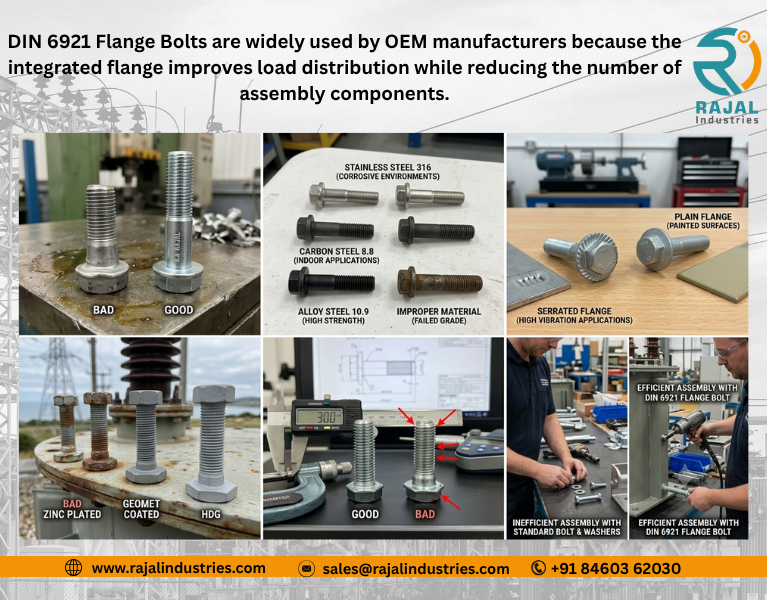
A DIN 6921 Flange Bolt combines a hexagon head with an integrated flange that distributes the clamping load over a larger contact area. This often eliminates the need for a separate flat washer and reduces the number of components handled during assembly.
At Rajal Industries, we manufacture DIN 6921 Flange Bolts and custom flange bolts for OEM customers requiring bulk production from 50,000+ pieces. Our manufacturing supports international standards, drawing-based production and long-term supply programmes.
Quick Answer
A DIN 6921 Flange Bolt is a metric hexagon flange bolt manufactured according to the DIN 6921 standard. It features an integrated flange below the head that spreads the tightening force over a larger surface area, improving load distribution and simplifying assembly. It is commonly supplied in property classes such as 8.8 and 10.9, with plain or serrated flange options depending on the application.
OEM manufacturers commonly specify DIN 6921 flange bolts for:
- Transformer manufacturing
- Switchgear
- Electrical panels
- Industrial machinery
- Telecom cabinets
- Heavy fabrication
- Renewable energy equipment
- Material handling systems
What is DIN 6921?
DIN 6921 is one of the most recognised standards covering hexagon flange bolts with metric coarse or fine threads. The standard defines important dimensional and manufacturing requirements so that bolts from different production batches remain interchangeable. It covers nominal thread diameters from M5 to M20 for standard product grade A configurations.
The standard specifies:
- Head dimensions
- Flange diameter
- Thread dimensions
- Bolt length
- Tolerances
- Product grade
- Thread type
Using a recognised standard simplifies procurement, quality inspection and replacement during maintenance.
Main Features of DIN 6921 Flange Bolts
Unlike a standard hex bolt, a DIN 6921 flange bolt has an integral flange below the head.
Major features include:
- Hexagon head
- Integrated circular flange
- Metric thread
- Standard dimensions
- Better load distribution
- Reduced need for separate washers
- Faster assembly
- Improved production efficiency
These features make flange bolts one of the preferred fastening solutions for industrial OEM production.
Why Transformer Manufacturers Use DIN 6921 Flange Bolts
Transformer assemblies contain many bolted joints that remain in service for 20–30 years or longer.
Typical applications include:
- Transformer tank fabrication
- Radiator mounting
- Conservator brackets
- Terminal box installation
- Base frame assembly
- Structural supports
- Earthing assemblies
- Cable support brackets
The integrated flange helps distribute clamp force over painted steel surfaces, reducing local surface pressure and supporting more consistent joint performance.
Applications in Electrical Panels
Electrical panel manufacturers also benefit from DIN 6921 flange bolts because they simplify assembly and reduce the number of loose components.
Typical applications include:
- LT Panels
- HT Panels
- PCC Panels
- MCC Panels
- PLC Panels
- Control Panels
- Distribution Boards
- Junction Boxes
- Battery Cabinets
- Power Distribution Equipment
For automated production lines, reducing separate washer handling can improve assembly speed and reduce operator errors.
Applications in Switchgear Manufacturing
Switchgear manufacturers commonly specify flange bolts for:
- Equipment frames
- Structural members
- Busbar supports
- Cable management systems
- Protective covers
- Sheet metal assemblies
- Equipment mounting brackets
The larger bearing surface of the flange helps improve load distribution on fabricated sheet metal components.
DIN 6921 Dimensions
DIN 6921 flange bolts are available in several standard metric thread sizes.
| Thread Size | Common OEM Applications |
| M5 | Electrical Devices |
| M6 | Control Panels |
| M8 | Electrical Equipment |
| M10 | Transformer Assemblies |
| M12 | Switchgear Structures |
| M16 | Industrial Machinery |
| M20 | Heavy Equipment |
Actual head dimensions, flange diameter, thread length and tolerances should always comply with the applicable engineering drawing and DIN 6921 requirements.
Materials Used for DIN 6921 Flange Bolts
Selecting the correct material is essential for long-term performance.
Common materials include:
| Material | Typical Applications |
| Carbon Steel | General Industrial Equipment |
| High Tensile Steel | Heavy Mechanical Loads |
| Alloy Steel | High Strength Applications |
| Stainless Steel 304 | Indoor Electrical Equipment |
| Stainless Steel 316 | Coastal & Chemical Environments |
Material selection depends on:
- Mechanical load
- Corrosion exposure
- Operating temperature
- Product life expectancy
- Environmental conditions
Property Classes
DIN 6921 flange bolts are commonly manufactured in:
- Property Class 4.6
- Property Class 5.6
- Property Class 8.8
- Property Class 10.9
- Property Class 12.9 (special applications)
For most transformer, switchgear and electrical panel applications, Grade 8.8 provides an effective balance of strength, availability and cost. Higher grades should only be selected when supported by engineering calculations.
Plain vs Serrated Flange Bolts
DIN 6921 flange bolts are available with:
Plain Flange
Suitable for:
- Painted surfaces
- Powder-coated enclosures
- Sheet metal assemblies
- Decorative equipment
Serrated Flange
Suitable for:
- Machinery
- High vibration equipment
- Automotive assemblies
- Industrial equipment
The serrations increase resistance to loosening but may mark the mating surface, so the choice should match the application.
Step 1 – Select the Correct Surface Coating
Selecting the right surface coating is just as important as selecting the correct bolt material. Many bolted joints fail because corrosion protection does not match the service environment, even though the bolt has the correct strength grade.
Before selecting a coating, OEM engineers should evaluate:
- Indoor or outdoor installation
- Humidity levels
- Rainwater exposure
- Coastal atmosphere
- Industrial pollution
- Chemical exposure
- Operating temperature
- Expected equipment life
- Maintenance intervals
The coating should protect the bolt throughout the expected service life without affecting assembly quality.
Common Surface Finishes for DIN 6921 Flange Bolts
| Surface Finish | Typical Applications | Main Benefits |
| Zinc Plated | Electrical Panels, Indoor Equipment | Economical corrosion protection |
| Hot Dip Galvanized (HDG) | Outdoor Transformers, Steel Structures | Excellent long-term corrosion resistance |
| Geomet | EV Chargers, Telecom Cabinets | High salt spray resistance without hydrogen embrittlement risk |
| Dacromet | Heavy Industrial Equipment | Excellent corrosion protection for harsh environments |
| Black Oxide | Machinery & Indoor Equipment | Attractive finish with light corrosion protection |
| Phosphate | Industrial Machinery | Good lubrication and paint adhesion |
| Stainless Steel Finish | Marine & Chemical Industries | Excellent corrosion resistance without additional coating |
Selecting the correct finish helps reduce maintenance costs while extending equipment life.
DIN 6921 vs ISO 4162
Many procurement engineers receive quotations based on either DIN 6921 or ISO 4162.
Both standards describe hex flange bolts with similar applications, but engineering drawings should always specify the required standard.
| Feature | DIN 6921 | ISO 4162 |
| Bolt Type | Hex Flange Bolt | Hex Flange Bolt |
| Metric Threads | Yes | Yes |
| OEM Applications | Excellent | Excellent |
| International Acceptance | Very High | Very High |
| Industrial Usage | Common | Common |
For most OEM projects, always manufacture according to the drawing or customer specification rather than substituting standards without engineering approval.
Engineering Factors Before Selecting a DIN 6921 Flange Bolt
A flange bolt should never be selected using diameter alone.
Engineering teams normally evaluate:
Joint Load
The bolt must provide sufficient preload to maintain clamp force throughout the equipment’s operating life.
Material Thickness
Flange diameter and bolt length should suit the thickness of the joined components.
Thread Engagement
Adequate thread engagement is essential for reliable joint performance.
Clamp Load
Correct tightening torque produces the preload required to keep the joint secure.
Vibration
Switchgear, transformers and machinery experience varying levels of vibration.
Where appropriate, serrated flange bolts or additional locking methods may improve resistance to loosening.
Corrosion
Outdoor transformer installations generally require greater corrosion protection than indoor electrical equipment.
Service Life
Fastener selection should match the expected equipment life rather than only the initial purchase cost.
Why OEM Manufacturers Standardise DIN 6921 Flange Bolts
Large OEM manufacturers often standardise flange bolts across multiple product families.
Benefits include:
- Simplified procurement
- Reduced inventory
- Faster production
- Lower assembly cost
- Easier maintenance
- Better spare part availability
- Consistent torque procedures
- Improved quality control
Standardisation also simplifies vendor qualification and long-term purchasing agreements.
Common Procurement Mistakes
Many production problems begin during procurement rather than assembly.
Avoid these common mistakes:
Buying Only on Price
The cheapest bolt is not always the lowest-cost solution over the equipment’s lifetime.
Selecting Incorrect Flange Diameter
The flange must provide sufficient bearing area without interfering with surrounding components.
Ignoring Coating Thickness
Excessive coating thickness may affect thread fit, while insufficient coating may reduce corrosion resistance.
Choosing Higher Property Class Without Engineering Approval
Selecting Grade 10.9 instead of Grade 8.8 does not automatically improve reliability.
Mixing Different Standards
Always follow the engineering drawing.
Avoid mixing DIN 6921, ISO 4162 or customer-specific dimensions without technical approval.
Ignoring Manufacturing Quality
Dimensional consistency, thread accuracy and material traceability are critical for high-volume OEM production.
Quality Inspection Checklist
Before approving a production batch, OEM quality teams should verify:
| Inspection Item | Verify |
| DIN 6921 Compliance | ✔ |
| Bolt Diameter | ✔ |
| Bolt Length | ✔ |
| Flange Diameter | ✔ |
| Head Dimensions | ✔ |
| Thread Accuracy | ✔ |
| Material Grade | ✔ |
| Property Class | ✔ |
| Surface Finish | ✔ |
| Coating Thickness (if applicable) | ✔ |
| Visual Appearance | ✔ |
| Packaging | ✔ |
| Batch Traceability | ✔ |
| Material Certificates | ✔ (if required) |
A structured inspection process improves production consistency and reduces field failures.
When Should OEM Buyers Request Custom Flange Bolts?
Although DIN 6921 covers standard flange bolts, many OEM manufacturers require custom solutions.
Custom flange bolts may be needed for:
- Non-standard bolt lengths
- Special thread lengths
- Larger flange diameters
- Customer-specific head markings
- Special coatings
- Unique materials
- Fine thread requirements
- Drawing-based products
Custom manufacturing helps eliminate unnecessary assembly compromises and supports product standardisation.
Why Rajal Industries?
Rajal Industries manufactures DIN 6921 Flange Bolts and custom flange bolts for industrial OEM manufacturers.
Our capabilities include:
- MOQ from 50,000+ pieces
- DIN, ISO and drawing-based manufacturing
- Carbon Steel, Alloy Steel, SS304 and SS316
- Grade 4.6, 5.6, 8.8, 10.9 and customised requirements
- Zinc, HDG, Geomet, Dacromet and other surface finishes
- Cold forged manufacturing
- Consistent dimensional accuracy
- Batch traceability
- OEM packaging
- Long-term supply agreements
- Export-ready production
We primarily supply:
- Transformer Manufacturers
- Electrical Panel Manufacturers
- Switchgear Manufacturers
- Telecom Cabinet Manufacturers
- EV Charger Manufacturers
- Battery Energy Storage System (BESS) Manufacturers
- Industrial Machinery OEMs
- Renewable Energy Equipment Manufacturers
OEM RFQ Checklist
Before requesting a quotation, include:
☐ Standard (DIN 6921 / ISO 4162)
☐ Thread Size
☐ Bolt Length
☐ Property Class
☐ Material
☐ Surface Finish
☐ Serrated / Non-Serrated Flange
☐ Annual Quantity
☐ MOQ
☐ Engineering Drawing
☐ Inspection Requirements
☐ Packaging Details
☐ Delivery Schedule
Providing complete information helps reduce quotation time and improves manufacturing accuracy.
Key Takeaways
- DIN 6921 is one of the most widely specified standards for metric hex flange bolts.
- The integrated flange improves load distribution and often eliminates the need for a separate washer.
- Material, property class and coating should be selected according to engineering requirements.
- Standardisation improves procurement, production efficiency and inventory management.
- Working with an experienced OEM flange bolt manufacturer helps ensure consistent quality and long-term supply.
Frequently Asked Questions
What is a DIN 6921 flange bolt?
A DIN 6921 flange bolt is a metric hex bolt with an integrated flange that distributes the tightening load over a larger surface area.
Why are flange bolts used instead of standard hex bolts?
They simplify assembly, reduce component count, improve load distribution and may eliminate the need for separate washers.
Which industries commonly use DIN 6921 flange bolts?
Transformer manufacturers, switchgear manufacturers, electrical panel builders, telecom cabinet manufacturers, industrial machinery OEMs, EV charger manufacturers and renewable energy equipment manufacturers.
Are flange bolts available in stainless steel?
Yes. DIN 6921 flange bolts are commonly manufactured in SS304 and SS316 depending on the operating environment.
Which property class is commonly used?
Grade 8.8 is widely used for industrial applications, while Grade 10.9 is selected where higher strength is required by engineering design.
Can DIN 6921 flange bolts be manufactured according to customer drawings?
Yes. Rajal Industries manufactures both standard and custom flange bolts based on customer drawings and specifications.
What is your production quantity?
We primarily support OEM production from 50,000+ pieces, depending on the product and manufacturing process.
Which coating is best for outdoor transformer applications?
Hot Dip Galvanized (HDG), Geomet or stainless steel are commonly selected depending on the service environment and engineering requirements.
Conclusion
DIN 6921 Flange Bolts have become one of the preferred fastening solutions for industrial OEM manufacturers because they combine reliable clamping performance, simplified assembly and consistent engineering standards. Their integrated flange improves load distribution, reduces component count and supports efficient high-volume production.
For manufacturers of transformers, switchgear, electrical panels, telecom cabinets, EV chargers, BESS systems and industrial machinery, selecting the correct DIN 6921 flange bolt specification improves assembly quality, reduces maintenance and supports long-term equipment reliability.
If your company requires DIN 6921 flange bolts, custom flange bolts or drawing-based manufacturing with bulk production from 50,000+ pieces, Rajal Industries can support your engineering, procurement and long-term OEM manufacturing requirements.
Related Keywords
DIN 6921 Flange Bolt, DIN 6921 Specifications, Hex Flange Bolt, Hex Flange Bolt Manufacturer, Flange Bolt Manufacturer, Flange Bolt Supplier, ISO 4162 Flange Bolt, Grade 8.8 Flange Bolt, Grade 10.9 Flange Bolt, Stainless Steel Flange Bolt, High Tensile Flange Bolt, Transformer Fasteners, Switchgear Fasteners, Electrical Panel Fasteners, Industrial Fasteners, OEM Fastener Manufacturer, Bulk Fastener Supplier, Drawing-Based Fastener Manufacturer, Cold Forged Flange Bolts.