

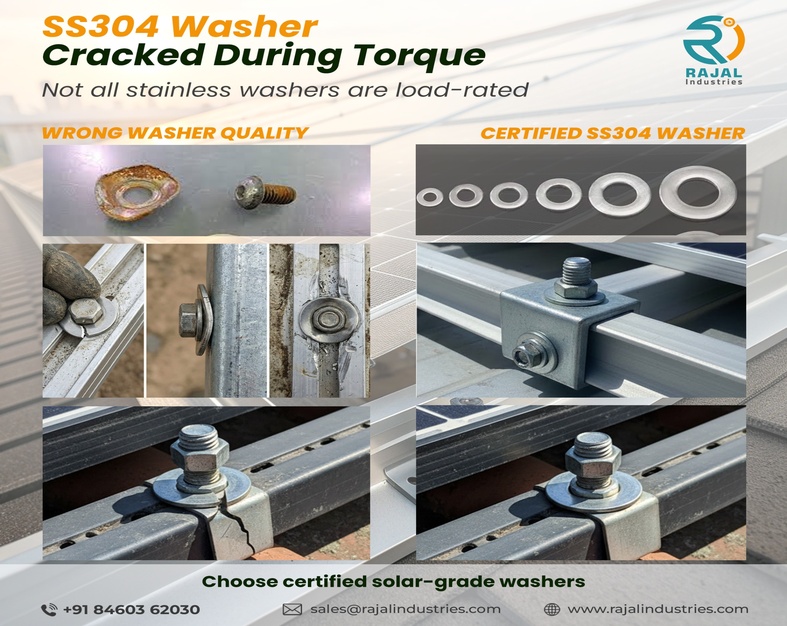
Why SS304 Flat Washers Crack During Solar Installation
A cracked washer looks small.
The damage it causes is not.
In many solar projects today, EPC teams are reporting the same issue:
SS304 washers splitting during tightening.
No overload.
No wrong tool.
No installer mistake.
Still, the washer fails.
So what’s really going wrong?
The Real Function of a Washer in Solar Mounting
In solar installations, a washer does more than sit under a bolt.
It:
• Distributes load
• Prevents surface damage
• Maintains joint tension
• Absorbs vibration
• Supports long-term stability
If the washer cracks, the joint immediately becomes unreliable.
Why Most SS304 Washers Crack
Not because they are stainless.
Because they are:
• Too thin
• Improper heat treated
• Poorly punched
• Wrong OD
• Made from soft sheet
• Incorrect chemical composition
• Sold without testing
Many washers in the market are:
“SS in name, not in grade.
Typical Faults Seen on Site
- • Washer splits during torque
- • Washer bends outward
• Washer edges crack
• Washer dig into bracket slots
• Joint loosens after vibration
All because the washer was:
Wrong thickness or wrong grade.
Correct Specification for Solar Washers
For solar applications, always specify:
✔ SS304 chemical grade
✔ Minimum thickness based on load
✔ OD matching mounting slot
✔ Hardness tested
✔ Uniform stamping
✔ Burr-free edges
✔ MTC from manufacturer
Never accept:
“Looks OK”
as a quality standard.
Common Solar Sizes Where This Happens
The most affected washer sizes:
• M8 flat washers
• M10 flat washers
• M12 flat washers
Especially when used with:
• HDG bolts
• Flanged assemblies
• Aluminium brackets
• Slotted structures
• High-wind zones
Final Word
If your washer fails, your structure weakens.
The bolt can survive.
The nut can survive.
But without a proper washer, the joint doesn’t.
Fasteners should save you money.
Not cost you rework.