

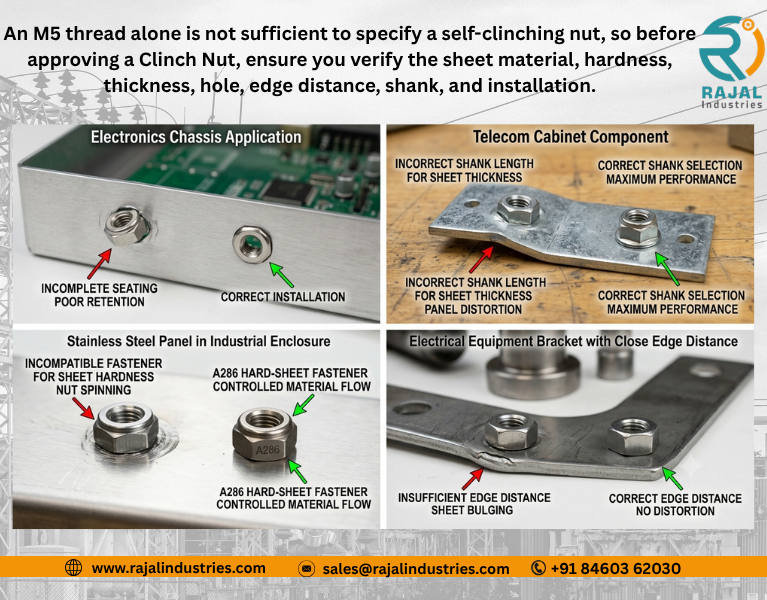
Selecting the correct Self Clinching Nut Sizes requires much more than choosing an M3, M4, M5, M6 or M8 thread.
A self-clinching nut becomes mechanically retained in sheet metal through controlled interaction between the fastener and the sheet. The nut is inserted into a correctly sized hole and installed using parallel squeezing force. Sheet material then flows into the fastener’s undercut, while the clinching geometry helps resist rotation. (PennEngineering (PEM))
Therefore, buyers should evaluate:
Thread Size → Sheet Material → Sheet Hardness → Sheet Thickness → Hole Size → Edge Distance → Shank Length → Clinching Geometry → Fastener Material → Installation → Push-Out/Torque-Out → Finish
Two clinch nuts with the same M5 thread can require different sheet thicknesses, hole dimensions or material conditions.
This guide explains Clinch Nut Sizes, types, materials and practical selection factors for electronics, telecom, electrical panels, appliances, enclosures and other sheet-metal applications.
Quick Answer: What Sizes Do Self-Clinching Nuts Come In?
Commercial metric self-clinching nut families are available across a range of thread sizes. Current product data, for example, shows products from M2 through M10 in certain families. (PennEngineering (PEM))
Typical metric thread examples buyers may encounter include:
| Thread | Standard Coarse Pitch Example |
| M2 | 0.4 mm |
| M2.5 | 0.45 mm |
| M3 | 0.5 mm |
| M4 | 0.7 mm |
| M5 | 0.8 mm |
| M6 | 1.0 mm |
| M8 | 1.25 mm |
| M10 | 1.5 mm |
However, this should not be treated as a universal size range for every self-clinching nut design.
Availability depends on the fastener family, material, manufacturer and sheet application.
What Does Self-Clinching Nut Size Mean?
When a buyer requests an:
M5 Self Clinching Nut
the M5 primarily identifies the nominal internal metric thread diameter.
It does not fully specify the fastener.
You still need to define:
- Thread pitch
- Thread tolerance
- Shank length
- Pilot diameter
- Head dimensions
- Clinching geometry
- Required sheet thickness
- Sheet hardness
- Hole diameter
- Edge distance
- Fastener material
- Finish
Therefore:
Thread size is only the starting point of a self-clinching nut specification.
Self Clinching Nut Sizes vs Sheet Thickness
This is one of the most important relationships for buyers.
The correct nut configuration depends partly on the thickness of the sheet into which it will be installed.
Commercial self-clinching systems often offer different shank configurations for different minimum sheet thicknesses.
The sheet must provide enough material for the clinching mechanism to develop proper retention.
Why Sheet Thickness Matters
During installation, sheet material flows into the fastener’s undercut.
If the sheet is unsuitable for the selected shank configuration, possible problems include:
- Poor retention
- Nut spinning
- Low push-out performance
- Panel distortion
- Incomplete seating
Therefore:
Thread Size ≠ Sheet Thickness
Both must be specified independently.
Example: Same Thread, Different Sheet Requirement
Consider two M5 clinch nuts.
Both may use an M5 × 0.8 internal thread.
But Nut A may have a shorter clinching shank intended for thinner sheet, while Nut B may have a different shank configuration for another sheet thickness.
This is why OEM drawings should not simply specify:
M5 clinch nut.
The exact product geometry matters.
Real-World Example: M2 Self-Clinching Nut
A current commercial M2 × 0.4 stainless self-clinching nut example specifies:
- M2 × 0.4 thread
- 0.77 mm maximum shank dimension
- 0.8 mm recommended minimum sheet thickness
- 4.22 mm sheet hole
- 4.8 mm minimum hole-center-to-edge distance
- Internal metric 6H thread
These dimensions apply to that particular product, not every M2 clinch nut. (PennEngineering (PEM))
This illustrates why Self Clinching Nut Sizes must be read from the complete product drawing.
Real-World Example: M10 Self-Clinching Nut
A current M10 × 1.5 commercial example specifies:
- M10 × 1.5 internal thread
- 2.21 mm maximum shank dimension
- 2.29 mm recommended minimum sheet thickness
- 14 mm sheet hole
- 13.5 mm minimum hole-center-to-edge distance
The product is specified for sheet hardness up to HRB 80 / HB 150. (PennEngineering (PEM))
Again, these are product-specific values.
They should not be copied to every M10 clinch nut drawing.
Why We Should Not Publish One Universal Clinch Nut Dimension Table
It is tempting to create a table such as:
M5 thread = X hole = Y sheet thickness
But this can be technically misleading.
Different product families can use different:
- Shank lengths
- Materials
- Clinching geometry
- Sheet-hardness limits
- Hole requirements
- Edge distances
A dimensional table should always identify the specific design or standard being referenced.
Main Self-Clinching Nut Dimensions
When comparing Clinch Nut Sizes, buyers should understand the main dimensional features.
Thread Diameter
Defines the nominal mating screw diameter.
Thread Pitch
Defines the distance between adjacent metric threads.
Shank or Pilot
Enters the prepared sheet hole.
Shank Length
Must suit the sheet-thickness requirement.
Hole Diameter
Controls the fastener-to-sheet interface.
Head Diameter
Influences installation area and space requirement.
Overall Height
Important where assembly clearance is limited.
Edge Distance
Defines how close the fastener can be positioned to a free sheet edge under the product’s recommended conditions.
Thread Size and Pitch
For metric Clinch Nuts, the full thread should be stated.
Instead of:
M6
prefer:
M6 × 1.0
where that is the specified thread.
This helps prevent ambiguity during international sourcing.
Metric Internal Thread Tolerance
Current commercial metric self-clinching products can use internal threads specified to ASME B1.13M, class 6H. (PennEngineering (PEM))
However, the customer’s approved drawing should control the required thread specification.
Do not assume every clinch nut from every manufacturer automatically uses the same tolerance.
Metric vs Inch Clinch Nut Sizes
Self-clinching nuts are available in both:
- Metric threads
- Unified/inch threads
The buyer should clearly identify the thread system in the RFQ.
Similar-looking metric and inch fasteners should never be mixed.
Main Self-Clinching Nut Types
Self Clinching Nut types can differ by:
- Material
- Sheet hardness compatibility
- Thread
- Shank configuration
- Locking function
- Profile
- Installation requirement
- OEM design
For procurement, it is more useful to classify them by application than by one manufacturer’s proprietary product code.
Type 1: Standard Steel Self-Clinching Nut
A standard steel clinch nut can be used in compatible softer steel or aluminium sheet where its design and hardness requirements are satisfied.
Potential applications include:
- Electrical panels
- Appliance frames
- Industrial enclosures
- Electronics chassis
The exact sheet-hardness limit depends on the product.
Type 2: Stainless Self-Clinching Nut
Stainless fasteners may be selected for:
- Corrosion resistance
- OEM material requirements
- Electronics
- Enclosures
- Industrial equipment
However:
A stainless clinch nut is not automatically suitable for clinching into hard stainless sheet.
Sheet compatibility must be checked separately.
Type 3: Self-Clinching Nut for Harder Stainless Sheet
Specialized self-clinching products are available for suitable harder stainless sheets.
For example, one current commercial family uses age-hardened A286 stainless steel and is specified for certain stainless sheets up to HRB 90 / HB 185. (PennEngineering (PEM))
This is a product-family example, not a universal rule for all stainless clinch nuts.
Type 4: Aluminium Self-Clinching Nut
Aluminium clinch nuts are available for compatible softer applications.
For example, one current commercial aluminium family is recommended for suitable aluminium sheet at HRB 50 or lower. (PennEngineering (PEM))
Potential reasons to consider aluminium include:
- Weight
- Material compatibility
- Application-specific requirements
But the complete joint must be validated.
Type 5: Self-Locking Self-Clinching Nut
Some self-clinching nut designs combine:
Self-Clinching Retention + Thread Locking Feature
These are two different functions.
Self-Clinching
Retains the nut in the sheet.
Self-Locking
Provides resistance to mating-screw rotation according to the locking design.
Do not assume every clinch nut is self-locking.
Type 6: Low-Profile or Space-Constrained Clinch Nut
OEM designs with limited space may use specialized lower-profile or compact Sheet Metal Fasteners.
Selection can depend on:
- Panel thickness
- Rear clearance
- Thread requirement
- Head clearance
- Required performance
The actual design should be drawing-controlled.
Type 7: Custom Self-Clinching Nut
Custom OEM requirements can involve:
- Special thread
- Custom head
- Special clinching geometry
- Different shank length
- Special material
- Special finish
- Customer-specific performance
Custom development should include installation and functional validation.
Self-Clinching Nut Types Comparison
| Type | Main Selection Reason | Important Check |
| Steel Clinch Nut | General sheet-metal applications | Sheet hardness |
| Stainless Clinch Nut | Corrosion/material requirement | Sheet compatibility |
| Hard-Sheet Clinch Nut | Suitable harder stainless applications | Approved hardness limit |
| Aluminium Clinch Nut | Lightweight/compatible soft sheet | Sheet material |
| Self-Locking Clinch Nut | Added thread-locking function | Locking requirement |
| Low-Profile Type | Restricted space | Clearance |
| Custom Clinch Nut | OEM-specific requirement | Drawing + testing |
Sheet Hardness Is Critical
The self-clinching process requires suitable material interaction between the nut and sheet.
Commercial families show why one hardness limit cannot be applied to every clinch nut.
For example, current manufacturer data lists families for sheets up to approximately:
- HRB 50 / HB 82 for certain aluminium products
- HRB 70 / HB 125 for certain stainless fastener families
- HRB 80 / HB 150 for certain steel/stainless products
- HRB 90 / HB 185 for specialized harder-sheet products (PennEngineering (PEM))
These are examples from specific commercial families.
They are not universal self-clinching nut hardness limits.
Why the Clinch Nut Must Suit the Sheet Hardness
The sheet needs to plastically flow into the fastener’s retention features.
If the sheet is too hard for the selected product:
- Material flow may be insufficient
- Nut may spin
- Push-out resistance may decrease
- Seating can become incomplete
Increasing installation force does not necessarily correct an incompatible fastener-sheet combination.
Sheet Material Selection
A useful selection matrix is:
| Sheet Material | Main Engineering Check |
| Aluminium | Alloy, temper, hardness, thickness |
| Mild Steel | Grade, hardness, thickness |
| Stainless Steel | Hardness + specialized fastener compatibility |
| Galvanized Sheet | Base sheet + coating interaction |
| Painted Sheet | Installation sequence + coating |
| OEM Special Sheet | Drawing + functional validation |
Self-Clinching Nuts in Aluminium Sheet
Aluminium applications should define:
- Alloy
- Temper
- Hardness
- Thickness
- Hole
- Fastener material
Do not specify simply:
Suitable for aluminium.
Different aluminium alloys and tempers can behave differently during clinching.
Self-Clinching Nuts in Mild Steel Sheet
For steel sheet, verify:
Grade → Hardness → Thickness → Hole → Clinch Nut Type
A low-carbon steel sheet can be a strong application fit for many clinch fasteners, but actual product limits should still be followed.
Self-Clinching Nuts in Stainless Steel Sheet
Stainless sheet requires careful selection because its hardness can exceed the capability of clinch nuts designed for softer materials.
A specialized harder fastener may be required.
The selected product should be validated against the actual stainless grade and condition.
Example: Stainless-Sheet Product Family
A current specialized commercial family includes metric M3, M4, M5, M6, M8 and M10 options using age-hardened A286 stainless steel for suitable stainless-sheet applications. (PennEngineering (PEM))
That does not mean every A286 nut or every stainless panel combination will work automatically.
The specific product specification still controls.
Self-Clinching Nut Hole Size
The mounting hole is a critical feature.
It affects:
- Fastener insertion
- Location
- Sheet flow
- Rotation resistance
- Push-out performance
The hole should be made to the selected fastener’s specification.
Why Hole Size Does Not Equal Thread Size
For example, an M5 internal thread obviously does not use a 5 mm sheet mounting hole.
The external clinching geometry requires a larger prepared opening.
Therefore:
Thread Diameter ≠ Sheet Hole Diameter
This distinction should be clearly shown on OEM drawings.
Hole Too Large
An oversized hole can result in:
- Reduced sheet engagement
- Nut movement
- Lower retention
- Spinning
- Poor positioning
Hole tolerance matters.
Hole Too Small
An undersized hole can create:
- Difficult insertion
- Excessive sheet deformation
- Higher installation force
- Improper seating
- Fastener damage
Do not correct the problem by simply increasing press force.
Should the Hole Be Tapped?
No.
The panel hole used for a conventional self-clinching nut is generally a prepared clearance-type installation hole, not a tapped internal thread.
The thread is provided by the clinch nut.
Should the Hole Be Countersunk?
Not unless the selected fastener specifically requires it.
Removing material around the hole can interfere with the clinching mechanism.
Follow the product drawing.
Punching vs Drilling the Hole
The appropriate hole-making process can depend on:
- Sheet material
- Thickness
- Production volume
- Tolerance
- Burr control
- OEM manufacturing process
What matters is that the finished hole meets the required geometry and condition.
Hole Burr Direction
Burr condition can affect seating and installation.
For high-volume production, the panel drawing and process plan should control:
- Hole diameter
- Burr
- Installation side
- Flatness
Do not assume any burr orientation is acceptable without validation.
Edge Distance
The center of the installation hole should remain sufficiently far from a free edge according to the selected product’s requirements.
Insufficient edge distance can cause:
- Sheet bulging
- Edge distortion
- Reduced retention
- Visible deformation
Commercial product drawings therefore commonly specify a minimum hole-center-to-edge dimension. (PennEngineering (PEM))
Example: Edge Distance Changes With Size
The commercial examples reviewed illustrate this clearly:
- One M2 product lists 4.8 mm minimum center-to-edge distance. (PennEngineering (PEM))
- One M10 product lists 13.5 mm. (PennEngineering (PEM))
These values belong to those specific products.
They demonstrate why edge distance should be selected from the drawing rather than estimated from thread size.
Self-Clinching Nut Shank Codes
Some commercial systems use different shank codes to identify configurations intended for different sheet thicknesses.
For example, current manufacturer data explicitly recommends using the maximum suitable shank length for the actual sheet thickness to obtain maximum performance. (PennEngineering (PEM))
For generic OEM drawings, it is better to specify the actual required geometry rather than relying only on another manufacturer’s proprietary code.
Why Shank Length Matters
The shank interacts with the prepared hole and sheet during installation.
The correct configuration helps provide:
- Proper seating
- Sheet flow
- Retention
- Consistent installation
An incorrect shank selection can reduce performance even when the thread is correct.
Self-Clinching Nut Materials
Material selection should consider both:
Fastener Performance + Sheet Compatibility
Possible material directions include:
- Carbon steel
- Stainless steel
- Hardened stainless/alloy
- Aluminium
- Customer-specified material
Do not select material from corrosion requirement alone.
Carbon Steel Clinch Nuts
Steel Clinch Nuts can be suitable for many:
- Electrical enclosures
- Appliance frames
- Electronics chassis
- Industrial panels
Selection should still consider:
- Sheet hardness
- Coating
- Corrosion environment
- Required mechanical performance
Stainless Steel Clinch Nuts
Stainless clinch nuts may be used where the fastener specification requires corrosion-resistant material.
But the buyer must separately check whether the nut is designed for:
- Aluminium sheet
- Mild-steel sheet
- Stainless sheet
- Another material
Fastener material and sheet compatibility are related but not identical requirements.
Aluminium Clinch Nuts
Aluminium Sheet Metal Fasteners can be considered for suitable applications where:
- Sheet compatibility is established
- Mechanical performance is sufficient
- Corrosion requirements are understood
- Weight matters
OEM validation should control the final selection.
Self-Clinching Nut Finish
Surface finish may be selected for:
- Corrosion protection
- Appearance
- OEM requirement
- Electrical requirements
The finish should not interfere with:
- Internal thread
- Clinching features
- Installation
- Functional retention
Passivated Stainless Example
The specialized A286 stainless product example reviewed uses a passivated/tested finish according to ASTM A380 in the manufacturer’s specification. (PennEngineering (PEM))
This is one commercial example.
It should not be converted into a requirement for every stainless clinch nut.
Zinc-Plated Steel Clinch Nuts
Zinc-based finishes may be specified for suitable steel fasteners where required by the customer.
Important considerations include:
- Coating specification
- Thickness
- Corrosion requirement
- Thread fit
- Environmental compliance
The exact coating system should be stated on the drawing or purchase specification.
Self-Clinching Nut Installation
The basic process is:
Prepare Correct Hole → Position Nut → Support Sheet → Apply Parallel Squeezing Force → Fully Seat Fastener → Inspect Installation
Current manufacturer guidance confirms the use of a properly sized hole and parallel squeezing force so that sheet metal flows into the fastener undercut. (PennEngineering (PEM))
Why Hammer Installation Should Be Avoided
Self-clinching fasteners are designed for controlled squeezing.
Impact installation can lead to:
- Uneven seating
- Panel distortion
- Damaged fastener
- Inconsistent retention
Use appropriate press tooling.
Press Tooling
A typical installation system can include:
- Punch
- Anvil
- Press
- Part location
- Fastener location
Tool geometry and alignment matter.
The tooling should support the panel while allowing the fastener to seat correctly.
Installation Force
Installation force is not determined by thread size alone.
It depends on:
- Clinch nut design
- Fastener material
- Sheet material
- Sheet hardness
- Sheet thickness
- Tooling
Therefore, avoid generic statements such as:
All M5 clinch nuts require X kN.
Use product-specific or validated process data.
Push-Out Resistance
Push-out resistance describes the installed nut’s resistance to axial displacement from the sheet under a defined test.
It is influenced by:
Nut + Sheet + Hole + Installation
Commercial self-clinching products are specifically designed to provide axial retention in compatible thin sheet. (PennEngineering (PEM))
Torque-Out Resistance
Torque-out evaluates resistance of the installed fastener to rotation in the sheet.
It is influenced by:
- Clinching geometry
- Sheet material
- Hole
- Installation
- Material flow
Do not confuse torque-out with mating-screw tightening torque.
Push-Out vs Torque-Out vs Screw Tightening Torque
| Term | What It Means |
| Push-Out | Axial retention of nut in sheet |
| Torque-Out | Rotational retention of nut in sheet |
| Screw Tightening Torque | Torque applied to mating screw |
These values should not be substituted for one another.
Self-Clinching Nut Applications in Electronics
Electronics manufacturers may use self-clinching fasteners for:
- Chassis
- Enclosures
- Brackets
- Internal assemblies
- Covers
- Mounting structures
The retained thread can simplify assembly where rear access is limited.
Self-Clinching Nut Applications in Telecom
Potential Self Clinching Nut applications include:
- Telecom cabinets
- Communication equipment
- Rack components
- Outdoor enclosures
- Electronic housings
Outdoor telecom equipment may require additional corrosion evaluation.
Self-Clinching Nut Applications in Electrical Equipment
Electrical applications can include:
- Control cabinets
- Switchgear enclosures
- Mounting brackets
- Internal panels
- Equipment housings
Where grounding or electrical continuity matters, coating and installation details should also be reviewed.
Self-Clinching Nut Applications in Appliances
Appliance manufacturers can use Sheet Metal Fasteners in suitable:
- Frames
- Covers
- Brackets
- Internal assemblies
- Service panels
High-volume production makes consistent installation especially important.
Self-Clinching Nut Applications in Enclosures
Industrial enclosures may benefit from a retained threaded attachment for:
- Removable covers
- Equipment brackets
- Internal mounting
- Electronic modules
- Serviceable components
The correct fastener should be selected from the panel design.
Self-Clinching Nut vs Rivet Nut
| Factor | Self-Clinching Nut | Rivet Nut |
| Retention Method | Sheet flows into clinch features | Insert deforms to capture sheet |
| Installation | Press/squeeze | Rivet-nut installation tool |
| Sheet Hardness | Important | Different compatibility factors |
| Rear Access During Final Screw Assembly | Usually unnecessary | Usually unnecessary |
| High-Volume Automation | Strong potential | Application dependent |
| Replaceability | Low | Low |
| Selection Basis | Sheet + hole + clinching geometry | Grip range + hole + insert design |
Self-Clinching Nut vs Cage Nut
| Factor | Self-Clinching Nut | Cage Nut |
| Installation | Pressed into sheet | Clips into compatible opening |
| Permanent Retention | Yes | Generally removable |
| Floating Option | Usually fixed | Available |
| Rack Reconfiguration | Limited | Strong fit |
| Sheet Metal OEM Production | Strong fit | Application dependent |
| Field Replacement | More difficult | Easier |
Self-Clinching Nut vs Weld Nut
Self-clinching nuts can avoid:
- Welding heat
- Weld spatter
- Welding operation
But they require:
- Compatible sheet
- Correct hole
- Installation press/tooling
A weld nut may be more appropriate where the joint is specifically designed for welding.
How to Select Self Clinching Nut Sizes
Use this sequence.
Step 1: Identify the Mating Screw
Define thread and pitch.
Step 2: Confirm Sheet Material
Steel, aluminium, stainless or another material.
Step 3: Check Sheet Hardness
Verify compatibility with the selected fastener.
Step 4: Measure Sheet Thickness
Select the appropriate shank configuration.
Step 5: Define the Hole
Use the approved fastener drawing.
Step 6: Check Edge Distance
Avoid panel distortion.
Step 7: Select Fastener Material
Based on clinching and service requirements.
Step 8: Select Finish
Based on environment and OEM specification.
Step 9: Define Installation Tooling
Use controlled squeezing.
Step 10: Validate Performance
Test installation, seating, push-out and torque-out where required.
Self-Clinching Nut Selection Matrix
| Buyer Question | Why It Matters |
| What thread do I need? | Mating screw |
| What is the sheet material? | Clinching compatibility |
| What is sheet hardness? | Material flow |
| What is sheet thickness? | Shank selection |
| What hole is available? | Installation |
| How close is the edge? | Panel distortion |
| What environment? | Material/finish |
| What installation equipment? | Process capability |
| What retention is required? | Functional validation |
Common Self-Clinching Nut Selection Mistakes
Avoid:
- Selecting only by thread size.
- Assuming every M5 clinch nut is identical.
- Ignoring sheet hardness.
- Ignoring sheet thickness.
- Assuming stainless nut works in every stainless sheet.
- Using a universal hole-size table.
- Ignoring hole tolerance.
- Installing too close to an edge.
- Using the wrong shank length.
- Ignoring panel coating.
- Hammering the fastener into the sheet.
- Using generic installation-force values.
- Confusing torque-out with tightening torque.
- Confusing push-out with final joint load capacity.
- Skipping production-sheet testing.
Poor Clinch Nut RFQ
Need M5 clinch nuts for sheet metal. Please quote.
This does not define the sheet-fastener interface.
Better Self-Clinching Nut RFQ
We require M5 × 0.8 self-clinching nuts for an electronics enclosure. Please review the attached fastener and panel drawings and confirm compatibility with the specified sheet grade, hardness and thickness. Please also confirm required hole size, edge distance, shank configuration, nut material, finish, installation method, samples, MOQ and annual-volume pricing.
Technical RFQ Checklist
| Requirement | Buyer Should Provide |
| Application | Electronics / telecom / electrical / appliance |
| Thread | Diameter + pitch |
| Thread Tolerance | Drawing requirement |
| Sheet Material | Exact grade |
| Sheet Hardness | Actual/specification |
| Sheet Thickness | Exact/range |
| Hole | Diameter + tolerance |
| Edge Distance | Drawing |
| Shank | Required configuration |
| Nut Material | Specification |
| Finish | Required |
| Installation | Press/tooling |
| Push-Out | If controlled |
| Torque-Out | If controlled |
| Mating Screw | Specification |
| Quantity | Order quantity |
| Annual Volume | Forecast |
What Are Common Self Clinching Nut Sizes?
Common metric Self Clinching Nut Sizes can include M2, M2.5, M3, M4, M5, M6, M8 and M10 depending on the product family. Thread size alone does not define the fastener; sheet material, hardness, thickness, hole size and shank configuration must also be checked. Commercial ranges demonstrate that size availability varies by product family. (PennEngineering (PEM))
How Do I Choose a Clinch Nut Size?
Start with the required mating screw thread, then check the sheet material, hardness and thickness. Select a clinch nut configuration with the correct hole, shank length and edge-distance requirement, and validate installation in representative production sheet.
Does M5 Define the Hole Size?
No. M5 defines the nominal internal thread diameter. The installation hole is determined by the external clinching geometry of the selected fastener and must be taken from its controlled drawing.
Can the Same Clinch Nut Be Used in Different Sheet Thicknesses?
Sometimes a product family offers different shank configurations for different sheet thicknesses. The correct configuration should be selected for the actual panel rather than assuming one clinch nut fits every sheet thickness.
Can Self-Clinching Nuts Be Used in Stainless Sheet?
Yes, but the selected fastener must be designed for the hardness of the stainless sheet. Specialized products are available for suitable harder stainless applications, while clinch nuts intended for softer sheets should not automatically be substituted. (PennEngineering (PEM))
What Hole Is Needed for a Self-Clinching Nut?
The required hole depends on the specific clinch nut design, not only the thread size. Use the manufacturer’s or approved OEM drawing for the hole diameter and tolerance. An oversized or undersized hole can reduce installation quality and retention.
What Material Is Best for a Self-Clinching Nut?
There is no single best material. Steel, stainless steel, hardened stainless and aluminium can be used depending on sheet material, hardness, corrosion environment, mechanical requirements and the fastener design. Sheet compatibility should be checked before selecting material.
Conclusion: Self Clinching Nut Sizes Are Only One Part of the Joint
Selecting Self Clinching Nut Sizes should start with the mating screw, but it cannot end there.
Reliable selection follows:
Thread → Sheet Material → Hardness → Thickness → Hole → Edge Distance → Shank → Clinching Geometry → Material → Finish → Installation → Testing
For electronics, telecom, electrical equipment, appliances and industrial enclosures, the fastener and sheet operate as one system.
Rajal Industries can evaluate standard and customer drawing-based Self Clinching Nut, Clinch Nuts and other Sheet Metal Fasteners subject to manufacturing feasibility, material compatibility, tooling and sample validation.
Need Help Selecting Self Clinching Nut Sizes?
Send Rajal Industries:
Fastener Drawing + Panel Drawing + Thread + Sheet Grade + Sheet Hardness + Sheet Thickness + Hole + Edge Distance + Material + Finish + Mating Screw + Performance Requirements + Annual Quantity
for technical feasibility and quotation review.