

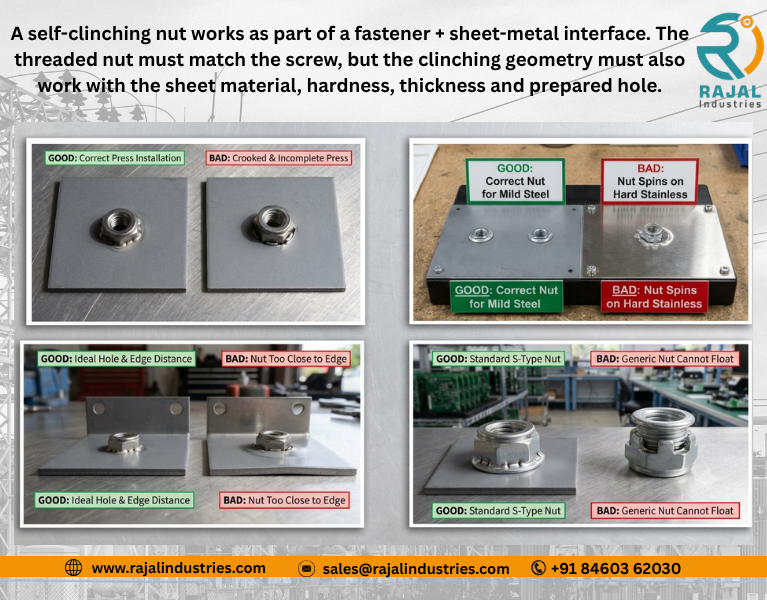
Choosing the right Self Clinching Nut Manufacturer is important when an OEM needs a permanent, reusable internal thread in relatively thin sheet metal.
Unlike a loose nut, a self-clinching nut is mechanically installed into a correctly prepared hole in a compatible sheet. During proper installation, sheet material flows into the fastener’s undercut while a clinching feature resists rotation. This creates a mechanically retained threaded attachment in the sheet. (PennEngineering (PEM))
This makes Self Clinching Nuts relevant to applications such as:
- Electronics enclosures
- Electrical panels
- Telecom cabinets
- Appliances
- Automotive sheet-metal assemblies
- Industrial equipment
However, successful clinching depends on much more than thread size.
A practical specification sequence is:
Application → Sheet Material → Sheet Hardness → Sheet Thickness → Hole → Edge Distance → Clinch Nut Type → Thread → Installation Force/Tooling → Finish → Mating Screw → Functional Testing
A reliable Clinch Nut Manufacturer should therefore understand both the fastener and the sheet-metal installation interface.
Quick Answer: What Is a Self-Clinching Nut?
A self-clinching nut is a threaded fastener designed to be mechanically pressed into a properly sized hole in suitable sheet material.
During installation, a parallel squeezing force seats the nut and causes surrounding sheet material to flow into an undercut. A clinching feature helps prevent rotation after installation. (PennEngineering (PEM))
The result is a permanent threaded attachment point that can accept a mating screw during final assembly.
How Does a Self-Clinching Nut Work?
The basic installation principle is:
Prepare Hole → Insert Clinch Nut → Support Sheet With Anvil → Apply Controlled Squeezing Force → Sheet Material Flows Into Undercut → Nut Becomes Mechanically Retained
The process should use squeezing rather than an uncontrolled impact method.
The exact tooling and installation force depend on the fastener design, thread size and sheet. (PennEngineering (PEM))
Anatomy of a Self-Clinching Nut
Although designs vary, important functional features can include:
Internal Thread
Accepts the mating screw.
Shank or Pilot
Locates the fastener in the prepared sheet hole.
Clinching Feature
Helps resist rotation.
Undercut
Provides space into which sheet material flows during installation.
Head
Provides the surface through which installation force is applied.
These features work together.
Why Is It Called “Self-Clinching”?
“Self-clinching” describes the mechanical installation principle.
It does not mean the nut installs itself without equipment.
A controlled press or suitable installation system is normally required to apply the necessary squeezing force.
Self-Clinching Nut vs Standard Nut
| Feature | Self-Clinching Nut | Standard Loose Nut |
| Permanently Retained in Sheet | Yes, after correct installation | No |
| Access Behind Sheet During Final Assembly | Usually not needed | Usually needed |
| Press Installation | Yes | No |
| Dedicated Sheet Hole | Yes | Application dependent |
| Reusable Internal Thread | Yes | Yes |
| Suitable for Thin Sheet | Strong application fit | Can be difficult without rear access |
Why OEMs Use Self-Clinching Nuts
A self-clinching nut can provide a threaded attachment without:
- Welding a nut
- Holding a loose nut behind the panel
- Tapping a thin sheet directly
- Adding a separate loose nut during final assembly
This can simplify high-volume sheet-metal assembly where the design is suitable.
Self-Clinching Nut vs Weld Nut
A weld nut and self-clinching nut both create a retained internal thread, but the installation methods are different.
| Feature | Self-Clinching Nut | Weld Nut |
| Installation | Press/squeeze | Welding |
| Heat Input | No welding heat | Welding heat |
| Hole Required | Yes | Design dependent |
| Sheet Compatibility | Material/hardness dependent | Welding compatibility required |
| Threaded Attachment | Permanent | Permanent |
| Installation Equipment | Press/tooling | Welding system |
Neither is universally better.
Self-Clinching Nut vs Rivet Nut
A rivet nut and self-clinching nut both provide internal threads in sheet materials, but their retention methods differ.
Self-Clinching Nut
Installed by pressing the fastener into compatible sheet so the sheet material flows into the clinching features.
Rivet Nut
Installed by deforming part of the rivet nut to mechanically capture the sheet.
This difference affects:
- Hole design
- Installation equipment
- Sheet requirements
- Access
- Production method
- Service behaviour
Self-Clinching Nut vs Cage Nut
A cage nut is typically removable from a compatible rack or panel opening.
A self-clinching nut becomes mechanically locked into the sheet.
| Requirement | Self-Clinching Nut | Cage Nut |
| Permanent Installation | Yes | No, generally replaceable |
| Floating Alignment | Usually not the main feature | Available in some designs |
| Press Required | Yes | Usually no |
| Rack Reconfiguration | Limited | Strong fit |
| Sheet-Metal OEM Production | Strong fit | Application dependent |
| Field Replacement | More difficult | Easier |
Self-Clinching Nut vs Tapped Sheet Metal
Thin sheet may not provide enough material for the desired direct thread engagement in some designs.
A self-clinching nut adds a dedicated threaded fastener to the panel.
Potential advantages can include:
- More defined thread geometry
- Permanent retention
- Repeated screw assembly
- No loose rear nut
The actual joint still needs engineering validation.
Self-Clinching Nut vs Press-Fit Fastener
“Press-fit” is a broad description.
Self-clinching is a specific retention principle involving controlled sheet flow into fastener features.
Not every fastener installed using a press should automatically be described as self-clinching.
The Most Important Rule: Fastener Must Be Harder Than the Sheet
Self-clinching performance depends heavily on the relationship between fastener design and sheet material.
The sheet must be capable of plastically flowing into the fastener’s retention features during installation.
Commercial self-clinching families therefore specify maximum sheet-hardness limits.
For example, PennEngineering lists different recommended sheet hardness limits for different product families, ranging from softer steel/aluminium applications to specialized products intended for harder stainless sheet. (PennEngineering (PEM))
This demonstrates why:
A self-clinching nut suitable for aluminium or mild steel should not automatically be used in stainless steel.
Why Sheet Hardness Matters
If the sheet is too hard relative to the selected clinch fastener, the sheet may not flow correctly into the undercut.
Possible consequences include:
- Weak retention
- Nut spinning
- Poor push-out performance
- Incomplete seating
- Sheet damage
The actual fastener manufacturer’s approved sheet-hardness limit should be checked before production.
Commercial Example of Sheet Hardness Limits
PennEngineering’s current product data illustrates how the limits vary by fastener family:
- CLA family: steel/aluminium sheets up to HRB 50 / HB 82
- CLS/CLSS: up to HRB 70 / HB 125
- S/SS: up to HRB 80 / HB 150
- Specialized SP products: stainless sheet up to HRB 90 / HB 185
These are PEM product-family specifications, not universal values for every self-clinching nut manufactured by every supplier. (PennEngineering (PEM))
This distinction is important when developing custom Clinch Fasteners.
Self-Clinching Nuts for Stainless Steel
Stainless sheet needs particular attention because it can be harder than common aluminium or mild-steel sheets.
A clinch nut designed for softer sheet may not develop proper retention in harder stainless material.
Specialized products are available for suitable stainless applications. For example, PennEngineering’s SP family uses age-hardened A286 stainless steel and is specified for certain stainless sheets up to HRB 90 / HB 185. (PennEngineering (PEM))
This is a product-specific example, not a universal material requirement.
Do Not Assume “Stainless Nut for Stainless Sheet”
This is an important engineering point.
The words:
Stainless nut + stainless panel
do not prove that the clinching combination will work.
The fastener must have suitable hardness and geometry relative to the sheet.
Always review:
Fastener Material + Fastener Hardness/Design + Sheet Material + Sheet Hardness + Sheet Thickness
Sheet Thickness Matters
Self-clinching nuts require sufficient sheet thickness for their clinching geometry.
Commercial product families therefore specify a recommended minimum sheet thickness or appropriate shank length.
For example, PennEngineering’s metric CLSS M5 product lists a recommended minimum sheet thickness of 0.8 mm for that particular configuration. (PennEngineering (PEM))
That number should not be applied to every M5 self-clinching nut.
Why Minimum Sheet Thickness Matters
If the sheet is too thin for the selected fastener:
- Insufficient material may flow into the undercut
- Retention can decrease
- Panel distortion can increase
- Installation may not seat correctly
The correct fastener length/configuration should match the actual sheet.
Is There a Maximum Sheet Thickness?
This depends on the fastener design.
PennEngineering notes that many self-clinching fasteners do not have a general maximum sheet thickness, although certain product types specify a defined thickness range. (Pemnet)
For OEM sourcing, do not assume either “any thick sheet works” or one universal maximum.
Check the exact product specification.
Hole Size Is a Critical Dimension
The prepared hole is one of the most important features in a self-clinching joint.
It influences:
- Fastener location
- Sheet flow
- Retention
- Installation
- Panel deformation
The hole should follow the selected fastener’s drawing.
Hole Too Small
If the hole is too small:
- Fastener may not insert correctly
- Installation force may rise
- Sheet can deform
- Clinching may be inconsistent
Do not force an oversized fastener into the opening.
Hole Too Large
If the hole is too large:
- Sheet material available for clinching may be reduced
- Rotation resistance can fall
- Push-out performance can decrease
- Fastener may not locate properly
Hole tolerance is therefore part of the fastener specification.
Example: Hole Size Depends on the Exact Product
A current M5 × 0.8 CLSS self-clinching nut from PennEngineering specifies a 6.35 mm nominal sheet-hole size with its stated tolerance for that specific product. (PennEngineering (PEM))
By comparison, other thread sizes and product families use different hole dimensions.
Therefore:
Do not create one generic hole-size formula from thread diameter.
Use the selected fastener drawing.
Edge Distance Matters
A clinch nut installed too close to a sheet edge can distort the panel because the sheet material has less support around the hole.
Manufacturers therefore publish minimum hole-center-to-edge recommendations for individual products.
For example, the cited M5 CLSS product lists a 7.1 mm minimum centerline-to-edge value. (PennEngineering (PEM))
Again, this is product-specific.
Why Edge Distance Affects Performance
During installation, material around the hole moves into the clinching features.
If the fastener is too close to:
- Panel edge
- Bend
- Large opening
- Another fastener
the surrounding sheet may deform differently.
The final panel layout should therefore be reviewed before tooling is frozen.
Installation Near a Bend
A bend can stiffen or distort the surrounding sheet.
When a clinch nut is positioned near a formed feature, check:
- Hole position
- Edge distance
- Bend location
- Sheet flatness
- Tool access
- Installation sequence
The drawing and trial parts should confirm feasibility.
Install Before or After Bending?
There is no universal answer.
The manufacturing sequence can depend on:
- Nut location
- Bend proximity
- Press access
- Risk of fastener interference
- Coating process
- Panel distortion
OEM process planning should define the correct sequence.
Self-Clinching Nut Installation Process
A typical installation process is:
Step 1: Prepare the Correct Hole
Use the specified hole size and tolerance.
Step 2: Deburr as Required
Avoid geometry that interferes with seating.
Step 3: Insert the Nut
Place the nut into the correct side of the sheet.
Step 4: Support With the Correct Anvil
Tooling should support the installation geometry.
Step 5: Apply Parallel Squeezing Force
Use controlled press force rather than uncontrolled impact.
Step 6: Seat the Fastener
Allow the sheet material to flow into the undercut.
Step 7: Inspect
Verify seating and panel condition.
Why a Press Is Preferred
Self-clinching fasteners are designed around controlled squeezing force.
A press provides better control over:
- Alignment
- Force
- Seating
- Repeatability
than hammering or uncontrolled impact installation.
Can Self-Clinching Nuts Be Hammered Into the Sheet?
That should not be treated as the normal installation method.
Impact can produce:
- Uneven seating
- Sheet distortion
- Damaged threads
- Inconsistent retention
Use the installation process specified for the fastener.
Installation Force
Installation force depends on:
- Fastener size
- Fastener design
- Sheet material
- Sheet hardness
- Sheet thickness
- Hole
- Tooling
There is no single universal press-force value for all Self Clinching Nuts.
Do Not Publish Generic Clinch-Nut Press Force Charts
An online chart that states:
M5 clinch nut = X kN
without identifying the exact product, sheet and installation condition can mislead buyers.
Installation values should come from the selected fastener’s controlled technical data or validated OEM process.
Clinching Ring and Rotation Resistance
Commercial self-clinching designs can use serrations or similar anti-rotation geometry.
PennEngineering describes a serrated clinching ring that helps prevent rotation after installation. (PennEngineering (PEM))
This is important because the installed nut must resist turning when the mating screw is tightened.
What Is Torque-Out Resistance?
Torque-out resistance describes resistance to rotation of the installed fastener within the sheet.
It is influenced by:
- Clinching geometry
- Sheet material
- Sheet hardness
- Sheet thickness
- Hole
- Installation quality
It should not be confused with the tightening torque specification for the final screw joint.
What Is Push-Out Resistance?
Push-out resistance describes resistance to axial displacement of the installed fastener from the sheet under the specified test direction.
It is influenced by the complete installed interface.
Commercial self-clinching nut families are designed to provide push-out and torque-out resistance in compatible thin sheets. (PennEngineering (PEM))
Push-Out Is Not the Same as Joint Tensile Capacity
These terms should remain separate.
Push-Out Resistance
How strongly the fastener is mechanically retained in the sheet.
Final Joint Strength
Depends on the complete screw, nut, sheet and loading system.
Do not use a push-out value as a universal equipment-load rating.
Torque-Out Is Not the Same as Screw Tightening Torque
Likewise:
Torque-Out
Resistance of the installed nut to rotating in the panel.
Screw Tightening Torque
Rotational input applied during final assembly.
They are related to different failure mechanisms.
Common Self-Clinching Nut Types
Self Clinching Nuts can be differentiated by:
- Thread size
- Fastener material
- Sheet compatibility
- Shank length
- Installation geometry
- Performance requirement
- Customer drawing
Some manufacturers use proprietary type codes.
Important Trademark and Product-Code Note
Names such as specific PEM type codes identify PennEngineering product families.
A generic Self Clinching Nut Manufacturer should not describe its own product as a genuine PEM product unless it is actually supplied under that brand/authorization.
For Rajal Industries content, safer terminology is:
- Self-clinching nut
- Clinch nut
- Press-in clinch nut
- Sheet-metal clinch nut
- Customer drawing-based clinch fastener
This avoids confusing a generic product category with a specific brand.
Metric Self-Clinching Nuts
Metric clinch nuts can be produced in different thread sizes depending on the product family.
Commercial ranges demonstrate that multiple metric threads are available.
For example, current PennEngineering listings include metric products from small threads through larger sizes, including examples such as M4 and M10 in specialized stainless-sheet families. (PennEngineering (PEM))
The available size range should always be confirmed for the specific design.
Inch-Series Self-Clinching Nuts
Unified/inch threads are also available in commercial self-clinching product families.
The RFQ should clearly state whether the requirement is:
Metric or Unified/Inch
Mixing similar-looking thread systems can cause assembly failures.
Thread Specification
The internal thread should follow the required engineering specification.
For example, PennEngineering’s metric product data references ASME B1.13M 6H internal threads for specific products, while its unified products reference ASME B1.1 2B. (PennEngineering (PEM))
A custom supplier should manufacture to the thread requirement stated on the OEM drawing.
Self-Clinching Nut Materials
Possible material directions include:
- Carbon steel
- Stainless steel
- Specialized harder stainless/alloy materials
- Other drawing-specific materials
Material selection depends strongly on the sheet into which the nut will be installed.
Steel Self-Clinching Nuts
Steel clinch nuts can be suitable for many:
- Electrical panels
- Electronics enclosures
- Appliance panels
- Automotive sheet assemblies
- Industrial cabinets
The fastener must be compatible with the sheet material and hardness.
Stainless Self-Clinching Nuts
Stainless clinch nuts can be useful where corrosion requirements justify them.
But remember:
Stainless fastener material alone does not prove suitability for stainless sheet.
The fastener’s hardness and clinching design must be appropriate for the panel.
Aluminium Self-Clinching Nuts
Certain self-clinching product families are available in aluminium for compatible applications.
For example, PennEngineering’s CLA family is designed for relatively soft steel or aluminium sheets within its specified hardness limits. (PennEngineering (PEM))
This does not mean aluminium clinch nuts are appropriate for every sheet-metal assembly.
Material Selection Matrix
| Sheet/Application | Main Review |
| Aluminium Sheet | Sheet hardness + compatible fastener |
| Mild Steel | Hardness + thickness + finish |
| Stainless Sheet | Specialized fastener compatibility |
| Coated Sheet | Clinching + coating interaction |
| OEM Special Material | Drawing and validation |
Self-Clinching Nut Finishes
Finishes can be selected for requirements such as:
- Corrosion protection
- OEM specification
- Electrical considerations
- Appearance
The finish should not interfere with:
- Thread fit
- Clinching geometry
- Installation
- Functional performance
Coating Before or After Installation
The manufacturing sequence needs review.
Possible approaches depend on:
- Panel coating
- Fastener finish
- Electrical grounding requirement
- Corrosion requirement
- Appearance
- Process temperature
Do not assume one sequence works for every application.
Self-Clinching Nuts in Electronics
Electronics enclosures often require threaded mounting points for:
- Covers
- Brackets
- Modules
- PCBs and supports where appropriately designed
- Internal assemblies
Self-clinching hardware can eliminate loose nuts from suitable assemblies.
Self-Clinching Nuts in Electrical Panels
Potential applications include:
- Enclosure covers
- Mounting brackets
- Internal components
- DIN-rail-related brackets
- Equipment supports
- Removable panels
The electrical and mechanical design should determine the fastener.
Self-Clinching Nuts in Telecom
Telecom applications can include:
- Cabinets
- Communication equipment
- Rack components
- Electronic modules
- Outdoor enclosures
Environmental requirements become particularly important for outdoor telecom systems.
Self-Clinching Nuts in Appliances
Appliance manufacturers may use Sheet Metal Nuts in:
- Structural panels
- Covers
- Brackets
- Internal frames
- Serviceable components
High production volumes make installation consistency important.
Self-Clinching Nuts in Automotive
Automotive applications can include suitable:
- Brackets
- Electronic housings
- Sheet-metal modules
- Interior structures
- Equipment mounts
The fastener should follow the approved OEM drawing and validation requirements.
Automotive Selection Factors
Automotive buyers may need to control:
- Sheet material
- Sheet hardness
- Sheet thickness
- Hole tolerance
- Edge distance
- Fastener material
- Installation force
- Push-out
- Torque-out
- Coating
- Traceability
- PPAP documentation
The lowest unit price should not override installation reliability.
Self-Clinching Nuts for Automated Production
Clinch fasteners can be suitable for high-volume manufacturing when:
- Parts feed consistently
- Hole geometry is controlled
- Press tooling is aligned
- Installation force is monitored
- Fasteners seat consistently
Automation requirements should be considered during fastener design.
Manufacturing Self-Clinching Nuts
Depending on design and volume, manufacturing can involve:
Raw Material → Forming/Machining → Clinching Feature Formation → Hole/Thread Formation → Heat Treatment if Required → Surface Treatment → Dimensional Inspection → Thread Inspection → Functional Testing → Packing
The exact process depends on the design and material.
Why Clinching Geometry Is Critical
A normal threaded nut does not automatically become a self-clinching nut by adding a small projection.
The retention geometry must work with the sheet to provide:
- Sheet flow
- Anti-rotation
- Axial retention
This makes tooling and dimensional control important.
Self-Clinching Nut Quality Control
A practical control plan can include:
Raw Material
- Material identification
- Traceability
Dimensions
- Shank/pilot
- Head
- Clinching geometry
- Thread
- Overall dimensions
Surface
- Finish
- Burrs
- Damage
Functional
- Installation into representative sheet
- Seating
- Push-out where required
- Torque-out where required
Why Functional Installation Testing Matters
A clinch nut can pass dimensional inspection yet perform poorly if:
- Sheet hardness is incompatible
- Hole is wrong
- Tooling is incorrect
- Clinching geometry does not produce adequate retention
Testing in representative sheet provides much stronger evidence of suitability.
Representative Sheet Test Coupon
For OEM approval, a test coupon can reproduce:
- Sheet material
- Sheet hardness
- Sheet thickness
- Hole
- Coating condition
The clinch nut can then be installed using representative tooling.
This helps evaluate the actual fastener-sheet interface.
Common Self-Clinching Nut Buying Mistakes
Avoid:
- Selecting only by thread size.
- Ignoring sheet material.
- Ignoring sheet hardness.
- Ignoring sheet thickness.
- Using a generic hole size.
- Ignoring hole tolerance.
- Installing too close to an edge.
- Assuming every clinch nut works in stainless.
- Assuming stainless nut automatically works in stainless sheet.
- Using hammer installation.
- Using generic installation-force charts.
- Confusing torque-out with screw tightening torque.
- Ignoring coating.
- Approving only by dimensional inspection.
- Skipping installation trials.
Poor Self-Clinching Nut RFQ
Need M5 self clinching nuts. Please quote.
This does not tell the supplier enough about the sheet or installation.
Better Self-Clinching Nut RFQ
We require M5 self-clinching nuts for an electrical enclosure. Please review the attached nut and panel drawings and confirm compatibility with the specified sheet material, hardness and thickness. Please also confirm hole requirement, edge distance, fastener material, finish, installation method, sample lead time, MOQ and annual-volume pricing.
Self-Clinching Nut RFQ Checklist
| Requirement | Buyer Input |
| Application | Electronics / panel / telecom / appliance / automotive |
| Thread | Exact size and pitch |
| Sheet Material | Exact grade |
| Sheet Hardness | Required/actual |
| Sheet Thickness | Exact/range |
| Hole | Diameter + tolerance |
| Edge Distance | Drawing requirement |
| Nut Type | Standard/custom |
| Nut Material | Specification |
| Finish | Required |
| Installation | Press/tooling |
| Push-Out | If controlled |
| Torque-Out | If controlled |
| Mating Screw | Specification |
| Documentation | Required reports |
| Quantity | Order quantity |
| Annual Demand | Forecast |
Questions to Ask a Self Clinching Nut Manufacturer
Before approving a Self Clinching Nut Manufacturer, ask:
- Which thread sizes can you manufacture?
- Which sheet materials can your designs support?
- What sheet-hardness limits apply?
- What minimum sheet thickness is required?
- What hole size and tolerance are required?
- What edge distance is recommended?
- Which nut materials can you provide?
- Can you support stainless-sheet applications?
- How is clinching geometry controlled?
- How are threads inspected?
- What installation tooling is required?
- Can you provide installation-force guidance for the specific product?
- Can you test push-out and torque-out?
- Can you test in our actual sheet material?
- Can you support PPAP or OEM documentation?
- Can you manufacture to our drawing?
Self-Clinching Nut Supplier Qualification
| Requirement | Priority |
| Thread Accuracy | Very High |
| Clinching Geometry | Very High |
| Sheet Compatibility | Very High |
| Material Control | Very High |
| Hole Requirement Knowledge | Very High |
| Installation Support | Very High |
| Push-Out Testing | High |
| Torque-Out Testing | High |
| Coating Control | High |
| Traceability | High |
| OEM Documentation | High |
| Capacity | High |
| Delivery | High |
| Price | Compare after technical compliance |
AEO Quick Answer: What Is a Self-Clinching Nut?
A self-clinching nut is a threaded fastener pressed into a correctly sized hole in compatible sheet metal. During controlled installation, sheet material flows into the fastener’s undercut and clinching features, creating a mechanically retained threaded attachment. (PennEngineering (PEM))
Can Self-Clinching Nuts Be Used in Thin Sheet Metal?
Yes. Self-clinching nuts are specifically designed to provide load-bearing threads in compatible thin sheets, but minimum sheet thickness, material hardness, hole dimensions and fastener type must match the manufacturer’s specification. (PennEngineering (PEM))
Can Self-Clinching Nuts Be Used in Stainless Steel?
Yes, but only with a fastener designed for the hardness of the stainless sheet. Standard clinch nuts intended for softer steel or aluminium should not automatically be used in stainless. Specialized self-clinching products are available for suitable stainless-sheet applications. (PennEngineering (PEM))
What Is the Difference Between a Clinch Nut and Rivet Nut?
A clinch nut is pressed into compatible sheet so sheet material flows into its retention features. A rivet nut is installed by deforming part of the insert around the sheet. The correct choice depends on sheet material, thickness, access, installation equipment and service requirements.
Does a Self-Clinching Nut Need Welding?
No. Self-clinching nuts are mechanically installed using controlled squeezing force and do not require welding. This makes them useful for suitable electronics, electrical-panel, appliance, telecom and automotive sheet-metal assemblies.
What Is the Most Important Factor When Selecting a Clinch Nut?
The complete sheet-fastener interface is critical. Buyers should check sheet material, hardness, thickness, hole size, edge distance, clinch nut type, thread, installation tooling and required push-out or torque-out performance before approving production.
Can Rajal Industries Manufacture Self-Clinching Nuts?
Rajal Industries can evaluate Self Clinching Nuts, Sheet Metal Nuts and customer drawing-based Clinch Fasteners for electronics, electrical panels, telecom, appliances, automotive and industrial OEM applications.
Technical feasibility should be reviewed against:
Drawing + Thread + Sheet Material + Sheet Hardness + Sheet Thickness + Hole + Edge Distance + Fastener Material + Finish + Installation + Quantity
Samples should be validated in representative customer sheet before mass-production approval.
Conclusion: A Self-Clinching Nut Is Only as Good as Its Sheet Interface
Selecting a Self Clinching Nut Manufacturer requires more than comparing thread size and price.
The correct engineering approach is:
Sheet → Hardness → Thickness → Hole → Edge Distance → Clinch Geometry → Thread → Material → Installation → Functional Testing
For electronics, electrical panels, telecom equipment, appliances and automotive assemblies, reliable Self Clinching Nuts depend on controlled interaction between the fastener and the production sheet.
Rajal Industries can evaluate standard and drawing-based Sheet Metal Nuts and Clinch Fasteners for OEM requirements, subject to technical feasibility, tooling and validation in representative customer sheet.
Looking for a Self Clinching Nut Manufacturer in India?
Send Rajal Industries:
Fastener Drawing + Panel Drawing + Thread + Sheet Grade + Sheet Hardness + Sheet Thickness + Hole + Edge Distance + Material + Finish + Performance Requirements + Annual Quantity
for technical feasibility and quotation review.