

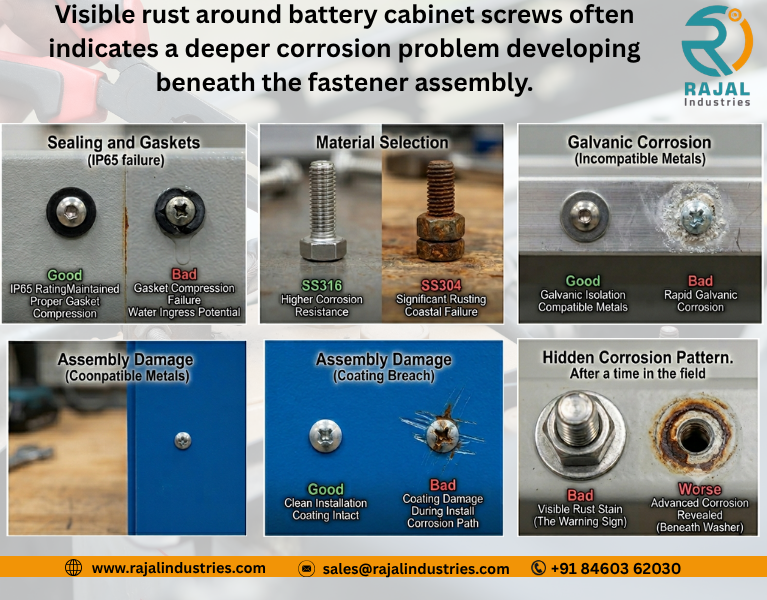
Introduction – The Rust Was Small, The Problem Was Not
A Battery Energy Storage System (BESS) operator noticed something unusual during a routine inspection.
One of the outdoor battery cabinets showed small rust marks around several screws.
At first glance, it looked insignificant.
The maintenance team assumed:
- Surface contamination
- Cosmetic staining
- Minor environmental exposure
The cabinet continued operating.
Three months later, the rust spots became larger.
Six months later, inspectors found:
- Corroded screw threads
- Water ingress
- Damaged gasket compression
- Loose door hardware
- Reduced enclosure protection
The rust was never the actual problem.
It was the warning sign.
The real failure had already started beneath the fastener.
This scenario is common in:
- Battery Cabinets
- Battery Enclosures
- Battery Racks
- Outdoor Battery Containers
- Telecom Battery Cabinets
- EV Charging Cabinets
- Energy Storage Systems (BESS)
- Solar Battery Installations
Many battery cabinet manufacturers focus on enclosure design while overlooking the small fasteners holding the system together.
Quick Answer
Why does rust form around battery cabinet screws?
Rust typically develops due to moisture exposure, coating damage, galvanic corrosion, improper stainless steel selection, gasket leaks, condensation, or contamination trapped around the fastener assembly.
Why Battery Cabinet Fasteners Are Critical
Battery cabinet screws perform several functions simultaneously.
They:
✔ Hold structural panels together
✔ Maintain enclosure strength
✔ Compress weatherproof gaskets
✔ Support internal equipment
✔ Maintain IP protection ratings
✔ Resist vibration and thermal cycling
When a screw begins corroding, all these functions can be affected.
Common Fasteners Used in Battery Cabinets
Battery cabinet manufacturers commonly use:
Machine Screws
- M4 Machine Screws
- M5 Machine Screws
- M6 Machine Screws
- Captive Screws
- Torx Screws
Structural Fasteners
- M8 Hex Bolts
- M10 Hex Bolts
- Flange Bolts
- Socket Head Cap Screws
Stainless Steel Fasteners
- SS304 Screws
- SS304 Bolts
- SS316 Screws
- SS316 Bolts
- Stainless Steel Washers
Other Hardware
Among these, SS304 machine screws are among the most commonly used battery cabinet screws worldwide.
Why Rust Around Screws Is More Dangerous Than It Looks
Most corrosion starts in hidden areas.
Typical locations include:
- Under Washers
- Inside Threads
- Beneath Screw Heads
- Behind Gaskets
- Around Rivet Nuts
- Around Weld Nuts
By the time rust becomes visible externally:
The corrosion process is usually well advanced internally.
This is why visible rust should never be ignored.
Failure #1 – Wrong Stainless Steel Selection
One of the most common mistakes.
Many manufacturers assume:
Stainless Steel Cannot Rust
This is incorrect.
SS304 offers excellent corrosion resistance.
However, in harsh environments such as:
- Coastal Areas
- High Humidity Regions
- Chemical Plants
- Outdoor BESS Installations
SS304 may eventually show corrosion.
In these applications:
SS316 Fasteners
often provide significantly better performance.
SS304 vs SS316 Battery Cabinet Screws
| Parameter | SS304 Screw | SS316 Screw |
| Corrosion Resistance | High | Very High |
| Salt Resistance | Medium | Excellent |
| Outdoor Performance | Good | Excellent |
| BESS Applications | Common | Preferred |
| Coastal Projects | Limited | Recommended |
| Cost | Lower | Higher |
Many large BESS projects now specify SS316 fasteners for outdoor installations.
Failure #2 – Water Ingress Around Fasteners
Many battery cabinets achieve:
- IP54
- IP55
- IP65
- IP66
protection ratings.
However, fasteners often become weak points.
Water can enter through:
- Damaged Gaskets
- Oversized Holes
- Poor Assembly
- Missing Sealing Washers
Once moisture enters:
Corrosion accelerates.
Failure #3 – Galvanic Corrosion
Battery cabinets often contain:
- Stainless Steel Screws
- Aluminum Panels
- Copper Grounding Components
- Zinc-Plated Hardware
When moisture is present:
Different metals interact electrically.
This creates:
Galvanic Corrosion
The result can be rapid degradation around fastener locations.
Failure #4 – Condensation Inside Battery Cabinets
Even sealed cabinets experience condensation.
This commonly occurs when:
- Daytime temperatures rise
- Nighttime temperatures drop
Moisture accumulates around:
- Screw Threads
- Washers
- Door Hardware
- Hinges
This hidden moisture can drive corrosion for years.
Failure #5 – Coating Damage During Installation
Many painted cabinets suffer damage during assembly.
Common causes include:
- Power Tool Slippage
- Over-Tightening
- Sharp Washers
- Improper Installation
Once protective coatings are damaged:
Corrosion often begins around the screw hole.
Real Battery Cabinet Failure Example
A battery cabinet manufacturer supplying telecom backup systems received field complaints.
Inspection revealed:
Fastener Assembly
- SS304 Screw
- Zinc-Plated Washer
- Painted Steel Cabinet
After three years:
- Rust staining appeared
- Washer corrosion developed
- Thread condition deteriorated
Root Cause:
Galvanic corrosion combined with moisture exposure
Corrective Action:
✔ SS316 Screws
✔ Stainless Steel Washers
✔ Improved sealing system
✔ Updated hardware specification
Warranty claims reduced significantly.
Why Rust Usually Appears Around Washers First
Washers create ideal conditions for corrosion.
They trap:
- Moisture
- Dust
- Salt
- Chemical Residue
These contaminants remain hidden.
Over time:
Corrosion develops beneath the washer before becoming visible.
This is why rust rings often appear around screw heads.
Self-Tapping Screw vs Machine Screw
Which Performs Better in Battery Cabinets?
| Parameter | Self-Tapping Screw | Machine Screw |
| Installation Speed | High | Medium |
| Serviceability | Low | High |
| Thread Life | Limited | Excellent |
| Corrosion Maintenance | Medium | Better |
| Battery Cabinet Usage | Common | Preferred |
Many battery cabinet manufacturers use machine screws with rivet nuts for improved service life.
Captive Screws Are Becoming More Popular
Modern battery cabinet manufacturers increasingly use:
Captive Screws
Advantages include:
✔ Reduced lost hardware
✔ Improved maintenance
✔ Better sealing consistency
✔ Faster servicing
✔ Better field reliability
This is particularly important for BESS containers and telecom battery cabinets.
Fasteners Commonly Used in Battery Cabinets
Large battery cabinet manufacturers frequently purchase:
Screws
- M4 Machine Screws
- M5 Machine Screws
- M6 Machine Screws
- Captive Screws
- Torx Screws
- Self-Tapping Screws
Structural Hardware
- M8 Hex Bolts
- M10 Hex Bolts
- Flange Bolts
Stainless Steel Fasteners
- SS304 Screws
- SS304 Bolts
- SS316 Screws
- SS316 Bolts
- Stainless Steel Washers
Installation Hardware
- Rivet Nuts
- Cage Nuts
- Weld Nuts
- Threaded Inserts
These are among the highest-volume fasteners used in battery cabinet manufacturing.
Why Corrosion Often Starts Before Anyone Notices
The corrosion process usually follows this pattern:
Stage 1
Moisture Exposure
↓
Stage 2
Hidden Corrosion
↓
Stage 3
Coating Breakdown
↓
Stage 4
Visible Rust
↓
Stage 5
Thread Damage
↓
Stage 6
Preload Loss
↓
Stage 7
Water Ingress
↓
Stage 8
Structural Failure
By the time visible rust appears, the process is already well underway.
Industries Most Affected
This issue frequently impacts:
- Battery Cabinet Manufacturers
- Battery Enclosure Manufacturers
- Battery Rack Manufacturers
- Lithium Battery Pack Manufacturers
- BESS Integrators
- Telecom Battery Manufacturers
- EV Charger Manufacturers
- Energy Storage Equipment OEMs
Inspection Checklist
Before approving battery cabinet hardware:
✔ Verify stainless steel grade
✔ Check washer material compatibility
✔ Inspect sealing systems
✔ Review galvanic corrosion risk
✔ Check gasket compression
✔ Verify IP rating requirements
✔ Inspect condensation-prone locations
✔ Review maintenance intervals
Typical Battery Cabinet Fastener Consumption
A medium-sized battery cabinet manufacturer may consume annually:
- 500,000+ M4 Machine Screws
- 300,000+ M5 Machine Screws
- 200,000+ M6 Machine Screws
- 150,000+ Captive Screws
- 100,000+ SS304 Fasteners
- 50,000+ SS316 Fasteners
- Hundreds of thousands of washers, rivet nuts, and cage nuts
Even a small corrosion rate can affect thousands of assemblies.
Key Takeaways
- Visible rust is often a late-stage warning sign.
- Corrosion frequently begins beneath washers and screw heads.
- SS304 and SS316 perform differently in outdoor environments.
- Water ingress and condensation accelerate corrosion.
- Galvanic corrosion is often overlooked in battery cabinet design.
- Machine screws and captive screws improve long-term serviceability.
- Battery cabinet fastener selection directly affects enclosure reliability.
FAQ
Why is rust forming around my battery cabinet screws?
Rust usually develops due to moisture exposure, corrosion, coating damage, galvanic reactions, or incorrect fastener material selection.
Can stainless steel screws rust?
Yes. SS304 and even SS316 can corrode under certain environmental conditions, although they resist corrosion much better than carbon steel fasteners.
Which is better for outdoor battery cabinets, SS304 or SS316?
SS316 generally offers superior corrosion resistance, especially in coastal and high-humidity environments.
Why does rust appear around washers first?
Washers trap moisture and contaminants, making them one of the most common corrosion initiation points.
Are self-tapping screws suitable for battery cabinets?
They are commonly used, but machine screws with rivet nuts often provide better serviceability and long-term maintenance performance.
What fasteners are commonly used in battery cabinets?
M4 screws, M5 screws, M6 screws, captive screws, self-tapping screws, rivet nuts, cage nuts, SS304 fasteners, and SS316 fasteners.
How can OEMs reduce battery cabinet corrosion?
By selecting proper stainless steel grades, improving sealing systems, preventing galvanic corrosion, and implementing regular inspections.
Which industries face this problem most often?
Battery cabinet manufacturers, battery enclosure manufacturers, BESS integrators, telecom battery OEMs, and EV charger manufacturers.
Conclusion
Rust around a battery cabinet screw is rarely just a cosmetic issue.
It is often the first visible sign that corrosion has already begun inside the joint.
For battery cabinet manufacturers, battery enclosure OEMs, BESS integrators, and telecom battery suppliers, proper fastener selection can significantly improve enclosure life, reduce maintenance costs, and prevent long-term reliability problems.
The best time to solve corrosion is before the rust becomes visible.