

Introduction – The Battery Was Perfect, But the Tray Was Falling Apart
An EV battery manufacturer was investigating abnormal vibration issues.
The battery cells were performing normally.
The Battery Management System (BMS) reported no faults.
The cooling system worked perfectly.
However, during vehicle testing, engineers noticed:
- Unusual vibration noise
- Battery tray movement
- Loose mounting points
- Fastener preload loss
- Structural rattling
The issue wasn’t electrical.
The issue wasn’t thermal.
The issue was mechanical.
After disassembly, engineers discovered several structural bolts had lost preload.
Some bolts showed signs of fatigue.
Others had started loosening.
The battery tray itself was beginning to move under dynamic loads.
The investigation eventually led to a common question asked by OEM engineers worldwide:
Should we use Grade 8.8 bolts or Grade 10.9 bolts?
The answer is more complex than most people think.
Quick Answer
Which is better for battery trays, Grade 8.8 or Grade 10.9 bolts?
Grade 10.9 bolts provide higher strength and higher preload capability, making them suitable for high-load and vibration-critical battery tray applications. However, Grade 8.8 bolts remain the most widely used structural fasteners in many battery tray designs because joint design and preload are often more important than bolt strength alone.
Why Battery Tray Fasteners Matter
The battery tray is one of the most heavily loaded structures in an EV or energy storage system.
It supports:
- Battery Modules
- Cooling Systems
- Busbars
- Battery Management Components
- High Voltage Wiring
- Structural Enclosures
Modern battery trays may weigh:
200 kg to 1,500+ kg
Large BESS battery trays can support even higher loads.
Every load is ultimately transferred through fasteners.
What Are Battery Tray Bolts?
Battery tray bolts are structural fasteners used to secure battery trays, battery modules, battery enclosures, and mounting structures.
Common battery tray fasteners include:
Structural Bolts
- M8 Grade 8.8 Bolts
- M10 Grade 8.8 Bolts
- M12 Grade 8.8 Bolts
- M8 Grade 10.9 Bolts
- M10 Grade 10.9 Bolts
- M12 Grade 10.9 Bolts
Other Structural Hardware
- Hex Bolts
- Flange Bolts
- Socket Head Cap Screws
- Structural Washers
- Heavy Hex Nuts
- Lock Nuts
- Prevailing Torque Nuts
Locking Components
- Nylock Nuts
- All-Metal Lock Nuts
- Belleville Washers
- Nord-Lock Washers
- Structural Washers
These are among the most searched battery tray fasteners used by EV battery manufacturers and BESS integrators.
Why Battery Tray Vibration Is So Dangerous
Battery trays experience continuous vibration from:
Road Conditions
- Potholes
- Speed Breakers
- Rough Terrain
Vehicle Dynamics
- Acceleration
- Braking
- Cornering
Equipment Operation
- Cooling Fans
- Pumps
- Compressors
Transportation
- Shipping
- Container Movement
- Truck Transport
Over time, vibration attacks the fastener joint.
Not necessarily the bolt itself.
The Biggest Myth in Fastener Selection
Many engineers assume:
Stronger Bolt = Better Joint
This is not always true.
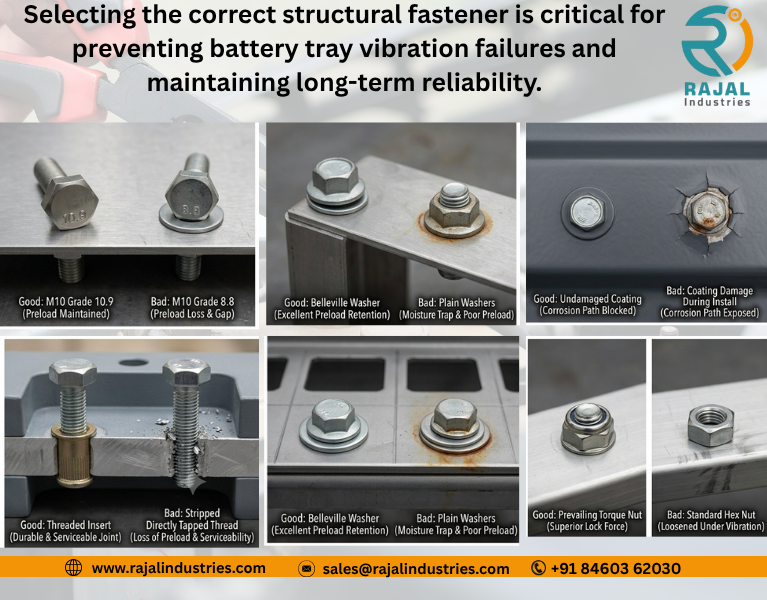
A Grade 10.9 bolt installed incorrectly can fail sooner than a properly designed Grade 8.8 joint.
The real goal is:
Maintaining Clamp Force
If clamp force remains stable:
- Vibration reduces
- Joint movement stops
- Fatigue risk decreases
Understanding Grade 8.8 Bolts
Grade 8.8 bolts are among the most widely used structural fasteners in industrial equipment.
Mechanical Properties
Minimum Tensile Strength:
800 MPa
Yield Strength:
640 MPa
Applications:
- Battery Trays
- Battery Cabinets
- Battery Racks
- EV Structures
- Industrial Equipment
Advantages:
✔ Cost Effective
✔ Easily Available
✔ Excellent Structural Performance
✔ Widely Approved by OEMs
Understanding Grade 10.9 Bolts
Grade 10.9 bolts are high-strength structural fasteners.
Mechanical Properties
Minimum Tensile Strength:
1,000 MPa
Yield Strength:
900 MPa
Applications:
- High Load Structures
- EV Chassis Systems
- Heavy Battery Trays
- Crash-Critical Components
- High Vibration Assemblies
Advantages:
✔ Higher Strength
✔ Higher Preload Capacity
✔ Better Resistance To Joint Separation
✔ Suitable For Critical Applications
Grade 8.8 vs Grade 10.9 Comparison
| Parameter | Grade 8.8 Bolt | Grade 10.9 Bolt |
| Tensile Strength | 800 MPa | 1000 MPa+ |
| Yield Strength | 640 MPa | 900 MPa |
| Preload Capability | High | Very High |
| Fatigue Resistance | Good | Better |
| Cost | Lower | Higher |
| Battery Tray Usage | Very Common | Critical Applications |
| OEM Usage | Extensive | Growing |
Why Battery Tray Failures Usually Start at the Joint
Most engineers focus on bolt strength.
However, failures typically begin because of:
Joint Movement
When preload drops:
- Components slip
- Vibration increases
- Stress concentration rises
Eventually:
- Bolt fatigue begins
- Hole elongation occurs
- Structural damage develops
Even the strongest bolt cannot prevent failure if the joint moves.
Real EV Battery Tray Failure Example
An EV battery manufacturer used:
Original Design
- M10 Grade 8.8 Bolts
- Flat Washers
- Standard Hex Nuts
Field Issues:
- Joint loosening
- Vibration noise
- Tray movement
Investigation found:
Insufficient preload retention
Not insufficient bolt strength.
The OEM upgraded to:
- M10 Grade 8.8 Bolts
- Belleville Washers
- Prevailing Torque Nuts
Failure rate dropped dramatically.
Interestingly:
They did not switch to Grade 10.9.
When Grade 10.9 Bolts Make Sense
Grade 10.9 bolts are often justified when:
Higher Preload Is Required
Heavy Battery Packs
Crash Load Requirements
Large Battery Enclosures
High Dynamic Loads
Seismic Battery Installations
Utility-Scale BESS Systems
In these situations, higher preload capability can improve joint performance.
Why Washers Matter More Than Many Engineers Think
Many vibration failures occur because of poor washer selection.
Common options include:
Flat Washers
Load distribution only.
Spring Washers
Basic vibration resistance.
Belleville Washers
Excellent preload retention.
Nord-Lock Washers
Excellent anti-loosening performance.
Structural Washers
Improved load distribution.
Belleville Washer vs Spring Washer
| Parameter | Spring Washer | Belleville Washer |
| Vibration Resistance | Medium | High |
| Preload Retention | Medium | Excellent |
| Battery Tray Usage | Common | Growing |
| Thermal Cycling Performance | Medium | High |
| OEM Preference | Moderate | High |
Many leading battery manufacturers now specify Belleville washers in vibration-sensitive joints.
M10 Battery Tray Bolt Load Example
Assume:
Battery Tray Weight:
800 kg
Dynamic Load Factor:
3×
Effective Load:
2,400 kg
Number Of Structural Bolts:
16
Load Per Bolt:
Approximately:
1.47 kN
Now add:
- Shock Loads
- Braking Loads
- Cornering Loads
- Road Vibration
Actual design loads become much higher.
This is why preload retention becomes critical.
Common Battery Tray Fasteners Used By OEMs
Large battery tray manufacturers commonly purchase:
Structural Bolts
- M8 Grade 8.8 Bolts
- M10 Grade 8.8 Bolts
- M12 Grade 8.8 Bolts
- M8 Grade 10.9 Bolts
- M10 Grade 10.9 Bolts
- M12 Grade 10.9 Bolts
- Flange Bolts
- Structural Bolts
Locking Hardware
- Prevailing Torque Nuts
- Nylock Nuts
- All-Metal Lock Nuts
- Heavy Hex Nuts
Washers
- Belleville Washers
- Structural Washers
- Nord-Lock Washers
- Flat Washers
Installation Hardware
- Threaded Inserts
- Rivet Nuts
- Weld Nuts
- Anchor Bolts
- Threaded Rods
These keywords are frequently searched by EV battery manufacturers, battery tray manufacturers, and BESS system designers.
Why OEMs Are Moving Toward Joint Engineering
Leading manufacturers are no longer asking:
“Which bolt is strongest?”
They ask:
“Which joint survives 10 years of vibration?”
Modern fastener engineering focuses on:
✔ Clamp Force
✔ Joint Stability
✔ Fatigue Life
✔ Vibration Resistance
✔ Thermal Expansion
✔ Long-Term Reliability
Industries Most Affected
Battery tray vibration failures commonly affect:
- EV Battery Manufacturers
- Battery Tray Manufacturers
- Lithium Battery Pack Manufacturers
- Battery Enclosure Manufacturers
- Battery Rack Manufacturers
- Battery Cabinet Manufacturers
- BESS Integrators
- Utility Energy Storage Developers
- Telecom Battery OEMs
Inspection Checklist
Before approving battery tray fasteners:
✔ Verify bolt grade
✔ Calculate preload requirements
✔ Check washer selection
✔ Verify lock nut specification
✔ Review vibration testing
✔ Analyze fatigue loads
✔ Inspect thermal expansion effects
✔ Validate long-term preload retention
Key Takeaways
- Grade 10.9 bolts are stronger than Grade 8.8 bolts.
- Stronger bolts do not automatically create stronger joints.
- Most battery tray failures begin with preload loss.
- Vibration causes joint movement before bolt failure.
- Belleville washers and lock nuts often improve reliability more than increasing bolt grade.
- Grade 8.8 bolts remain the most widely used battery tray fasteners.
- Joint design is usually more important than bolt strength alone.
FAQ
Which bolt grade is best for battery trays?
The answer depends on load requirements. Grade 8.8 bolts are commonly used, while Grade 10.9 bolts are preferred for higher-load and vibration-critical applications.
Why do battery tray bolts loosen?
Vibration, thermal expansion, preload loss, and joint settlement are the most common causes.
Are Grade 10.9 bolts always better?
No. If preload retention is poor, even Grade 10.9 bolts can experience loosening and fatigue failures.
What fasteners are commonly used in battery trays?
M8 bolts, M10 bolts, M12 bolts, flange bolts, structural washers, lock nuts, Belleville washers, and threaded inserts.
What is the biggest cause of battery tray vibration failure?
Joint movement caused by preload loss is one of the most common root causes.
Are Belleville washers useful in battery trays?
Yes. They help maintain clamp force during vibration and thermal cycling.
Why do OEMs use lock nuts in battery trays?
Lock nuts help prevent loosening under vibration and dynamic loading conditions.
Which industries commonly face battery tray fastener failures?
EV battery manufacturers, battery tray manufacturers, lithium battery pack manufacturers, battery enclosure manufacturers, and BESS integrators.
Conclusion
When battery tray failures occur, engineers often blame the bolt.
In reality, the problem is usually the joint.
A properly engineered Grade 8.8 bolt assembly can outperform a poorly designed Grade 10.9 assembly.
For battery tray manufacturers, EV battery OEMs, lithium battery pack manufacturers, and BESS integrators, the focus should be on preload retention, vibration resistance, and long-term joint stability rather than simply selecting the strongest bolt available.