

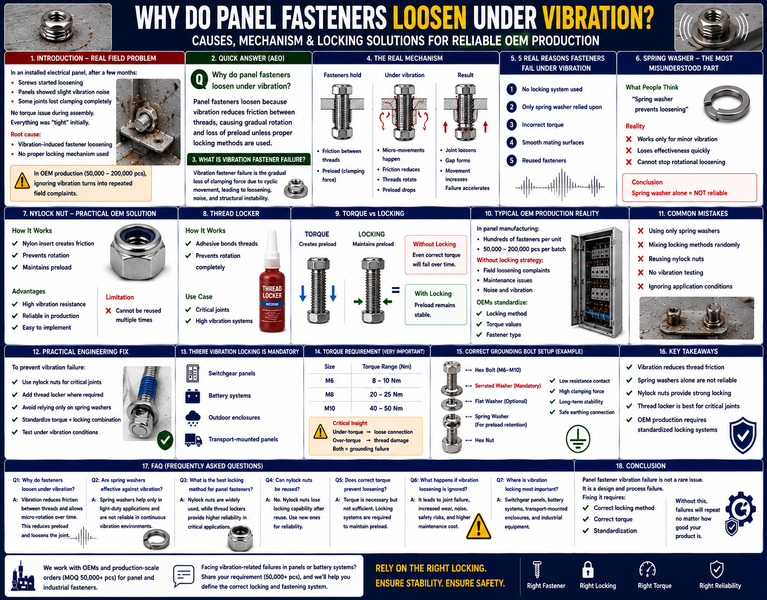
Introduction – Real Field Problem
In an installed electrical panel, after a few months:
👉 Screws started loosening
👉 Panels showed slight vibration noise
👉 Some joints lost clamping completely
No torque issue during assembly.
Everything was “tight” initially.
Then failure started.
Root cause:
👉 Vibration-induced fastener loosening
👉 No proper locking mechanism used
This is extremely common in:
- Switchgear panels
- Battery enclosures
- Industrial cabinets
In OEM production (50,000–200,000 pcs), ignoring vibration turns into repeated field complaints.
Quick Answer
Why do panel fasteners loosen under vibration?
Panel fasteners loosen because vibration reduces friction between threads, causing gradual rotation and loss of preload unless proper locking methods are used.
What is Vibration Fastener Failure?
Vibration fastener failure is the gradual loss of clamping force due to cyclic movement, leading to loosening, noise, and structural instability.
The Real Mechanism
Fasteners hold because of:
👉 Friction between threads
👉 Preload (clamping force)
Under vibration:
👉 Micro-movements happen
👉 Friction reduces
👉 Threads rotate
👉 Preload drops
Result
- Joint loosens
- Gap forms
- Movement increases
- Failure accelerates
5 Real Reasons Fasteners Fail Under Vibration
- No locking system used
- Only spring washer relied upon
- Incorrect torque
- Smooth mating surfaces
- Reused fasteners
Spring Washer – The Most Misunderstood Part
What People Think
“Spring washer prevents loosening”
Reality
❌ Works only for minor vibration
❌ Loses effectiveness quickly
❌ Cannot stop rotational loosening
Conclusion
👉 Spring washer alone = NOT reliable
Nylock Nut – Practical OEM Solution
How It Works
✔ Nylon insert creates friction
✔ Prevents rotation
✔ Maintains preload
Advantages
✔ High vibration resistance
✔ Reliable in production
✔ Easy to implement
Limitation
❌ Cannot be reused multiple times
Thread Locker
How It Works
✔ Adhesive bonds threads
✔ Prevents rotation completely
Use Case
✔ Critical joints
✔ High vibration systems
Comparison – Locking Methods
| Method | Vibration Resistance | Reusability | OEM Use |
| Spring Washer | Low | Yes | Not sufficient alone |
| Nylock Nut | High | Limited | Recommended |
| Thread Locker | Very High | No | Critical joints |
Torque vs Locking
👉 Torque creates preload
👉 Locking maintains preload
Without Locking
Even correct torque will fail over time.
With Locking
Preload remains stable.
Typical OEM Production Reality
In panel manufacturing:
- Hundreds of fasteners per unit
- 50,000–200,000 pcs per batch
Without locking strategy:
👉 Field loosening complaints
👉 Maintenance issues
👉 Noise and vibration
OEMs standardize:
✔ Locking method
✔ Torque values
✔ Fastener type
Common Mistakes
- Using only spring washers
- Mixing locking methods randomly
- Reusing nylock nuts
- No vibration testing
- Ignoring application conditions
👉 This is why failures repeat.
Practical Engineering Fix
To prevent vibration failure:
✔ Use nylock nuts for critical joints
✔ Add thread locker where required
✔ Avoid relying only on spring washers
✔ Standardize torque + locking combination
✔ Test under vibration conditions
Where Vibration Locking is Mandatory
✔ Switchgear panels
✔ Battery systems
✔ Outdoor enclosures
✔ Transport-mounted panels
Key Takeaways
• Vibration reduces thread friction
• Spring washers alone are not reliable
• Nylock nuts provide strong locking
• Thread locker is best for critical joints
• OEM production requires standardized locking systems
FAQ
Q1: Why do fasteners loosen under vibration?
Fasteners loosen because vibration reduces friction between threads and allows micro-rotation over time. This gradually reduces preload until the joint becomes loose. Without a locking mechanism, even properly tightened bolts will eventually fail.
Q2: Are spring washers effective against vibration?
Spring washers provide limited resistance and are not reliable for continuous vibration environments. They can help in light-duty applications but fail in dynamic systems like panels and battery enclosures. OEMs do not rely on them as the primary locking solution.
Q3: What is the best locking method for panel fasteners?
Nylock nuts are widely used due to their simplicity and effectiveness, while thread lockers provide higher reliability in critical applications. The best solution depends on vibration level, maintenance requirements, and production process. In OEM systems, a combination approach is often used.
Q4: Can nylock nuts be reused?
Nylock nuts lose their locking capability after repeated use because the nylon insert deforms. Reusing them reduces reliability and increases the risk of loosening. For OEM production and critical assemblies, new nylock nuts should always be used.
Q5: Does correct torque prevent loosening?
Correct torque is necessary but not sufficient on its own. Torque creates preload, but vibration can still reduce that preload over time. Locking systems are required to maintain the clamping force under dynamic conditions.
Q6: What happens if vibration loosening is ignored?
Ignoring vibration loosening leads to joint failure, increased wear, noise, and eventually structural or functional issues. In electrical panels, it can also cause contact problems and safety risks. Over time, this results in higher maintenance costs and customer complaints.
Q7: Where is vibration locking most important?
Vibration locking is critical in switchgear panels, battery systems, transport-mounted enclosures, and industrial equipment. Any system exposed to continuous or cyclic movement requires a proper locking strategy. These are the areas where most field failures occur if ignored.
Conclusion
Panel fastener vibration failure is not a rare issue.
It is a design and process failure.
Fixing it requires:
✔ Correct locking method
✔ Correct torque
✔ Standardization
Without this, failures will repeat no matter how good your product is.
👉 We work with OEMs and production-scale orders (MOQ 50,000+ pcs) for panel and industrial fasteners.Facing vibration-related failures in panels or battery systems?
Share your requirement (50,000+ pcs), and we’ll help you define the correct locking and fastening system.