
Introduction – Real Safety Observation
During inspection of a switchgear panel, earthing continuity was tested.
Results showed:
👉 Fluctuating resistance values
👉 Some grounding points weak
👉 One joint showed heat marks
No cable issue. No earthing strip issue.
Root cause:
👉 Improper grounding bolt selection and assembly
This is critical.
Grounding is not just a connection.
👉 It is a safety system
In OEM production (50,000–200,000 fasteners), one wrong grounding setup repeated across panels becomes a system-wide safety risk.
Quick Answer
How should grounding bolts be selected in switchgear panels?
Grounding bolts must ensure strong mechanical clamping, low resistance contact, and long-term stability using proper materials, serrated washers, and controlled torque.
What is a Grounding Bolt?
A grounding bolt is a fastener used to connect electrical equipment to earth, ensuring safe dissipation of fault current and protection against electrical hazards.
The Real Problem Engineers Ignore
Most grounding failures are NOT electrical.
👉 They are mechanical fastening failures
If clamping is weak:
👉 Resistance increases
👉 Heat builds
👉 Safety fails
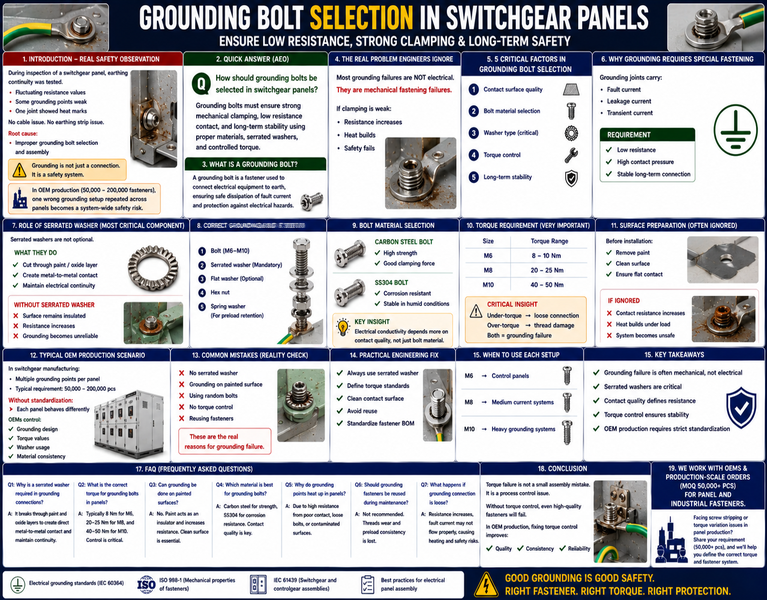
5 Critical Factors in Grounding Bolt Selection
- Contact surface quality
- Bolt material selection
- Washer type (critical)
- Torque control
- Long-term stability
Why Grounding Requires Special Fastening
Grounding joints carry:
👉 Fault current
👉 Leakage current
👉 Transient current
Requirement
✔ Low resistance
✔ High contact pressure
✔ Stable long-term connection
Role of Serrated Washer
Serrated washers are not optional.
What They Do
👉 Cut through paint / oxide layer
👉 Create metal-to-metal contact
👉 Maintain electrical continuity
Without Serrated Washer
- Surface remains insulated
- Resistance increases
- Grounding becomes unreliable
Correct Grounding Bolt Setup
Standard OEM configuration:
✔ Bolt (M6–M10 depending on application)
✔ Serrated washer (mandatory)
✔ Flat washer (optional)
✔ Hex nut
✔ Spring washer (for preload retention)
Bolt Material Selection
Carbon Steel Bolt
✔ High strength
✔ Good clamping force
SS304 Bolt
✔ Corrosion resistant
✔ Stable in humid conditions
Key Insight
👉 Electrical conductivity depends more on contact quality, not just bolt material
Torque Requirement
| Size | Torque Range |
| M6 | 8–10 Nm |
| M8 | 20–25 Nm |
| M10 | 40–50 Nm |
Critical Insight
- Under-torque → loose connection
- Over-torque → thread damage
- Both = grounding failure
Surface Preparation
Before installation:
✔ Remove paint
✔ Clean surface
✔ Ensure flat contact
If Ignored
- Contact resistance increases
- Heat builds under load
- System becomes unsafe
Typical OEM Production Scenario
In switchgear manufacturing:
- Multiple grounding points per panel
- Typical requirement: 50,000–200,000 pcs
Without standardization:
👉 Each panel behaves differently
OEMs control:
✔ Grounding design
✔ Torque values
✔ Washer usage
✔ Material consistency
Common Mistakes
- No serrated washer
- Grounding on painted surface
- Using random bolts
- No torque control
- Reusing fasteners
👉 These are the real reasons for grounding failure.
Practical Engineering Fix
To ensure reliable grounding:
✔ Always use serrated washer
✔ Define torque standards
✔ Clean contact surface
✔ Avoid reuse
✔ Standardize fastener BOM
When to Use Each Setup
✔ M6 → control panels
✔ M8 → medium current systems
✔ M10 → heavy grounding systems
Key Takeaways
• Grounding failure is often mechanical, not electrical
• Serrated washers are critical
• Contact quality defines resistance
• Torque control ensures stability
• OEM production requires strict standardization
FAQ
Q1: Why is a serrated washer required in grounding connections?
Serrated washers break through paint and oxide layers to create direct metal-to-metal contact. Without this, the connection may look tight but electrically behaves like a poor conductor. This increases resistance and can lead to heating and unsafe grounding performance.
Q2: What is the correct torque for grounding bolts in panels?
Torque depends on bolt size, typically ranging from 8 Nm for M6 up to 50 Nm for M10 bolts. Correct torque ensures proper contact pressure without damaging threads or deforming components. Both under-tightening and over-tightening can reduce grounding reliability.
Q3: Can grounding be done on painted surfaces?
No, grounding on painted or coated surfaces creates insulation and increases resistance. The contact area must be cleaned to bare metal to ensure proper current flow. Ignoring this is one of the most common causes of grounding failure in panels.
Q4: Which material is best for grounding bolts?
Carbon steel provides strong clamping, while SS304 is better in humid or corrosive environments. The key factor is not just material, but ensuring proper contact and pressure at the joint. A well-installed carbon steel bolt can perform better than a poorly installed stainless bolt.
Q5: Why do grounding points heat up in panels?
Heating occurs due to increased resistance caused by poor contact, loose bolts, or contaminated surfaces. Even small resistance increases can generate heat under fault current conditions. This can damage components and create safety hazards over time.
Q6: Should grounding fasteners be reused during maintenance?
Reusing grounding fasteners is not recommended, especially in critical systems. Threads may be worn, and preload consistency is lost after initial tightening. For OEM-level reliability, new fasteners ensure stable and repeatable grounding performance.
Q7: What happens if grounding connection is loose?
A loose grounding connection increases electrical resistance and reduces fault current flow capability. This can lead to improper circuit protection, overheating, and potential equipment damage. In worst cases, it creates a serious electrical safety risk for operators.
Conclusion
Grounding bolt selection is not a small decision.
It directly affects:
👉 Electrical safety
👉 Equipment protection
👉 System reliability
Most grounding failures are caused by:
👉 Wrong fastener setup
👉 Not wrong design
Fix the fastening system, and grounding becomes reliable.
👉 We work with OEMs and production-scale orders (MOQ 50,000+ pcs) for switchgear and industrial fasteners.Designing switchgear panels or facing grounding issues in production?
Share your drawing or requirement (50,000+ pcs), and we’ll help you standardize a safe and reliable grounding fastener system.