

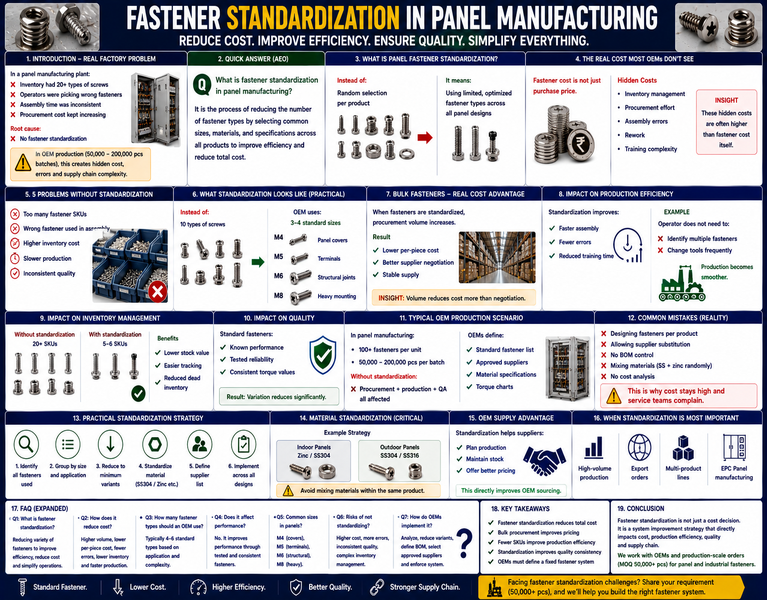
Introduction – Real Factory Problem
In a panel manufacturing plant:
👉 Inventory had 20+ types of screws
👉 Operators were picking wrong fasteners
👉 Assembly time was inconsistent
👉 Procurement cost kept increasing
No major design issue.
But system was inefficient.
Root cause:
Each design used different:
- Sizes
- Materials
- Types
In OEM production (50,000–200,000 pcs batches), this creates:
👉 Hidden cost
👉 Production errors
👉 Supply chain complexity
Quick Answer
What is fastener standardization in panel manufacturing?
Fastener standardization is the process of reducing the number of fastener types by selecting common sizes, materials, and specifications across all products to improve efficiency and reduce cost.
What is Panel Fastener Standardization?
It means:
👉 Using limited, optimized fastener types across all panel designs
Instead of:
👉 Random selection per product
The Real Cost Most OEMs Don’t See
Fastener cost is not just purchase price.
Hidden Costs
- Inventory management
- Procurement effort
- Assembly errors
- Rework
- Training complexity
👉 These are often higher than fastener cost itself
5 Problems Without Standardization
- Too many fastener SKUs
- Wrong fastener used in assembly
- Higher inventory cost
- Slower production
- Inconsistent quality
What Standardization Looks Like (Practical)
Instead of:
👉 10 types of screws
OEM uses:
👉 3–4 standard sizes
Example:
- M4 → panel covers
- M5 → terminals
- M6 → structural joints
- M8 → heavy mounting
Bulk Fasteners – Real Cost Advantage
When fasteners are standardized:
👉 Procurement volume increases
Result
✔ Lower per-piece cost
✔ Better supplier negotiation
✔ Stable supply
Insight
Volume reduces cost more than negotiation
Impact on Production Efficiency
Standardization improves:
✔ Faster assembly
✔ Fewer errors
✔ Reduced training time
Example
Operator does not need to:
- Identify multiple fasteners
- Change tools frequently
👉 Production becomes smoother
Impact on Inventory Management
Without standardization:
👉 20+ SKUs
With standardization:
👉 5–6 SKUs
Benefits
✔ Lower stock value
✔ Easier tracking
✔ Reduced dead inventory
Impact on Quality
Standard fasteners:
✔ Known performance
✔ Tested reliability
✔ Consistent torque values
👉 Variation reduces significantly
Typical OEM Production Scenario
In panel manufacturing:
- 100+ fasteners per unit
- 50,000–200,000 pcs per batch
Without standardization:
👉 Procurement + production + QA all affected
OEMs define:
✔ Standard fastener list
✔ Approved suppliers
✔ Material specifications
✔ Torque charts
Common Mistakes (Reality)
- Designing fasteners per product
- Allowing supplier substitution
- No BOM control
- Mixing materials (SS + zinc randomly)
- No cost analysis
👉 This is why cost stays high.
Practical Standardization Strategy
Step-by-step:
✔ Identify all fasteners used
✔ Group by size and application
✔ Reduce to minimum variants
✔ Standardize material (SS304 / zinc etc.)
✔ Define supplier list
✔ Implement across all designs
Material Standardization
Example Strategy
✔ Indoor panels → Zinc / SS304
✔ Outdoor panels → SS304 / SS316
👉 Avoid mixing within same product
OEM Supply Advantage
Standardization helps suppliers:
✔ Plan production
✔ Maintain stock
✔ Offer better pricing
👉 This directly improves OEM sourcing
When Standardization is Most Important
✔ High-volume production
✔ Export orders
✔ Multi-product lines
✔ EPC panel manufacturing
Key Takeaways
• Fastener standardization reduces total cost
• Bulk procurement improves pricing
• Fewer SKUs improve production efficiency
• Standardization improves quality consistency
• OEMs must define a fixed fastener system
FAQ
Q1: What is fastener standardization in panel manufacturing?
Fastener standardization means reducing the variety of screws, bolts, and nuts used across products. It helps simplify procurement, production, and inventory management. OEMs use this approach to improve efficiency and reduce overall cost.
Q2: How does standardization reduce cost?
Standardization increases purchase volume for fewer fastener types, which reduces per-piece cost. It also lowers inventory handling, reduces errors, and improves production speed. These combined savings are often much higher than the cost of the fasteners themselves.
Q3: How many fastener types should an OEM use?
Typically, OEMs aim to limit fasteners to 4–6 standard types based on application. This depends on product complexity, but fewer is always better for efficiency. The goal is to balance performance with simplicity.
Q4: Does standardization affect product performance?
No, if done correctly. In fact, it improves performance by using tested and consistent fasteners across all products. It also ensures predictable torque and reliability.
Q5: What sizes are commonly standardized in panels?
Common sizes include M4 for covers, M5 for terminals, M6 for structural joints, and M8 for heavy applications. These sizes cover most panel requirements. OEMs usually build their system around these.
Q6: What are the risks of not standardizing fasteners?
Without standardization, OEMs face higher costs, more assembly errors, and inconsistent product quality. Inventory becomes complex and difficult to manage. Over time, this reduces profitability and operational efficiency.
Q7: How do OEMs implement fastener standardization?
They start by analyzing all current fasteners, reducing variants, and defining a standard BOM. They also select approved suppliers and enforce the system across all designs. This ensures long-term consistency and cost control.
Conclusion
Fastener standardization is not just a cost decision.
It is a system improvement strategy.
It directly impacts:
👉 Cost
👉 Production efficiency
👉 Quality
👉 Supply chain
Most OEMs lose money here without realizing it.
👉 We work with OEMs and production-scale orders (MOQ 50,000+ pcs) to optimize fastener systems and reduce cost.Looking to reduce cost and improve efficiency in panel manufacturing?
Share your BOM or requirement (50,000+ pcs), and we’ll help you standardize your fastener system.