
Choosing a reliable Nyloc Nut Manufacturer requires more than matching the thread size of a bolt.
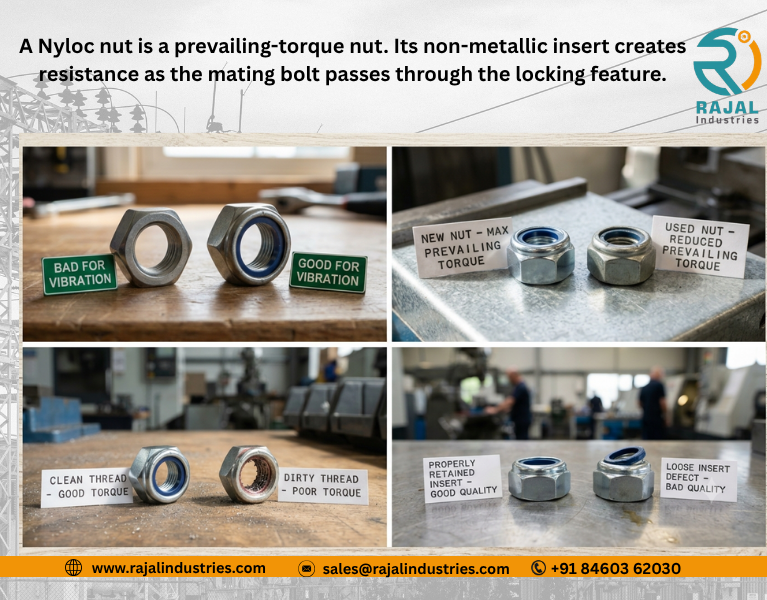
A nylon insert lock nut is a prevailing-torque nut that uses a non-metallic insert to create resistance during screw-thread engagement.
For industrial buyers, the correct selection process is:
Application → Thread → Nut Type → Standard → Mechanical Requirement → Insert → Material → Finish → Mating Bolt → Temperature → Functional Testing
This matters in automotive, machinery, automation and industrial equipment where the threaded joint can experience movement, vibration or repeated service conditions.
A Nyloc-type nut should be treated as part of the complete bolted joint, not as a universal solution for every loosening problem.
What Is a Nyloc Nut?
A Nyloc nut is commonly understood as a hexagonal lock nut containing a non-metallic, typically nylon-type, insert near one end of the nut.
As the mating bolt enters the insert, the insert interacts with the bolt thread and creates prevailing torque.
This means resistance exists during rotation even when the nut is not yet clamping the joint.
The basic system is:
Hex Nut Body + Non-Metallic Insert + Mating Bolt = Prevailing-Torque Nut Assembly
How Does a Nyloc Nut Work?
A Nyloc Nut uses a non-metallic insert that interacts with the mating bolt thread and creates prevailing torque during rotation. This resistance can help the fastening system resist unintended rotation, but the nut must still be correctly selected, tightened and validated for the application.
Nyloc Nut Is a Prevailing-Torque Nut
This distinction is important.
A standard hex nut rotates relatively freely until it contacts the joint.
A Nylon Insert Lock Nut introduces additional resistance through its non-metallic insert.
That resistance is called:
Prevailing Torque
Prevailing torque is not the same as:
- Clamp load
- Tightening torque
- Breakaway torque
- Proof load
- Joint strength
These terms should not be mixed.
Prevailing Torque vs Tightening Torque
Suppose an OEM specifies a tightening process.
The torque applied by the tool may include effects from:
Thread Friction + Bearing Friction + Prevailing Torque + Joint Tightening
Therefore, replacing a normal hex nut with a Nyloc lock nut can change the tightening behaviour of the assembly.
Do not assume the same tightening strategy can always be used without validation.
Nyloc Nut vs Standard Hex Nut
| Feature | Nyloc Nut | Standard Hex Nut |
| Non-Metallic Insert | Yes | No |
| Prevailing Torque Feature | Yes | No |
| Free Rotation | Reduced by insert | Generally freer |
| Vibration-Loosening Resistance | Can improve in suitable joints | Depends on joint/preload |
| Temperature Sensitivity | Insert must be considered | No polymer insert |
| Reuse | Must be validated | Application-specific |
| Functional Testing | Important | Application-specific |
A Nyloc nut should not automatically replace a standard hex nut without reviewing the joint.
Nyloc Nut vs Lock Nut
“Lock nut” is a broad category.
It can include:
- Nylon/non-metallic insert prevailing-torque nuts
- All-metal prevailing-torque nuts
- Other engineered locking nut designs
Therefore:
Every Nyloc-type nut is a lock-nut design, but not every lock nut is a Nyloc-type nut.
Nyloc Nut vs All-Metal Lock Nut
The locking mechanism is different.
Nyloc Nut
Uses a non-metallic insert to generate prevailing torque.
All-Metal Lock Nut
Uses controlled metallic thread or nut deformation/geometry to generate prevailing torque.
This difference can affect:
- Temperature capability
- Reuse behaviour
- Prevailing torque
- Installation
- Cost
- Application suitability
Neither type is universally better.
Nyloc Nut vs Jam Nut
A jam nut generally uses a different locking strategy involving two nuts or a particular joint arrangement.
A Nyloc nut generates prevailing torque through its insert.
These are different fastening principles and should not be treated as direct equivalents.
Nyloc Nut vs Flange Lock Nut
A flange lock nut can combine:
- Integrated flange
- Prevailing-torque feature
depending on the product.
The flange and locking feature perform different functions.
Flange = Bearing Geometry
Insert/Deformed Feature = Prevailing Torque
Do not assume a flange alone creates a lock nut.
Main Nyloc Nut Product Families
Current ISO standards distinguish different non-metallic-insert prevailing-torque nut geometries.
Important families include:
- Regular prevailing-torque hexagon nut
- High prevailing-torque hexagon nut
- Thin prevailing-torque hexagon nut
- Fine-pitch variants under applicable standards
- Flange prevailing-torque nuts under separate standards
The customer should specify the correct family rather than simply requesting:
Nyloc Nut
ISO 7040:2025 — Regular Nylon Insert Lock Nut
ISO 7040:2025 covers:
Prevailing torque hexagon regular nuts with non-metallic insert
The current 2025 edition specifies steel and stainless-steel nuts with metric coarse-pitch threads from M3 to M39, with product grades A and B.
This is an important current reference for regular-height non-metallic-insert prevailing-torque nuts.
ISO 7041:2025 — High Nylon Insert Lock Nut
ISO 7041:2025 covers:
Prevailing torque hexagon high nuts with non-metallic insert
Its scope includes steel and stainless-steel nuts with metric coarse-pitch threads from M5 to M39, with product grades A and B.
The higher nut form should not automatically be substituted for a regular nut because:
- Overall height changes
- Assembly envelope changes
- Product requirements differ
The drawing or applicable standard should control.
ISO 10511:2025 — Thin Nylon Insert Lock Nut
ISO 10511:2025 covers:
Prevailing torque hexagon thin nuts with non-metallic insert
Its scope includes steel and stainless steel with metric coarse-pitch threads from M3 to M39, with product grades A and B.
The standard specifically warns that thin style-0 nuts have reduced loadability compared with regular or high nuts and are not designed to provide resistance to thread stripping in the same way.
Therefore:
Thin Nyloc Nut ≠ Regular Nyloc Nut
even when the thread size is identical.
Current Nyloc Nut Standards Overview
| Standard | Product Family | Current Edition |
| ISO 7040 | Regular prevailing-torque nut with non-metallic insert | 2025 |
| ISO 7041 | High prevailing-torque nut with non-metallic insert | 2025 |
| ISO 10511 | Thin prevailing-torque nut with non-metallic insert | 2025 |
| ISO 2320 | Functional properties for prevailing-torque steel nuts | 2015, confirmed 2025 |
The exact product standard should be stated in the RFQ.
ISO 2320:2015 — Functional Properties
ISO 2320:2015 is particularly important because it deals with the functional properties of prevailing-torque steel nuts.
ISO confirms that the 2015 edition was reviewed and confirmed in 2025, so it remains current.
Its scope includes both:
- All-metal prevailing-torque nuts
- Non-metallic-insert prevailing-torque nuts
within its defined thread and mechanical-property scope.
Why ISO 2320 Matters to OEM Buyers
A Nyloc nut can look dimensionally correct and still fail to provide the required prevailing-torque behaviour.
That is why OEM qualification should not rely only on:
- Thread gauge
- Width across flats
- Nut height
- Appearance
Functional behaviour also matters.
Prevailing Torque Is a Functional Property
Prevailing torque describes the torque required to rotate the nut relative to the mating thread while the prevailing-torque feature is engaged and before the joint’s clamp load becomes the main factor.
This property can change due to:
- Insert design
- Insert material
- Bolt thread
- Coating
- Temperature
- Manufacturing variation
- Repeated installation
It should be tested under the applicable procedure.
Laboratory Values vs Actual Application
ISO 2320 notes that specified prevailing-torque values are based on laboratory test conditions and that actual prevailing torque in practical applications can vary.
This is an important engineering point.
Do not take one catalogue torque value and automatically use it as the expected production assembly torque.
Temperature and Nylon Insert Lock Nuts
Temperature deserves special attention because the locking feature contains a non-metallic insert.
ISO 2320 notes application ranges within its scope for non-metallic-insert prevailing-torque nuts and warns that temperature influences functional properties.
Therefore, temperature should be treated as an application-selection factor rather than simply quoting a universal Nyloc temperature rating.
Do Not Use One Temperature Number for Every Nyloc Nut
Actual suitability depends on:
- Insert material
- Nut design
- Standard
- Exposure duration
- Temperature cycling
- Chemicals
- Mating bolt
- Manufacturer qualification
For high-temperature applications, an all-metal prevailing-torque nut may need to be evaluated.
Nyloc Nut Thread Sizes
Depending on the applicable product standard, non-metallic-insert lock nuts are available across a broad metric range.
Common industrial requirements may include:
- M3
- M4
- M5
- M6
- M8
- M10
- M12
- M14
- M16
- Larger sizes where the applicable standard/product supports them
But:
Thread size alone does not define the complete Nyloc nut.
Metric Coarse Thread Examples
| Thread | Common Coarse Pitch |
| M3 | 0.5 mm |
| M4 | 0.7 mm |
| M5 | 0.8 mm |
| M6 | 1.0 mm |
| M8 | 1.25 mm |
| M10 | 1.5 mm |
| M12 | 1.75 mm |
| M14 | 2.0 mm |
| M16 | 2.0 mm |
The applicable standard or customer drawing should control the final thread specification.
Fine-Pitch Nyloc Nuts
Fine-pitch prevailing-torque nuts also exist under applicable product standards.
A buyer should specify:
Diameter + Pitch + Product Standard
rather than only:
M12 Nyloc Nut
For example:
M12 × 1.5
and:
M12 × 1.75
are different threads.
Nyloc Nut Dimensions
Important dimensions can include:
- Thread diameter
- Thread pitch
- Width across flats
- Overall height
- Metal nut-body height
- Prevailing-torque feature height
- Chamfer
- Bearing surface
Exact dimensions depend on the applicable product standard.
Nyloc Nut Materials
Depending on the applicable standard and application, the nut body can be manufactured from materials such as:
- Carbon/alloy steel as specified
- Stainless steel
The non-metallic insert is a separate functional component.
Therefore, a complete material specification may need to address both:
Nut Body + Insert
Steel Nyloc Nuts
Steel Industrial Nuts can suit many:
- Automotive
- Machinery
- Automation
- Industrial equipment
applications.
The buyer should specify:
- Mechanical/property requirement
- Finish
- Corrosion requirement
- Functional requirement
Do not order only:
Steel Nyloc Nut
for an engineered OEM joint.
Stainless Steel Nyloc Nuts
Stainless steel can be selected for suitable corrosion-resistant applications.
Current ISO 7040, ISO 7041 and ISO 10511 scopes include stainless-steel variants.
The exact stainless grade/property requirement should follow the applicable standard and customer specification.
Do not assume:
Stainless = 316/A4
without confirming the requirement.
Nylon Insert Material
The insert is a critical functional component.
Its characteristics can affect:
- Prevailing torque
- Temperature behaviour
- Chemical compatibility
- Reuse
- Shelf/storage conditions
- Installation
For special environments, buyers should confirm the insert specification with the manufacturer.
Insert Colour Is Not a Reliable Grade System
OEM buyers sometimes identify Nyloc nuts by insert colour.
This is risky.
Insert colour may vary by:
- Manufacturer
- Material
- Customer identification
- Product family
Do not assume:
Blue insert = one universal grade
or:
White insert = another universal performance level.
Use the product specification.
Nyloc Nut Surface Finishes
Steel Nyloc nuts can use suitable finish systems such as:
- Zinc electroplating
- Zinc-flake coating
- Phosphate or other specified finishes
- Customer-specific coating systems
depending on product and OEM requirements.
The coating should be compatible with:
- Thread
- Prevailing-torque performance
- Corrosion requirement
- Mating bolt
- Tightening process
Coating Can Affect Prevailing Torque
Coating can change:
- Thread friction
- Surface condition
- Bolt/nut interaction
Therefore, a supplier should not qualify an uncoated nut and assume the coated production version behaves identically.
Functional testing should represent the final production condition where required.
Zinc-Plated Nyloc Nuts
Zinc-plated steel Nyloc nuts are common for suitable industrial applications.
The buyer should define:
- Coating specification
- Corrosion requirement
- Appearance where relevant
- Friction requirement where controlled
Avoid specifying only:
Zinc plated
when the OEM has a detailed coating requirement.
Zinc-Flake Nyloc Nuts
Zinc-flake systems may be specified in automotive or industrial applications where the OEM requires a particular corrosion/friction system.
The exact coating and topcoat should follow the approved specification.
Do not substitute zinc electroplating and zinc-flake coating without approval.
Hydrogen Embrittlement Considerations
For susceptible high-strength steel fasteners, coating and manufacturing processes may require specific controls related to hydrogen embrittlement risk.
This should be handled according to:
- Material
- hardness/strength
- coating process
- applicable fastener/coating standard
- OEM specification
Do not assume every plated Nyloc nut has the same risk level.
Nyloc Nut for Automotive Applications
Automotive applications may include suitable:
- Brackets
- Interior assemblies
- Equipment mounting
- Electrical systems
- Underbody equipment
- Accessory systems
Important OEM requirements can include:
- Prevailing torque
- Corrosion
- Traceability
- Automated assembly
- Tightening control
- PPAP
- Reuse policy
Automotive Nyloc Nut Selection
Use:
Application → Bolt → Thread → Nut Standard → Property Requirement → Insert → Coating → Temperature → Prevailing Torque → Tightening Process → PPAP
This is more reliable than selecting only by thread size.
Nyloc Nuts in Machinery
Machinery can use Nyloc-type nuts in suitable:
- Guards
- Covers
- Equipment mounts
- Brackets
- Frames
- Adjustment assemblies
where prevailing-torque behaviour is useful.
But machine vibration should still be evaluated as a joint-system problem.
Nyloc Nut Is Not “Vibration Proof”
Avoid claims such as:
100% vibration proof
or:
Cannot loosen.
A prevailing-torque nut can improve resistance to unintended rotation in suitable applications, but actual joint performance depends on:
- Preload
- Vibration
- Joint stiffness
- Surface condition
- Bolt
- Nut
- Temperature
- Installation
Validation is required.
Nyloc Nuts for Automation Equipment
Automation equipment may use locking nuts in:
- Sensor mounts
- Machine guards
- Frames
- Actuator assemblies
- Equipment brackets
- Moving machinery
Selection should consider:
- Vibration
- Service access
- Temperature
- Repeated maintenance
- Installation tool
- Prevailing torque
Nyloc Nuts for Industrial Equipment
Potential applications include:
- Pumps
- Compressors
- Conveyors
- Material-handling equipment
- Packaging machinery
- Industrial cabinets
- General equipment
Each application should be reviewed for:
Load + Vibration + Temperature + Corrosion + Maintenance
High-Temperature Industrial Equipment
Where service temperature is elevated, do not automatically specify a nylon/non-metallic-insert nut.
Evaluate:
- Actual operating temperature
- Peak temperature
- Exposure time
- Heat cycling
- Insert capability
- Alternative all-metal lock nut
The application specification should control.
Chemical Exposure
A non-metallic insert may be exposed to:
- Oils
- Fuels
- Cleaning chemicals
- Coolants
- Solvents
- Process chemicals
Compatibility should be verified for the actual insert material.
Do not assume “nylon” means universal chemical resistance.
Nyloc Nut and Mating Bolt Compatibility
Always check:
Nut Thread + Bolt Thread + Nut Mechanical Requirement + Bolt Mechanical Requirement + Coating + Functional Requirement
The bolt also influences prevailing-torque performance because its thread interacts directly with the insert.
Bolt Thread Condition Matters
Prevailing torque can be influenced by:
- Bolt thread dimensions
- Coating
- Burrs
- Damage
- Surface roughness
Therefore, testing a Nyloc nut on a random bolt may not represent the actual OEM assembly.
Use a controlled mating fastener.
Bolt Length and Insert Engagement
The bolt must extend sufficiently through the nut to achieve the intended threaded engagement and interact correctly with the locking feature.
The exact protrusion/engagement requirement should follow the applicable standard, joint design and OEM specification.
Do not use a universal “number of threads showing” rule for every application.
Nyloc Nut Installation Direction
The normal assembly concept is for the bolt thread to engage the metal nut thread before fully interacting with the non-metallic prevailing-torque feature.
Installation should follow the product design and applicable technical specification.
Incorrect orientation can create assembly problems.
Nyloc Nut Reuse
A common buyer question is:
Can Nyloc nuts be reused?
The safest engineering answer is:
Reuse should not be assumed.
Repeated installation can change prevailing-torque behaviour.
Reuse depends on:
- Product standard
- OEM specification
- Remaining prevailing torque
- Insert condition
- Temperature history
- Service environment
For safety-critical applications, follow the approved maintenance specification.
Do Not Create a Universal Reuse Count
Avoid statements such as:
Nyloc nuts can always be reused five times.
The permitted number of installations depends on the specific product and acceptance criteria.
Functional testing should control.
Nyloc Nut Manufacturing Process
A typical manufacturing flow can include:
Raw Material → Nut Forming → Piercing/Threading → Heat Treatment if Required → Surface Treatment → Insert Assembly → Inspection → Functional Testing → Packing
The exact sequence depends on:
- Nut material
- Property requirement
- coating
- insert design
- manufacturing process
Nut Body Manufacturing
For high-volume standard products, cold-forming processes may be suitable.
The manufacturer must control:
- Hex geometry
- Nut height
- Thread
- Bearing surface
- Mechanical properties
according to the applicable specification.
Thread Manufacturing
Internal threads must be controlled for:
- Diameter
- Pitch
- Thread tolerance
- Burr
- Coating allowance
- Functional engagement
The thread must work correctly with both:
- Mating bolt
- Prevailing-torque insert system
Insert Assembly
The insert must be:
- Correctly positioned
- Properly retained
- Free from unacceptable damage
- Consistent around the nut
Poor insert assembly can affect functional performance even when the metal nut dimensions are correct.
Insert Retention
During normal assembly, the insert should remain properly retained within the nut design.
Potential problems can include:
- Insert displacement
- Insert damage
- Incomplete assembly
- Deformation
Visual and functional inspection can help detect these issues.
Quality Inspection for a Nyloc Nut Manufacturer
A production control plan can include:
Material → Nut Dimensions → Thread → Mechanical Properties → Coating → Insert → Prevailing Torque → Visual Inspection → Traceability → Packing
Critical-to-Quality Characteristics
| CTQ | Why It Matters |
| Thread Diameter/Pitch | Bolt compatibility |
| Thread Quality | Assembly |
| Nut Dimensions | Fit/tooling |
| Nut Mechanical Properties | Joint requirement |
| Insert Material | Locking behaviour |
| Insert Position | Functional consistency |
| Prevailing Torque | Locking function |
| Coating | Corrosion/friction |
| Traceability | OEM quality control |
Thread Inspection
Suitable calibrated thread gauges can be used where required.
Typical inspection can include:
- GO gauge
- NO-GO gauge
according to the specified thread tolerance and inspection plan.
Dimensional Inspection
Important dimensions depend on the product standard and can include:
- Width across flats
- Nut height
- Prevailing-torque feature height
- Bearing geometry
- Thread
Prevailing-Torque Testing
For OEM applications, functional testing is one of the most important checks.
The test should follow the applicable standard or customer procedure.
Do not invent:
- Generic first-install torque
- Generic removal torque
- Universal reuse torque
for all Nyloc nuts.
Why the Test Bolt Matters
Prevailing-torque testing depends on the mating thread.
Therefore, the test fastener should meet the applicable test requirements.
A damaged, oversized, undersized or unusually coated bolt can change the result.
Mechanical Testing
Depending on the applicable nut specification, testing may include:
- Proof-load-related verification
- Hardness
- Other mechanical tests
The applicable standard and customer specification should define acceptance.
Coating Inspection
Depending on the requirement, inspect:
- Coating thickness
- Appearance
- Corrosion performance
- Friction where specified
Functional prevailing-torque testing should represent the approved final condition where required.
Common Nyloc Nut Failure: Low Prevailing Torque
Possible causes include:
- Insert geometry
- Insert material
- Insert damage
- Incorrect bolt thread
- Manufacturing variation
- Temperature exposure
- Repeated use
Investigate the complete system.
Common Failure: Excessive Prevailing Torque
Possible causes include:
- Insert dimension
- Thread condition
- Incorrect mating bolt
- Coating
- Product variation
Excessive prevailing torque can affect automated assembly and tightening control.
Common Failure: Insert Comes Out
Possible causes can include:
- Insert-retention problem
- Manufacturing defect
- Incorrect installation
- Severe thermal/chemical exposure
- Abnormal mating thread
Preserve failed samples for investigation.
Common Failure: Bolt Will Not Pass Through Nut
Check:
- Thread diameter
- Pitch
- Thread damage
- Insert
- Bolt coating
- Alignment
Do not force the assembly.
Common Failure: Nut Loosens in Service
Do not automatically blame the nylon insert.
Investigate:
- Joint preload
- Tightening process
- Bolt
- Nut
- vibration
- joint settlement
- temperature
- reuse
- insert condition
Manufacturing Defect vs Application Problem
| Problem | Possible Nut Cause | Possible Application Cause |
| Low Prevailing Torque | Insert issue | Wrong/test bolt |
| Excessive Torque | Insert/thread issue | Bolt/coating variation |
| Insert Displacement | Retention defect | Incorrect assembly |
| Thread Failure | Thread/mechanical issue | Over-tightening |
| Nut Loosening | Functional issue possible | Preload/vibration |
| Corrosion | Coating/material | Environment |
| Insert Damage | Material/assembly | Temperature/chemicals/reuse |
Root-Cause Investigation Sequence
Use:
Identify Lot → Preserve Samples → Review Drawing → Confirm Standard → Gauge Thread → Verify Nut Material → Check Mechanical Properties → Inspect Coating → Inspect Insert → Verify Mating Bolt → Measure Prevailing Torque → Review Tightening → Review Temperature/Chemicals → Reproduce Assembly → Confirm Root Cause
What Should an OEM Send to a Nyloc Nut Manufacturer?
A good RFQ should include:
☐ Drawing
☐ Product standard
☐ Thread diameter
☐ Thread pitch
☐ Nut type: regular/high/thin/flange as applicable
☐ Nut material
☐ Mechanical/property requirement
☐ Insert requirement if specified
☐ Finish/coating
☐ Mating bolt
☐ Service temperature
☐ Chemical exposure if relevant
☐ Prevailing-torque requirement
☐ Tightening requirement
☐ Reuse policy if applicable
☐ Testing
☐ Documentation
☐ Quantity
☐ Annual demand
Poor Nyloc Nut RFQ
Need M8 Nyloc nut. Quote 100,000 pcs.
This leaves several technical assumptions.
Better Nyloc Nut RFQ
Product: M8 × 1.25 Nylon Insert Lock Nut
Standard: Applicable ISO/customer drawing attached
Nut Type: Regular prevailing-torque nut
Material/Mechanical Requirement: Specification attached
Finish: OEM coating specification attached
Mating Bolt: Drawing attached
Application: Industrial machinery
Service Temperature: Application data attached
Functional Testing: Prevailing-torque requirement per specification
Quantity: 100,000 pcs/year
Samples: Required before production approval
Supplier Qualification Questions
Before approving a Nyloc Nut Supplier, ask:
- Which prevailing-torque nut standards are manufactured?
- Can ISO 7040:2025 products be supported?
- Can ISO 7041:2025 products be supported?
- Can ISO 10511:2025 products be supported?
- Which metric sizes are produced?
- Are fine-pitch products available?
- Which nut materials are available?
- Which insert materials are used?
- How is insert material controlled?
- How is insert retention controlled?
- How are threads inspected?
- How are mechanical properties verified?
- How is prevailing torque tested?
- Which test bolts are used?
- Which coatings are available?
- Can PPAP be supported?
- Is lot traceability available?
- What is monthly capacity?
Nyloc Nut Supplier Qualification Matrix
| Requirement | Priority |
| Thread Quality | Very High |
| Prevailing-Torque Performance | Very High |
| Insert Consistency | Very High |
| Mechanical Properties | Very High |
| Standard Compliance | Very High |
| Material Control | Very High |
| Coating Control | High |
| Functional Testing | Very High |
| Traceability | High |
| PPAP | Automotive High |
| Production Capacity | High |
| Delivery | High |
| Price | After Technical Approval |
Automotive PPAP Requirements
Automotive OEMs may request documentation such as:
- Process Flow
- PFMEA
- Control Plan
- MSA
- Dimensional Results
- Material Results
- Performance Results
- Capability Studies
- Sample Parts
- Traceability
The customer should define the required PPAP level and submission requirements.
Sample Approval
A Nyloc nut sample should not be approved only because:
The bolt screws into it.
Check:
Dimensions → Thread → Material → Mechanical Properties → Coating → Insert → Prevailing Torque → Mating Bolt → Tightening → Application
Pilot Production
For high-volume OEM orders, a pilot lot can help verify:
- Tooling
- Nut dimensions
- Thread
- Heat treatment
- coating
- insert assembly
- prevailing torque
- automated installation
- packing
This reduces risk before mass production.
Localization of Imported Nyloc Nuts
When localizing an imported Nyloc Lock Nut, do not copy only:
Thread + Width + Height
Also identify:
- Product standard
- Mechanical requirement
- Nut material
- Insert material
- Coating
- Prevailing torque
- Mating bolt
- Temperature
- Chemical environment
- Reuse requirement
Reverse Engineering Limitations
A physical sample can help identify:
- Thread
- Dimensions
- Basic geometry
- Insert appearance
- Approximate finish
But it may not reliably reveal:
- Exact material
- Property class
- Insert polymer specification
- Original prevailing-torque requirement
- Coating specification
- Heat-treatment requirement
- Reuse criteria
Obtain the original drawing/specification whenever possible.
What Is a Nyloc Nut?
A Nyloc nut is a prevailing-torque lock nut that uses a non-metallic insert to create resistance as the mating bolt thread passes through the locking feature. It is used in suitable automotive, machinery, automation and industrial equipment joints.
Is a Nyloc Nut Vibration Proof?
No locking nut should be described as universally vibration proof. A nylon insert lock nut creates prevailing torque that can help resist unintended rotation, but actual joint performance depends on preload, vibration, bolt, nut, temperature, installation and service conditions.
What Standard Covers Nyloc Nuts?
Current ISO standards include ISO 7040:2025 for regular non-metallic-insert prevailing-torque hex nuts, ISO 7041:2025 for high nuts and ISO 10511:2025 for thin nuts. ISO 2320:2015 covers functional properties of prevailing-torque steel nuts within its scope.
Can Nyloc Nuts Be Reused?
Reuse should not be assumed. Repeated installation can change prevailing-torque performance. Follow the product standard, manufacturer data and OEM maintenance specification, and verify remaining functional performance where reuse is permitted.
Can Nyloc Nuts Be Used at High Temperature?
Temperature affects the non-metallic insert and prevailing-torque performance. Suitability should be checked against the specific product, insert material, applicable standard and service conditions. For higher-temperature applications, an all-metal prevailing-torque nut may need evaluation.
What Is Prevailing Torque?
Prevailing torque is the rotational resistance generated by a locking feature while the nut moves on the mating thread, separate from the torque required to create clamp load in the joint.
What Is the Difference Between a Nyloc Nut and an All-Metal Lock Nut?
A Nyloc-type nut uses a non-metallic insert to create prevailing torque, while an all-metal lock nut generates prevailing torque through controlled metallic geometry or deformation. Temperature, reuse, installation and application requirements can differ.
Can Stainless Steel Nyloc Nuts Be Manufactured?
Yes. Current ISO product standards for non-metallic-insert prevailing-torque nuts include stainless-steel products within their specified scope. The exact stainless grade and property requirement should follow the applicable standard or customer drawing.
Before selecting a Nyloc Nut Manufacturer, confirm:
Application + Thread + Product Standard + Nut Type + Mechanical Requirement + Insert + Material + Coating + Mating Bolt + Temperature + Prevailing Torque + Testing
Select the Nyloc Nut as Part of the Complete Joint
Choosing a Nyloc Nut Manufacturer should involve more than comparing prices for an M6, M8 or M10 lock nut.
The correct engineering sequence is:
Application → Bolt → Thread → Nut Type → Standard → Mechanical Properties → Insert → Material → Coating → Temperature → Prevailing Torque → Tightening → Testing
The non-metallic insert provides an important prevailing-torque function, but it does not replace correct joint design or clamp load.
A Nyloc nut can still perform poorly if:
- The mating bolt is incorrect.
- The nut’s mechanical properties are unsuitable.
- The insert is exposed beyond its validated conditions.
- Coating changes assembly behaviour.
- Tightening is incorrect.
- The nut is reused without approval.
- The complete joint is unsuitable for the service environment.
Rajal Industries can evaluate standard and customer drawing-based Nylon Insert Lock Nut and Nyloc Lock Nut requirements for automotive, machinery, automation and industrial OEM applications, subject to technical feasibility, manufacturing process, tooling and sample validation.
Looking for a Nyloc Nut Manufacturer in India?
Send Rajal Industries:
Drawing + Standard + Thread + Nut Type + Material + Mechanical Requirement + Insert Requirement + Finish + Mating Bolt + Temperature + Prevailing-Torque Requirement + Testing + Quantity
for technical feasibility and quotation review.