

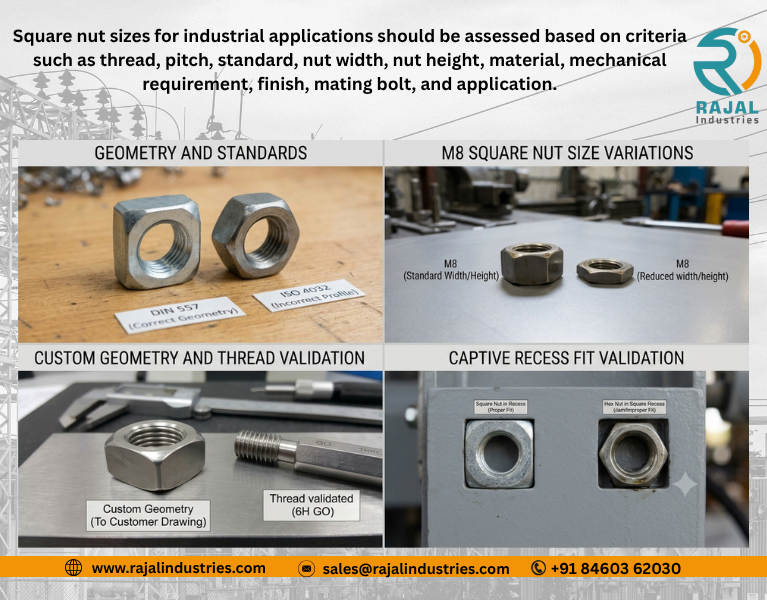
Selecting the correct Square Nut Sizes requires more than matching an M6, M8, M10 or M12 thread.
Industrial buyers should check:
Thread → Pitch → Standard → Nut Width → Nut Height → Material → Mechanical Requirement → Finish → Mating Bolt → Application
This becomes especially important when the square nut fits inside a:
- Channel
- Slot
- Square recess
- Captive assembly
In these applications, even a small dimensional difference can affect installation.
The current DIN reference for metric product-grade C square nuts is DIN 557:2026-02. For inch-series square nuts, ASME B18.2.2-2022 covers general and dimensional requirements for square and other nut types. (Dinmedia)
What Are Square Nut Sizes?
Square Nut Sizes are defined by more than the internal thread.
Important dimensions can include:
- Nominal thread diameter
- Thread pitch
- Width across the square
- Nut height
- Corner geometry
- Chamfer
- Bearing surface
For a standard product, these dimensions should follow the specified Square Nut Standards.
For a custom product, the approved customer drawing controls.
What Does M8 Square Nut Mean?
An M8 square nut has an internal metric thread with a nominal diameter of:
8 mm
For a standard coarse metric thread:
M8 × 1.25
But M8 does not define the complete nut.
You still need to know:
Standard + Width + Height + Material + Mechanical Requirement + Finish
This is why an RFQ stating only:
M8 Square Nut
is incomplete for many industrial applications.
Main Square Nut Dimensions
A square nut drawing can contain several important dimensions.
1. Thread Diameter
The nominal internal thread.
Examples:
- M5
- M6
- M8
- M10
- M12
- M16
depending on the applicable standard or custom design.
2. Thread Pitch
For metric coarse threads, common examples include:
| Thread | Common Coarse Pitch |
| M3 | 0.5 mm |
| M4 | 0.7 mm |
| M5 | 0.8 mm |
| M6 | 1.0 mm |
| M8 | 1.25 mm |
| M10 | 1.5 mm |
| M12 | 1.75 mm |
| M16 | 2.0 mm |
The drawing or applicable thread standard should control final selection.
Do not assume coarse pitch when the customer specifies a fine pitch.
3. Square Nut Width
The external width of the square body is one of the most important Square Nut Dimensions.
It affects:
- Bearing area
- Wrench engagement where applicable
- Channel fit
- Recess fit
- Anti-rotation geometry
- Assembly clearance
A small difference in width may matter significantly in a captive application.
4. Square Nut Height
Nut height affects:
- Available internal thread engagement
- Assembly envelope
- Pocket depth
- Mechanical capability
- Clearance
Standard-height and thin square nuts should therefore not be treated as interchangeable.
5. Corner Geometry
The corners may include standard-controlled or manufacturing-related:
- Chamfers
- Radii
- edge forms
If the square nut fits inside a tight pocket, design the pocket around the actual approved nut geometry rather than an ideal mathematical square.
6. Bearing Surface
The bearing surface transfers load into the clamped component.
Important factors include:
- Flatness as required
- Burr
- Damage
- Coating buildup
- Contact area
The bearing interface becomes especially important in softer materials.
Why Square Nut Dimensions Matter
Imagine an M8 square nut used inside a machinery channel.
If the nut is:
Too Wide
It may:
- Jam
- Fail to enter
- Damage coating
- Stop adjustment
Too Narrow
It may:
- Rotate excessively
- Misalign
- Damage the channel
- Make bolt insertion difficult
Therefore:
Thread size alone cannot define a captive square-nut assembly.
Current DIN 557 Standard
For buyers using DIN square nuts, an important 2026 update is:
DIN 557:2026-02 — Fasteners — Square nuts — Product grade C
DIN Media identifies this edition as CURRENT. (Dinmedia)
This should now be the reference point when a new requirement specifies the current DIN 557 edition.
Why the DIN 557 Edition Matters
Fastener standards can be revised.
Therefore, an RFQ should ideally state:
DIN 557 + Required Edition
where contractual control of the edition matters.
Do not assume an old internet dimensional chart automatically represents the latest standard.
Older DIN 557 Information Online
Many websites still display dimensions based on older DIN 557 editions.
These can be useful for identifying legacy parts, but they should not automatically be used to define a new 2026 production requirement.
For a new drawing or purchase specification:
Use the applicable current standard or the customer’s controlled drawing.
DIN 557 and Product Grade C
DIN 557:2026 identifies the product as:
Square nuts — Product grade C. (Dinmedia)
Product grade relates to dimensional/product requirements.
It should not be confused with:
- Material grade
- Nut property class
- Strength class
- Coating
These are separate specification elements.
Product Grade Is Not Strength Grade
This is a common purchasing mistake.
For example:
Product Grade C
does not mean:
Property Class C
or a particular steel strength.
Product grade addresses dimensional/product accuracy under the applicable fastener standard.
Mechanical properties must be defined separately by the applicable mechanical-property specification or customer drawing.
DIN 557 vs DIN 562
These are different square-nut product families.
DIN 557
Standard-height square nut pattern.
DIN 562
Thin square nut pattern.
The main practical difference is that the thin pattern has reduced height.
That affects:
- Thread engagement
- Assembly clearance
- Potential mechanical capability
Do not substitute one for the other solely because the thread matches.
Standard Square Nut vs Thin Square Nut
| Feature | Standard Square Nut | Thin Square Nut |
| External Form | Square | Square |
| Nut Height | Greater | Reduced |
| Thread Engagement | Greater potential | Reduced by lower height |
| Space Requirement | Higher | Lower |
| Typical Use | General industrial | Space-limited applications |
| Substitution | Drawing controlled | Drawing controlled |
Do Not Treat DIN 557 as an ISO 4032 Equivalent
This distinction is important.
DIN 557 covers square nuts.
ISO 4032:2023 covers regular hexagon nuts, style 1. DIN Media identifies ISO 4032:2023 as the current edition. (Dinmedia)
Therefore:
DIN 557 ≠ ISO 4032
They describe different external nut geometries.
Square Nut vs Hex Nut Standards
| Nut Type | Example Standard |
| Square Nut | DIN 557 |
| Thin Square Nut | DIN 562 |
| Regular Hex Nut | ISO 4032 |
| Inch Square Nut | ASME B18.2.2 |
Always verify the exact standard requested by the customer.
ASME B18.2.2-2022 Square Nuts
For inch-series applications, ASME B18.2.2-2022 is an important current reference.
ASME states that this standard covers general and dimensional data for various inch-series nut types, including square nuts. (ASME)
Its table of contents specifically includes:
- Dimensions of Square and Hex Machine Screw Nuts
- Dimensions of Square Nuts
- Dimensions of Heavy Square Nuts
among other nut types. (ASME)
Metric vs Inch Square Nuts
Do not mix these systems.
Metric Square Nut
Specified using metric thread terminology such as:
M8 × 1.25
Inch Square Nut
May use thread systems such as:
UNC or UNF
depending on the requirement.
The two systems are not interchangeable.
Metric Square Nuts
Metric Square Nuts are widely used in industrial assemblies where metric bolts and threaded components are specified.
Selection should include:
Metric Thread + Standard + Dimensions + Material + Mechanical Requirement + Finish
Examples can include:
- Construction equipment
- Machinery
- Furniture
- Electrical equipment
- Fabricated systems
Metric Thread Size Does Not Define Nut Width
For example:
M8
defines the nominal thread diameter.
It does not independently define the square body’s width.
That dimension comes from:
- Product standard
- Manufacturer drawing
- Customer drawing
This distinction becomes critical when the nut fits into a channel.
Square Nut Size Terminology
When reviewing a drawing, buyers may encounter symbols representing dimensions such as:
d
Nominal thread diameter.
s
Width across flats/sides, depending on the applicable drawing convention.
m
Nut height.
Other dimensions may define:
- Chamfer
- Corner geometry
- bearing surface
Always follow the notation in the applicable standard or drawing.
Square Nut Dimensions for Captive Applications
For a loose general-purpose nut, small external dimensional variation may have limited impact.
For a captive nut, it can be critical.
The designer must compare:
Maximum Nut Width ↔ Minimum Pocket/Channel Width
and:
Minimum Nut Width ↔ Maximum Pocket/Channel Width
to evaluate fit and possible rotation.
Nominal Dimension Is Not Enough
Suppose a square nut has a nominal width of:
13 mm
and the channel has a nominal internal width of:
13.2 mm
That alone does not prove the assembly will work.
You also need:
- Nut tolerance
- Channel tolerance
- Coating thickness
- Burr
- Manufacturing variation
Tolerance stack-up should be reviewed.
Maximum Material Condition
In a tight channel, the worst-case condition may occur when:
Nut = Maximum Allowed Width
and:
Channel = Minimum Allowed Width
This condition determines whether the nut can physically enter and move as required.
Maximum Clearance Condition
The opposite condition occurs when:
Nut = Minimum Allowed Width
and:
Channel = Maximum Allowed Width
This condition can determine:
- Maximum rotation
- Alignment variation
- Rattle
- Captive effectiveness
Both extremes matter.
Square Nut Size Selection for a Recess
A square recess should consider:
- Nut width
- nut corner geometry
- recess width
- recess depth
- coating
- insertion method
- manufacturing tolerance
Do not design the pocket directly from the nominal nut width alone.
Square Nut Size Selection for a Channel
For channel applications, verify:
- External nut width
- Nut height
- Channel internal width
- Channel opening
- Bolt clearance
- Nut rotation
- Required sliding movement
The square nut and channel should be validated as one assembly.
Square Nut Size Selection for Timber
For suitable timber connections, nut size selection should follow the approved joint design.
Check:
- Bolt diameter
- Nut
- Washer if required
- Timber thickness
- Bearing
- Edge distance
- Structural load
Do not select the nut only from timber thickness.
Square Nut Size Selection for Machinery
Machinery designers should consider:
Bolt Size → Joint Load → Channel/Recess → Nut Standard → Nut Dimensions → Material → Mechanical Requirement → Finish
Possible uses include:
- Adjustment slots
- Machine frames
- Fixtures
- Guards
- Equipment supports
Square Nut Size Selection for Furniture
Furniture applications can require:
- Compact dimensions
- Captive installation
- Easy assembly
- Repeat disassembly
- Appearance
- Corrosion protection
The thread should match the required bolt while the external square dimensions should match the recess or frame.
Square Nut Size Selection for Electrical Equipment
Electrical assemblies may use square nuts in:
- Panels
- Enclosures
- Channels
- Cabinets
- Equipment frames
Important factors include:
- Space
- corrosion
- thread
- captive fit
- serviceability
Any required electrical bonding function should be separately engineered and tested.
Square Nut Size Selection for General Engineering
General engineering applications can vary widely.
A practical selection sequence is:
Thread → Standard → Dimensions → Material → Mechanical Requirement → Finish → Mating Bolt → Assembly Fit → Testing
Square Nut Materials
Common material directions can include:
- Carbon steel
- Alloy steel where required
- Stainless steel
- Brass
- Customer-specified material
Material selection should follow the application rather than square geometry alone.
Carbon Steel Square Nuts
Carbon steel can suit many:
- Construction
- Machinery
- Furniture
- Fabrication
- General engineering
applications.
The buyer should still specify:
- Mechanical/property requirement
- Finish
- Environment
Alloy Steel Square Nuts
Where higher mechanical requirements apply, an alloy steel or other specified material may be required.
Do not assume every high-load application automatically requires alloy steel.
The applicable joint specification should control.
Stainless Steel Square Nuts
Stainless steel may be selected for corrosion resistance in suitable environments.
Possible specifications may distinguish different stainless families or grades.
Do not order simply:
Stainless Square Nut
when the project requires a particular grade.
A2 and A4 Stainless Terminology
Fastener buyers often encounter stainless designations such as:
- A2
- A4
The exact stainless requirement should follow the applicable fastener material/property specification.
Do not assume:
Stainless = A4
or:
Outdoor = A4
without evaluating the actual environment.
Brass Square Nuts
Brass can be used in certain specialized assemblies.
Possible reasons can include:
- Electrical characteristics
- corrosion behaviour
- appearance
- equipment requirements
Mechanical capability should still be verified.
Material Selection Matrix
| Application | Possible Material Direction | Main Requirement |
| Construction | Carbon steel | Mechanical + corrosion |
| Machinery | Carbon/alloy/stainless | Joint requirement |
| Furniture | Steel/stainless | Finish + appearance |
| Electrical | Steel/stainless/brass where suitable | Functional requirement |
| General Engineering | Drawing-specific | Complete joint |
| Outdoor | Coated steel/stainless | Environment |
| Custom OEM | Customer specification | Validation |
This is a selection guide, not a material standard.
Square Nut Grades: What Does “Grade” Mean?
The word grade can refer to several different things:
- Product grade
- Material grade
- Nut property class
- Stainless designation
- Customer-specific grade
These should not be mixed.
Product Grade
Product grade generally relates to dimensional/product accuracy requirements under a fastener standard.
DIN 557:2026 identifies square nuts as product grade C. (Dinmedia)
This does not independently define the nut’s strength.
Material Grade
Material grade defines the material itself.
Examples may include specific:
- Carbon steels
- Alloy steels
- Stainless steels
- Brass grades
depending on the drawing.
Nut Property Class
For mechanically specified steel nuts, the applicable property-class system defines mechanical requirements.
The correct property requirement should be selected based on:
- Nut design
- Mating bolt
- Applicable standard
- Joint requirement
Do not assign a property class simply because another nut of the same thread size uses it.
Mating Bolt and Nut Grade
The buyer should verify compatibility between:
Bolt Mechanical Requirement ↔ Nut Mechanical Requirement
For example, using a high-strength bolt with an unspecified low-capability nut can create a weak link in the threaded connection.
The thread fitting together does not prove the mechanical pairing is correct.
Square Nut Grade vs Size
Nut size and nut grade are independent specification elements.
For example:
M10
defines thread size.
It does not tell you:
- Material
- Property class
- Product grade
- Coating
A complete specification must include the necessary additional requirements.
Square Nut Surface Finishes
Possible finish systems for steel Industrial Nuts can include:
- Zinc plating
- Zinc-flake coating
- Hot-dip galvanizing
- Phosphate
- Black finish
- Customer-specified coating
The correct finish depends on the service environment and joint.
Zinc-Plated Square Nuts
Zinc-based plating is widely used for corrosion protection on suitable steel fasteners.
Selection should consider:
- Required corrosion performance
- coating thickness
- thread fit
- friction
- appearance
The exact coating specification should be stated.
Zinc-Flake Coatings
Zinc-flake systems can be considered where the customer specification calls for this type of corrosion-protection system.
Coating choice should be based on:
- Environmental requirement
- fastener material
- friction requirement
- mating components
Do not substitute coatings without customer approval.
Hot-Dip Galvanized Square Nuts
Hot-dip galvanizing may be used for suitable outdoor fastener systems.
However, the coating thickness can significantly affect thread fit.
The bolt and nut should therefore be specified as a compatible galvanized threaded system.
Black Finish
A black finish may be used for certain machinery or industrial requirements.
Do not assume a black appearance provides a particular corrosion performance.
The exact finish system should be specified.
Coating Affects Square Nut Dimensions
Coating can affect both:
Internal Dimensions
Thread fit.
External Dimensions
Channel or recess fit.
This is particularly important for custom captive Square Nut Sizes.
Finished Part Should Be Validated
For a close-fitting square nut:
Do not approve only the uncoated blank.
Validate the finished production part because plating or coating can change fit.
Square Nut Manufacturing Considerations
The manufacturing process depends on:
- Size
- Material
- Standard
- Quantity
- Tolerance
- Custom geometry
Possible production routes can involve:
Material Preparation → Forming/Blanking/Forging/Machining as Applicable → Thread Production → Heat Treatment if Required → Finish → Inspection
The most economical route depends on volume and specification.
Standard High-Volume Square Nuts
For high quantities, forming-oriented production can provide:
- Repeatability
- Production speed
- Material efficiency
- Lower unit cost after tooling
Tooling economics should be evaluated against annual volume.
Custom Square Nut Dimensions
A custom square nut may specify:
- Non-standard width
- Special height
- Fine thread
- Special corner geometry
- Special material
- Special coating
These products should be inspected against the customer drawing rather than a standard DIN dimensional table.
Dimensional Inspection
Depending on the drawing, inspection may include:
- Width
- Height
- Thread
- Chamfer
- Corner geometry
- Bearing surface
For captive assemblies, functional fit can be as important as dimensional inspection.
Thread Inspection
Internal threads can be checked using suitable calibrated gauges where required.
Typical functional inspection can include:
- GO gauge
- NO-GO gauge
The applicable thread tolerance should control.
Functional Channel Inspection
For a channel-mounted square nut, a useful production test can be:
Insert → Slide if Required → Position → Install Bolt → Tighten → Check Rotation → Remove
This can identify issues that a dimensional report alone may miss.
Functional Recess Inspection
For a captive recess:
Insert Nut → Check Seating → Align Bolt → Tighten → Check Rotation → Remove if Required
Representative production components are preferable for validation.
Square Nut Size Tolerance Is Part of the Design
Buyers sometimes focus only on nominal dimensions.
For OEM production, tolerance can be equally important.
The complete fit is:
Nut Nominal + Nut Tolerance + Coating + Channel/Recess Nominal + Channel/Recess Tolerance
Ignoring any one of these can create production problems.
Common Square Nut Dimension Problems
Nut Too Wide
Possible result:
- Cannot enter channel
- Jams in recess
- Coating damage
Nut Too Narrow
Possible result:
- Excessive rotation
- Poor alignment
- Channel damage
Nut Too Thick
Possible result:
- Clearance interference
- Assembly cannot close
Nut Too Thin
Possible result:
- Reduced thread engagement
- Excess movement
- Application mismatch
Thread Incorrect
Possible result:
- Bolt cannot assemble
- Cross-threading
- Thread failure
Square Nut Size Selection Workflow
Use:
Step 1
Define application.
Step 2
Identify mating bolt.
Step 3
Select thread.
Step 4
Identify applicable standard.
Step 5
Confirm external dimensions.
Step 6
Check channel/recess if applicable.
Step 7
Specify material.
Step 8
Specify mechanical requirement.
Step 9
Select finish.
Step 10
Validate bolt/nut compatibility.
Step 11
Inspect samples.
Step 12
Functionally test the actual assembly.
Square Nut Specification Example
Instead of:
Need M8 Square Nuts.
Specify:
M8 × 1.25 square nut, DIN 557:2026 where applicable, material and mechanical requirements per drawing, specified surface finish, mating bolt details attached, functional fit required in customer channel.
This reduces supplier assumptions.
Square Nut RFQ Checklist
Provide:
☐ Standard
☐ Standard edition where required
☐ Thread diameter
☐ Thread pitch
☐ Thread tolerance
☐ Nut width
☐ Nut height
☐ Material
☐ Mechanical/property requirement
☐ Finish
☐ Coating requirement
☐ Mating bolt
☐ Channel/recess dimensions
☐ Application
☐ Testing
☐ Documentation
☐ Quantity
☐ Annual volume
What Are Common Square Nut Sizes?
Common Metric Square Nuts are available in several thread sizes depending on the applicable product standard and manufacturer. For DIN square nuts, buyers should use the dimensions and size range from the applicable DIN 557 or DIN 562 edition rather than assuming all metric square nuts follow one universal chart.
What Is the Current DIN 557 Standard?
The current edition is DIN 557:2026-02, titled “Fasteners — Square nuts — Product grade C.” Buyers specifying DIN 557 for new production should check the applicable 2026 requirements or their controlled customer drawing. (Dinmedia)
What Dimensions Define a Square Nut?
Important Square Nut Dimensions include the internal thread diameter and pitch, square-body width, nut height, bearing surface and applicable corner or chamfer geometry. Captive applications must also consider the channel or recess dimensions and tolerances.
Is DIN 557 the Same as ISO 4032?
No. DIN 557 covers square nuts, while ISO 4032:2023 covers regular hexagon nuts, style 1. They are different nut geometries and should not be treated as equivalent standards. (Dinmedia)
Which Standard Covers Inch Square Nuts?
ASME B18.2.2-2022 covers general and dimensional requirements for several inch-series nut types, including square nuts. Its dimensional tables include square nuts and heavy square nuts. (ASME)
Does M8 Define the Complete Square Nut Size?
No. M8 identifies the nominal metric thread diameter. The applicable standard or drawing is still needed to define the square-body width, nut height, tolerances, material, mechanical requirements and other product characteristics.
What Is Product Grade C?
Product grade C is a dimensional/product classification used by relevant fastener standards. DIN 557:2026 identifies its square nuts as product grade C. Product grade should not be confused with material grade or mechanical property class. (Dinmedia)
How Do I Select Square Nut Sizes?
Select Square Nut Sizes by checking the mating bolt, thread, applicable standard, square-body dimensions, material, mechanical requirement and finish. For captive applications, also validate the nut against the actual channel, slot or recess.
Questions Buyers Should Ask Before Ordering Square Nuts
Ask:
- Which standard applies?
- Which edition applies?
- What thread is required?
- What is the nut width?
- What is the nut height?
- Is the product standard or custom?
- What material is required?
- What mechanical requirement applies?
- What coating is required?
- What bolt will mate with the nut?
- Does the nut fit a channel or recess?
- Are samples required?
- Which inspection documents are required?
Before approving Square Nut Sizes, verify:
Thread + Standard + Dimensions + Material + Mechanical Requirement + Finish + Mating Bolt + Channel/Recess + Functional Fit
Need Help Selecting Square Nut Sizes?
Send Rajal Industries:
Drawing + Standard + Thread + Nut Dimensions + Material + Mechanical Requirement + Finish + Mating Bolt + Channel/Recess Details + Quantity
for technical feasibility and quotation review.
Rajal Industries can evaluate standard and customer drawing-based Metric Square Nuts and Industrial Nuts, subject to technical feasibility, manufacturing process, tooling and sample validation.
Conclusion: Select Square Nut Sizes as Part of the Complete Assembly
The key point for industrial buyers is:
Square Nut Sizes cannot be selected from thread diameter alone.
A technically complete selection process is:
Thread → Standard → Dimensions → Material → Mechanical Requirement → Finish → Mating Bolt → Channel/Recess → Functional Testing
An M8 square nut may have the correct thread and still be unsuitable if:
- Its width does not fit the channel.
- Its height is wrong.
- Its mechanical properties do not match the joint.
- Its coating creates interference.
- Its mating bolt is incompatible.
- Its external geometry allows excessive rotation.
For construction, machinery, furniture, electrical equipment and general engineering, the square nut should therefore be evaluated as part of the complete fastening system.
Rajal Industries can evaluate standard and customer drawing-based Metric Square Nuts and custom Industrial Nuts, subject to technical feasibility, tooling, manufacturing process and sample validation.
Need Square Nut Sizes for an OEM or Industrial Application?
Send Rajal Industries:
Drawing + Standard + Thread + Square Nut Dimensions + Material + Mechanical Requirement + Finish + Mating Bolt + Channel/Recess Details + Testing + Quantity
for technical feasibility and quotation review.