

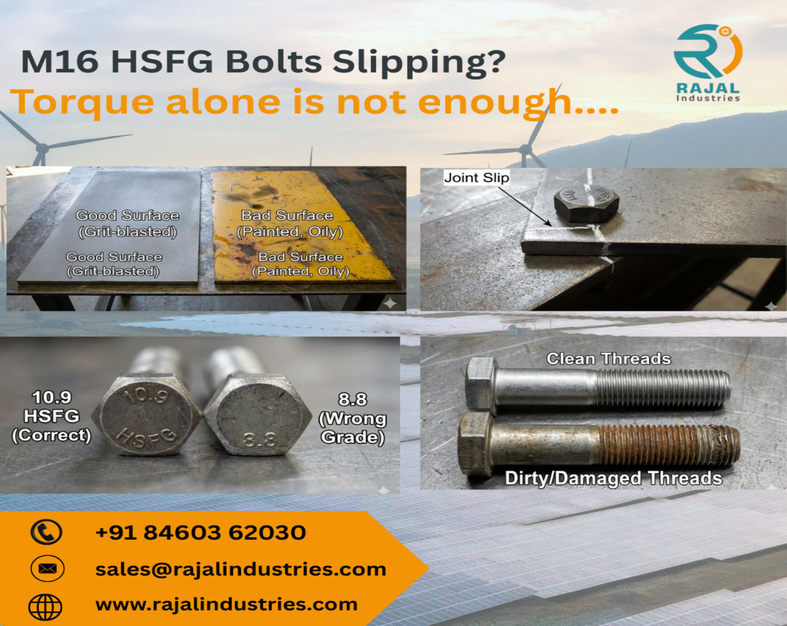
M16 HSFG bolts slipping in PEB joints is more common than people admit
If you’ve worked on prefabricated steel buildings, you’ve likely seen this happen.
The team installs M16 HSFG structural bolts.
Torque wrench shows the correct value.
Inspection signs off.
And yet, during the first load test or wind event, the joint still moves.
This situation — M16 HSFG bolts slipping in PEB joints even after correct torque — is one of the most misunderstood failures in steel construction.
Because HSFG bolts don’t behave like normal bolts.
They don’t rely on shear.
They rely on friction.
And friction depends on more than just tightening.
How HSFG joints are actually supposed to work
High Strength Friction Grip bolts work by:
- Applying high preload
- Compressing steel plates together
- Creating friction between contact surfaces
- Preventing relative movement through friction, not shear
If friction is low, the joint will slip — even if torque is perfect.
That’s the part many sites miss.
Why M16 HSFG bolts slip even after proper torque
Here are the real reasons we see on sites:
1. Surface condition was wrong
If the faying surfaces are:
- Painted
- Oily
- Galvanized
- Rusty
- Dusty
Then friction coefficient drops.
HSFG joints need clean, unpainted, grit-blasted or shot-blasted steel surfaces.
If this is ignored, slip is guaranteed. - 2. Wrong washer or washer orientation
HSFG systems require:
- Proper hardened washers
- Correct placement under nut and bolt head
- No mixing with soft washers
If a normal washer is used instead of a hardened washer, it plastically deforms, preload drops, and friction is lost. - 3. Torque ≠ Preload
Torque is only an indirect indicator. - Preload depends on:
- Thread condition
- Lubrication
- Wax or coating
- Surface roughness
If threads are too rough, too smooth, dirty, or damaged, the torque reading lies.
You hit the number — but you never reached the real clamp force. - 4. Incorrect bolt system
- Common errors:
- Grade 8.8 used instead of 10.9 HSFG
- Wrong nut height
- Mixed suppliers in same joint
- Re-used bolts
Any of these reduce preload reliability.
Typical sizes and specs involved
In PEB and industrial steel:
- M16 × 40 / 45 / 50 mm HSFG bolts
- Grade 10.9
- As per IS 3757 / EN 14399
- With hardened washers
- Installed on grit-blasted steel surfaces
How EPC and fabrication teams can prevent HSFG joint slip
Specify HSFG bolts as a system, not just bolt grade
Demand friction surface preparation, not just torque control
Use calibrated torque or tension tools
Never reuse HSFG bolts
Keep fasteners clean and dry before installation
Why this matters
Slip in a joint is not just a quality issue.
It means:
- Fatigue damage starts early
- Load distribution changes
- Structural safety margin drops
- Audit failures become likely
- Liability shifts to EPC and fabricator
All because friction was assumed instead of verified.
Final thought
HSFG bolts don’t fail loudly. They fail quietly.
By the time someone sees movement, the damage has already started.
Understanding why M16 HSFG bolts slip in PEB joints is not optional anymore — it’s essential.