

Introduction – Real Site Observation
At a 20 MW outdoor BESS installation, anchor bolts appeared intact—but container base frames showed 4–6 mm lateral movement during wind loading.
No bolt breakage.
No visible corrosion.
Yet the system was unstable.
Root cause:
👉 Insufficient embedment depth of M12 wedge anchors
👉 Inadequate load transfer to concrete
👉 Loss of holding strength
This is a common issue in large battery storage systems where anchor bolts are expected to resist wind load, vibration, and long-term structural stress.
In EPC projects, these anchors are installed in production quantities of 50,000–200,000 pcs, where small design errors scale into major structural risks.
Quick Answer
What causes anchor bolt movement in BESS containers?
Anchor bolt movement occurs when embedment depth is insufficient, reducing pull-out strength. This leads to loss of load resistance under wind and vibration forces.
What Is The Anchor Bolt Movement?
Anchor bolt movement is the displacement of embedded fasteners within concrete due to inadequate embedment depth, improper installation, or insufficient load resistance.
5 Reasons Anchor Bolts Move in BESS Systems
- Insufficient embedment depth
- Incorrect anchor type selection
- Poor concrete quality
- High wind load not considered
- Lack of structural washer support
Why Embedment Depth is Critical
Anchor bolts do not rely only on bolt strength.
They depend on:
👉 Concrete grip (bond + friction)
If embedment depth is low:
- Pull-out resistance decreases
- Anchor loosens under load
- Micro-movement begins
- Structural instability develops
Embedment Depth Calculation
For M12 wedge anchor:
Recommended Embedment Depth:
👉 90–110 mm in C25 concrete
Basic Pull-Out Logic
Pull-out capacity depends on:
- Embedment depth
- Concrete strength
- Anchor diameter
Simplified Insight:
Increasing embedment depth:
✔ Increases holding strength
✔ Improves load distribution
✔ Reduces movement risk
Load Condition in BESS Containers
Anchor bolts resist:
- Wind uplift forces
- Lateral movement
- Dead load of container
- Vibration
Real Case Insight
In a 20 MW BESS site:
- Wind load caused repeated stress cycles
- Shallow anchors failed to resist pull-out
- Result: 4–6 mm movement at base frame
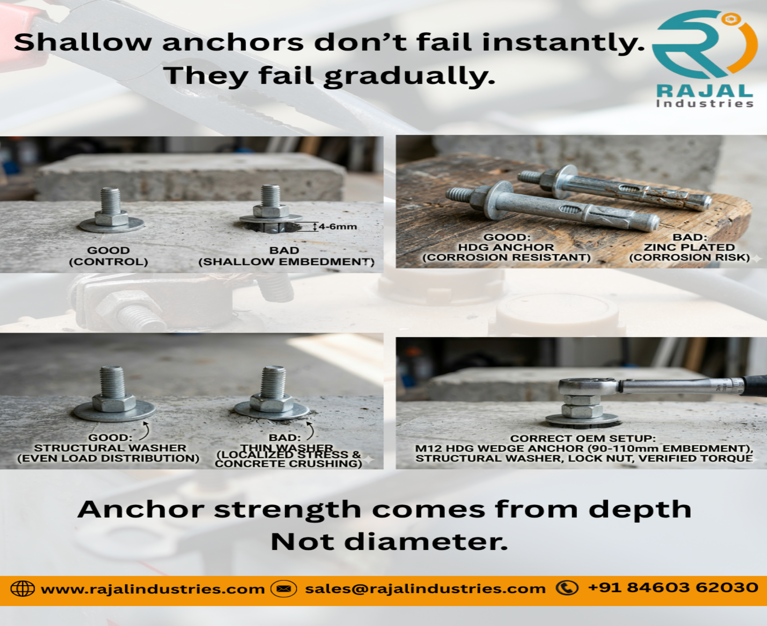
M12 Wedge Anchor vs Improper Installation
| Parameter | Proper Installation | Shallow Embedment |
| Holding Strength | High | Low |
| Movement | Minimal | High |
| Stability | Maintained | Reduced |
Role of HDG Fasteners in Outdoor BESS
Outdoor installations require:
👉 Hot Dip Galvanized (HDG) anchors
Benefits:
✔ Corrosion resistance
✔ Long-term durability
✔ Maintains structural integrity
Role of Structural Washer
- Distribute load evenly
- Prevent bolt head sinking
- Maintain preload
Without washer:
❌ Load concentrates
❌ Movement increases
Correct OEM Anchor Setup
Recommended configuration:
- M12 HDG wedge anchor
- Embedment depth: 90–110 mm
- Structural washer
- Lock nut
- Proper torque application
Typical EPC / OEM Scenario
In large BESS installations:
- Thousands of anchors used per site
- Typical requirement: 50,000–200,000 pcs
- Installation errors repeat across entire system
OEM and EPC companies focus on:
✔ Design accuracy
✔ Installation consistency
✔ Reliable fastener supply
Common Installation Mistakes
- Using shallow drilling depth
- Dust not cleaned before installation
- Incorrect torque application
- Using zinc anchors instead of HDG
👉 These reduce anchor performance significantly
When to Use M12 Wedge Anchors
✔ Standard BESS container installations
✔ Medium load structural anchoring
✔ Outdoor applications (with HDG coating)
When Not to Use
❌ For very heavy loads (consider larger diameter)
❌ Poor quality concrete zones
❌ Temporary installations
Key Takeaways
• Anchor movement is mainly caused by low embedment depth
• M12 anchors require 90–110 mm embedment
• HDG coating is essential for outdoor BESS
• Structural washers improve load stability
• Installation quality directly affects performance
FAQ
Q1: What is the ideal embedment depth for M12 anchor bolts in BESS systems?
Typically 90–110 mm in C25 concrete, depending on load conditions and design requirements.
Q2: Why do anchor bolts move even if they are not broken?
Movement occurs due to insufficient embedment depth or weak concrete grip, not necessarily bolt failure.
Q3: Are wedge anchors suitable for BESS installations?
Yes. M12 wedge anchors are commonly used when properly installed with correct embedment and HDG coating.
Q4: Does embedment depth affect load capacity?
Yes. Greater embedment depth increases pull-out strength and improves stability.
Q5: Why are structural washers required in anchor systems?
They distribute load evenly and prevent localized stress, improving joint stability.
Conclusion
Anchor bolt movement in BESS systems is not a visible failure—but a design and installation issue.
Incorrect embedment depth reduces holding strength and compromises structural stability over time.
In large-scale EPC projects, this becomes a system-wide risk.
👉 We work with OEMs and EPC companies for production-scale fastener supply (MOQ 50,000+ pcs).
Planning a BESS project or facing anchor movement issues?
Share your drawing or production requirement (50,000+ pcs), and our engineering team will recommend the correct anchor system.
References
- ACI 318 – Concrete anchor design
- ASTM A153 – HDG coating standard
- Wind load design guidelines