

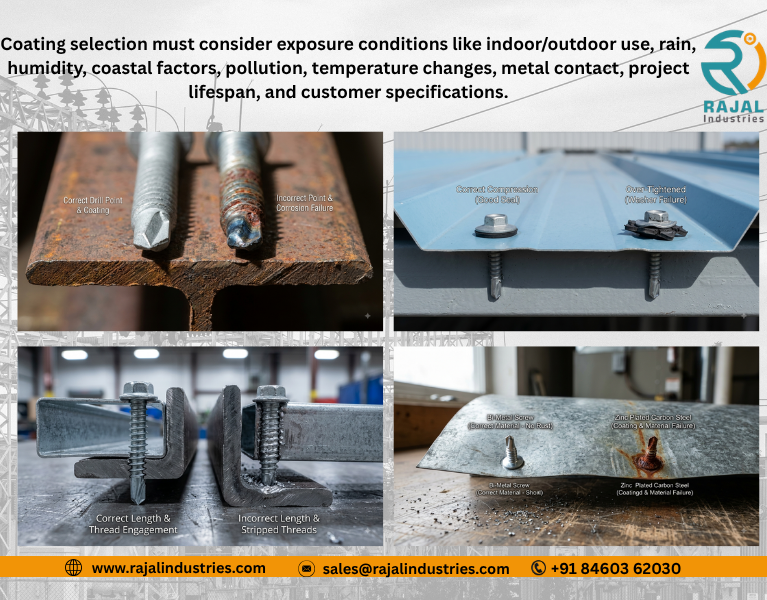
Choosing the correct self drilling screw for roofing or steel construction requires more than checking diameter and length. The fastener must match the base material, drilling thickness, drill-point type, thread design, head style, washer system, corrosion environment and installation method.
A screw that performs well in thin sheet metal may fail in thicker steel. A roofing screw with the wrong washer or coating may create sealing or corrosion problems. In the same way, a screw selected only by price can create much higher costs later through slow installation, broken drill points, rework or maintenance.
For large PEB buildings, warehouses, industrial sheds, roofing projects and steel fabrication, thousands of screws may be installed. This makes consistent drilling performance and reliable quality important for both engineering and procurement teams.
Buyers commonly search for a Tek Screw Guide, Roofing Fasteners, Steel Screws, Self Drilling Screw for Steel, Roofing Screw Size, and How to Select Self Drilling Screws before releasing an RFQ or approving a fastener.
This guide explains the main technical points buyers should evaluate before selecting self-drilling fasteners for steel construction and roofing applications.
Quick Answer
Before choosing a self drilling screw, confirm:
- Application
- Base material
- Material grade
- Individual material thickness
- Total drilling thickness
- Screw diameter
- Screw length
- Drill point
- Thread engagement
- Head style
- Washer requirement
- Material
- Heat treatment
- Surface coating
- Corrosion requirement
- Installation tool
The screw should be selected as part of the complete joint, not as an isolated component.
Why Correct Screw Selection Matters
Poor selection can result in:
- Slow drilling
- Drill-point failure
- Screw breakage
- Stripped threads
- Inadequate clamping
- Roofing sheet damage
- Washer failure
- Water leakage
- Corrosion
- Site delays
For high-volume projects, even a small installation problem can become expensive when repeated across thousands of fastening points.
Correct selection helps improve:
- Installation speed
- Joint reliability
- Roofing performance
- Production consistency
- Service life
- Project efficiency
Industries That Commonly Use Self Drilling Screws
Self-drilling fasteners are widely used in:
- PEB Buildings
- Industrial Roofing
- Steel Fabrication
- Warehouses
- Factory Buildings
- Solar Equipment
- HVAC Systems
- Cladding Systems
- Modular Buildings
- Cold Storage
- Telecom Equipment
- BESS Enclosures
- Industrial Machinery
- Electrical Enclosures
- Infrastructure Projects
The exact fastener specification varies according to material thickness, exposure and required joint performance.
Step 1 – Identify the Exact Application
First determine where the fastener will be used.
Typical applications include:
- Metal Roofing
- Wall Cladding
- PEB Secondary Assemblies
- Steel Fabrication
- Light-Gauge Steel
- Equipment Housings
- Industrial Enclosures
- HVAC Assemblies
The application helps determine the required:
- Head style
- Washer
- Drill point
- Coating
- Material
Step 2 – Identify the Base Material
Confirm what the screw must drill through.
Common materials include:
- Mild Steel
- Galvanized Steel
- Coated Steel
- Stainless Steel
- Aluminium
- Light-Gauge Steel
The material grade and hardness affect drilling performance.
A screw suitable for mild steel should not automatically be assumed suitable for stainless steel or another harder substrate.
Step 3 – Calculate Total Drilling Thickness
This is one of the most important selection steps.
Suppose the joint contains:
- 0.8 mm roofing sheet
- 3.0 mm supporting steel
The screw must successfully penetrate the total material stack before proper thread engagement develops.
Always provide:
- First material thickness
- Supporting material thickness
- Total drilling thickness
This information is critical when selecting the drill point.
Step 4 – Select the Correct Drill Point
Different drill-point geometries are intended for different material thicknesses and applications.
Depending on the screw system, buyers may encounter point designations such as:
- #1
- #2
- #3
- #4
- #5
The exact drilling capacity varies by manufacturer and product design.
A buyer should never assume:
Point #3 = same drilling capacity from every supplier.
The manufacturer’s technical data and actual application testing should be checked.
Why Drill Point Selection Is Critical
An underspecified drill point may cause:
- Slow penetration
- Excessive heat
- Burnt points
- Screw breakage
- Tool wear
- Installation delays
An unnecessarily aggressive or unsuitable point can also create poor thread engagement or installation issues.
The point should be matched to the actual substrate.
Step 5 – Select the Correct Screw Diameter
Diameter influences:
- Holding strength
- Thread engagement
- Head size
- Drilling performance
- Installation torque
Common nominal diameters can include:
- 3.5 mm
- 4.2 mm
- 4.8 mm
- 5.5 mm
- 6.3 mm
The final selection should follow the engineering requirement and validated application.
Step 6 – Select the Correct Screw Length
Length should provide sufficient thread engagement after drilling through the material stack.
Check:
- Total joint thickness
- Drill-point length
- Washer thickness
- Required thread engagement
- Clearance behind the assembly
A screw that is too short may provide insufficient engagement.
A screw that is too long can create unnecessary protrusion or interfere with nearby components.
Step 7 – Choose the Correct Head Style
Common head styles include:
- Hex Washer Head
- Pan Head
- Countersunk Head
- Wafer Head
- Truss Head
Hex Washer Head
Commonly used for:
- Roofing
- PEB
- Cladding
- Steel Fabrication
It provides an external hex drive and broad bearing surface.
Pan Head
Often used for:
- Electrical Enclosures
- Industrial Equipment
- Sheet-Metal Assemblies
Countersunk Head
Selected where a flush surface is required.
Wafer Head
Common in suitable light-gauge steel applications where a low-profile head is preferred.
Step 8 – Select the Correct Washer for Roofing
For roofing applications, the washer system is a critical part of the fastener.
A typical roofing assembly may include:
- Self drilling screw
- Metal washer
- EPDM sealing element
The washer helps:
- Distribute load
- Compress against the roofing sheet
- Support weather sealing
Buyer specifications should define:
- Washer diameter
- Washer material
- EPDM requirement
- Compression requirements
- Corrosion resistance
Why EPDM Quality Matters
Poor washer quality can lead to:
- Premature deterioration
- Water ingress
- Uneven compression
- Poor sealing
- Higher maintenance
For this reason, roofing screws should be evaluated as a complete screw-and-washer system.
Step 9 – Select the Screw Material
Common material choices can include:
| Material | Typical Application |
| Hardenable Carbon Steel | Roofing, PEB, steel fabrication |
| Stainless Steel | Corrosion-resistant applications |
| Bi-Metal Construction | Demanding outdoor projects |
| Custom Material | Drawing-specific requirements |
The correct material must provide both:
- Suitable drilling performance
- Suitable service-life performance
Hardened Carbon Steel Screws
Carbon steel is widely used because it can be heat-treated to provide suitable drill-point hardness.
Typical applications include:
- Roofing
- PEB
- Steel Fabrication
- HVAC
- Industrial Sheet Metal
Heat treatment must be controlled because both drill-point performance and screw strength depend on it.
Stainless Steel Screws
Stainless steel may be preferred where corrosion resistance is more important.
Common considerations include:
- SS304 / A2
- SS316 / A4
Potential applications include:
- Coastal Projects
- Solar Equipment
- Outdoor Enclosures
- Facades
- Humid Environments
However, stainless steel selection should also consider drilling capability.
Bi-Metal Self-Drilling Screws
Bi-metal designs can combine:
- Stainless steel body
- Hardened drilling section
This can help balance:
- Corrosion resistance
- Drilling performance
Possible applications include:
- Solar Projects
- Coastal Roofing
- Facades
- Outdoor Industrial Equipment
Step 10 – Choose the Correct Surface Coating
The coating should match:
- Indoor or outdoor use
- Rain exposure
- Humidity
- Coastal environment
- Industrial pollution
- Project life
- Customer specification
Common options may include:
- Zinc Plating
- Zinc-Nickel
- Zinc Flake
- Other Project-Specified Coatings
For long-life outdoor projects, the required corrosion performance should be clearly defined rather than using only a coating name.
Step 11 – Consider the Installation Tool
Installation performance also depends on:
- Tool type
- RPM
- Applied pressure
- Drive engagement
- Operator technique
A technically correct screw can still perform poorly if installed with the wrong tool or incorrect speed.
For high-volume projects, test the fastener with the actual or representative installation equipment.
Step 12 – Check Structural vs Non-Structural Use
This distinction is critical.
Self-drilling fasteners are commonly used for:
- Roofing
- Cladding
- Light-Gauge Steel
- Secondary Assemblies
- Sheet-Metal Components
They should not automatically replace engineered structural bolts in primary load-bearing connections.
Always follow the approved engineering drawing.
How to Select Roofing Fasteners
For roofing projects, focus on:
- Roofing sheet material
- Supporting steel thickness
- Drill capacity
- Head style
- EPDM washer
- Corrosion protection
- Installation torque
- Weather exposure
The roofing fastener should provide both mechanical fastening and proper sealing where required.
How to Select Steel Screws for Fabrication
For steel fabrication, focus on:
- Material grade
- Total drilling thickness
- Drill point
- Screw diameter
- Thread engagement
- Heat treatment
- Installation speed
- Required strength
For repetitive fabrication, functional drilling trials before mass use can save significant time later.
Tek Screw Guide: What Buyers Should Really Specify
A useful Tek Screw Guide should not stop at size.
A complete specification should include:
- Diameter
- Length
- Drill point
- Drilling range
- Thread
- Head
- Drive
- Washer
- Material
- Heat treatment
- Coating
- Corrosion requirement
- Base material
- Material thickness
- Quantity
This gives the manufacturer enough information to evaluate the requirement properly.
Roofing vs Steel Construction: Selection Comparison
Although both applications use a self drilling screw, their technical priorities can be different.
| Selection Factor | Roofing Projects | Steel Construction |
| Main Priority | Sealing + corrosion + fastening | Drilling + thread engagement |
| Typical Material | Profile/coated sheet + steel support | Steel sheet / light-gauge steel |
| Drill Point | Based on total thickness | Based on steel grade & thickness |
| Washer | Often required | Application dependent |
| EPDM Seal | Common | Usually application dependent |
| Corrosion Protection | Very important | Depends on environment |
| Installation Speed | Very important | Very important |
| Thread Engagement | Important | Critical |
| Structural Use | Design dependent | Design dependent |
| Outdoor Exposure | Common | Indoor or outdoor |
The final selection should always follow the approved project drawing and fastening specification.
Step 13 – Define the Corrosion Requirement
Corrosion protection should be selected according to the actual service environment.
Before specifying a coating, consider:
- Indoor or outdoor use
- Rain exposure
- Humidity
- Coastal conditions
- Industrial pollution
- Temperature changes
- Contact with dissimilar metals
- Required project life
- Customer specifications
A screw used inside a factory may require very different corrosion protection from a roofing fastener installed near the coast.
Zinc Plated Self-Drilling Screws
Zinc plating is commonly considered for:
- Indoor Industrial Equipment
- Protected Steel Assemblies
- HVAC Equipment
- Electrical Enclosures
- General Sheet-Metal Applications
Advantages include:
- Economical
- Widely available
- Suitable for many protected applications
- Clean appearance
For exposed roofing or long-life outdoor structures, buyers should confirm whether the specified zinc system provides sufficient corrosion resistance.
Zinc-Nickel Coated Screws
Zinc-nickel may be considered where greater corrosion protection is required.
Possible applications include:
- Outdoor Industrial Equipment
- Solar Equipment
- Telecom Enclosures
- High-Humidity Environments
- Certain Steel Construction Applications
The required coating thickness and corrosion performance should be clearly defined in the specification.
Zinc Flake Coated Screws
Zinc flake systems may be considered for demanding outdoor applications such as:
- PEB Buildings
- Industrial Roofing
- Solar Equipment
- Outdoor Steel Assemblies
- Infrastructure Equipment
Potential advantages include:
- Strong corrosion protection
- Relatively low coating thickness
- Suitability for many industrial environments
Buyers should specify the required coating system and test performance instead of using only a general description such as “high corrosion coating.”
Stainless Steel & Bi-Metal Options
Stainless steel can be considered where corrosion resistance is a major requirement.
Common grades include:
- SS304 / A2
- SS316 / A4
However, drilling performance must also be considered.
For demanding applications, a bi-metal design may combine:
- Corrosion-resistant stainless steel body
- Hardened drilling section
This approach can be useful where both drilling performance and corrosion resistance are required.
Step 14 – Define Salt Spray Requirements Correctly
Buyers often specify salt spray hours when sourcing roofing fasteners.
A proper requirement should define:
- Test standard
- Test duration
- Coating system
- White corrosion acceptance criteria, where relevant
- Red rust acceptance criteria
- Inspection method
Do not simply write:
1,000 hours salt spray required
without defining the applicable test method and acceptance criteria.
Also, laboratory salt spray hours should not be directly converted into a specific number of years of real outdoor service life.
Step 15 – Control Roofing Washer Compression
For roofing applications, installation torque affects both fastening and sealing.
Over-Tightening
Excessive tightening can cause:
- EPDM over-compression
- Washer deformation
- Roofing sheet deformation
- Thread damage
- Reduced sealing performance
Under-Tightening
Insufficient tightening can cause:
- Poor clamping
- Inadequate washer compression
- Movement
- Potential water entry
The objective is controlled installation rather than simply applying maximum torque.
Why Installation RPM Matters
Self-drilling performance can be affected by installation speed.
The correct RPM depends on factors such as:
- Screw diameter
- Drill point
- Steel thickness
- Material hardness
- Installation tool
- Manufacturer recommendations
Incorrect speed can increase:
- Heat generation
- Point wear
- Drilling time
- Tool wear
- Fastener failure
For large projects, installation trials should be completed using the actual or representative steel and installation tools.
Drilling Torque vs Tightening Torque
These are different stages of installation.
Drilling Stage
The point penetrates the steel.
Threading Stage
The threads engage the material.
Seating Stage
The screw head or washer contacts the assembly and develops clamp.
Problems can occur at any of these stages.
For example:
- Poor drill point → slow penetration
- Poor thread engagement → stripping
- Excessive final tightening → washer or thread damage
This is why functional testing is valuable for high-volume projects.
Self-Drilling Screw vs Self-Tapping Screw
A common buyer question is whether these fasteners are interchangeable.
| Feature | Self-Drilling Screw | Self-Tapping Screw |
| Integral Drill Point | Yes | Not necessarily |
| Creates Hole | Yes, within rated capacity | Usually needs prepared hole |
| Creates Mating Thread | Yes | Yes |
| Roofing | Very Common | Application dependent |
| Steel Construction | Common | Common for suitable prepared holes |
| Separate Drilling | Usually Eliminated | Often Required |
| Installation Speed | High | Depends on preparation |
A self drilling screw is normally preferred when drilling and fastening need to happen during one installation operation.
Self-Drilling Screw vs Structural Bolt
These fasteners should not be treated as direct alternatives.
| Feature | Self-Drilling Screw | Structural Bolt |
| Drills Its Own Hole | Yes, within rated capacity | No |
| Roofing & Cladding | Very Common | Limited |
| Light-Gauge Steel | Common | Application dependent |
| Primary Structural Joint | Not automatically suitable | Common |
| Nut Required | No | Usually |
| Installation Speed | Fast | Joint dependent |
| High-Load Connections | Design dependent | Commonly engineered for these |
A roofing or general-purpose steel screw should never replace a structural bolt simply because it is faster to install.
The engineered connection design should determine the correct fastening system.
Common Engineering Mistakes
1. Selecting by Diameter and Length Only
A specification such as:
5.5 × 25 mm
does not tell the manufacturer enough.
Also define:
- Drill point
- Drilling thickness
- Material
- Head
- Washer
- Coating
- Application
2. Ignoring Total Drilling Thickness
One of the most important mistakes is failing to tell the supplier what the screw must actually drill.
For example:
0.8 mm sheet + 4.0 mm steel support
is much more useful than simply saying:
“For roofing.”
3. Selecting the Wrong Drill Point
A point designed for thinner material can result in:
- Slow drilling
- Excessive heat
- Point damage
- Screw breakage
- Installation delays
Always verify the manufacturer’s drilling range.
4. Ignoring Thread Engagement
The screw needs sufficient usable thread engagement after the drill point has passed through the material.
A long drill point combined with an incorrectly selected screw length can reduce effective thread engagement.
5. Ignoring Roofing Washer Quality
For roofing, the washer is not simply an accessory.
Poor washer quality or incorrect compression can affect long-term sealing performance.
6. Selecting Coating Only by Appearance
A bright finish does not tell you how a screw will perform outdoors.
Specify measurable corrosion requirements.
7. Assuming All Tek Screws Are the Same
“Tek screw” is a broad market term.
Two screws with similar dimensions can differ in:
- Drill-point geometry
- Material
- Hardness
- Heat treatment
- Coating
- Washer
- Drilling performance
Compare the complete technical specification.
Common Procurement Mistakes
Buying Only on Lowest Unit Price
Suppose a project requires 500,000 roofing screws.
A small price difference per screw may look attractive, but poor drilling performance can increase:
- Installation labour
- Tool wear
- Rejections
- Rework
- Site delays
- Maintenance
For bulk requirements, procurement should evaluate total installed performance, not only unit price.
Not Providing Application Information
Tell the supplier whether the fastener is for:
- Roofing
- PEB
- Cladding
- Steel Fabrication
- Solar
- HVAC
- Industrial Equipment
This helps prevent incorrect recommendations.
Not Providing Annual Consumption
For OEM and repeat project buyers, provide:
- Immediate quantity
- Annual consumption
- Delivery frequency
- Expected project schedule
This helps manufacturers evaluate production planning, tooling, raw material and pricing.
Quality Inspection Checklist
A self-drilling screw inspection plan may include:
| Inspection Item | Check |
| Drawing / Standard Compliance | ✓ |
| Diameter | ✓ |
| Length | ✓ |
| Thread Geometry | ✓ |
| Thread Pitch | ✓ |
| Drill-Point Geometry | ✓ |
| Drill-Point Length | ✓ |
| Head Dimensions | ✓ |
| Drive Dimensions | ✓ |
| Washer Dimensions | ✓ |
| EPDM Requirement | ✓ |
| Material | ✓ |
| Hardness | ✓ |
| Heat Treatment | ✓ |
| Surface Coating | ✓ |
| Coating Thickness | ✓ |
| Visual Condition | ✓ |
| Functional Drilling Test | ✓ |
| Installation Test | ✓ |
| Batch Traceability | ✓ |
| Required Certificates | ✓ |
For roofing projects, washer and sealing-related requirements should also be checked according to the approved specification.
OEM & Project RFQ Checklist
When requesting a quotation for self drilling screws, provide:
☐ Application
☐ Screw Diameter
☐ Screw Length
☐ Thread Specification
☐ Drill-Point Type
☐ Required Drilling Capacity
☐ Head Style
☐ Drive Type
☐ Washer Diameter
☐ EPDM Requirement
☐ Screw Material
☐ Heat Treatment Requirement
☐ Surface Coating
☐ Coating Thickness
☐ Corrosion Requirement
☐ Base Material
☐ Material Grade
☐ Individual Material Thickness
☐ Total Drilling Thickness
☐ Quantity per Order
☐ Annual Consumption
☐ Engineering Drawing
☐ Applicable Standard
☐ Inspection Requirements
☐ Testing Requirements
☐ Packaging
☐ Delivery Schedule
A detailed RFQ helps manufacturers quote the correct product the first time.
What Should Buyers Ask a Self-Drilling Screw Manufacturer?
Before approving a bulk supplier, ask:
- What drilling thickness is this screw designed for?
- Which drill point do you recommend for our steel?
- What screw material is used?
- How is heat treatment controlled?
- Is drill-point hardness tested?
- Do you perform functional drilling tests?
- Can testing be performed on our actual steel thickness?
- What coating options are available?
- Can you meet our corrosion specification?
- Can you supply EPDM washer assemblies?
- Can you manufacture according to our drawing?
- What inspection reports are available?
- Is batch traceability available?
- What is the MOQ?
- What is your monthly production capacity?
- Can you support scheduled repeat deliveries?
These questions are particularly useful for OEMs, PEB manufacturers, roofing companies and large project buyers.
Why Rajal Industries for Bulk Self-Drilling Screws?
Rajal Industries manufactures industrial fasteners for bulk OEM and project requirements.
Depending on the approved specification and manufacturing feasibility, requirements can include:
- Standard Self-Drilling Screws
- Custom Drawing-Based Screws
- Roofing Fasteners
- PEB Screws
- Industrial Steel Screws
- Sheet-Metal Fasteners
- Bulk OEM Production
- Cold Forming
- Thread Rolling
- Controlled Heat Treatment
- Surface Finishing
- Dimensional Inspection
- Mechanical Testing as Specified
- Functional Drilling Evaluation
- Batch Traceability
- OEM Packaging
- Export Supply Support
Target customers include:
- PEB Manufacturers
- Roofing Companies
- Steel Fabricators
- Solar EPC Companies
- Industrial OEMs
- HVAC Manufacturers
- Electrical Equipment Manufacturers
- Telecom Equipment Manufacturers
- Renewable Energy Equipment Companies
Final manufacturability should be confirmed against the drawing, material, drilling requirement, coating, testing requirements and production volume.
Frequently Asked Questions
How do I select the correct self drilling screw?
Start with the base material, material grade and total drilling thickness. Then select the drill point, diameter, length, thread engagement, head, washer, material and corrosion protection.
How do I choose a Tek screw for steel?
Determine the actual steel thickness and grade first. Then select a screw with a validated drill point and drilling capacity suitable for that material.
Which self drilling screw is best for roofing?
There is no single screw suitable for every roof. The correct roofing fastener depends on the roofing sheet, supporting steel thickness, drill capacity, washer system, environment and project specification.
How do I calculate the required drilling thickness?
Add the thickness of the material layers the drill point must penetrate. Also provide the individual material thicknesses and grades to the supplier.
Do roofing screws need EPDM washers?
Many exposed metal roofing systems use a suitable sealing washer, often incorporating EPDM. The exact requirement should follow the roofing-system specification.
Can self drilling screws drill thick steel?
Some designs can drill thicker steel than others. The screw’s validated drilling range must be checked rather than assuming capability from diameter alone.
Which coating is suitable for outdoor steel construction?
The correct coating depends on humidity, rain, coastal exposure, industrial atmosphere, expected service life and project specifications. Zinc-nickel, zinc-flake and other systems may be considered depending on these requirements.
Are stainless steel self drilling screws better?
They can offer stronger corrosion resistance, but drilling capability must also be considered. For some applications, engineered stainless or bi-metal designs may be more suitable.
What is the difference between a self drilling screw and a self tapping screw?
A self-drilling screw incorporates a drill point that creates the hole during installation. A self-tapping screw forms or cuts a mating thread but may require a prepared hole.
Can self drilling screws replace structural bolts?
Not automatically. Primary structural connections should use the fastening system specified by the structural design.
What information should I send to a manufacturer for a quotation?
Provide size, drill point, base material, material thickness, head, washer, material, coating, corrosion requirement, quantity, drawing and application information.
Can custom self drilling screws be manufactured?
Yes. Custom designs can be evaluated for bulk production based on the drawing, dimensions, drill-point requirements, materials, coatings, testing and expected volume.
Key Takeaways
- Select a self drilling screw according to the complete joint, not only diameter and length.
- Base material grade and total drilling thickness should be confirmed first.
- Drill-point selection directly affects installation speed and reliability.
- Roofing fasteners require careful washer and sealing consideration.
- Corrosion protection should match the actual project environment.
- Thread engagement must be considered together with drill-point length.
- Tek screws should not automatically replace structural bolts.
- Functional drilling tests are valuable before high-volume installation.
- OEM and project buyers should send complete technical information with the RFQ.
Conclusion
Choosing the correct self drilling screw for steel construction and roofing requires a systematic approach.
Start with the base material and total drilling thickness, then determine the appropriate drill point, diameter, length, thread engagement, head style, washer system, material, heat treatment and corrosion protection.
For roofing projects, sealing and washer performance deserve special attention. For steel construction, drilling capacity and thread engagement become major technical considerations.
For high-volume projects, sample testing with the actual steel and installation equipment can help identify problems before thousands of fasteners reach the site.
Rajal Industries can evaluate standard and custom self-drilling screw requirements for bulk OEM and project applications based on customer drawings, technical specifications, drilling conditions and production quantities.