

Finding the right chipboard screw manufacturer is important for furniture companies, modular furniture manufacturers, cabinet makers and woodworking OEMs that use screws in large production volumes.
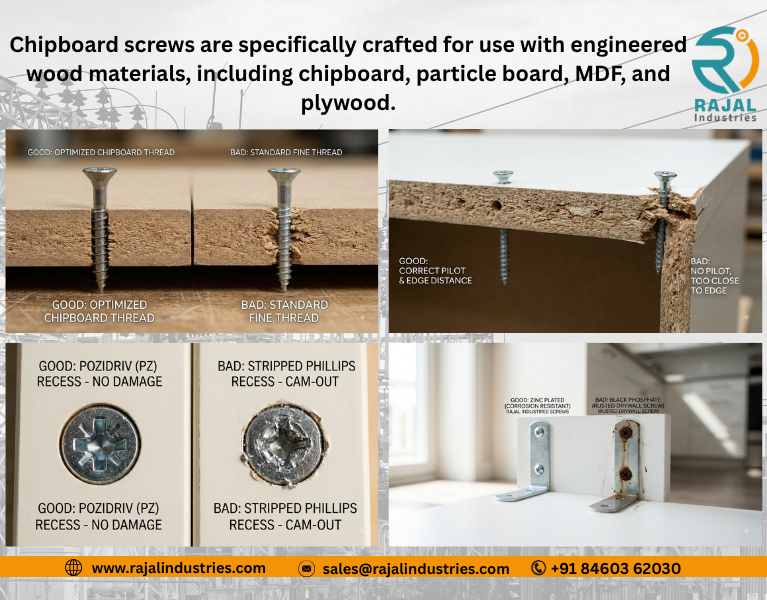
Chipboard screws are designed for fastening into engineered wood and suitable wood-based materials. Their thread geometry and point design help the screw enter the material and develop holding strength while reducing installation problems when the correct screw is selected.
They are commonly used with:
- Chipboard
- Particle Board
- MDF
- Plywood
- Softwood
- Furniture Components
- Cabinet Assemblies
- Modular Furniture
For OEM buyers, however, selecting a screw only by diameter and length is not enough.
Procurement and engineering teams should also consider thread design, point geometry, head style, drive type, screw material, heat treatment, coating, board thickness, pilot-hole requirements and required holding performance.
Rajal Industries manufactures industrial fasteners for bulk and drawing-based OEM requirements, subject to technical and manufacturing feasibility.
Quick Answer: What Is a Chipboard Screw?
A chipboard screw is a threaded fastener commonly designed for joining chipboard, particle board, MDF and other suitable wood-based materials.
Typical features can include:
- Sharp point
- Deep thread profile
- Relatively thin shank
- Countersunk or other application-specific head
- Suitable drive system
- Hardened steel construction
These features can help provide efficient installation and reliable engagement in suitable wood-based substrates.
Common applications include:
- Furniture Manufacturing
- Modular Furniture
- Cabinets
- Kitchen Furniture
- Office Furniture
- Shelving
- Wooden Fixtures
- Interior Products
- Woodworking Assemblies
The exact screw should be selected according to the board material, thickness and joint design.
Why Furniture Manufacturers Use Chipboard Screws
Modern furniture manufacturing uses large quantities of engineered wood products.
These may include:
- MDF
- Particle Board
- Laminated Board
- Plywood
- Chipboard
- Other Engineered Wood Panels
Standard general-purpose screws may not always provide the required installation behaviour in these materials.
A correctly selected chipboard screw can offer:
- Good thread engagement
- Efficient installation
- Strong holding in suitable board
- Reduced installation time
- Consistent assembly
- Compatibility with powered screwdrivers
- Suitability for repetitive furniture production
For factories producing thousands of furniture assemblies every month, screw consistency can directly affect production efficiency.
Chipboard Screw vs Regular Wood Screw
Buyers often search for both chipboard screws and wood screws, but they should not automatically be treated as identical.
| Feature | Chipboard Screw | Traditional Wood Screw |
| Main Application | Engineered wood / furniture board | Solid wood and general woodworking |
| Thread | Often deeper / optimized for board | Depends on design |
| Point | Usually sharp | Usually pointed |
| Shank | Often relatively slim | Design dependent |
| MDF / Particle Board | Common | Application dependent |
| Furniture Production | Very Common | Common |
| Powered Assembly | Common | Common |
| Head Style | Often Countersunk | Multiple options |
The actual performance depends on the screw design and material being fastened.
Chipboard Screw vs Drywall Screw
This is another common buying question.
A drywall screw may look similar to some furniture screws, but it is designed primarily for drywall-related fastening applications.
| Feature | Chipboard Screw | Drywall Screw |
| Main Purpose | Wood-based boards & furniture | Drywall installation |
| Furniture Assembly | Designed for suitable applications | Not automatically suitable |
| MDF / Particle Board | Common | Not the primary intended use |
| Thread Design | Board/application specific | Drywall/application specific |
| Selection Basis | Furniture joint requirement | Drywall system requirement |
For furniture production, use a screw designed and validated for the actual wood-based material rather than choosing another screw only because it looks similar.
Major Industries Using Chipboard Screws
The main target industries include:
- Furniture Manufacturing
- Modular Furniture
- Kitchen Furniture
- Office Furniture
- Cabinet Manufacturing
- Wardrobe Manufacturing
- MDF Product Manufacturing
- Particle Board Products
- Plywood Products
- Interior Fit-Out
- Retail Fixtures
- Display Systems
- Wooden Packaging
- Woodworking OEMs
- Prefabricated Furniture
These industries can consume large quantities of standardized screws, making them strong target markets for bulk fastener manufacturers.
Chipboard Screws for Furniture Manufacturing
Furniture screws are used across many types of furniture assemblies.
Possible applications include:
- Tables
- Chairs
- Beds
- Cabinets
- Storage Units
- Shelving
- Desks
- Wardrobes
- Drawers
- Wooden Frames
For mass furniture production, manufacturers typically need:
- Consistent dimensions
- Reliable drive engagement
- Controlled head geometry
- Good thread quality
- Repeatable installation
- Suitable surface finish
- Reliable batch supply
A small screw problem can become a major production issue when hundreds of thousands of fasteners are used every month.
Chipboard Screws for Modular Furniture
Modular furniture manufacturing is particularly suitable for standardized fastener sourcing because components are produced repeatedly in controlled dimensions.
Chipboard fasteners may be used in:
- Modular Kitchens
- Wardrobes
- Storage Systems
- Office Furniture
- Cabinets
- Shelving Systems
- Residential Furniture
For automated or semi-automated furniture assembly, dimensional consistency becomes especially important.
Chipboard Screws for MDF
MDF is widely used in furniture and interior products because of its smooth and consistent surface.
However, MDF fastening requires careful screw selection.
Important factors include:
- Board thickness
- Screw diameter
- Screw length
- Thread design
- Edge distance
- Pilot-hole requirement
- Installation torque
Incorrect screw selection or installation can contribute to:
- Board splitting
- Edge damage
- Thread stripping
- Poor holding
- Head over-driving
For critical joints, the furniture manufacturer should validate the screw using the actual MDF grade and thickness.
Chipboard Screws for Particle Board
Particle board is another major engineered wood material used in furniture.
Typical applications include:
- Cabinets
- Shelving
- Wardrobes
- Tables
- Office Furniture
- Storage Furniture
For particle board, buyers should focus on:
- Thread engagement
- Point geometry
- Screw diameter
- Length
- Board density
- Edge distance
- Installation torque
The screw must provide sufficient holding without unnecessarily damaging the surrounding board material.
Chipboard Screws for Plywood
Chipboard screws may also be considered for suitable plywood applications.
Possible uses include:
- Furniture
- Cabinets
- Wooden Fixtures
- Interior Assemblies
- Shelving
- Light Wooden Structures
Plywood behaves differently from MDF and particle board because it consists of multiple wood veneers.
The fastener should therefore be tested in the actual plywood specification rather than assuming identical performance across all wood-based materials.
Chipboard Screws for Kitchen Furniture
Kitchen furniture can require large quantities of screws for:
- Base Cabinets
- Wall Cabinets
- Shelves
- Drawers
- Internal Frames
- Storage Units
- Modular Components
Important buyer requirements may include:
- Consistent screw dimensions
- Clean countersinking
- Reliable drive engagement
- Suitable corrosion protection
- Good appearance
- Repeat supply quality
Where moisture exposure is possible, the surface finish should also be selected accordingly.
Chipboard Screws for Office Furniture
Office furniture manufacturers may use these fasteners for:
- Desks
- Workstations
- Cabinets
- Storage Units
- Shelving
- Partitions
- Drawer Systems
For high-volume production, fasteners should support efficient powered installation and repeatable assembly.
Chipboard Screws for Cabinets & Wardrobes
Cabinet and wardrobe manufacturing often involves fastening near board edges.
This makes the following factors important:
- Screw diameter
- Thread geometry
- Pilot hole
- Edge distance
- Installation torque
- Board density
Incorrect selection can increase the risk of board damage.
Common Chipboard Screw Sizes
Chipboard screws are available in many diameter and length combinations.
Common nominal diameters may include sizes around:
- 3.0 mm
- 3.5 mm
- 4.0 mm
- 4.5 mm
- 5.0 mm
- 6.0 mm
Lengths can vary widely according to the application.
Common combinations in the market may include sizes such as:
| Diameter | Example Lengths |
| 3.0 mm | 12, 16, 20, 25, 30 mm |
| 3.5 mm | 16, 20, 25, 30, 35, 40 mm |
| 4.0 mm | 20, 25, 30, 35, 40, 50 mm |
| 4.5 mm | 30, 35, 40, 50, 60 mm |
| 5.0 mm | 30, 40, 50, 60, 70 mm |
| 6.0 mm | Application dependent |
Important: These are common market examples, not a universal dimensional standard. Final sizes should follow the approved drawing, applicable standard or manufacturer specification.
How to Select Chipboard Screw Length
The correct length depends on:
- Thickness of the first component
- Thickness of the receiving board
- Required thread engagement
- Joint design
- Clearance behind the assembly
A screw that is too short may provide insufficient holding.
A screw that is too long may:
- Break through the opposite surface
- Damage finished furniture
- Interfere with another component
- Create a safety issue
For furniture production, screw length should be confirmed during product development rather than changed during mass assembly.
Why Thread Design Matters
Thread design is one of the most important parts of a chipboard screw.
The thread affects:
- Material engagement
- Driving behaviour
- Pull-out resistance
- Installation torque
- Board damage
Important thread parameters can include:
- Thread pitch
- Thread depth
- Major diameter
- Minor diameter
- Thread angle
- Thread length
Different board materials may respond differently to the same thread geometry.
Coarse Thread Chipboard Screws
A relatively coarse and deep thread is commonly used for many engineered wood applications.
It can help the screw engage the wood-based substrate efficiently.
Applications may include:
- Chipboard
- Particle Board
- MDF
- Softwood
- Furniture Boards
However, the exact thread design should match the material and joint requirements.
Full Thread vs Partial Thread Chipboard Screws
Fully Threaded Screws
Threads extend along most of the usable shank.
They can be suitable for many general furniture and board applications.
Partially Threaded Screws
A portion beneath the head may remain unthreaded.
Depending on the joint design, this can help pull one component toward another during tightening.
The correct option depends on the assembly.
Common Head Types
Countersunk Head
One of the most common head styles for furniture screws.
The head can sit flush with or below the material surface when the joint is correctly designed.
Applications include:
- Cabinets
- Furniture
- Shelves
- MDF Assemblies
- Particle Board Assemblies
Pan Head
Pan heads may be used where a flush finish is not required.
Possible applications include:
- Hardware Attachment
- Brackets
- Furniture Components
- Industrial Wood Assemblies
Raised or Application-Specific Heads
Special head designs may be used for particular furniture fittings or OEM applications.
Custom head dimensions can also be evaluated against customer drawings where manufacturing feasibility allows.
Common Drive Types
Chipboard screws may use:
- Phillips
- Pozidriv
- Torx
- Hex Socket
- Other Application-Specific Drives
Drive selection affects:
- Torque transfer
- Bit engagement
- Cam-out
- Assembly speed
- Automation
- Operator productivity
For high-volume furniture production, drive consistency is especially important.
Phillips Drive
Phillips is widely recognized and commonly used.
Advantages can include:
- Easy tool availability
- Familiar installation
- Broad market acceptance
However, high-torque applications may require careful control to reduce cam-out.
Pozidriv Drive
Pozidriv is commonly found in furniture and woodworking applications in some markets.
It can provide improved tool engagement compared with certain conventional cross-drive applications when the correct bit is used.
Using the wrong driver bit can damage the recess.
Torx Drive
Torx drives can provide strong tool engagement and efficient torque transfer.
Potential advantages include:
- Reduced cam-out
- Good power-tool engagement
- Consistent installation
- Suitability for high-volume assembly
This can make Torx attractive for industrial furniture production.
Materials Used for Chipboard Screws
Common material choices can include:
Carbon Steel
Widely used for general furniture and woodworking screws.
Advantages include:
- Good manufacturing suitability
- Heat-treatment capability
- Economical bulk production
- Wide coating options
Stainless Steel
May be considered where greater corrosion resistance is required.
Possible applications include:
- Moisture-prone furniture
- Outdoor wood products
- Certain kitchen applications
- Specialized interior applications
The material should be selected according to both mechanical and environmental requirements.
Why Heat Treatment Matters
Carbon steel chipboard screws may require controlled heat treatment to achieve the required installation performance.
Heat treatment can affect:
- Screw strength
- Point performance
- Thread durability
- Torsional behaviour
Poor control can result in:
- Screw breakage
- Drive failure
- Point deformation
- Thread damage
- Inconsistent installation
For high-volume OEM supply, material and heat-treatment consistency are important quality controls.
How to Select the Right Chipboard Screw
Step 1 – Identify the Board Material
Confirm whether the application uses:
- Chipboard
- MDF
- Particle Board
- Plywood
- Solid Wood
- Laminated Board
Step 2 – Confirm Board Thickness
Provide the thickness of both components being joined.
Step 3 – Select Diameter
Diameter should balance:
- Holding requirement
- Board thickness
- Edge distance
- Risk of material damage
Step 4 – Select Length
Ensure sufficient thread engagement without breaking through the opposite face.
Step 5 – Select Thread Design
Choose according to:
- Board material
- Density
- Joint requirement
- Installation method
Step 6 – Select Head & Drive
For flush furniture surfaces, a countersunk head may be appropriate.
For production efficiency, select a drive compatible with the manufacturer’s assembly tools.
Step 7 – Determine Pilot-Hole Requirements
Whether a pilot hole is required depends on:
- Board material
- Board density
- Screw diameter
- Edge distance
- Joint location
- Screw design
Testing should be performed on the actual board before mass production.
Step 8 – Define Material & Coating
Specify:
- Screw material
- Surface finish
- Corrosion requirement
- Appearance requirement
This is particularly important for visible furniture and moisture-prone environments.
Surface Finishes & Coatings for Chipboard Screws
The surface finish of a chipboard screw affects corrosion protection, appearance and suitability for the finished furniture product.
Common finishes may include:
- Zinc Plated
- Yellow Zinc
- Black Finish
- Nickel or Decorative Finishes
- Other Customer-Specified Coatings
- Stainless Steel for suitable applications
The correct finish depends on:
- Indoor or outdoor use
- Moisture exposure
- Furniture appearance
- Corrosion requirement
- Customer specification
- Storage conditions
For bulk OEM production, the coating specification should be clearly stated in the drawing or RFQ.
Zinc Plated Chipboard Screws
Zinc plating is commonly used for furniture and woodworking fasteners.
Typical applications include:
- Indoor Furniture
- Cabinets
- Office Furniture
- Wardrobes
- Shelving
- MDF Assemblies
- Particle Board Assemblies
Potential advantages include:
- Economical corrosion protection
- Clean appearance
- Wide industrial availability
- Suitability for many indoor applications
For humid or demanding environments, buyers should specify the required corrosion performance rather than assuming standard zinc plating will be sufficient.
Yellow Zinc Chipboard Screws
Yellow zinc finishes are also commonly seen in furniture and woodworking applications.
They can provide:
- Distinctive appearance
- General corrosion protection
- Easy visual identification
However, appearance alone should not be used to judge corrosion performance.
Buyers should define the actual plating and performance requirement in the purchase specification.
Black Chipboard Screws
Black finishes may be selected where the screw needs to match:
- Dark Furniture
- Black Hardware
- Interior Fittings
- Decorative Components
- Visible Assemblies
Depending on the required performance, different coating systems can produce a black appearance.
Therefore, an OEM drawing should specify the actual finish rather than simply stating “black screw.”
Corrosion-Resistant Chipboard Screws
Standard indoor furniture may require relatively modest corrosion protection.
However, higher corrosion resistance may be needed for:
- Kitchen Furniture
- Bathroom Furniture
- Moisture-Prone Interiors
- Outdoor Wooden Products
- Storage Areas
- Humid Environments
Depending on the application, buyers may consider an appropriate coating system or stainless steel.
The final selection should match the expected environment and customer specification.
How to Select Chipboard Screws for MDF
MDF requires careful fastening because its structure differs from natural solid wood.
When selecting a screw for MDF, consider:
- MDF thickness
- MDF density and grade
- Screw diameter
- Screw length
- Thread geometry
- Edge distance
- Pilot-hole requirement
- Installation torque
Testing the screw in the actual MDF used in production is strongly recommended.
MDF Face Fastening vs Edge Fastening
Fastening into the face of an MDF panel is different from fastening into its edge.
Face Fastening
The screw enters through the broad face of the board.
Important factors include:
- Screw diameter
- Thread engagement
- Head seating
- Countersinking
- Installation torque
Edge Fastening
The screw enters near or into the edge of the board.
This can require greater care because incorrect screw diameter, pilot hole or installation torque can contribute to board damage.
For high-volume furniture production, edge fastening should be validated during product development.
How to Select Chipboard Screws for Particle Board
For particle board, buyers should consider:
- Board density
- Board thickness
- Screw diameter
- Screw length
- Thread depth
- Edge distance
- Pilot hole
- Installation torque
- Required holding performance
A screw that is too large for the available material may damage the board.
A screw that is too small may not provide the required engagement.
The objective is to balance holding performance with protection of the board material.
Do Chipboard Screws Need Pilot Holes?
There is no single answer for every application.
A pilot hole may be useful depending on:
- Board material
- Board density
- Screw diameter
- Screw length
- Distance from the board edge
- Joint design
- Installation torque
- Manufacturer recommendations
A pilot hole can help reduce installation stress in some joints.
For repetitive OEM production, the pilot-hole diameter and depth should be validated using the actual screw and board material.
Why Pilot-Hole Size Matters
A pilot hole that is too small may increase:
- Driving torque
- Material stress
- Risk of splitting
- Screw breakage
A pilot hole that is too large may reduce:
- Thread engagement
- Holding performance
- Joint reliability
For this reason, buyers should avoid using one general pilot-hole rule for every chipboard screw and board combination.
Screw Length and Board Thickness
One common furniture-manufacturing mistake is selecting a screw without checking the complete joint thickness.
The screw should provide sufficient engagement without penetrating through the finished surface.
For example, the buyer should consider:
Component Thickness + Receiving Board Thickness + Required Engagement
rather than selecting a screw simply because that length was used in another product.
Why Installation Torque Matters
Driving torque affects both the fastener and the board.
Excessive torque can cause:
- Thread stripping in the board
- Head over-driving
- Board surface damage
- Screw breakage
- Drive recess damage
Insufficient tightening can cause:
- Loose joints
- Incomplete head seating
- Component movement
- Poor assembly consistency
For high-volume furniture production, controlled powered installation can improve repeatability.
Pull-Out Performance
Pull-out resistance describes the resistance of the fastener against being pulled from the material.
Performance can depend on:
- Board material
- Board density
- Screw diameter
- Thread depth
- Thread pitch
- Engagement length
- Pilot-hole size
- Installation quality
A larger screw does not automatically provide the best joint.
The complete screw-and-board combination should be tested where joint performance is important.
Torsional Performance
A screw also needs sufficient torsional performance during installation.
If driving resistance becomes higher than the screw can tolerate, the screw may fail during installation.
Factors affecting torsional performance include:
- Screw diameter
- Material
- Heat treatment
- Core diameter
- Drive geometry
- Installation torque
For an industrial chipboard screw manufacturer, consistent material and heat-treatment control are therefore important.
Drive Recess Quality
The drive recess is especially important in furniture factories using powered screwdrivers.
Poor recess quality can cause:
- Bit slipping
- Cam-out
- Damaged screw heads
- Slower assembly
- Tool wear
- Operator frustration
- Production delays
For automated and semi-automated assembly, buyers should check:
- Recess dimensions
- Bit fit
- Drive depth
- Recess consistency
A small dimensional issue can become significant when millions of screws are installed.
Chipboard Screw vs Confirmat Screw
Both fasteners are used in furniture manufacturing, but they are different products.
| Feature | Chipboard Screw | Confirmat Screw |
| Furniture Use | Very Common | Very Common |
| MDF / Particle Board | Common | Common |
| General-Purpose Furniture Assembly | Strong | More specialized |
| Screw Body | Relatively slim | Generally heavier |
| Thread Design | Chipboard/wood oriented | Engineered furniture joint oriented |
| Pilot Hole | Application dependent | Commonly used with prepared hole |
| Modular Furniture | Common | Common |
| Joint Selection | Application specific | Application specific |
Confirmat screws are often associated with engineered furniture-board joints where a prepared hole and specific geometry are used.
A chipboard screw offers broader use across many general furniture and woodworking applications.
The correct choice depends on the joint design.
Chipboard Screw vs Wood Screw
A common buyer question is:
Are chipboard screws and wood screws the same?
Not exactly.
| Feature | Chipboard Screw | Traditional Wood Screw |
| Main Target | Engineered wood boards | General wood applications |
| Chipboard | Very Common | Application dependent |
| MDF | Common | Application dependent |
| Particle Board | Very Common | Application dependent |
| Solid Wood | Possible | Very Common |
| Thread Geometry | Often deep/coarse | Varies |
| Furniture Production | Very Common | Common |
| Bulk Automated Assembly | Suitable designs available | Design dependent |
The best fastener should be selected based on the actual substrate and joint rather than the product name alone.
Chipboard Screw vs Self-Tapping Screw
These fasteners are intended for different substrate types.
| Feature | Chipboard Screw | Self-Tapping Screw |
| Main Material | Wood / engineered wood | Metal, plastic or specified substrate |
| Furniture Board | Common | Generally not primary use |
| Sheet Metal | Not primary use | Common |
| Thread Design | Wood-board oriented | Substrate/application oriented |
| Typical Industries | Furniture / woodworking | Metal fabrication / industrial OEM |
Using the correct fastener family is important for predictable joint performance.
Common Furniture Manufacturing Mistakes
1. Using One Screw for Every Board Material
MDF, particle board, plywood and solid wood behave differently.
A screw validated for one material should not automatically be assumed suitable for another.
2. Selecting Only by Diameter and Length
A specification such as:
4 × 40 mm chipboard screw
does not fully define the product.
Buyers should also specify:
- Thread design
- Head style
- Drive
- Material
- Finish
- Point
- Application
3. Ignoring Board Thickness
An excessively long screw may penetrate the visible side of the furniture.
An undersized screw may not provide enough engagement.
4. Ignoring Edge Distance
Fastening too close to an edge can increase the risk of board damage.
Joint design should provide appropriate spacing for the specific board and fastener.
5. Using Excessive Installation Torque
More torque does not automatically mean a stronger joint.
Excessive tightening may strip the board material or damage the screw.
6. Using the Wrong Driver Bit
Phillips, Pozidriv and other recesses require the correct matching bit.
Incorrect bits can cause:
- Cam-out
- Recess damage
- Tool wear
- Slower production
7. Ignoring Surface Finish
The correct finish matters for both appearance and corrosion resistance, particularly when screws remain visible in the finished product.
Common Procurement Mistakes
Buying Furniture Screws Only by Price
For a furniture factory using hundreds of thousands or millions of screws, a small quality problem can affect the entire production line.
Poor fasteners may cause:
- Screw breakage
- Bit slipping
- Slow installation
- Board damage
- Rework
- Customer complaints
- Production downtime
The lowest unit price is therefore not always the lowest total assembly cost.
Not Sending the Actual Application
Instead of asking only for:
4 × 40 chipboard screw
tell the supplier:
4 × 40 mm chipboard screw for 18 mm MDF furniture assembly, countersunk head, Torx drive, zinc plated, monthly requirement 200,000 pcs.
This gives the manufacturer much better information for technical and commercial evaluation.
Not Sharing Annual Consumption
Bulk buyers should provide both:
- Immediate order quantity
- Estimated annual requirement
For example:
Initial Order: 100,000 pcs
Annual Requirement: 1,200,000 pcs
This helps a wood screw supplier evaluate:
- Tooling
- Production planning
- Raw material
- Heat treatment
- Plating
- Packaging
- Inventory
- Commercial pricing
Quality Inspection Checklist for Chipboard Screws
| Inspection Item | Check |
| Drawing / Specification | ✓ |
| Screw Diameter | ✓ |
| Overall Length | ✓ |
| Thread Pitch | ✓ |
| Thread Geometry | ✓ |
| Thread Length | ✓ |
| Point Geometry | ✓ |
| Head Diameter | ✓ |
| Head Height | ✓ |
| Drive Recess | ✓ |
| Material | ✓ |
| Hardness | ✓ |
| Heat Treatment | ✓ |
| Surface Finish | ✓ |
| Coating Thickness | As Specified |
| Visual Appearance | ✓ |
| Drive Performance | ✓ |
| Installation Test | ✓ |
| Torsional Performance | As Required |
| Pull-Out Test | As Required |
| Batch Traceability | ✓ |
Testing requirements should be agreed according to the customer’s drawing, standard and application.
Bulk OEM RFQ Checklist
When requesting a quotation from a chipboard screw manufacturer, provide:
☐ Screw Diameter
☐ Screw Length
☐ Thread Specification
☐ Full Thread / Partial Thread
☐ Head Style
☐ Drive Type
☐ Point Requirement
☐ Screw Material
☐ Heat Treatment Requirement
☐ Surface Finish
☐ Coating Requirement
☐ Board Material
☐ Board Thickness
☐ Joint Location
☐ Pilot-Hole Requirement
☐ Required Performance Tests
☐ Drawing / Standard
☐ Quantity per Order
☐ Monthly Consumption
☐ Annual Consumption
☐ Packaging Requirement
☐ Inspection Requirement
☐ Delivery Schedule
A detailed RFQ helps reduce unnecessary clarification and incorrect quotations.
What Should Furniture Buyers Ask a Chipboard Screw Manufacturer?
Before approving a supplier for bulk production, ask:
- Do you manufacture chipboard screws directly?
- Which sizes and thread designs can you manufacture?
- Can you manufacture according to our drawing?
- Which head and drive options are available?
- What materials are available?
- How is heat treatment controlled?
- What surface finishes can you provide?
- Can you provide coating thickness reports where required?
- Can you perform torsional testing?
- Can you support pull-out or application testing where required?
- Can samples be tested in our MDF or particle board?
- How is drive recess quality controlled?
- Is batch traceability available?
- What is your MOQ?
- What is your monthly production capacity?
- Can you support scheduled OEM deliveries?
- Can you provide custom packaging?
These questions help procurement teams evaluate manufacturing capability rather than comparing only the quoted price.
Why Rajal Industries for Bulk Chipboard Screws?
Rajal Industries manufactures industrial fasteners for bulk OEM requirements.
Depending on the approved design and manufacturing feasibility, requirements can include:
- Chipboard Screws
- Furniture Screws
- Wood Screws
- Custom Drawing-Based Screws
- Countersunk Screws
- Different Drive Configurations
- Bulk OEM Production
- Cold Forming
- Thread Rolling
- Controlled Heat Treatment
- Surface Finishing
- Dimensional Inspection
- Functional Testing as Specified
- Batch Traceability
- OEM Packaging
- Export Supply Support
Our target customers for these products include:
- Furniture Manufacturers
- Modular Furniture Companies
- Kitchen Manufacturers
- Cabinet Manufacturers
- Office Furniture Manufacturers
- MDF Product Manufacturers
- Particle Board Product Manufacturers
- Woodworking OEMs
- Interior Product Manufacturers
- Hardware Distributors
For custom requirements, manufacturability should be confirmed against the drawing, material, dimensions, thread design, finish and production quantity.
What Bulk Furniture Buyers Should Evaluate Beyond Price
For OEM sourcing, compare suppliers across five main areas:
Product Consistency
Can the supplier maintain the same thread, point, head and recess geometry across repeat batches?
Installation Performance
Does the screw install smoothly using the buyer’s actual production tools?
Board Performance
Does the fastener perform correctly in the buyer’s actual MDF, particle board or other substrate?
Quality Documentation
Can the supplier provide the agreed inspection and test documentation?
Supply Reliability
Can the manufacturer support monthly or scheduled production quantities consistently?
For large furniture factories, these factors can matter more than a small difference in unit price.
Frequently Asked Questions
What is a chipboard screw?
A chipboard screw is a threaded fastener commonly designed for fastening chipboard, particle board, MDF and other suitable wood-based materials.
Which screws are best for chipboard?
The correct screw depends on board thickness, density, joint design, required engagement and installation method. Chipboard screws with suitable thread geometry are commonly used.
Can chipboard screws be used in MDF?
Yes, they can be used in suitable MDF applications. Screw diameter, length, pilot-hole requirement, edge distance and installation torque should be checked using the actual MDF.
What screws are commonly used for furniture?
Common furniture screws include chipboard screws, wood screws, confirmat screws and other application-specific fasteners. The correct type depends on the furniture joint and board material.
What is the difference between chipboard screws and wood screws?
Chipboard screws are commonly designed for engineered wood materials such as particle board and MDF, while traditional wood screws cover a broader range of solid-wood and woodworking applications.
Do chipboard screws need a pilot hole?
It depends on the board material, screw size, edge distance and joint design. Pilot holes can be useful in applications where installation stress or board damage is a concern.
Which drive is suitable for furniture screws?
Phillips, Pozidriv and Torx are common. The best drive depends on assembly equipment, torque requirements and production needs.
Are Torx chipboard screws good for automated furniture production?
Torx drives can provide strong bit engagement and reduced cam-out, which can be useful for high-volume powered assembly. The complete screw should still be validated with the actual production equipment.
Which coating is used on chipboard screws?
Zinc plating, yellow zinc, black finishes and other customer-specified coatings may be used depending on appearance and corrosion requirements.
Can chipboard screws be used outdoors?
Only when the screw material, coating and complete joint are suitable for the outdoor environment. Standard indoor furniture screws should not automatically be used outdoors.
What size chipboard screw should I use?
The correct size depends on board thickness, joint geometry and required thread engagement. There is no single size suitable for every furniture application.
What information should I send to a chipboard screw supplier?
Send the diameter, length, thread, head, drive, material, finish, board type, board thickness, drawing, quantity, annual demand and required testing.
Can Rajal Industries manufacture custom chipboard screws?
Custom and drawing-based chipboard screw requirements can be evaluated for bulk production according to dimensions, thread design, material, finish, testing requirements and expected volume.
Key Takeaways
- A chipboard screw manufacturer should be evaluated on product consistency, thread quality, drive performance and bulk supply capability.
- MDF, particle board, plywood and solid wood should not automatically use the same screw specification.
- Screw diameter and length alone are not enough to define a furniture fastener.
- Thread geometry is important for engagement in engineered wood.
- Pilot-hole requirements should be tested using the actual board.
- Controlled installation torque helps reduce stripping and board damage.
- Drive recess consistency is important for high-volume furniture production.
- Coating should be selected according to appearance and corrosion exposure.
- OEM buyers should provide monthly or annual consumption when requesting bulk quotations.
- Application testing can help identify problems before mass production.
Conclusion
Selecting the right chipboard screw manufacturer is important for furniture companies, MDF product manufacturers, modular furniture companies and woodworking OEMs that require reliable fasteners in large quantities.
The correct chipboard fastener should be selected according to the board material, board thickness, thread geometry, screw diameter, length, head style, drive system, material, heat treatment and surface finish.
For high-volume furniture production, buyers should also evaluate installation performance using the actual board and production tools. Consistent drive engagement, controlled thread geometry and reliable repeat-batch quality can directly affect production efficiency.
Rajal Industries can evaluate standard and custom chipboard screw requirements for bulk OEM production based on customer drawings, technical specifications, board applications and expected order volumes.