

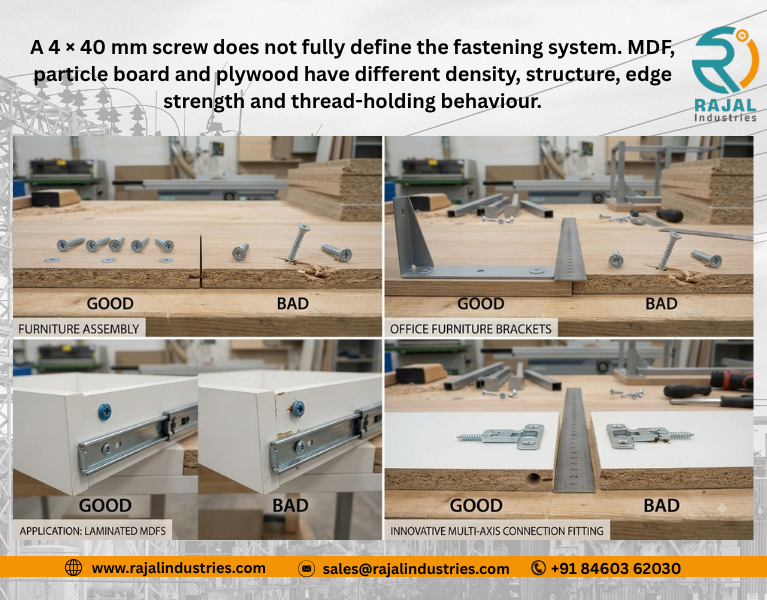
Choosing the correct chipboard screw requires more than selecting a diameter and length.
MDF, particle board, plywood, chipboard and solid wood all behave differently during screw installation. A screw that performs well in one board may provide poor holding, excessive installation torque or board damage in another.
For furniture OEMs and woodworking manufacturers, screw selection can directly affect:
- Assembly speed
- Joint consistency
- Board damage
- Screw breakage
- Head seating
- Product appearance
- Rework
- Long-term joint performance
The correct approach is to evaluate the board material, board thickness, joint location, screw diameter, screw length, thread design, head style, drive type, pilot-hole requirement, material and surface finish together.
Procurement teams commonly search for terms such as MDF Screws, Furniture Fasteners, Wood Screw Guide, Screws for Particle Board, Chipboard Screw Size and How to Choose Chipboard Screws before approving fasteners for production.
This guide explains a practical step-by-step process for selecting screws for MDF, particle board and other wood-based applications.
Quick Answer: How Do You Choose a Chipboard Screw?
Before selecting a screw, confirm:
- Board material
- Board thickness
- Face or edge fastening
- Joint design
- Screw diameter
- Screw length
- Thread type
- Thread engagement
- Head style
- Drive type
- Pilot-hole requirement
- Screw material
- Surface finish
- Installation torque
- Required testing
For OEM production, the selected screw should ideally be tested using the actual board, joint, pilot hole, driver bit and installation tool.
Why Board Material Should Be Selected First
The first question should not be:
Which screw size do we need?
It should be:
What material are we fastening?
Common furniture materials include:
- MDF
- Particle Board
- Chipboard
- Plywood
- Laminated Board
- Solid Wood
- Engineered Wood Panels
These materials differ in:
- Density
- Internal structure
- Edge strength
- Thread holding behaviour
- Splitting tendency
- Response to installation torque
This means the same screw specification should not automatically be used across every board material.
Step 1 – Identify the Exact Board Material
MDF
MDF is manufactured from fine wood fibres compressed into a dense board.
It is widely used for:
- Cabinets
- Wardrobes
- TV Units
- Shelves
- Office Furniture
- Interior Panels
- Retail Fixtures
When selecting MDF screws, consider:
- MDF density
- Board thickness
- Face or edge fastening
- Pilot hole
- Edge distance
- Installation torque
Particle Board
Particle board contains compressed wood particles and is widely used in:
- Modular Furniture
- Cabinets
- Office Furniture
- Wardrobes
- Shelving
- Storage Units
Important selection factors include:
- Board density
- Screw engagement
- Thread depth
- Diameter
- Length
- Pilot-hole size
Plywood
Plywood consists of multiple wood veneer layers.
Common applications include:
- Furniture
- Cabinets
- Shelving
- Wooden Fixtures
- Interior Products
Because of its layered structure, screw performance can vary depending on:
- Plywood grade
- Thickness
- Layer orientation
- Edge location
- Screw direction
Solid Wood
Traditional wood products can behave differently again because grain direction, species and moisture content influence fastening.
A general wood screw guide should therefore avoid treating solid wood and engineered boards as identical substrates.
Step 2 – Check Board Thickness
Board thickness affects:
- Available thread engagement
- Screw length
- Risk of breakthrough
- Joint strength
- Edge fastening
- Pilot-hole requirements
Common furniture board thicknesses can vary widely depending on product design.
The screw should provide sufficient engagement without penetrating through the visible side of the panel.
Why Screw Length Matters
A screw that is too short can lead to:
- Insufficient engagement
- Weak joint
- Reduced pull-out resistance
A screw that is too long can cause:
- Breakthrough on the opposite surface
- Damage to decorative finishes
- Sharp exposed points
- Interference with hardware
- Product rejection
For furniture manufacturing, screw length should therefore be selected from the actual joint stack-up.
Step 3 – Determine Face vs Edge Fastening
This is especially important with MDF and particle board.
Face Fastening
The screw enters through the broad face of the board.
Important factors include:
- Head seating
- Countersinking
- Screw length
- Thread engagement
- Surface appearance
Edge Fastening
The screw enters near or into the board edge.
This can require more care because poor selection may increase the risk of:
- Board bulging
- Edge damage
- Material separation
- Poor thread holding
- Splitting
For edge joints, pilot-hole size and installation torque are often particularly important.
Step 4 – Select the Correct Screw Diameter
Common chipboard screw diameters may include:
- 3.0 mm
- 3.5 mm
- 4.0 mm
- 4.5 mm
- 5.0 mm
- 6.0 mm
The correct diameter depends on:
- Board thickness
- Required holding
- Edge distance
- Joint location
- Thread geometry
- Installation torque
A larger screw is not automatically better.
An oversized screw can increase board stress and driving torque.
Step 5 – Select the Correct Screw Length
When choosing length, consider:
First Component Thickness + Receiving Board Thickness + Required Engagement
For example, if a fastener passes through one panel into another, the length should allow sufficient engagement without breaking through the finished surface.
Always check:
- Board thickness
- Countersunk depth
- Hardware thickness
- Washer thickness, if any
- Required clearance
Step 6 – Choose the Right Thread Design
Thread geometry is one of the most important parts of a chipboard screw.
It affects:
- Board engagement
- Driving torque
- Pull-out resistance
- Installation behaviour
- Joint consistency
Important thread parameters include:
- Major diameter
- Core diameter
- Thread pitch
- Thread depth
- Thread length
- Thread angle
Two screws with the same nominal diameter and length can perform differently because their thread geometries are different.
Coarse Thread for Engineered Wood
Chipboard screws commonly use relatively deep and coarse threads.
This type of thread can provide suitable engagement in:
- Chipboard
- Particle Board
- MDF
- Softwood
- Furniture Board
However, the exact thread design should still be validated according to the board and joint.
Why Core Diameter Matters
The screw core influences both:
- Fastener strength
- Available thread depth
A smaller core can allow deeper thread geometry, but the screw must still withstand installation torque.
This means the screw manufacturer must balance:
- Thread engagement
- Core strength
- Material
- Heat treatment
- Torsional performance
Step 7 – Full Thread vs Partial Thread
Full Thread Screws
Threads run across most of the usable shank.
Common applications may include:
- MDF Assemblies
- Particle Board
- Cabinets
- Furniture Components
- Hardware Attachment
Partial Thread Screws
A portion of the shank may remain unthreaded.
Depending on the joint, this can help pull two components together during tightening.
Possible applications include:
- Board-to-Board Connections
- Furniture Frames
- Wooden Component Assemblies
The best option depends on the actual joint design.
Step 8 – Select the Correct Head Style
Common head styles include:
- Countersunk
- Pan Head
- Application-Specific Heads
Countersunk Head for Furniture
Countersunk heads are widely used where the screw should sit flush with the furniture surface.
Typical applications include:
- Cabinets
- MDF Furniture
- Particle Board Furniture
- Shelving
- Wardrobes
- Modular Furniture
Important dimensions include:
- Head diameter
- Head angle
- Head height
Incorrect countersunk geometry can affect both joint performance and appearance.
Pan Head for Hardware & Brackets
Pan heads may be used where flush installation is not required.
Typical uses can include:
- Furniture Hardware
- Brackets
- Plates
- Supports
- Fittings
The correct head should match the component being fastened.
Step 9 – Select the Correct Drive Type
Common furniture screw drives include:
- Phillips
- Pozidriv
- Torx
- Hex Socket
- Other OEM-Specified Drives
Drive choice affects:
- Torque transfer
- Cam-out
- Bit engagement
- Assembly speed
- Tool wear
- Automation compatibility
Phillips vs Pozidriv vs Torx
| Drive | Main Consideration |
| Phillips | Common, widely available tooling |
| Pozidriv | Common in furniture applications in many markets |
| Torx | Strong bit engagement and torque transfer |
| Hex Socket | Used for selected furniture fasteners |
For mass production, the drive should match the factory’s assembly tools.
Why Torx Can Be Useful for Furniture OEMs
Torx can provide:
- Strong driver engagement
- Reduced cam-out
- Reliable powered installation
- Good torque transfer
For factories installing large volumes of furniture fasteners, these characteristics may improve assembly consistency.
Step 10 – Determine Whether a Pilot Hole Is Needed
Not every chipboard screw application requires the same pilot-hole approach.
A pilot hole may be useful depending on:
- Board type
- Board density
- Screw diameter
- Core diameter
- Edge distance
- Joint location
- Installation torque
Pilot holes can be particularly useful for some MDF edge applications.
What Happens if the Pilot Hole Is Too Small?
Possible problems include:
- Excessive driving torque
- Board stress
- Screw breakage
- Edge damage
- Material bulging
What Happens if the Pilot Hole Is Too Large?
Possible problems include:
- Reduced thread engagement
- Lower pull-out resistance
- Loose fastening
- Reduced joint reliability
For OEM applications, pilot-hole size should be tested using the actual board and screw.
Step 11 – Select the Screw Material
Common options include:
Carbon Steel
Widely used for general furniture applications because it supports:
- High-volume manufacturing
- Heat treatment
- Multiple surface coatings
- Economical production
Stainless Steel
May be considered for:
- Moisture-prone furniture
- Outdoor wooden products
- Certain kitchen applications
- Corrosion-sensitive environments
The final material should match the mechanical and environmental requirements.
Step 12 – Select the Surface Finish
Common options may include:
- Zinc Plated
- Yellow Zinc
- Black Finish
- Decorative Coating
- Customer-Specified Finish
- Stainless Steel
The finish should be selected according to:
- Furniture appearance
- Indoor or outdoor use
- Humidity
- Moisture exposure
- Corrosion requirement
Visible furniture screws may also need consistent colour and surface appearance.
Step 13 – Control Installation Torque
Correct torque is critical.
Too Much Torque
Can cause:
- Thread stripping
- Head over-driving
- Board damage
- Recess damage
- Screw breakage
Too Little Torque
Can cause:
- Loose joints
- Poor head seating
- Component movement
- Inconsistent assembly
For high-volume manufacturing, controlled powered installation can improve repeatability.
Step 14 – Consider Pull-Out Performance
Pull-out resistance depends on:
- Board material
- Board density
- Thread geometry
- Screw diameter
- Engagement length
- Pilot-hole size
- Installation quality
There is no useful universal pull-out value without defining the substrate and test conditions.
For important furniture joints, test the actual screw in the actual board.
Step 15 – Check Torsional Performance
The screw must withstand installation torque without failure.
Torsional behaviour depends on:
- Material
- Core diameter
- Screw size
- Heat treatment
- Head geometry
- Drive recess
- Manufacturing consistency
For OEM production, torsional testing may be useful where required by the customer specification.
Selection Guide by Material
| Material | Main Selection Focus |
| MDF | Pilot hole, edge distance, torque |
| Particle Board | Thread engagement, board density |
| Chipboard | Thread geometry, engagement length |
| Plywood | Layer structure, screw location |
| Solid Wood | Grain, splitting risk |
| Laminated Board | Surface protection + underlying substrate |
This table gives a starting point, but the actual joint should still be validated.
How to Select MDF Screws
For MDF, prioritize:
- Correct diameter
- Adequate length
- Suitable thread geometry
- Pilot-hole validation
- Edge distance
- Controlled torque
- Head seating
- Drive engagement
For repeated OEM production, test the screw using the same MDF grade used on the production line.
How to Select Screws for Particle Board
For particle board, prioritize:
- Board density
- Thread depth
- Engagement length
- Screw diameter
- Pilot-hole size
- Installation torque
- Edge distance
A screw that works in one particle-board grade may not behave identically in another.
How to Select Screws for Plywood
For plywood, consider:
- Layer orientation
- Thickness
- Screw location
- Thread engagement
- Edge distance
- Pilot hole
- Surface finish
Testing in the actual plywood is recommended for critical or high-volume applications.
What OEM Furniture Buyers Should Specify
A complete purchasing specification should include:
- Screw Diameter
- Screw Length
- Thread Design
- Full / Partial Thread
- Head Style
- Drive Type
- Point Design
- Material
- Heat Treatment
- Surface Finish
- Board Material
- Board Thickness
- Face / Edge Fastening
- Pilot-Hole Requirement
- Required Testing
- Quantity
- Monthly Consumption
- Annual Consumption
This reduces technical misunderstandings between buyer and supplier.
Example of a Strong OEM RFQ
Instead of:
Need 4 × 40 screws for furniture.
Use:
4.0 × 40 mm chipboard screw for 18 mm MDF furniture assembly, countersunk head, Torx drive, zinc plated. Application includes board-to-board joints. Monthly requirement 300,000 pcs, annual requirement approximately 3.6 million pcs. Please confirm sample and OEM quotation.
This gives the supplier much more useful technical and commercial information.
MDF vs Particle Board vs Plywood: Quick Selection Guide
The correct chipboard screw depends heavily on the material being fastened. MDF, particle board and plywood have different internal structures, so the same screw may not perform equally well in all three.
| Selection Factor | MDF | Particle Board | Plywood |
| Material Structure | Fine compressed fibres | Compressed wood particles | Layered wood veneers |
| Chipboard Screw Use | Common | Very Common | Application dependent |
| Face Fastening | Common | Common | Common |
| Edge Fastening | Requires care | Requires care | Depends on layers |
| Thread Engagement | Important | Very Important | Depends on layers |
| Pilot Hole | Application dependent | Application dependent | Application dependent |
| Board Density | Important | Important | Grade dependent |
| Installation Torque | Must be controlled | Must be controlled | Must be controlled |
| Main Risk | Edge damage / stripping | Pull-out / stripping | Splitting / layer damage |
This table should be treated as a starting point. Final screw selection should be validated using the actual board, joint and production method.
Chipboard Screw Selection by Application
Different furniture applications may require different priorities.
| Application | Main Selection Priority |
| MDF Furniture | Pilot hole, edge distance, torque |
| Particle Board Furniture | Thread engagement, board density |
| Modular Cabinets | Repeatability, drive engagement |
| Kitchen Cabinets | Moisture resistance, finish |
| Wardrobes | Length, board thickness, edge joints |
| Office Furniture | High-volume installation consistency |
| Shelving | Engagement and joint loading |
| Hardware Attachment | Head style and clamping |
| Plywood Furniture | Layer structure and screw location |
| Interior Fixtures | Appearance, finish and substrate |
For bulk production, application-specific testing is more useful than selecting a screw only from a general size chart.
How Much Thread Engagement Is Needed?
There is no single engagement length that is correct for every furniture application.
Required engagement depends on:
- Board material
- Board density
- Screw diameter
- Thread geometry
- Joint loading
- Pilot hole
- Installation direction
More engagement can improve holding in some applications, but increasing screw length without considering board thickness can create other problems.
The screw should provide sufficient engagement without:
- Breaking through the opposite surface
- Interfering with other components
- Damaging decorative surfaces
- Creating unnecessary installation resistance
For OEM furniture, the joint should be evaluated as a complete assembly.
Pilot-Hole Guidance for MDF & Particle Board
A common search from furniture manufacturers is:
What size pilot hole should I use for a chipboard screw?
There is no universal pilot-hole diameter that applies to every chipboard screw.
Pilot-hole selection depends on:
- Screw core diameter
- Major diameter
- Thread depth
- Board density
- Board thickness
- Face or edge fastening
- Installation torque
The goal is to create enough clearance for controlled installation while maintaining sufficient material for thread engagement.
Pilot Hole Too Small vs Too Large
| Pilot-Hole Condition | Possible Result |
| Too Small | High driving torque |
| Too Small | MDF or board bulging |
| Too Small | Screw breakage |
| Too Small | Edge damage |
| Too Large | Reduced thread engagement |
| Too Large | Lower pull-out resistance |
| Too Large | Loose joint |
| Too Large | Poor fastening consistency |
For a production application, test several controlled pilot-hole sizes using the actual board and screw rather than relying on one general rule.
Pilot Holes for MDF Edge Fastening
MDF edge fastening deserves particular attention.
A suitable pilot hole may help reduce:
- Material displacement
- Board bulging
- Excessive driving torque
- Edge damage
However, an oversized pilot hole may reduce thread engagement.
For high-volume MDF furniture, establish the pilot-hole specification during product development and keep it controlled during production.
Installation Torque: Why It Matters
Installation torque affects both the furniture fastener and the board.
Too much torque can damage the joint.
Too little torque can leave the assembly loose.
Excessive Torque May Cause:
- Thread stripping
- Board crushing
- Head over-driving
- Recess damage
- Screw breakage
- Surface damage
Insufficient Torque May Cause:
- Loose joints
- Incomplete head seating
- Component movement
- Poor assembly consistency
For automated or semi-automated furniture production, controlled installation tools can improve repeatability.
Seating Torque vs Failure Torque
Furniture OEMs should understand the difference between:
Seating Torque:
The torque required to correctly seat and tighten the screw.
Failure Torque:
The torque at which the screw, board or joint begins to fail.
A reliable production process should provide enough margin between normal installation conditions and failure.
The exact limits should be established through application testing.
Why Driver Bit Quality Matters
The screw is only one part of the fastening system.
The complete installation system includes:
Screw + Board + Pilot Hole + Driver Bit + Installation Tool
Poor driver-bit fit can cause:
- Cam-out
- Recess damage
- Poor torque transfer
- Increased tool wear
- Operator delays
- Screw rejection
For high-volume furniture factories, even a small problem repeated thousands of times can become expensive.
Common Chipboard Screw Selection Failures
1. Screw Pulls Out of MDF or Particle Board
Possible causes include:
- Insufficient engagement
- Incorrect thread geometry
- Oversized pilot hole
- Low board density
- Damaged board
- Incorrect screw diameter
The solution is not to use a larger screw.
The complete joint should be reviewed.
2. Board Splits or Bulges During Installation
Possible causes include:
- Screw diameter too large
- Pilot hole too small
- Screw installed too close to edge
- Excessive torque
- Unsuitable thread geometry
- Joint design limitations
This is particularly important for MDF edge fastening.
3. Screw Spins Without Tightening
This usually indicates that the thread is no longer developing sufficient engagement with the surrounding material.
Possible reasons include:
- Thread stripping
- Oversized pilot hole
- Damaged board
- Excessive tightening
- Repeated installation and removal
- Poor screw-to-board combination
4. Screw Breaks During Installation
Possible causes include:
- Excessive driving torque
- Incorrect pilot hole
- Poor material
- Incorrect heat treatment
- Insufficient core strength
- Installation misalignment
A broken screw should therefore not automatically be treated as only a material problem.
The installation conditions should also be investigated.
5. Driver Keeps Slipping
Possible causes include:
- Incorrect driver bit
- Poor drive recess
- Insufficient recess depth
- Excessive torque
- Misalignment
- Worn tooling
For automated assembly, consistent recess geometry is especially important.
6. Screw Head Goes Too Deep into MDF
Countersunk screws can be over-driven into softer engineered wood.
This can cause:
- Surface damage
- Reduced clamping
- Poor appearance
- Local board crushing
Installation depth and torque should be controlled.
7. Screw Comes Through the Other Side
This is usually a screw-length or joint-stack problem.
Before selecting length, calculate:
Component Thickness + Available Receiving Material + Required Engagement
Do not select screw length from the receiving board thickness alone.
Chipboard Screw vs Wood Screw
A common buyer question is:
Should I use a chipboard screw or wood screw?
| Feature | Chipboard Screw | Traditional Wood Screw |
| MDF | Common | Application dependent |
| Particle Board | Very Common | Application dependent |
| Chipboard | Very Common | Application dependent |
| Plywood | Application dependent | Common |
| Solid Wood | Possible | Very Common |
| Furniture Production | Very Common | Common |
| Thread Geometry | Often deep/coarse | Varies |
| Engineered Wood Focus | Strong | Broader woodworking use |
The term wood screw covers many different fastener designs. Buyers should compare the actual geometry rather than relying only on the product name.
Chipboard Screw vs Confirmat Screw
Another common question is:
Which is better: chipboard screw or confirmat screw?
Neither is automatically better.
They serve different furniture-joint requirements.
| Feature | Chipboard Screw | Confirmat Screw |
| General Furniture | Very Common | Common |
| MDF | Common | Common |
| Particle Board | Very Common | Common |
| Board-to-Board Joints | Common | Very Common |
| Prepared Hole | Application dependent | Common |
| General Woodworking | Broad | More specialized |
| Body | Usually slimmer | Generally heavier |
| RTA Furniture | Common | Common |
Confirmat screws are often used for specific engineered-board furniture joints.
Chipboard screws provide broader flexibility across many furniture and woodworking applications.
Chipboard Screw vs Drywall Screw
A drywall screw may look similar to some MDF screws, but visual similarity does not mean the products should be substituted.
| Feature | Chipboard Screw | Drywall Screw |
| Primary Purpose | Engineered wood / furniture | Drywall systems |
| MDF Furniture | Common | Not primary intended use |
| Particle Board | Common | Not primary intended use |
| Cabinet Production | Common | Not automatically suitable |
| OEM Furniture | Common | Application dependent |
Furniture manufacturers should use a fastener designed and validated for their actual application.
Common Engineering Mistakes When Selecting Furniture Fasteners
Mistake 1: Selecting by Diameter and Length Only
A specification such as:
4 × 40 mm screw
is incomplete.
Also define:
- Thread
- Head
- Drive
- Point
- Material
- Heat treatment
- Finish
- Board
- Joint
Mistake 2: Assuming All MDF Is the Same
MDF density and properties can vary between grades and suppliers.
If the board changes significantly, the fastening system should be reviewed.
Mistake 3: Ignoring Face vs Edge Fastening
A screw that works well through the face of a board may behave differently when installed into its edge.
Mistake 4: Choosing the Largest Possible Screw
A larger diameter does not automatically create a stronger joint.
It may increase:
- Board stress
- Installation torque
- Splitting risk
- Edge damage
Mistake 5: Ignoring Installation Equipment
A screw may be technically suitable but still create production problems if its drive system does not work well with the factory’s tools.
Mistake 6: Skipping Application Testing
Dimensional inspection alone cannot fully predict performance inside MDF or particle board.
The actual joint should be tested.
Common Procurement Mistakes
Buying Only on Lowest Price
For a furniture OEM purchasing millions of screws, a small unit-price saving can be lost quickly through:
- Board rejection
- Screw breakage
- Driver-bit wear
- Assembly delays
- Rework
- Production downtime
- Finished-product complaints
The better purchasing question is:
What is the total fastening cost per successful assembly?
Not Telling the Supplier the Application
Compare:
Need 4 × 40 screws. Quote price.
with:
Need 4.0 × 40 mm chipboard screws for 18 mm MDF modular furniture, countersunk Torx head, zinc plated, monthly consumption 300,000 pcs.
The second RFQ allows the supplier to understand the technical requirement and commercial scale.
Not Sharing Annual Volume
OEM buyers should provide:
- Sample quantity
- Trial quantity
- Initial order
- Monthly consumption
- Annual consumption
- Delivery frequency
This helps the manufacturer evaluate:
- Tooling
- Raw material
- Production planning
- Heat treatment
- Plating
- Packaging
- Inventory
- Commercial pricing
OEM Quality Inspection Checklist
| Inspection Item | Check |
| Approved Drawing | ✓ |
| Nominal Diameter | ✓ |
| Core Diameter | ✓ |
| Overall Length | ✓ |
| Thread Pitch | ✓ |
| Thread Depth | ✓ |
| Thread Length | ✓ |
| Point Geometry | ✓ |
| Head Diameter | ✓ |
| Head Height | ✓ |
| Drive Recess | ✓ |
| Material | ✓ |
| Heat Treatment | ✓ |
| Hardness | As Specified |
| Surface Finish | ✓ |
| Coating Thickness | As Specified |
| Visual Appearance | ✓ |
| Driver-Bit Fit | ✓ |
| Installation Test | ✓ |
| Torsional Test | As Required |
| Pull-Out Test | As Required |
| Batch Traceability | ✓ |
The final inspection plan should follow the customer’s approved drawing and specification.
OEM Furniture Fastener RFQ Checklist
Before requesting a quotation, provide:
☐ Screw Diameter
☐ Screw Length
☐ Thread Pitch / Geometry
☐ Full or Partial Thread
☐ Head Type
☐ Drive Type & Size
☐ Point Design
☐ Material
☐ Heat Treatment
☐ Surface Finish
☐ Coating Requirement
☐ Board Material
☐ Board Thickness
☐ Face or Edge Fastening
☐ Joint Details
☐ Pilot-Hole Requirement
☐ Required Mechanical Tests
☐ Drawing / Specification
☐ Trial Quantity
☐ Monthly Requirement
☐ Annual Consumption
☐ Packaging Requirement
☐ Delivery Schedule
Questions to Ask a Chipboard Screw Manufacturer
For bulk OEM sourcing, ask:
- Are you the actual manufacturer?
- Which chipboard screw sizes do you manufacture?
- Can you manufacture according to our drawing?
- Can you support custom thread geometry?
- Which head and drive configurations are available?
- How do you control drive recess dimensions?
- Which materials can you manufacture?
- How is heat treatment controlled?
- Which coatings are available?
- Can coating performance be tested where required?
- Can you perform torsional testing?
- Can you support pull-out or application testing?
- Can samples be tested in our board material?
- Is batch traceability available?
- What is the MOQ?
- What is the production capacity?
- Can you support monthly scheduled deliveries?
- Can you provide OEM packaging?
For a large furniture buyer, production consistency and repeat supply capability can be just as important as the initial quotation.
Why Rajal Industries for Bulk Chipboard & Furniture Screws?
Rajal Industries manufactures fasteners for bulk OEM requirements.
Depending on the approved design, manufacturing feasibility and customer specification, requirements can include:
- Chipboard Screws
- MDF Screws
- Furniture Screws
- Wood Screws
- Cabinet Screws
- Custom Drawing-Based Screws
- Countersunk Screws
- Different Drive Configurations
- Custom Thread Requirements
- Bulk OEM Production
- Cold Forming
- Thread Rolling
- Controlled Heat Treatment
- Surface Finishing
- Dimensional Inspection
- Mechanical Testing as Specified
- Application Testing as Specified
- Batch Traceability
- OEM Packaging
- Export Supply Support
Potential bulk customers include:
- Furniture Manufacturers
- Modular Furniture Manufacturers
- Kitchen Manufacturers
- Cabinet Manufacturers
- Wardrobe Manufacturers
- Office Furniture Companies
- MDF Product Manufacturers
- Particle Board Product Manufacturers
- Woodworking OEMs
- Interior Product Manufacturers
- Retail Fixture Manufacturers
- Hardware Distributors
Custom products should be reviewed against the drawing, dimensions, material, thread design, finish, testing requirements and expected production quantity.
Bulk Buyer Quick Answer
What information should I send when buying chipboard screws in bulk?
Send the manufacturer:
Screw size or drawing + board material + board thickness + joint type + head + drive + finish + monthly quantity + annual consumption.
For a technical application, also provide:
- Face or edge fastening
- Pilot-hole details
- Installation method
- Performance requirements
This allows the manufacturer to evaluate both product suitability and production requirements.
Frequently Asked Questions
How do I select the correct chipboard screw?
Start with the board material and thickness, then evaluate screw diameter, length, thread geometry, head, drive, pilot hole, installation torque and required holding performance.
What screws are best for MDF?
Suitable MDF screws should provide reliable thread engagement without creating excessive board stress. The exact screw depends on MDF density, thickness, joint location and installation method.
What screws should I use for particle board?
Chipboard screws are commonly used for suitable particle-board furniture applications. Thread geometry, engagement length and installation torque should match the board.
Can chipboard screws be used in plywood?
Yes, in suitable applications. Plywood grade, thickness, layer structure, edge distance and screw location should be considered.
Can chipboard screws be used in solid wood?
They may be suitable for some applications, but traditional wood screws and other wood-fastener designs may also be considered depending on the joint.
What size chipboard screw should I use?
There is no universal size. Select the screw according to board thickness, joint design, required engagement, edge distance and performance requirements.
Should I use a pilot hole in MDF?
It depends on the screw and joint. Pilot holes can be particularly useful in some MDF edge-fastening applications.
What happens if the pilot hole is too large?
Thread engagement and pull-out resistance may be reduced.
What happens if the pilot hole is too small?
Driving torque and board stress may increase, potentially causing board damage or screw failure.
Is Torx better for furniture screws?
Torx can provide good bit engagement and torque transfer, making it useful for some high-volume powered assembly applications. The correct drive still depends on production requirements.
Why do screws strip in particle board?
Possible causes include excessive tightening, poor engagement, oversized pilot holes, low board density or repeated installation.
Why do screws break during installation?
Possible causes include excessive torque, incorrect pilot holes, material problems, heat-treatment issues, insufficient core strength or installation misalignment.
Which is better, chipboard screw or confirmat screw?
Neither is universally better. Confirmat screws are often used for specific engineered-board joints, while chipboard screws cover a broader range of furniture applications.
What should I check before bulk ordering furniture screws?
Check the drawing, dimensions, thread, head, drive, material, heat treatment, coating, board compatibility, installation performance and supplier production capability.
Can custom chipboard screws be manufactured for OEM applications?
Yes. Custom screws can be evaluated based on drawing, dimensions, thread geometry, material, finish, testing and production quantity.
Key Takeaways
- Select the chipboard screw according to the board and joint, not only diameter and length.
- MDF, particle board, plywood and solid wood behave differently.
- Face and edge fastening should be evaluated separately.
- Thread geometry and engagement length are major selection factors.
- A larger screw does not automatically provide a stronger joint.
- Pilot-hole size can affect both installation torque and holding performance.
- Installation torque should be controlled during high-volume assembly.
- Drive recess and driver-bit compatibility matter for production efficiency.
- Test the screw in the actual board before large-volume approval.
- OEM buyers should provide application details and annual consumption when requesting quotations.
Conclusion
Selecting the correct chipboard screw starts with understanding the material and joint rather than simply choosing a standard screw size.
For MDF, particle board and other furniture materials, buyers should evaluate the board thickness, face or edge fastening, screw diameter, length, thread geometry, engagement, head style, drive type, pilot hole, installation torque, material and surface finish.
For high-volume furniture production, the most reliable selection process is to test:
Actual Board + Actual Screw + Actual Joint + Pilot Hole + Driver Bit + Production Tool
This helps identify installation and joint-performance problems before the fastener enters mass production.
Rajal Industries can evaluate standard and custom chipboard, MDF and furniture screw requirements for bulk OEM applications based on customer drawings, technical specifications, application details and expected production volumes.