

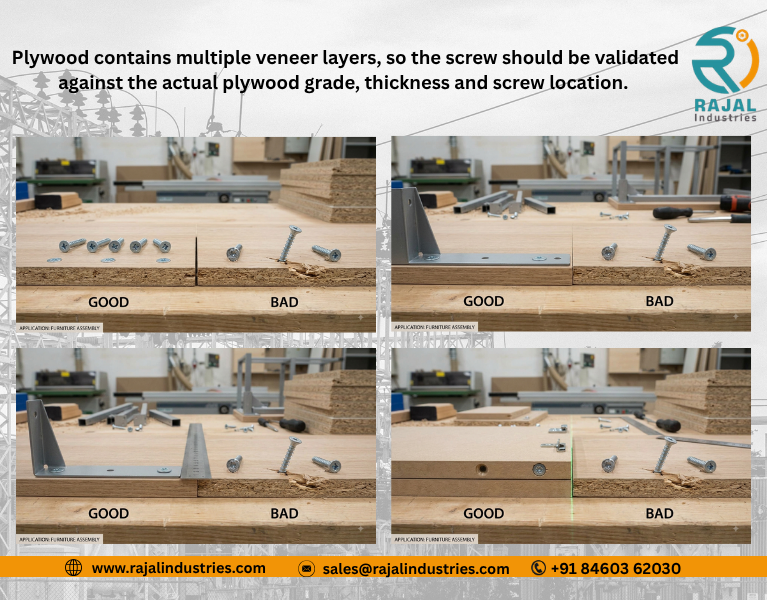
Chipboard screw applications cover a wide range of furniture, cabinet, MDF, particle board and interior-product assemblies.
These screws are commonly selected for engineered wood because their thread geometry can provide effective engagement in materials such as chipboard, MDF and particle board when the correct screw and joint design are used.
For furniture manufacturers and woodworking OEMs, however, the requirement goes beyond simply buying a box of screws.
Large manufacturers may use thousands or millions of furniture screws across repeated production. Small differences in thread geometry, point design, drive recess, head dimensions or heat treatment can affect installation speed, board damage and final assembly quality.
Common chipboard screw applications include:
- Residential Furniture
- Modular Furniture
- Kitchen Cabinets
- Wardrobes
- Office Furniture
- MDF Products
- Particle Board Products
- Shelving Systems
- Retail Fixtures
- Interior Fit-Out Products
- Wooden Display Systems
- Prefabricated Furniture
This guide explains where chipboard screws are used, what each industry should consider and what OEM buyers should specify before approving a screw for bulk production.
Quick Answer: Where Are Chipboard Screws Used?
Chipboard screws are commonly used for fastening suitable engineered wood and wood-based components in:
- Furniture
- Modular Cabinets
- MDF Assemblies
- Particle Board
- Wardrobes
- Kitchen Furniture
- Office Furniture
- Shelving
- Interior Fixtures
- Retail Displays
- Wooden Components
The correct screw depends on the board material, board thickness, joint design, screw diameter, length, thread geometry, head style, drive type, pilot-hole requirement and installation torque.
A screw suitable for one furniture assembly should not automatically be used for every MDF or particle-board joint.
Why Chipboard Screws Are Used in Furniture Manufacturing
Furniture manufacturers need fasteners that can support fast, repeatable assembly.
A suitable chipboard screw can provide:
- Effective thread engagement
- Fast installation
- Consistent head seating
- Compatibility with powered tools
- Suitable holding in engineered wood
- Repeatable production
- Wide size availability
This makes chipboard screws useful for factories producing:
- Beds
- Tables
- Cabinets
- Desks
- Shelves
- Storage Units
- Wardrobes
- Kitchen Furniture
- Office Furniture
For mass production, consistency is especially important.
A screw that occasionally causes bit slipping, board damage or head breakage can create significant production losses when repeated across hundreds of thousands of installations.
Major Industries Using Chipboard Screws
The strongest industrial markets for chipboard screws include:
| Industry | Typical Applications |
| Furniture Manufacturing | Tables, beds, cabinets, storage |
| Modular Furniture | Kitchens, wardrobes, storage systems |
| Cabinet Manufacturing | Kitchen and commercial cabinets |
| Office Furniture | Desks, workstations, storage |
| MDF Products | Panels, fixtures, furniture |
| Particle Board Products | Cabinets, shelves, furniture |
| Interior Fit-Out | Fixtures, partitions, decorative assemblies |
| Retail Fixtures | Displays, counters, shelving |
| Hospitality Furniture | Hotel and restaurant furniture |
| Educational Furniture | Desks, cabinets, storage |
| Woodworking OEMs | Drawing-based wood assemblies |
For Rajal Industries’ bulk OEM strategy, furniture factories, modular furniture manufacturers, cabinet manufacturers and large woodworking OEMs are stronger targets than small retail users.
Chipboard Screw Applications in Furniture Manufacturing
Furniture manufacturing is one of the largest application areas for furniture screws.
Typical fastening points may include:
- Side Panels
- Internal Frames
- Shelves
- Drawer Components
- Cabinet Bodies
- Storage Units
- Furniture Supports
- Wooden Brackets
- Back Panels
- Structural and non-structural furniture components, depending on design
The fastener specification should match the actual joint.
Important factors include:
- Board type
- Board thickness
- Joint direction
- Edge distance
- Screw engagement
- Required holding performance
- Installation method
Chipboard Screws for Modular Furniture
Modular furniture manufacturers produce standardized components in large quantities.
Common products include:
- Modular Kitchens
- Wardrobes
- Storage Systems
- TV Units
- Office Furniture
- Shelving
- Cabinets
- Bedroom Furniture
This creates a strong application for standardized wood fasteners.
High-volume manufacturers normally need screws that provide:
- Consistent dimensions
- Reliable drive engagement
- Repeatable installation
- Controlled surface finish
- Stable quality across batches
- Reliable scheduled supply
For procurement teams, repeatability can be as important as the initial unit price.
Chipboard Screws for Modular Cabinets
Cabinet manufacturing can involve large numbers of repetitive fastening operations.
Chipboard screws may be used in suitable joints involving:
- Cabinet Side Panels
- Shelves
- Internal Dividers
- Base Components
- Backing Supports
- Wooden Frames
- Hardware Mounting
- Selected Board-to-Board Joints
The correct cabinet screws depend on the material and joint design.
For example, a screw used for joining two particle-board panels may require different dimensions from a screw used to attach hardware to a cabinet panel.
Chipboard Screws for Kitchen Cabinets
Kitchen furniture creates additional requirements because moisture and humidity may be higher than in ordinary indoor furniture.
Typical applications include:
- Base Cabinets
- Wall Cabinets
- Tall Units
- Drawer Units
- Shelving
- Internal Storage Systems
- Cabinet Frames
- Hardware Attachments
Buyers should consider:
- Board material
- Board thickness
- Surface finish
- Corrosion requirement
- Screw visibility
- Installation torque
- Required service life
Where moisture exposure is expected, the fastener finish should be selected accordingly.
Chipboard Screws for Wardrobes
Wardrobe manufacturers may use chipboard screws for:
- Side Panels
- Internal Shelves
- Dividers
- Storage Sections
- Drawer Units
- Internal Supports
- Suitable Hardware Attachments
Wardrobes are commonly produced from:
- MDF
- Particle Board
- Laminated Board
- Plywood
- Engineered Wood Panels
Each material can behave differently during screw installation.
The screw should therefore be tested in the actual board used by the manufacturer.
Chipboard Screws for MDF Furniture
MDF is widely used for:
- Cabinets
- Wardrobes
- Tables
- TV Units
- Interior Panels
- Decorative Furniture
- Retail Fixtures
- Storage Products
Chipboard screws can be suitable for many MDF applications when the correct geometry and installation conditions are used.
Important selection factors include:
- MDF density
- Board thickness
- Screw diameter
- Screw length
- Thread design
- Pilot-hole requirement
- Edge distance
- Installation torque
MDF Face Fastening Applications
When the screw enters through the broad face of an MDF board, buyers should consider:
- Head seating
- Countersinking
- Surface finish
- Thread engagement
- Screw length
- Installation torque
For visible furniture, head seating can also affect final appearance.
MDF Edge Fastening Applications
Edge fastening requires more care.
Incorrect screw selection may contribute to:
- Board bulging
- Edge damage
- Poor holding
- Material separation
- Thread stripping
Factors such as screw diameter, pilot-hole size and installation torque become particularly important.
For mass-produced furniture, edge joints should be tested before final screw approval.
Chipboard Screws for Particle Board
Particle board is another major application for chipboard fasteners.
It is widely used in:
- Furniture
- Cabinets
- Shelves
- Wardrobes
- Office Desks
- Storage Systems
- Modular Kitchens
The screw needs to engage the board without creating unnecessary material damage.
Important factors include:
- Board density
- Board thickness
- Thread depth
- Screw diameter
- Engagement length
- Pilot hole
- Edge distance
A larger screw does not automatically mean a better joint.
Chipboard Screws for Office Furniture
Office furniture manufacturers can be attractive bulk buyers because they produce standardized products repeatedly.
Typical products include:
- Office Desks
- Workstations
- Storage Cabinets
- Pedestals
- Filing Units
- Shelving
- Conference Tables
- Office Partitions
For high-volume assembly, important fastener characteristics include:
- Consistent drive recess
- Reliable bit engagement
- Controlled head dimensions
- Consistent thread geometry
- Suitable coating
- Repeat batch quality
These factors can directly affect production speed.
Chipboard Screws for Retail Fixtures & Displays
Retail furniture and display manufacturers use engineered wood for:
- Product Displays
- Shelving
- Counters
- Display Cabinets
- Shop Furniture
- Point-of-Sale Fixtures
- Storage Units
These applications may require both:
- Mechanical performance
- Good visual appearance
Where the screw remains visible, buyers may specify particular:
- Head styles
- Drive types
- Coating colors
- Surface finishes
Chipboard Screws for Interior Projects
Interior projects may use wood fasteners across many prefabricated or site-assembled components.
Applications can include:
- Wooden Fixtures
- Cabinets
- Decorative Panels
- Shelving
- Storage Systems
- Display Units
- Furniture
- Interior Wood Assemblies
However, interior contractors should select the fastener according to the specific substrate rather than treating every wood-based panel as the same material.
Chipboard Screws for Hotel & Hospitality Furniture
Hospitality furniture can include:
- Beds
- Side Tables
- Wardrobes
- Desks
- Cabinets
- Storage Units
- Restaurant Furniture
- Built-In Furniture
Hotels and commercial projects may require large numbers of repeated furniture units.
This can create bulk demand for standardized furniture screws and other furniture fasteners.
For project supply, buyers may also require:
- Batch consistency
- Defined finish
- Packaging by furniture set or project
- Delivery scheduling
- Traceability
Chipboard Screws for Educational Furniture
Schools, colleges and institutional furniture manufacturers may use engineered wood for:
- Student Desks
- Tables
- Storage Cabinets
- Bookshelves
- Teacher Furniture
- Laboratory Storage
- Library Furniture
For large institutional projects, manufacturers may require high quantities within a fixed delivery schedule.
This makes production capacity and delivery reliability important supplier-selection factors.
Chipboard Screws for Ready-to-Assemble Furniture
Ready-to-assemble or flat-pack furniture creates special fastening requirements.
Depending on the product design, fasteners may need:
- Easy installation
- Reliable drive engagement
- Consistent dimensions
- Suitable packaging
- Clear identification
- Repeatable joint performance
Some RTA furniture systems use chipboard screws together with other furniture fasteners such as confirmat screws, dowels, cam connectors and specialized fittings.
The final fastener system depends on the furniture design.
Chipboard Screws for Plywood Applications
Chipboard screws may also be considered for suitable plywood assemblies.
Applications can include:
- Furniture
- Cabinets
- Shelves
- Interior Fixtures
- Wooden Components
- Display Products
Plywood behaves differently from MDF and particle board because it consists of multiple veneer layers.
The screw should therefore be validated in the actual plywood grade and thickness.
Furniture Screws for Hardware Attachment
Not every furniture screw joins two wood panels directly.
Fasteners can also attach hardware such as:
- Brackets
- Hinges
- Supports
- Plates
- Furniture Fittings
- Mounting Components
The correct screw depends on:
- Hardware-hole diameter
- Board thickness
- Required engagement
- Head geometry
- Required clamping
- Joint load
A pan head, countersunk head or another design may be selected according to the hardware.
Why Board Material Changes Screw Performance
One of the most important points for OEM buyers is that all engineered wood is not identical.
| Material | Important Fastening Considerations |
| MDF | Density, edge fastening, pilot hole |
| Particle Board | Thread engagement, board density |
| Chipboard | Thread geometry, engagement |
| Plywood | Layer structure, screw location |
| Solid Wood | Grain, splitting risk |
| Laminated Board | Surface damage + underlying substrate |
Therefore, the same chipboard screw can behave differently across different materials.
How Thread Design Supports Furniture Applications
Chipboard screws commonly use relatively deep threads designed for suitable wood-based materials.
Thread geometry influences:
- Holding performance
- Installation torque
- Material engagement
- Pull-out resistance
- Board damage
Important parameters include:
- Major diameter
- Core diameter
- Thread pitch
- Thread depth
- Thread length
For OEM production, thread consistency should be controlled from batch to batch.
Full Thread vs Partial Thread in Furniture Applications
Full Thread
Full-thread screws may be used in many:
- MDF Assemblies
- Particle Board Joints
- Cabinets
- Furniture Components
- Hardware Attachments
Partial Thread
Depending on the joint design, partial-thread screws can help pull two components together during tightening.
Possible applications include:
- Furniture Frames
- Board-to-Board Connections
- Wood Assemblies
Neither design is universally better.
The joint determines the correct choice.
Head Types Used in Furniture & Cabinet Applications
Common options include:
Countersunk Head
Widely used where the screw should sit flush with the furniture surface.
Pan Head
Useful for certain hardware and bracket attachments where flush seating is not required.
Application-Specific Heads
Custom or specialized heads may be required for particular furniture fittings or OEM designs.
For visible furniture, head dimensions and surface finish can also affect product appearance.
Drive Types Used for Furniture Screws
Common drive systems include:
- Phillips
- Pozidriv
- Torx
- Hex Socket
- Customer-Specified Drives
For high-volume production, drive selection can affect:
- Assembly speed
- Bit engagement
- Cam-out
- Operator productivity
- Tool wear
- Automation compatibility
Why Torx Is Used in Some Furniture Applications
Torx can provide strong driver engagement and effective torque transfer.
Potential benefits for production include:
- Reduced cam-out
- Good bit engagement
- Reliable powered installation
- Consistent torque transfer
This can make Torx useful for some high-volume furniture manufacturing applications.
The drive should still be selected according to the buyer’s production equipment and fastener design.
Surface Finish by Application
| Application | Typical Consideration |
| Indoor Furniture | General corrosion protection + appearance |
| Kitchen Cabinets | Moisture exposure |
| Office Furniture | Appearance + indoor protection |
| Retail Displays | Visible finish may matter |
| Hotel Furniture | Appearance + repeat consistency |
| Outdoor Wood Products | Higher corrosion requirement |
| Interior Fixtures | Project specification |
Rather than choosing coating only by color, buyers should define the actual finish and required corrosion performance.
What Furniture OEMs Should Specify
A bulk furniture buyer should provide more than:
“Need furniture screws.”
A useful specification should include:
- Screw Diameter
- Screw Length
- Thread Design
- Full or Partial Thread
- Head Type
- Drive Type
- Point Design
- Material
- Heat Treatment
- Surface Finish
- Board Material
- Board Thickness
- Joint Type
- Pilot-Hole Requirement
- Required Testing
- Monthly Quantity
- Annual Consumption
This allows a manufacturer to understand both the technical and commercial requirement.
Example of a Better OEM RFQ
Instead of:
Need 4 × 40 mm chipboard screws. Send price.
A stronger RFQ could state:
4.0 × 40 mm chipboard screw for 18 mm MDF modular furniture, countersunk head, Torx drive, zinc plated, monthly requirement 250,000 pcs. Please quote for OEM supply and confirm sample availability.
This immediately gives the supplier more useful information about:
- Product
- Application
- Material
- Drive
- Finish
- Volume
It can reduce unnecessary back-and-forth during sourcing.
Why Application Testing Matters
For serious OEM buyers, one of the most useful approval methods is testing the screw in the actual production joint.
Test the proposed combination of:
Actual Board + Actual Screw + Pilot Hole + Driver Bit + Production Tool
Check:
- Starting behaviour
- Driving torque
- Head seating
- Board damage
- Drive engagement
- Thread stripping
- Joint tightness
- Pull-out performance, where required
This gives the buyer more useful information than evaluating the screw by dimensions alone.
How to Select Chipboard Screws by Furniture Application
Different chipboard screw applications need different fastening conditions. A screw used in an MDF cabinet should not automatically be used for particle-board shelving or plywood furniture without checking the joint.
The main selection factors are:
- Board material
- Board thickness
- Joint location
- Screw diameter
- Screw length
- Thread geometry
- Head style
- Drive type
- Pilot-hole requirement
- Installation torque
- Surface finish
- Required holding performance
For OEM production, the screw should ideally be tested in the actual board and joint before bulk approval.
Furniture Application Selection Guide
| Application | Main Selection Factors |
| Modular Furniture | Repeatability, drive engagement, thread quality |
| Kitchen Cabinets | Moisture exposure, finish, board thickness |
| Wardrobes | Board thickness, screw length, edge fastening |
| Office Furniture | High-volume installation, drive consistency |
| MDF Furniture | Pilot hole, edge distance, installation torque |
| Particle Board Furniture | Thread engagement, board density |
| Retail Fixtures | Appearance, head seating, finish |
| Hotel Furniture | Repeat quality, appearance, durability |
| Shelving | Engagement length, joint loading |
| Hardware Attachment | Head style, hole size, clamping |
| RTA Furniture | Easy installation, consistency, packaging |
This table can help procurement teams narrow the specification before sending an RFQ.
MDF vs Particle Board vs Plywood
One of the biggest mistakes in furniture fastening is treating all wood-based boards as identical.
| Factor | MDF | Particle Board | Plywood |
| Structure | Fine wood fibres | Compressed wood particles | Layered veneers |
| Chipboard Screw Use | Common | Very Common | Application dependent |
| Face Fastening | Common | Common | Common |
| Edge Fastening | Requires care | Requires care | Depends on layers |
| Pilot Hole | Application dependent | Application dependent | Application dependent |
| Board Density Effect | Important | Important | Important |
| Thread Engagement | Design dependent | Very important | Depends on layers |
| Installation Torque | Must be controlled | Must be controlled | Must be controlled |
The best approach is to validate the proposed wood fastener in the actual board grade used in production.
How to Select Screws for MDF Furniture
For MDF applications, first identify:
- MDF thickness
- MDF density or grade
- Face or edge fastening
- Joint design
- Required engagement
- Screw diameter
- Screw length
- Pilot-hole requirement
- Installation torque
MDF edge joints deserve particular attention because incorrect screw selection or excessive installation stress can damage the board.
How to Select Screws for Particle Board Furniture
For particle board, focus on:
- Board density
- Board thickness
- Thread depth
- Thread pitch
- Screw diameter
- Engagement length
- Pilot-hole size
- Edge distance
- Installation torque
A deeper thread may provide useful engagement in suitable engineered wood, but thread depth alone does not determine joint performance.
The complete screw-and-board combination matters.
How to Select Screws for Plywood Furniture
Plywood contains multiple layers, so its fastening behaviour differs from MDF and particle board.
Consider:
- Plywood grade
- Total thickness
- Screw location
- Layer orientation
- Screw diameter
- Length
- Thread engagement
- Edge distance
- Pilot-hole requirement
Testing should be carried out using the actual plywood specified for production.
Pilot-Hole Requirements for Furniture Screws
A common question is:
Do chipboard screws require pilot holes?
There is no single answer for every application.
A pilot hole may be useful depending on:
- Board material
- Board density
- Screw diameter
- Core diameter
- Thread geometry
- Edge distance
- Screw length
- Joint design
Pilot holes can be particularly useful where board damage or excessive driving torque is a concern.
Why Pilot-Hole Diameter Matters
A pilot hole that is too small may increase:
- Driving torque
- Board stress
- Screw stress
- Risk of splitting or bulging
- Installation difficulty
A pilot hole that is too large may reduce:
- Thread engagement
- Pull-out resistance
- Joint reliability
Furniture OEMs should establish the correct pilot-hole size through application testing rather than using one universal rule.
Installation Torque for Chipboard Screws
Correct installation torque is important for reliable furniture assembly.
Excessive Torque Can Cause
- Thread stripping
- Board damage
- Head over-driving
- Drive recess damage
- Screw breakage
Insufficient Torque Can Cause
- Loose joints
- Poor head seating
- Component movement
- Inconsistent assembly
High-volume furniture manufacturers can benefit from controlled installation tools where repeatable fastening is required.
Why Screwdriver Bit Selection Matters
The driver bit must correctly match the screw recess.
Common drives include:
- Phillips
- Pozidriv
- Torx
- Hex Socket
Using the wrong bit can cause:
- Cam-out
- Damaged recesses
- Poor torque transfer
- Tool wear
- Slower production
- Rejected screws
This becomes particularly important in factories installing hundreds of thousands of furniture screws every month.
Common Chipboard Screw Application Failures
Understanding common failures can help buyers improve their fastener specifications.
1. Screw Pull-Out
Possible causes include:
- Insufficient engagement
- Incorrect thread design
- Oversized pilot hole
- Low-density board
- Incorrect screw diameter
- Damaged board material
2. Board Splitting or Bulging
Possible causes include:
- Screw too large
- Pilot hole too small
- Fastening too close to an edge
- Excessive installation torque
- Unsuitable joint design
3. Thread Stripping in the Board
Possible causes include:
- Excessive tightening
- Insufficient material engagement
- Repeated installation
- Incorrect pilot hole
- Damaged board
4. Screw Breakage
Possible causes can include:
- Excessive installation torque
- Material or heat-treatment problems
- Insufficient screw core strength
- Incorrect pilot hole
- Poor installation conditions
5. Drive Recess Damage
Possible causes include:
- Wrong driver bit
- Poor recess dimensions
- Excessive torque
- Poor bit engagement
- Misalignment
6. Head Over-Driving
A countersunk screw can be driven too deeply into MDF or particle board.
This may cause:
- Surface damage
- Reduced clamping
- Poor appearance
- Local board damage
Installation depth and torque should therefore be controlled.
Chipboard Screw vs Confirmat Screw
Both fasteners are widely associated with furniture manufacturing, but their applications differ.
| Feature | Chipboard Screw | Confirmat Screw |
| General Furniture | Very Common | Common |
| MDF | Common | Common |
| Particle Board | Very Common | Common |
| Cabinet Manufacturing | Common | Common |
| Prepared Hole | Application dependent | Commonly required |
| General Woodworking | Broad use | More specialized |
| Body Design | Usually slimmer | Typically heavier |
| RTA Furniture | Common | Common |
| Joint Selection | Application specific | Application specific |
Confirmat screws are commonly used for specific board-to-board furniture joints.
Chipboard screws have broader use across general furniture, cabinets and woodworking.
Chipboard Screw vs Traditional Wood Screw
| Feature | Chipboard Screw | Traditional Wood Screw |
| Engineered Wood | Common | Application dependent |
| Particle Board | Very Common | Application dependent |
| MDF | Common | Application dependent |
| Solid Wood | Possible | Very Common |
| Furniture Manufacturing | Very Common | Common |
| Thread Geometry | Often deep/coarse | Varies |
| Bulk OEM Production | Common | Common |
A product should be selected according to its actual substrate and joint rather than only its market name.
Chipboard Screw vs Drywall Screw
Drywall screws should not automatically be substituted for cabinet screws or furniture fasteners simply because the products can look similar.
| Feature | Chipboard Screw | Drywall Screw |
| Main Application | Furniture / engineered wood | Drywall systems |
| MDF Furniture | Common | Not primary intended use |
| Particle Board | Common | Not primary intended use |
| Cabinet Manufacturing | Common | Not automatically suitable |
| Furniture OEM Production | Common | Application dependent |
For OEM furniture, use a fastener validated for the actual board and joint.
Common Furniture Manufacturing Mistakes
1. Using One Screw Specification Everywhere
A factory may use several different boards in one furniture product.
The same screw should not automatically be used for:
- MDF
- Particle Board
- Plywood
- Solid Wood
- Hardware Attachment
Each fastening point should be evaluated according to its joint requirements.
2. Selecting Screws Only by Size
A requirement such as:
4 × 40 mm chipboard screw
does not fully define the product.
Also specify:
- Thread
- Head
- Drive
- Point
- Material
- Finish
- Board
- Application
3. Ignoring Edge Fastening
Face fastening and edge fastening can behave differently.
For MDF and particle board, edge joints should be evaluated carefully during product development.
4. Ignoring Installation Torque
More torque does not always create a stronger joint.
Excessive torque can strip the material surrounding the screw threads.
5. Ignoring Drive Recess Quality
Poor recess geometry can slow an entire production line.
For automated or semi-automated assembly, recess consistency is especially important.
6. Changing Board Supplier Without Revalidating the Screw
Boards from different suppliers can have different density and material properties.
If the substrate changes significantly, the fastening system may need to be rechecked.
Common Procurement Mistakes
Buying Only on Price Per 1,000 Pieces
For a high-volume furniture manufacturer, screw price is only one part of the total cost.
Poor fasteners can increase:
- Installation time
- Bit consumption
- Screw rejection
- Board damage
- Rework
- Production downtime
- Finished-product rejection
Procurement teams should therefore consider cost per successful assembly, not simply cost per screw.
Buying From a Supplier Without Application Testing
Samples should ideally be tested using the buyer’s actual:
Board + Joint + Pilot Hole + Driver Bit + Production Tool
This can reveal issues that a dimensional inspection alone may not identify.
Not Sharing Monthly or Annual Consumption
A buyer requiring 20,000 screws once and a furniture OEM consuming 5 million screws annually represent very different commercial requirements.
Bulk buyers should provide:
- Trial quantity
- Initial order
- Monthly consumption
- Annual consumption
- Delivery schedule
This helps manufacturers plan production and commercial terms more accurately.
OEM Quality Inspection Checklist
| Inspection Item | Typical Check |
| Approved Drawing | ✓ |
| Screw Diameter | ✓ |
| Core Diameter | ✓ |
| Overall Length | ✓ |
| Thread Pitch | ✓ |
| Thread Depth | ✓ |
| Thread Length | ✓ |
| Point Geometry | ✓ |
| Head Diameter | ✓ |
| Head Height | ✓ |
| Countersunk Geometry | ✓ |
| Drive Recess | ✓ |
| Material | ✓ |
| Heat Treatment | ✓ |
| Hardness | As Specified |
| Surface Finish | ✓ |
| Coating Thickness | As Specified |
| Visual Appearance | ✓ |
| Bit Engagement | ✓ |
| Installation Test | ✓ |
| Torsional Test | As Required |
| Pull-Out Test | As Required |
| Batch Traceability | ✓ |
The final inspection plan should follow the customer’s drawing and approved specification.
Bulk Furniture Screw RFQ Checklist
When requesting a quotation for chipboard fasteners, provide:
☐ Screw Diameter
☐ Screw Length
☐ Thread Design
☐ Thread Pitch
☐ Full / Partial Thread
☐ Head Style
☐ Drive Type & Size
☐ Point Requirement
☐ Material
☐ Heat Treatment
☐ Surface Finish
☐ Coating Requirement
☐ Board Material
☐ Board Thickness
☐ Face / Edge Fastening
☐ Joint Details
☐ Pilot-Hole Requirement
☐ Performance Requirements
☐ Drawing / Specification
☐ Trial Quantity
☐ Initial Order Quantity
☐ Monthly Consumption
☐ Annual Consumption
☐ Packaging Requirement
☐ Delivery Schedule
A detailed RFQ helps both buyer and manufacturer avoid quoting technically different screws against the same product name.
What Should Furniture Buyers Ask a Chipboard Screw Manufacturer?
Before approving a supplier, ask:
- Are you the actual screw manufacturer?
- Which chipboard screw sizes can you manufacture?
- Can you manufacture according to our drawing?
- Can you support custom thread geometry?
- Which head and drive options are available?
- How is drive recess quality controlled?
- Which materials are available?
- How is heat treatment controlled?
- Which surface finishes can you provide?
- Can you provide coating reports where required?
- Can you perform torsional testing?
- Can you support application or pull-out testing?
- Can we evaluate samples in our own MDF or particle board?
- Is batch traceability available?
- What is your MOQ?
- What is your monthly production capacity?
- Can you support scheduled OEM deliveries?
- Can you provide customized packaging?
These questions help separate a capable OEM manufacturer from a supplier competing mainly on price.
Why Rajal Industries for Bulk Furniture & Chipboard Screws?
Rajal Industries manufactures industrial fasteners for bulk OEM requirements.
Depending on technical feasibility and the approved customer specification, requirements can include:
- Chipboard Screws
- Furniture Screws
- Wood Screws
- Cabinet Screws
- Custom Drawing-Based Screws
- Countersunk Screws
- Different Drive Configurations
- Custom Thread Requirements
- Bulk OEM Production
- Cold Forming
- Thread Rolling
- Controlled Heat Treatment
- Surface Finishing
- Dimensional Inspection
- Mechanical Testing as Specified
- Application Testing as Specified
- Batch Traceability
- OEM Packaging
- Export Supply Support
Target customers can include:
- Furniture Manufacturers
- Modular Furniture Manufacturers
- Kitchen Manufacturers
- Cabinet Manufacturers
- Wardrobe Manufacturers
- Office Furniture Companies
- MDF Product Manufacturers
- Particle Board Product Manufacturers
- Retail Fixture Manufacturers
- Interior Product Manufacturers
- Woodworking OEMs
- Hardware Distributors
Custom requirements should be reviewed against the drawing, thread geometry, dimensions, material, finish, testing requirements and production volume.
Bulk Buyer Quick Answer
What should a furniture OEM send when requesting chipboard screws?
For an accurate quotation, send the screw size or drawing, board material, board thickness, joint application, head and drive type, finish, monthly quantity and annual consumption.
If possible, also provide details of the pilot hole and installation method.
This gives the manufacturer enough information to evaluate both technical feasibility and bulk-production requirements.
Frequently Asked Questions
What are the main chipboard screw applications?
Common chipboard screw applications include furniture, modular cabinets, MDF products, particle-board furniture, wardrobes, shelving, office furniture and interior fixtures.
Which screws are commonly used for MDF furniture?
Chipboard screws and other suitable furniture fasteners can be used depending on the MDF grade, board thickness, joint design and fastening location.
Can chipboard screws be used for modular furniture?
Yes. They are commonly used in suitable modular furniture and cabinet applications, particularly with engineered wood boards.
What screws are used for particle board furniture?
Chipboard screws are commonly used because their thread geometry can provide engagement in suitable particle-board materials.
What screws should I use for kitchen cabinets?
The correct cabinet screws depend on the board material, thickness, joint design, hardware and moisture exposure. There is no single screw specification for every cabinet joint.
Can chipboard screws be used in plywood?
They can be used in suitable plywood applications, but performance should be checked with the actual plywood grade, thickness and joint.
Do MDF screws need pilot holes?
It depends on screw geometry, MDF density, board thickness, edge distance and joint design. Pilot holes can be particularly useful for some edge-fastening applications.
Why do chipboard screws pull out of particle board?
Possible causes include insufficient thread engagement, unsuitable screw geometry, oversized pilot holes, low board density, damaged material or incorrect installation.
Why do screws strip in MDF?
Excessive installation torque, poor thread engagement, repeated installation or an unsuitable pilot hole can contribute to stripping.
Which drive is suitable for furniture screws?
Phillips, Pozidriv and Torx are commonly used. The best drive depends on the assembly equipment and production requirements.
What is the difference between chipboard screws and confirmat screws?
Chipboard screws have broad furniture and woodworking applications. Confirmat screws are commonly associated with specific engineered board-to-board furniture joints and often use prepared holes.
Are chipboard screws the same as wood screws?
Not exactly. Chipboard screws are commonly designed for engineered wood products, while the term wood screws covers a broader range of woodworking fasteners.
What coating should furniture screws have?
The correct finish depends on appearance, indoor or outdoor exposure, humidity and customer specifications. Zinc plating and other finishes are commonly used for suitable indoor furniture applications.
Can chipboard screws be manufactured to an OEM drawing?
Yes. Drawing-based requirements can be evaluated for bulk production based on dimensions, thread geometry, material, finish, testing and expected quantity.
How should I evaluate a chipboard screw supplier?
Check manufacturing capability, dimensional consistency, heat-treatment control, drive recess quality, testing capability, application performance, production capacity and repeat supply reliability.
Key Takeaways
- Chipboard screw applications include furniture, modular cabinets, MDF, particle board, shelving and interior products.
- MDF, particle board and plywood should not automatically use the same fastening conditions.
- Face and edge fastening can require different approaches.
- Thread geometry, engagement length and installation torque directly affect joint performance.
- Pilot-hole requirements should be validated with the actual board.
- Drive recess consistency is important for high-volume furniture production.
- Application testing is valuable before approving large OEM quantities.
- Furniture buyers should compare total assembly performance, not only screw price.
- Bulk RFQs should include board details, application and annual consumption.
- A manufacturer should be evaluated for repeat quality and production capability as well as price.
Conclusion
Chipboard screw applications extend across furniture manufacturing, modular cabinets, MDF products, particle-board furniture, wardrobes, office furniture, retail fixtures and many other interior products.
However, successful fastening depends on more than choosing a standard screw size.
The buyer should evaluate the complete combination of board material, thickness, joint design, screw diameter, length, thread geometry, head, drive, pilot hole, installation torque and surface finish.
For high-volume OEM production, testing the proposed fastener in the actual board and production joint is one of the most useful approval steps.
Rajal Industries can evaluate standard and custom chipboard screw requirements for bulk furniture and woodworking OEM applications based on customer drawings, specifications, application details and expected production volumes.