

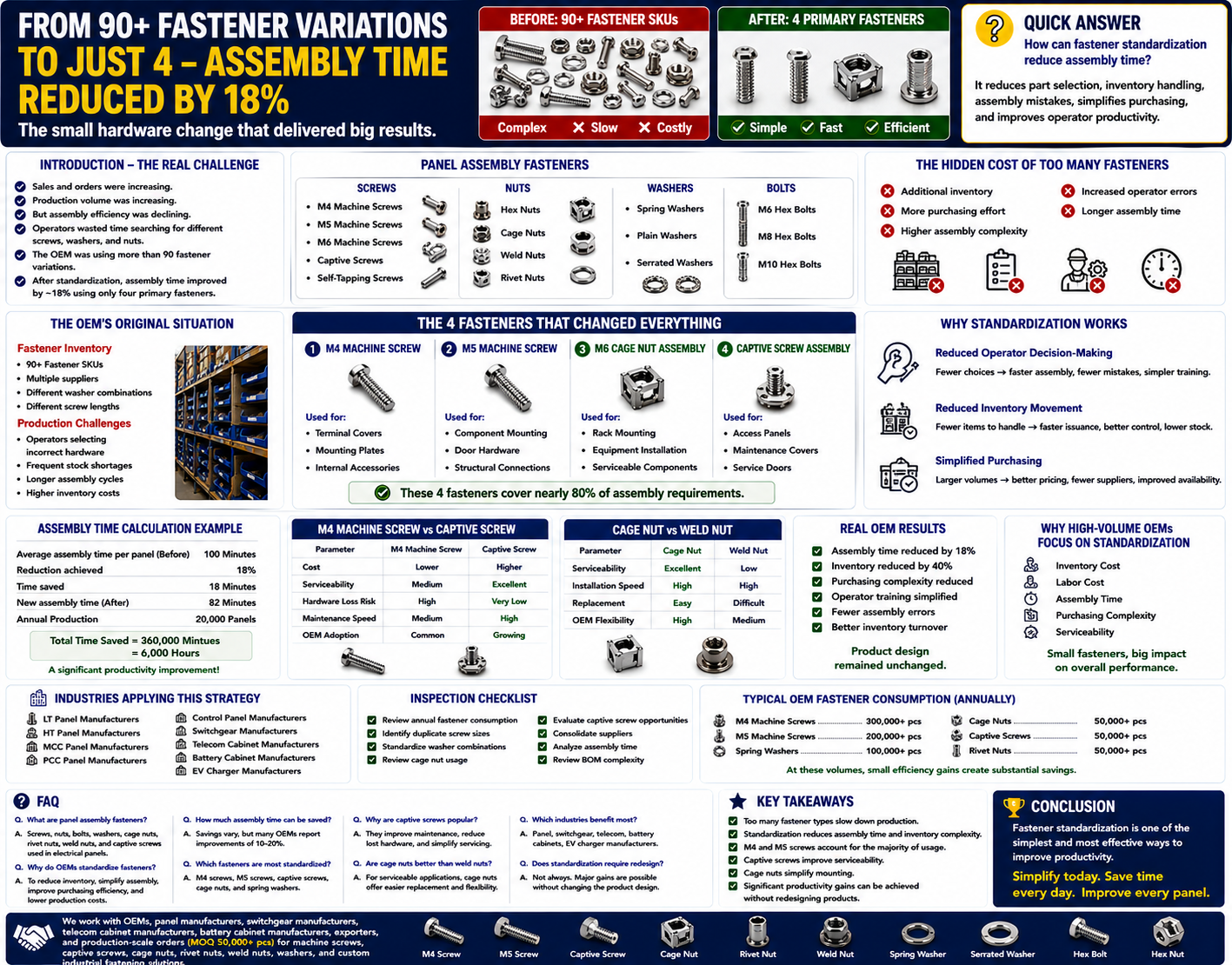
Introduction – The Factory Was Growing, But Production Was Slowing
An electrical panel manufacturer was experiencing a strange problem.
Sales were increasing.
Orders were increasing.
Production volume was increasing.
Yet assembly efficiency was declining.
Management initially blamed:
- Labor shortages
- Training issues
- Production planning
However, after conducting a time-study analysis, engineers discovered an unexpected bottleneck.
The problem was not people.
The problem was fasteners.
Operators were spending valuable time searching for:
- Different screw sizes
- Different washer combinations
- Different nut types
- Different assembly hardware
The company was using more than 90 fastener variations across its product range.
After a six-month standardization project, the OEM reduced assembly time by approximately 18%.
The surprising part?
The improvement came from using only four primary fasteners.
Quick Answer
How can fastener standardization reduce assembly time?
Fastener standardization reduces assembly complexity by minimizing part selection, reducing inventory handling, lowering assembly mistakes, simplifying purchasing, and improving operator productivity.
What Are Panel Assembly Fasteners?
Panel assembly fasteners are the hardware components used to build and assemble electrical panels.
Common examples include:
Screws
- M4 Machine Screws
- M5 Machine Screws
- M6 Machine Screws
- Captive Screws
- Self-Tapping Screws
Nuts
- Hex Nuts
- Cage Nuts
- Weld Nuts
- Rivet Nuts
Washers
- Spring Washers
- Plain Washers
- Serrated Washers
Bolts
- M6 Hex Bolts
- M8 Hex Bolts
- M10 Hex Bolts
These fasteners are used in:
- LT Panels
- HT Panels
- MCC Panels
- PCC Panels
- Control Panels
- PLC Panels
- APFC Panels
The Hidden Cost of Too Many Fasteners
Many panel manufacturers gradually accumulate fastener variations over time.
Examples:
- M4 × 10 Screw
- M4 × 12 Screw
- M4 × 16 Screw
- M5 × 10 Screw
- M5 × 12 Screw
- M5 × 16 Screw
Each variation creates:
❌ Additional inventory
❌ More purchasing effort
❌ Higher assembly complexity
❌ Increased operator errors
❌ Longer assembly time
The OEM’s Original Situation
Before optimization:
Fastener Inventory
- 90+ Fastener SKUs
- Multiple suppliers
- Different washer combinations
- Different screw lengths
Production challenges:
- Operators selecting incorrect hardware
- Frequent stock shortages
- Longer assembly cycles
- Higher inventory costs
The Four Fasteners That Changed Everything
After reviewing annual consumption data, the OEM standardized most assemblies around:
1. M4 Machine Screw
Used for:
- Terminal Covers
- Mounting Plates
- Internal Accessories
2. M5 Machine Screw
Used for:
- Component Mounting
- Door Hardware
- Structural Connections
3. M6 Cage Nut Assembly
Used for:
- Rack Mounting
- Equipment Installation
- Serviceable Components
4. Captive Screw Assembly
Used for:
- Access Panels
- Maintenance Covers
- Service Doors
These four fasteners covered nearly 80% of assembly requirements.
Why Standardization Works
Reduced Operator Decision-Making
Instead of selecting from dozens of fasteners, operators work with a limited set.
Benefits:
✔ Faster assembly
✔ Fewer mistakes
✔ Simpler training
Reduced Inventory Movement
Stores personnel handle fewer items.
Benefits:
✔ Faster material issuance
✔ Better inventory control
✔ Lower stock levels
Simplified Purchasing
Procurement teams negotiate larger volumes.
Benefits:
✔ Better pricing
✔ Fewer suppliers
✔ Improved availability
Assembly Time Calculation Example
Before standardization:
Average assembly time per panel:
100 Minutes
Reduction achieved:
18%
Time saved:
100 × 18%
= 18 Minutes
New assembly time:
82 Minutes
Annual Production:
20,000 Panels
Total Time Saved:
20,000 × 18 Minutes
= 360,000 Minutes
= 6,000 Hours
This represents a significant productivity improvement.
M4 Machine Screw vs Captive Screw
| Parameter | M4 Machine Screw | Captive Screw |
| Cost | Lower | Higher |
| Serviceability | Medium | Excellent |
| Hardware Loss Risk | High | Very Low |
| Maintenance Speed | Medium | High |
| OEM Adoption | Common | Growing |
Many OEMs now use captive screws for service access points.
Cage Nut vs Weld Nut
| Parameter | Cage Nut | Weld Nut |
| Serviceability | Excellent | Low |
| Installation Speed | High | High |
| Replacement | Easy | Difficult |
| OEM Flexibility | High | Medium |
For panel manufacturers, cage nuts often provide greater flexibility.
Real OEM Results
After implementation:
Improvements Achieved
✔ Assembly time reduced by 18%
✔ Inventory reduced by 40%
✔ Purchasing complexity reduced
✔ Operator training simplified
✔ Fewer assembly errors
✔ Better inventory turnover
Most importantly, product design remained unchanged.
Why High-Volume OEMs Focus on Fastener Standardization
Fasteners are inexpensive individually.
However, they influence:
- Inventory Cost
- Labor Cost
- Assembly Time
- Purchasing Complexity
- Serviceability
This is why many leading OEMs continuously review their fastening systems.
Industries Applying This Strategy
Fastener standardization is increasingly used by:
- LT Panel Manufacturers
- HT Panel Manufacturers
- MCC Panel Manufacturers
- PCC Panel Manufacturers
- Control Panel Manufacturers
- Switchgear Manufacturers
- Telecom Cabinet Manufacturers
- Battery Cabinet Manufacturers
- EV Charger Manufacturers
Inspection Checklist
Before launching a standardization project:
✔ Review annual fastener consumption
✔ Identify duplicate screw sizes
✔ Standardize washer combinations
✔ Review cage nut usage
✔ Evaluate captive screw opportunities
✔ Consolidate suppliers
✔ Analyze assembly time
✔ Review BOM complexity
Typical OEM Fastener Consumption
A medium-sized panel manufacturer may consume annually:
- 300,000+ M4 Machine Screws
- 200,000+ M5 Machine Screws
- 100,000+ Spring Washers
- 50,000+ Cage Nuts
- 50,000+ Captive Screws
- 50,000+ Rivet Nuts
At these volumes, small efficiency gains create substantial savings.
Key Takeaways
- Too many fastener types slow down production.
- Standardization reduces assembly time and inventory complexity.
- M4 and M5 machine screws often account for the majority of consumption.
- Captive screws improve serviceability.
- Cage nuts simplify mounting applications.
- OEM manufacturers can achieve significant productivity gains without redesigning products.
FAQ
What are panel assembly fasteners?
Panel assembly fasteners include machine screws, captive screws, cage nuts, rivet nuts, weld nuts, bolts, nuts, and washers used to assemble electrical panels.
Why do OEMs standardize fasteners?
To reduce inventory, simplify assembly, improve purchasing efficiency, and lower production costs.
How much assembly time can be saved?
Savings vary by manufacturer, but many OEMs report improvements of 10–20% after standardization.
Which fasteners are most commonly standardized?
M4 machine screws, M5 machine screws, captive screws, cage nuts, and spring washers.
Why are captive screws becoming popular?
They improve maintenance, reduce lost hardware, and simplify servicing.
Are cage nuts better than weld nuts?
For serviceable applications, cage nuts offer easier replacement and greater flexibility.
Which industries benefit most from fastener standardization?
Electrical panel manufacturers, switchgear manufacturers, telecom cabinet manufacturers, battery cabinet manufacturers, and EV charger OEMs.
Does standardization require product redesign?
Not always. Many manufacturers achieve major improvements by simply reducing duplicate fastener sizes.
Conclusion
Many OEM manufacturers focus on expensive automation projects while overlooking one of the simplest productivity improvements available.
Fastener standardization.
Reducing dozens of fastener variations to a small group of approved panel assembly fasteners can improve productivity, reduce inventory, simplify purchasing, and lower overall manufacturing cost.
For panel manufacturers producing thousands of units annually, even a few minutes saved per panel can create significant operational benefits.