

Introduction – Real Decision Problem
A buyer sends the same drawing to two suppliers.
One quotes:
👉 ₹3.20 per piece
Another quotes:
👉 ₹11.50 per piece
What changed?
👉 Manufacturing process
One is using:
Other is using:
This is one of the biggest cost and performance differences in fastener manufacturing.
Quick Answer
Which is better: cold forging or CNC machining for fasteners?
Cold forging is better for high-volume production with lower cost and higher strength, while CNC machining is suitable for low-volume, complex, or customized fasteners.
What is Cold Forging?
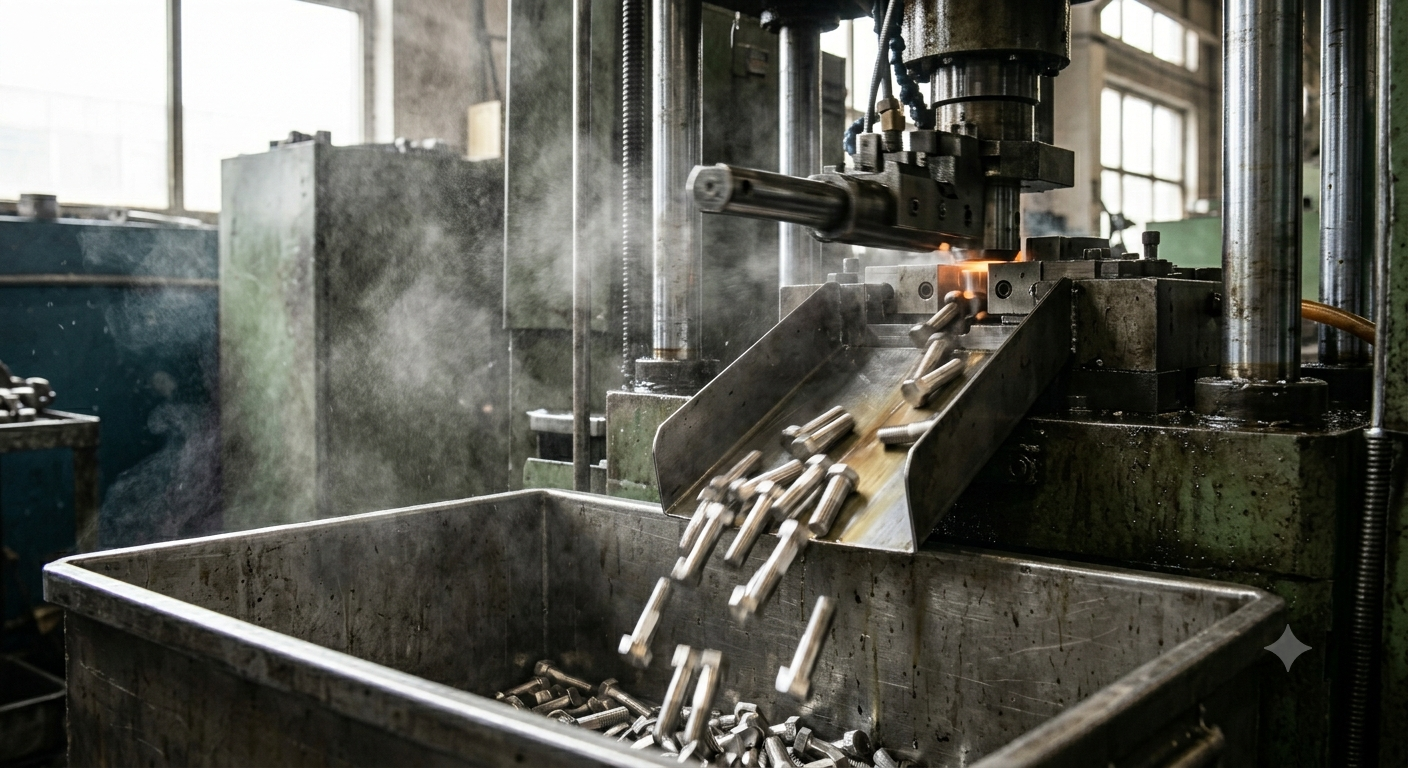
Cold forging is a manufacturing process where metal wire is shaped into a fastener using high pressure without removing material.
Key Characteristics
✔ High-speed production
✔ No material waste
✔ Grain flow improves strength
What is CNC Machining?
CNC machining is a subtractive process where material is removed from a rod or bar to create the fastener.
Key Characteristics
✔ High precision
✔ Flexible design
✔ Suitable for complex parts
Core Difference
👉 Cold forging = Forming process
👉 CNC machining = Cutting process
Cost Comparison
| Parameter | Cold Forging | CNC Machining |
| Cost per piece | Very Low | High |
| Setup cost | High | Low |
| Best quantity | 50,000+ pcs | Low volume |
| Material waste | Minimal | High |
Insight
👉 Forging becomes cheaper as quantity increases
👉 Machining stays expensive per piece
Strength Comparison
Cold Forged Fasteners
✔ Continuous grain flow
✔ Higher fatigue strength
✔ Better load handling
CNC Machined Fasteners
❌ Grain structure cut
❌ Lower fatigue resistance
👉 Forging produces stronger fasteners
Production Speed
Cold Forging
👉 100–300 pcs per minute
CNC Machining
👉 1–5 pcs per minute
👉 Not even comparable
Design Flexibility
CNC Machining Advantage
✔ Complex shapes
✔ Custom profiles
✔ Low quantity
Cold Forging Limitation
❌ Requires standard shapes
❌ Tooling required
👉 Machining wins in flexibility
Tooling Requirement
Cold Forging
✔ Requires dies
✔ Initial cost high
CNC Machining
✔ No dedicated tooling
✔ Faster to start
👉 Machining better for prototyping
Typical OEM Production Scenario
For fasteners like:
OEMs use:
👉 Cold forging for 50,000–200,000 pcs batches
CNC machining used for:
👉 Special parts
👉 Development
👉 Low-volume jobs
When to Use Cold Forging
✔ High-volume production
✔ Standard fasteners
✔ Cost-sensitive projects
✔ Structural applications
When to Use CNC Machining
✔ Low quantity
✔ Complex geometry
✔ Tight tolerance
✔ Prototype development
Real Cost Example
Cold Forging
- Tooling: ₹25,000
- Production: ₹2.5 per piece
CNC Machining
- No tooling
- Production: ₹10–₹15 per piece
👉 At volume, forging wins massively
Common Buyer Mistakes
- Choosing machining for bulk orders
- Avoiding tooling cost
- Not understanding process
- Comparing prices without process clarity
👉 This leads to high cost
OEM Strategy
OEMs:
✔ Start with CNC for prototype
✔ Shift to forging for production
✔ Standardize design
✔ Increase batch size
👉 This reduces cost drastically
Key Takeaways
• Cold forging is best for high-volume fasteners
• CNC machining is suitable for low-volume or complex parts
• Forging provides higher strength due to grain flow
• Machining offers design flexibility
• OEMs use both processes strategically
FAQ
Q1: Which process is cheaper for fasteners?
Cold forging is much cheaper for high-volume production because it produces parts quickly with minimal material waste. CNC machining becomes expensive as it removes material and takes more time per piece. At scale, the cost difference is significant.
Q2: Which process produces stronger fasteners?
Cold forging produces stronger fasteners because the grain flow of the material remains continuous. This improves fatigue strength and load capacity. CNC machining cuts through the grain, reducing structural strength.
Q3: Why is CNC machining still used?
CNC machining is used for low-volume production, prototypes, and complex designs that cannot be forged. It offers flexibility and precision. However, it is not cost-effective for bulk fastener production.
Q4: When should I switch from machining to forging?
Once your quantity reaches around 50,000 pcs or more, switching to cold forging becomes more economical. At this stage, tooling cost is justified. OEMs follow this transition to optimize cost.
Q5: Is tooling cost a disadvantage in forging?
Initially yes, but over large quantities, tooling cost becomes negligible per piece. It is a one-time investment. Over time, it significantly reduces overall cost.
Q6: Can all fasteners be cold forged?
No, some complex geometries or special designs require machining. Cold forging is best for standard shapes like bolts, screws, and nuts. Design plays a major role in process selection.
Q7: How do OEMs choose between forging and machining?
OEMs consider quantity, design complexity, cost targets, and performance requirements. They often prototype with machining and shift to forging for production. This hybrid approach balances flexibility and cost.
Conclusion
Cold forging vs machining is not a simple choice.
👉 It is a strategic decision
If you choose wrong:
👉 Your cost increases
👉 Your strength reduces
If you choose right:
✔ Lower cost
✔ Better performance
✔ Scalable production
👉 We support OEMs with both forged and machined fasteners for production-scale requirements (MOQ 50,000+ pcs).Not sure whether your fastener should be forged or machined?
Share your drawing and quantity (50,000+ pcs), and we’ll recommend the most cost-effective manufacturing method.