

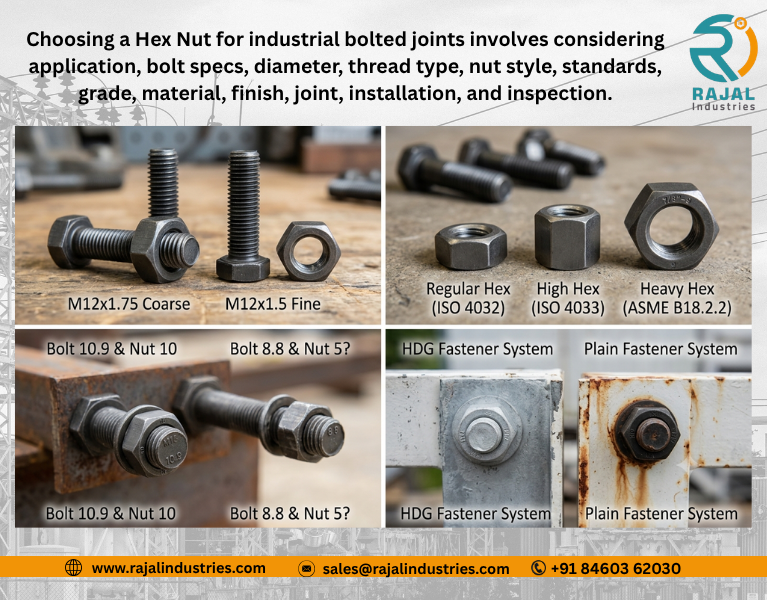
Choosing the correct Hex Nut is not simply a matter of matching the nut diameter with a bolt.
Industrial buyers should evaluate the complete fastening system:
Application → Bolt/Threaded Rod → Diameter → Thread → Nut Style → Nut Grade → Material → Standard → Finish → Mechanical Requirements → Installation
A nut can screw perfectly onto a bolt and still be technically incorrect.
For construction, EPC, solar, PEB, machinery and fabrication projects, this Hex Nut Selection Guide explains how to select nuts based on the actual joint requirement instead of price or availability alone.
Quick Answer: How Do You Select the Correct Hex Nut?
Start with the mating bolt, screw or threaded rod. Match the nominal diameter, thread pitch, thread system and required mechanical compatibility. Then select the correct nut style, dimensional standard, property class or grade, material, finish and application requirements. Thread fit alone does not prove that a nut is suitable for the joint.
The Correct Hex Nut Selection Sequence
Use this order:
Application
↓
Mating Bolt / Threaded Rod
↓
Metric or Inch Thread
↓
Diameter
↓
Pitch / TPI
↓
Nut Style
↓
Dimensional Standard
↓
Nut Property Class / Grade
↓
Material
↓
Finish / Coating
↓
Mechanical Requirements
↓
Installation
↓
Inspection & Documentation
This sequence reduces procurement errors.
Step 1: Identify the Application
Before selecting a nut, ask:
Where will the fastener be used?
A nut for general fabrication may have different requirements from a nut used in:
- Structural steel
- Solar mounting
- PEB construction
- Heavy machinery
- Automotive equipment
- Electrical equipment
- Outdoor infrastructure
The application determines the next technical questions.
Step 2: Start With the Bolt or Threaded Rod
The mating fastener is one of the most important inputs.
Identify whether the nut will mate with a:
- Hex bolt
- structural bolt
- threaded rod
- stud
- anchor rod
- machine screw
- special fastener
Then confirm its specification.
Why You Should Not Select the Nut First
Suppose a buyer needs:
That information does not tell us:
- Thread pitch
- bolt property class
- nut property class
- nut style
- material
- finish
- application
Therefore, M16 alone is not a complete specification.
Step 3: Confirm Metric or Inch Thread
First determine the thread system.
Metric Example
M16 × 2.0
means:
- M = ISO metric thread
- 16 mm = nominal diameter
- 2.0 mm = thread pitch
Inch Example
5/8″-11 UNC
means:
- 5/8″ = nominal diameter
- 11 = threads per inch
- UNC = Unified National Coarse
Do not mix metric and inch components.
Step 4: Match the Nominal Diameter
The nut and mating fastener must use compatible nominal thread diameters.
Examples:
M8 Bolt → M8 Nut
M12 Threaded Rod → M12 Nut
M16 Bolt → M16 Nut
3/4″-10 Bolt → Compatible 3/4″-10 Nut
But diameter is only the first compatibility check.
Step 5: Match Thread Pitch or TPI
Two fasteners can have the same nominal diameter but different threads.
For example:
M12 × 1.75
and
M12 × 1.5
are both nominally M12 but have different pitches.
Likewise, inch threads can have different TPI values.
Never force a nut onto a fastener with the wrong pitch.
Coarse Thread vs Fine Thread
Industrial nuts can be specified with coarse or fine threads.
Selection should follow the approved mating fastener and design requirement.
Do not assume:
Fine thread is always stronger.
or:
Coarse thread is always better for construction.
Thread selection depends on the actual joint and specification.
Common Metric Coarse Thread Examples
Typical metric coarse thread designations include:
| Diameter | Common Coarse Pitch |
| M5 | 0.8 mm |
| M6 | 1.0 mm |
| M8 | 1.25 mm |
| M10 | 1.5 mm |
| M12 | 1.75 mm |
| M16 | 2.0 mm |
| M20 | 2.5 mm |
| M24 | 3.0 mm |
| M30 | 3.5 mm |
| M36 | 4.0 mm |
These are useful identification examples. Final procurement should follow the specified thread standard and drawing.
Common Inch UNC Examples
| Diameter | Common UNC Thread |
| 1/4″ | 1/4″-20 |
| 5/16″ | 5/16″-18 |
| 3/8″ | 3/8″-16 |
| 1/2″ | 1/2″-13 |
| 5/8″ | 5/8″-11 |
| 3/4″ | 3/4″-10 |
| 7/8″ | 7/8″-9 |
| 1″ | 1″-8 |
Again, the mating fastener specification controls.
Step 6: Select the Correct Nut Style
Not every nut with six sides is technically the same product.
Common industrial nut styles can include:
- Regular hex nut
- High hex nut
- Heavy hex nut
- Thin/jam nut
- Flange nut
- Lock nut
- Nyloc nut
- Structural nut
- Specialized nuts
The required geometry should come from the joint design or product standard.
Regular Hex Nut
A regular Hex Nut is widely used in:
- Machinery
- general fabrication
- equipment
- construction
- industrial assemblies
For metric applications, ISO 4032 is an important standard for regular hex nuts, style 1.
ISO 4032:2023 Regular Hex Nuts
The current ISO 4032:2023 specifies regular hex nuts, style 1, in steel and stainless steel with:
- Metric coarse pitch thread
- M5 to M39
- Product grades A and B
For other specified mechanical requirements, the standard references relevant nut property-class and stainless-steel standards.
Product Grade Is Not Mechanical Property Class
This distinction is important.
Product Grade A or B
Relates primarily to dimensional/product accuracy requirements.
Property Class 8, 10, 12, etc.
Relates to mechanical-property requirements under the applicable standard.
Therefore:
Product Grade A ≠ Property Class 8
These terms should not be used interchangeably.
High Hex Nut
A high nut has a different height/style from a regular nut.
For current metric ISO requirements, ISO 4033:2023 covers hexagon high nuts, style 2.
Do not call every tall nut a heavy hex nut.
Heavy Hex Nut
Heavy hex is another dimensional pattern commonly encountered in applicable inch structural and industrial bolting systems.
It should not be confused with:
- Metric high nut
- regular hex nut
- jam nut
ASME B18.2.2-2022 covers applicable inch-series nut forms including heavy hex nuts.
Thin or Jam Nut
Thin/jam nuts have reduced height compared with regular nuts.
Do not replace a full-height nut with a thin nut merely because:
- Diameter matches
- pitch matches
- wrench size appears similar
Mechanical and functional requirements can differ.
Step 7: Select the Correct Hex Nut Standard
A complete specification may require more than one standard.
For example:
Dimensional Standard + Mechanical Standard + Material Standard + Coating Standard
The standards answer different technical questions.
Important Standards for Hex Nut Selection
| Standard | Main Purpose |
| ISO 4032:2023 | Metric regular hex nut style 1 characteristics |
| ISO 4033:2023 | Metric high hex nut style 2 characteristics |
| ISO 898-2:2022 | Carbon/alloy-steel nut mechanical properties |
| ISO 3506-2:2020 | Stainless-steel nut mechanical properties |
| ASME B18.2.2-2022 | Applicable inch-series nut dimensions |
Additional standards may apply depending on the product, coating and application.
Step 8: Select the Correct Hex Nut Grade
Hex Nut Grades should be selected based on the mating fastener and applicable engineering specification.
For ISO metric carbon/alloy-steel nuts, ISO 898-2:2022 includes property classes:
04, 05, 5, 6, 8, 10 and 12
within its defined scope.
But buyers should not simply choose the highest number.
Higher Property Class Is Not Automatically Better
A common procurement mistake is:
Bolt is important, so use the highest nut class available.
This is not a reliable selection method.
Nut property class should be compatible with:
- Mating bolt/screw/stud
- joint design
- application
- applicable standard
The correct class is the specified compatible class, not simply the highest class.
ISO 898-2:2022 Scope
ISO 898-2:2022 covers mechanical and physical properties of applicable non-alloy and alloy-steel nuts with:
- Metric threads
- Coarse pitch M5 to M39
- Fine pitch M8×1 to M39×3
- Defined thread tolerances
- Specified nut property classes
- Regular, high and thin nut styles
It also includes compatibility principles for mating bolts, screws and studs.
Bolt Property Class vs Nut Property Class
The bolt and nut both have mechanical requirements, but their designation systems should not be treated casually.
The correct selection should follow the compatibility requirements of the applicable standards.
For example, do not simply conclude:
Bolt 8.8 = Nut 8 because the numbers look similar.
Use the controlled compatibility requirements.
Hex Nut Grade vs Material
Grade and material are also different.
For example:
Carbon Steel describes a material family.
Property Class 8 describes mechanical requirements.
Stainless Steel A4-70 follows a different material/property designation system.
Therefore:
Material ≠ Property Class ≠ Product Grade
Step 9: Select the Nut Material
Common material families can include:
- Carbon steel
- Alloy steel
- Stainless steel
- Other specified materials
Material should be selected based on:
- Mechanical requirements
- environment
- corrosion
- temperature
- mating fastener
- project specification
Carbon Steel Hex Nuts
Carbon-steel Industrial Nuts are widely used for suitable:
- Construction
- machinery
- fabrication
- equipment
- general industrial assemblies
Mechanical property requirements should still be specified.
Do not order simply:
Carbon Steel Nut
when the joint requires a defined property class.
Alloy Steel Nuts
Alloy-steel nut requirements may appear in higher-demand or specialized bolting systems.
Material chemistry alone does not define finished mechanical compliance.
Heat treatment and mechanical testing may also be important.
Stainless Steel Hex Nuts
Stainless steel may be selected where corrosion resistance is required.
But:
Stainless Steel ≠ Automatically SS316
Common stainless fastener systems can include different stainless grades.
The correct grade depends on the service environment and project requirements.
ISO 3506-2:2020 Stainless Nuts
ISO 3506-2:2020 specifies mechanical and physical properties for corrosion-resistant stainless-steel nuts with specified grades and property classes.
It covers applicable:
- Austenitic
- martensitic
- ferritic
- duplex stainless steels
and remains current after review and confirmation in 2025.
Stainless Steel Selection Requires Environment Review
Consider:
- Indoor/outdoor use
- humidity
- coastal exposure
- chemical exposure
- cleaning agents
- temperature
- galvanic compatibility
- maintenance
Do not select stainless steel only because it “does not rust.”
Step 10: Select the Correct Surface Finish
Possible finishes can include:
- Plain
- zinc plated
- hot-dip galvanized
- other project-specified coatings
The coating should be selected based on:
Environment + Mating Fastener + Thread Fit + Corrosion Requirement + Installation
Plain Hex Nuts
Plain nuts may be appropriate for suitable controlled applications.
They still require the correct:
- Grade
- thread
- dimensions
- mechanical properties
“Plain” only describes surface condition.
Zinc-Plated Hex Nuts
Zinc plating can provide corrosion protection for suitable applications.
The required coating specification and thickness should be defined where important.
Do not specify only:
Silver Zinc
when engineering requires a controlled coating system.
Hot-Dip Galvanized Hex Nuts
Hot-dip galvanized nuts are common in suitable outdoor and infrastructure applications.
Potential examples include:
- Solar structures
- PEB
- structural steel
- outdoor fabrication
- utility projects
But galvanizing affects threaded fit and must be controlled as a complete bolt/nut system.
Hot-Dip Galvanized Nut Thread Compatibility
The coating on the external bolt thread occupies space.
The nut-thread system must provide the required compatibility according to the applicable galvanizing and fastener standards.
Do not apply an arbitrary universal over-tapping allowance.
Coating Changes Can Affect Nut Selection
Changing a fastener from:
Plain → Zinc Plated → Hot-Dip Galvanized
should not be treated as a cosmetic change.
It can affect:
- Thread fit
- friction
- installation
- nut compatibility
- corrosion performance
Recheck the complete fastener system.
Step 11: Check Bolt and Nut Mechanical Compatibility
Before approving the nut, confirm:
| Requirement | Bolt/Rod | Nut |
| Diameter | Defined | Compatible |
| Pitch/TPI | Defined | Compatible |
| Thread System | Defined | Compatible |
| Mechanical Class/Grade | Defined | Approved |
| Material | Defined | Suitable |
| Finish | Defined | Compatible |
| Application | Approved | Approved |
This is more reliable than simply checking whether the nut threads onto the bolt.
Thread Fit Does Not Prove Mechanical Compatibility
A low-property nut may fit a higher-demand bolt perfectly.
Likewise, a nut with the wrong material or finish may assemble correctly.
Therefore:
Successful Assembly ≠ Correct Engineering Selection
Step 12: Consider the Joint Design
The nut is one component of the bolted joint.
The complete joint can include:
Bolt/Stud + Nut + Washer + Connected Parts + Coating + Installation
Each component affects performance.
Washer Selection
A washer may be required depending on:
- Joint design
- bolt specification
- surface
- hole
- material
- installation method
Do not assume a washer is always required or never required.
Follow the applicable design/specification.
Nut Bearing Surface
The nut transfers clamp force through its bearing surface into:
- Washer
- plate
- bracket
- flange
- equipment component
The joint surface must be suitable for the intended bolting system.
Step 13: Consider Installation Requirements
Installation can depend on:
- Bolt size
- bolt grade
- nut grade
- coating
- lubrication
- required preload
- tool
- tightening procedure
There is no universal tightening torque based only on Hex Nut Sizes.
Avoid Generic Torque Values
Do not publish or use a rule such as:
M16 Hex Nut = X Nm
without defining the complete bolting system.
Torque depends strongly on:
- Bolt grade
- friction
- finish
- lubrication
- joint requirement
Torque vs Clamp Force
Tightening Torque
Rotational input applied during installation.
Clamp Force
Force holding the joint components together.
The relationship depends strongly on friction.
This is why changing coating or lubricant can change tightening behaviour.
Hex Nut Selection for Threaded Rods
When selecting a nut for threaded rod, confirm:
- Rod standard
- diameter
- pitch
- rod grade/property class
- nut compatibility
- material
- finish
- application
Do not assume all threaded rods of the same diameter have identical mechanical properties.
Threaded Rod Grade Matters
For example, two M16 threaded rods can have:
- Different materials
- different mechanical grades
- different coatings
- different intended applications
Therefore, both may require different engineering consideration even though an M16 nut physically fits both.
Hex Nuts for Anchor Rods
Anchor systems can require:
- Specific rod material
- specific nut grade
- plate washer
- coating
- embedment design
- installation requirements
Do not select anchor nuts based only on thread diameter.
Hex Nut Selection for Construction
Construction applications can include:
- General steelwork
- equipment installation
- support frames
- brackets
- fabrication
- anchor systems
The correct Hex Nut Grades depend on the specified bolt/rod and joint.
Hex Nut Selection for EPC Projects
EPC procurement often requires more than dimensional compliance.
The buyer may need:
- Approved standard
- material certificate
- mechanical test report
- dimensional report
- coating report
- traceability
- Certificate of Conformity
- ITP/TPI requirements
These should be defined before production.
Hex Nut Selection for Solar Projects
Solar projects can use Industrial Nuts in:
- Module mounting
- structural supports
- equipment frames
- cable/electrical support systems
- foundation-related assemblies
Important selection factors can include:
- Outdoor corrosion
- mating bolt/rod
- material compatibility
- coating
- maintenance
- project specification
Do Not Assume Every Solar Nut Should Be Stainless Steel
Solar structures can use different fastener material and coating systems depending on:
- Structural design
- location
- environment
- mating components
- customer specification
Use the approved project BOM.
Hex Nut Selection for PEB
PEB applications can include:
- Structural framing
- secondary structures
- accessories
- equipment supports
Some connections may require specialized structural bolting rather than general-purpose regular hex nuts.
Do not replace a specified structural nut with a generic hex nut.
Hex Nut Selection for Machinery
Machinery selection should consider:
- Load
- vibration
- maintenance
- temperature
- assembly frequency
- bolt grade
- locking requirement
A standard hex nut does not automatically provide a locking function.
Hex Nut Selection for Fabrication
General fabrication can include:
- Frames
- platforms
- guards
- supports
- brackets
- equipment structures
Even simple fabrication should define at least:
Size + Thread + Grade + Material + Finish
where mechanical requirements matter.
Hex Nut vs Lock Nut
A standard hex nut and lock nut perform different functions.
A regular hex nut does not automatically provide:
- Prevailing torque
- self-locking
- vibration resistance
If loosening is a design concern, evaluate the approved locking method separately.
Hex Nut vs Flange Nut
A flange nut incorporates an enlarged flange/bearing feature.
A regular hex nut does not.
Do not assume a flange nut can replace:
Hex Nut + Washer
in every joint.
The joint design controls.
Hex Nut vs Nyloc Nut
A Nyloc-type nut includes a non-metallic insert that creates prevailing torque.
A regular hex nut does not.
Use Nyloc-type nuts only where:
- Temperature
- reuse
- installation
- locking requirements
are suitable for the selected product.
Hex Nut vs Heavy Hex Nut
Heavy hex nuts generally have a larger external wrenching geometry than regular hex nuts of the same nominal thread size.
Do not interchange them based only on thread compatibility.
Hex Nut vs Jam Nut
A jam/thin nut has reduced height.
It should not automatically replace a regular full-height nut.
The mechanical and functional requirements differ.
Common Hex Nut Selection Mistakes
Avoid these mistakes:
- Selecting only by diameter.
- Ignoring thread pitch.
- Mixing metric and inch threads.
- Confusing product grade with property class.
- Selecting the highest nut class without checking compatibility.
- Assuming stainless always means SS316.
- Changing coating without checking thread fit.
- Using generic torque charts.
- Treating a regular hex nut as a lock nut.
- Replacing a structural nut with a generic nut.
- Ignoring the threaded-rod grade.
- Checking only whether the nut physically fits.
- Ignoring service temperature.
- Ignoring corrosion environment.
- Purchasing before confirming the applicable standard.
Hex Nut Selection Decision Table
| Question | What Buyer Should Confirm |
| What is the application? | Construction/EPC/Solar/PEB/Machinery |
| What is the mating fastener? | Bolt/stud/threaded rod |
| Metric or inch? | Thread system |
| What size? | Nominal diameter |
| What thread? | Pitch/TPI |
| What nut style? | Regular/high/heavy/thin/etc. |
| What standard? | ISO/ASME/project |
| What grade? | Compatible property class/grade |
| What material? | Carbon/alloy/stainless/etc. |
| What finish? | Plain/plated/HDG/etc. |
| Locking required? | Evaluate locking system |
| Corrosion exposure? | Material/coating selection |
| Installation requirement? | Approved procedure |
| Documentation? | MTC/DIR/test reports as required |
Hex Nut RFQ Checklist
A useful RFQ should include:
☐ Application
☐ Mating bolt/threaded rod specification
☐ Bolt/rod grade
☐ Nominal diameter
☐ Thread pitch/TPI
☐ Metric/inch system
☐ Nut style
☐ Dimensional standard
☐ Nut grade/property class
☐ Material
☐ Finish/coating
☐ Testing requirements
☐ Marking
☐ Documentation
☐ Quantity
Poor Hex Nut RFQ
Need M16 nuts. Qty 100,000. Best price?
This leaves major technical requirements undefined.
Better Hex Nut RFQ
Product: Hex Nut
Application: Industrial equipment frame
Mating Bolt: M16 × 2.0, specification attached
Nut Style: Regular hex, style 1
Dimensions: ISO 4032
Property Class: As approved bolt/nut specification
Material: Carbon steel
Finish: Project requirement attached
Testing: As applicable standard
Quantity: 100,000 pcs
This gives the supplier a measurable technical requirement.
How Do I Choose a Hex Nut for a Bolt?
Match the bolt’s diameter, thread pitch, thread system and applicable mechanical requirements first. Then select the correct nut style, dimensional standard, property class or grade, material and finish. A nut that physically threads onto a bolt is not automatically mechanically compatible.
How Do I Choose a Nut for Threaded Rod?
Identify the threaded rod’s diameter, pitch, material or mechanical grade, coating and application. Select a nut with compatible threads and an approved mechanical/material specification rather than choosing by diameter alone.
What Are Common Hex Nut Grades?
For applicable ISO metric carbon/alloy-steel nuts, ISO 898-2:2022 includes property classes 04, 05, 5, 6, 8, 10 and 12. The correct property class should be selected for compatibility with the mating fastener and application.
What Is ISO 4032?
ISO 4032:2023 specifies characteristics of metric regular hex nuts, style 1, in steel and stainless steel with coarse threads from M5 to M39 and product grades A and B.
Is Product Grade A the Same as Nut Class 8?
No. Product grade relates to dimensional/product accuracy, while property class relates to mechanical requirements. They are different classifications.
Can Any M16 Nut Fit an M16 Bolt?
Not necessarily. The diameter may match while the pitch, thread tolerance, mechanical property class, material or application requirements differ. Check the complete bolt and nut specifications.
Is a Higher Nut Grade Always Better?
No. Select the nut property class or grade required for the mating fastener and joint. A numerically higher class should not be substituted automatically without checking the applicable standard and engineering specification.
Can a Regular Hex Nut Replace a Lock Nut?
Not automatically. A standard hex nut does not provide a prevailing-torque locking feature. If the joint requires resistance to loosening, use the locking system specified by the design.
Industrial Buyer Checklist
Before selecting a Hex Nut, confirm:
☐ Application
☐ Mating bolt/screw/stud/threaded rod
☐ Mating fastener standard
☐ Mating fastener grade
☐ Metric or inch
☐ Nominal diameter
☐ Pitch/TPI
☐ Thread series
☐ Thread tolerance/class
☐ Nut style
☐ Dimensional standard
☐ Product grade where applicable
☐ Nut property class/grade
☐ Material
☐ Environment
☐ Temperature
☐ Corrosion requirement
☐ Finish/coating
☐ Bolt/nut coating compatibility
☐ Locking requirement
☐ Washer requirement
☐ Installation method
☐ Mechanical testing
☐ Thread inspection
☐ Dimensional inspection
☐ Marking
☐ Traceability
☐ MTC/RMTC where required
☐ DIR where required
☐ Coating report where required
☐ ITP/TPI where required
☐ Quantity
Conclusion: Select the Nut as Part of the Bolted Joint
A reliable Hex Nut Selection Guide should never begin and end with nut diameter.
Use:
Application → Bolt/Threaded Rod → Diameter → Thread → Nut Style → Standard → Nut Grade → Material → Finish → Joint → Installation → Inspection
Remember:
Same Diameter ≠ Same Thread
Thread Fit ≠ Mechanical Compatibility
Product Grade ≠ Property Class
Material ≠ Mechanical Grade
Heavy Hex ≠ Regular Hex
Standard Hex Nut ≠ Lock Nut
Higher Grade ≠ Automatically Better
Nut Size ≠ Tightening Torque
For construction, EPC, solar, PEB, machinery and fabrication projects, selecting the complete bolting system reduces assembly problems, field failures and procurement errors.
Rajal Industries can evaluate standard and customer drawing-based Hex Nuts, Hex Nut Grades, Hex Nut Sizes and related Industrial Nuts, subject to technical feasibility, manufacturing process, material availability, testing and customer/project approval.
Need Help Selecting Hex Nuts for Bolts or Threaded Rods?
Send Rajal Industries:
Application + Bolt/Threaded Rod Specification + Size + Thread + Grade + Material + Finish + Drawing + Testing + Quantity
for technical feasibility and quotation review.