

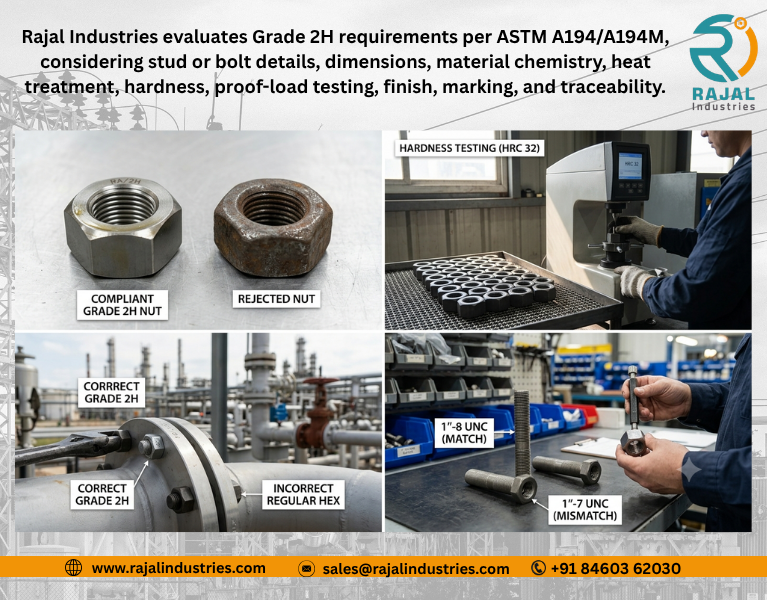
An ASTM A194 Grade 2H Nut is a controlled industrial fastener used in specified high-pressure or high-temperature bolting systems, or both.
Selecting the correct nut requires more than identifying a thread diameter.
A complete technical specification should consider:
ASTM Grade → Mating Bolt/Stud → Diameter → Thread → Nut Style → Dimensions → Material → Heat Treatment → Mechanical Properties → Finish → Testing → Marking → Traceability
For oil & gas, petrochemical, refinery, power-plant and pressure-equipment projects, each of these requirements can affect final acceptance.
Quick Answer: What Is an ASTM A194 Grade 2H Nut?
An ASTM A194 Grade 2H Nut is a heat-treated carbon-steel nut grade within ASTM A194/A194M, a specification covering nuts intended for high-pressure or high-temperature service, or both.
Grade 2H identifies the material/mechanical grade.
It does not independently define every:
- Dimension
- thread
- finish
- mating stud
- installation requirement
Those must be specified separately.
Current Standard: ASTM A194/A194M-26
The current active edition is:
ASTM A194/A194M-26
ASTM lists it as active and last updated on February 19, 2026.
The specification covers carbon steel, alloy steel and stainless steel nuts intended for high-pressure or high-temperature service, or both.
For current procurement, buyers should verify the edition required by the contract or project specification.
ASTM A194/A194M Size Scope
The current ASTM specification covers carbon, alloy and martensitic stainless-steel nuts in nominal sizes:
1/4″ through 4″
and metric:
M12 through M100
It also covers austenitic stainless-steel nuts from:
1/4″ and M12 nominal upward.
This is the overall ASTM A194/A194M specification scope.
It does not mean every grade, nut style or material condition is automatically applicable to every size.
ASTM A194 Grade 2H vs ASTM A194 Standard
This distinction matters.
ASTM A194/A194M
The complete specification contains multiple material/grade families.
Grade 2H
One specific grade within that specification.
Therefore:
ASTM A194 Nut ≠ Automatically Grade 2H
When Grade 2H is required, the PO should state it clearly.
ASTM A194 Grade 2H vs Heavy Hex Nut
These terms describe different characteristics.
| Term | What It Defines |
| ASTM A194/A194M | Nut material/mechanical specification family |
| Grade 2H | Specific grade |
| Heavy Hex | Nut dimensional form |
| UNC/Other Thread | Thread system |
| Coating | Surface condition |
| Mating Stud | Bolting-system compatibility |
Therefore, an ASTM A194 Grade 2H Heavy Hex Nut combines multiple requirements.
What Is a 2H Heavy Hex Nut?
A 2H Heavy Hex Nut is a nut specified to:
- ASTM A194/A194M Grade 2H material/mechanical requirements, and
- The applicable heavy-hex dimensional requirements.
Do not assume Grade 2H alone defines heavy-hex dimensions.
ASTM A194 Controls Material & Mechanical Requirements
ASTM A194/A194M controls important requirements related to areas such as:
- Material
- chemistry
- heat treatment
- mechanical testing
- hardness
- proof-load testing
- marking
- other grade requirements
The applicable dimensional standard provides the detailed nut geometry.
ASME B18.2.2 Controls Inch Heavy Hex Nut Dimensions
For applicable inch-series heavy hex nuts, ASME B18.2.2-2022 provides the dimensional requirements.
ASME B18.2.2-2022 contains a dedicated table for:
Heavy Hex Nuts and Heavy Hex Jam Nuts
Therefore, for an inch-series ASTM A194 Grade 2H Nut, buyers may need both:
ASTM A194/A194M + ASME B18.2.2
along with the thread and project requirements.
ASTM A194 vs ASME B18.2.2
| Requirement | ASTM A194/A194M | ASME B18.2.2 |
| Grade 2H | Yes | No |
| Material Requirements | Yes | No |
| Mechanical Requirements | Yes | No |
| Heavy Hex Geometry | Not the main dimensional source | Yes |
| Width Across Flats | Refer to applicable dimensional requirement | Yes |
| Nut Height | Refer to applicable dimensional requirement | Yes |
| Heavy Hex Nut Tables | Not its primary role | Yes |
This is why buyers should not use one standard as a substitute for the other.
A194 2H Nut Dimensions
Important A194 2H Nut Dimensions for a heavy hex product include:
- Nominal thread diameter
- Thread pitch or threads per inch
- Width across flats
- Width across corners
- Nut height
- Bearing surface
- Chamfer
- Thread dimensions
The controlled dimensional standard should be used for final values and tolerances.
Why We Should Not Copy a Full ASME Dimension Table
A technical blog can explain how dimensions work, but the official standard should remain the final manufacturing and inspection authority.
Using the controlled ASME table helps prevent:
- Wrong nut style
- old revision errors
- transcription errors
- incorrect tolerances
- mixing regular hex and heavy hex
- mixing inch and metric dimensions
This guide therefore explains the dimensional system rather than reproducing the complete copyrighted standard table.
Nominal Thread Diameter
The nominal diameter identifies the mating thread size.
Common inch designations encountered in industrial bolting can include:
- 1/2″
- 5/8″
- 3/4″
- 7/8″
- 1″
- 1-1/8″
- 1-1/4″
- 1-1/2″
- 1-3/4″
- 2″
- Larger sizes within applicable specification requirements
The diameter alone does not complete the specification.
Common Coarse Inch Thread Examples
Common UNC designations include:
| Nominal Diameter | Common UNC Thread |
| 1/2″ | 1/2″-13 UNC |
| 5/8″ | 5/8″-11 UNC |
| 3/4″ | 3/4″-10 UNC |
| 7/8″ | 7/8″-9 UNC |
| 1″ | 1″-8 UNC |
| 1-1/8″ | 1-1/8″-7 UNC |
| 1-1/4″ | 1-1/4″-7 UNC |
| 1-1/2″ | 1-1/2″-6 UNC |
These are thread-designation examples, not a statement that every Grade 2H application must use UNC.
The mating stud/bolt and project specification control.
Example: 1″-8 UNC ASTM A194 Grade 2H Nut
Consider:
1″-8 UNC ASTM A194 Grade 2H Heavy Hex Nut
This identifies:
1″ = nominal thread diameter
8 = threads per inch
UNC = Unified National Coarse thread
ASTM A194 = material/mechanical specification
2H = nut grade
Heavy Hex = nut style
The project may still need to specify:
- Dimensional standard
- thread class
- finish
- coating
- marking
- testing
- documentation
Thread Size Does Not Define Grade
A 1-inch nut can be manufactured to different material and mechanical specifications.
Therefore:
1″ Nut ≠ Grade 2H
Likewise:
Grade 2H ≠ One Fixed Diameter
Always define size and grade separately.
Width Across Flats
Width across flats is the distance between two opposite wrenching surfaces.
It determines important practical factors such as:
- Wrench size
- socket size
- tooling
- equipment clearance
- maintenance access
Heavy hex geometry generally has a larger wrenching envelope than a corresponding regular hex pattern.
Width Across Corners
Width across corners defines the maximum envelope across opposite hex corners.
This matters when the nut is close to:
- Flange geometry
- piping components
- equipment walls
- adjacent fasteners
- structural members
Tool clearance should also be considered.
Nut Height
Nut height is an axial dimensional requirement.
It affects:
- Overall assembly length
- thread engagement
- stud projection
- wrench/socket access
- dimensional compliance
But:
Greater Nut Height ≠ Automatically Greater Joint Capacity
The complete bolting system determines performance.
Bearing Surface
The nut bearing surface transfers load into the mating component, flange or washer where applicable.
Its geometry and condition can influence:
- Seating
- tightening
- load transfer
- installation
The applicable product standard controls dimensional requirements.
Chamfer
Heavy hex nuts typically include controlled chamfer geometry as defined by the applicable standard.
Chamfer should not be treated as an uncontrolled cosmetic feature.
It forms part of the finished nut geometry.
Heavy Hex vs Regular Hex Dimensions
A heavy hex nut and regular hex nut can have:
- The same thread diameter
- the same pitch
- the same mating stud
while having different external dimensions.
Differences can include:
- Width across flats
- nut height
- width across corners
- tool envelope
Therefore, thread compatibility does not make the two styles interchangeable.
Heavy Hex vs Heavy Hex Jam Nut
ASME B18.2.2 distinguishes heavy hex nuts from heavy hex jam nuts.
A jam nut uses a reduced-height configuration.
Do not substitute a heavy hex jam nut for a full-height heavy hex nut solely because:
- Diameter matches
- thread matches
- width across flats appears similar
The approved bolting specification controls.
Inch vs Metric ASTM A194 Grade 2H Nuts
ASTM A194/A194M is expressed in inch-pound and SI systems.
ASTM states that the values in each system are to be regarded separately as standard.
They may not be exact equivalents.
Therefore:
Do not mix inch and metric values in one uncontrolled specification.
Inch Specification Example
A typical inch requirement may begin:
1″-8 UNC ASTM A194 Grade 2H Heavy Hex Nut
Then add:
- Applicable dimensional standard
- finish
- testing
- marking
- documentation
Metric Specification Example
A metric procurement description should identify:
M Diameter × Pitch + ASTM A194M Grade Requirement + Nut Style + Finish + Mating Fastener
Do not simply convert an inch Grade 2H nut to the nearest metric diameter.
ASTM A194 Grade 2H Material
Grade 2H belongs to the carbon-steel nut family under ASTM A194/A194M.
It should not be described as:
- Stainless steel
- inherently corrosion resistant
- a generic alloy-steel grade
The applicable Grade 2H requirements control chemistry, heat treatment and mechanical condition.
Grade 2H Material Is Not Selected by Appearance
A Grade 2H heavy hex nut can visually resemble another industrial heavy hex nut.
Appearance cannot confirm:
- Chemistry
- Grade
- heat treatment
- hardness
- proof-load compliance
Material certification, testing and traceability are required where specified.
Material Chemistry
Chemical composition is part of material control.
The manufacturer should maintain traceability between applicable:
Raw Material → Heat Number → Production Lot → Finished Nut
For critical industrial procurement, the MTC or equivalent documentation should correspond to the supplied material.
Why Chemistry Matters
Chemistry affects:
- Heat-treatment response
- mechanical properties
- manufacturability
- material compliance
However, chemistry alone does not prove finished Grade 2H compliance.
Finished product requirements must also be satisfied.
ASTM A194 Grade 2H Heat Treatment
Grade 2H requires controlled heat treatment according to the applicable ASTM requirements.
Heat treatment is a critical part of achieving the specified mechanical condition.
A manufacturer’s process control can include:
- Furnace identification
- production batch
- heat-treatment lot
- process records
- post-treatment hardness
- mechanical testing
- traceability
Heat Treatment Cannot Be Confirmed Visually
Two nuts can look identical while having different:
- Material
- heat-treatment condition
- hardness
- mechanical performance
Therefore, visual inspection cannot replace mechanical verification.
ASTM A194 Grade 2H Properties
Important properties and compliance characteristics can include:
- Material chemistry
- heat-treated condition
- hardness
- proof-load performance
- thread compliance
- dimensional compliance
- marking
- traceability
The controlled ASTM edition provides the actual acceptance requirements.
ASTM A194 Grade 2H Hardness
Hardness is one of the important mechanical controls for Grade 2H.
But a common procurement mistake is:
“Higher hardness means better quality.”
That is incorrect.
A Grade 2H nut must satisfy the specified requirements, including applicable upper and lower limits.
Hardness Is Not Strength Grade by Itself
Hardness testing does not independently prove:
- Correct chemistry
- proof-load compliance
- thread quality
- dimensional compliance
- correct heat treatment history
Use hardness as one part of the complete quality system.
ASTM A194 Grade 2H Proof Load
Proof-load testing evaluates the finished nut under a prescribed axial test.
It is an important mechanical verification for applicable Grade 2H products.
The controlled ASTM specification defines the required procedure and acceptance criteria.
Proof Load vs Working Load
These terms must not be confused.
Proof Load
A standardized mechanical test requirement.
Working Load
An engineering/service-design concept for the actual joint or equipment.
Therefore:
Nut Proof Load ≠ Allowable Flange Load
and:
Nut Proof Load ≠ Safe Working Load of the Joint
Cone Proof Load
ASTM A194/A194M also includes cone proof-load testing within its mechanical testing framework.
The exact applicability, method and acceptance requirements should come from the controlled current specification.
Do not replace the official test method with an internet summary.
Chemistry vs Hardness vs Proof Load
| Requirement | Main Purpose |
| Chemistry | Verify material composition |
| Heat Treatment | Establish required material condition |
| Hardness | Verify specified mechanical condition |
| Proof Load | Verify finished nut performance under prescribed loading |
| Dimensions | Verify product geometry |
| Thread | Verify mating compatibility |
| Marking | Identify product/grade |
| Traceability | Connect product to manufacturing/testing records |
Complete compliance requires the applicable combination.
ASTM A194 Grade 2H Marking
Marking provides important identification for industrial bolting.
The applicable ASTM requirements should be followed for:
- Grade identification
- manufacturer identification
- other required markings
where applicable.
Why Marking Matters
Different industrial nut grades can look nearly identical.
Marking helps field and receiving teams distinguish:
- Grade
- source
- lot documentation
But marking alone does not prove compliance.
It must correspond to the certified material and production lot.
Grade Substitution
ASTM states that grade substitutions without purchaser permission are not allowed.
Therefore, when an RFQ specifies:
ASTM A194 Grade 2H
the supplier should not silently provide another A194 grade.
Even an apparently “higher” grade requires proper approval before substitution.
Why Stronger Is Not Automatically Better
Another grade may have different:
- Chemistry
- heat treatment
- hardness
- temperature behaviour
- corrosion characteristics
- marking
- project approval
The engineering specification controls the grade.
ASTM A194 Grade 2H and ASTM A193 B7
One widely encountered industrial bolting combination is:
ASTM A193 Grade B7 Stud + ASTM A194 Grade 2H Nut
This combination is common in specified pressure and process bolting systems.
But it should not be converted into a universal rule.
The project piping class, equipment specification and design requirements determine the approved combination.
Mating Stud Compatibility
Before selecting an ASTM A194 Grade 2H Nut, confirm:
- Stud/bolt specification
- stud/bolt grade
- nominal diameter
- pitch/TPI
- thread series
- finish
- service requirements
A Grade 2H nut should not be selected independently from the mating fastener.
Thread Fit Does Not Prove Compatibility
A nut may thread smoothly onto a stud and still have the wrong:
- Grade
- hardness
- proof-load capability
- material
- heat treatment
- finish
Therefore:
Thread Fit ≠ Mechanical Compatibility
ASTM A194 Grade 2H Surface Finish
The grade designation does not automatically define one surface finish.
Depending on the approved project specification, Grade 2H nuts may be supplied in an applicable:
- Plain condition
- coated condition
- other specified finish
Finish must be compatible with the mating fastener and service environment.
Plain Grade 2H Nuts
Plain nuts still require complete control of:
- Material
- heat treatment
- hardness
- proof load
- dimensions
- thread
- marking
- traceability
“Plain” only describes surface condition.
Coated Grade 2H Nuts
For coated nuts, evaluate:
Coating Type → Service Temperature → Corrosion Environment → Thread Fit → Mating Stud Finish → Lubrication → Installation
Do not select coating only from appearance or colour.
High Temperature and Coating Selection
A coating suitable for outdoor corrosion protection may not be suitable for every elevated-temperature application.
Verify:
- Service temperature
- process environment
- coating specification
- coating limitations
- mating fastener
- installation procedure
ASTM A194 Grade 2H Is Not Corrosion Proof
Grade 2H is a carbon-steel nut grade.
It should not be advertised as inherently:
- Corrosion proof
- seawater proof
- chemical proof
- stainless
Corrosion resistance depends on the approved material/coating system and actual environment.
ASTM A194 Grade 2H Applications
Grade 2H nuts can be used in approved industrial bolting systems for applications such as:
- Oil & gas
- Petrochemical plants
- Refineries
- Power plants
- Process piping
- Pressure equipment
- Valves
- Flanged joints
- Heat exchangers
- Industrial process equipment
The application alone does not determine the grade.
Grade 2H Nuts in Oil & Gas
Oil and gas projects can require strict control of:
- Bolting material
- temperature
- pressure
- corrosion protection
- traceability
- testing
Use the approved material class or equipment specification.
Grade 2H Nuts in Petrochemical Plants
Petrochemical systems can include many different operating conditions.
Do not assume all piping within one plant uses the same nut grade.
Selection should follow the piping material specification.
Grade 2H Nuts in Refineries
Refinery applications can include:
- Process piping
- pressure equipment
- heat exchangers
- valves
- flange connections
Each service can have different bolting requirements.
Grade 2H Nuts in Power Plants
Power-plant bolting can involve different temperature and pressure conditions.
Grade 2H should be used only where the approved bolting specification calls for it.
Grade 2H Nuts for Pressure Equipment
Pressure equipment can require controlled:
- Stud material
- nut material
- thread
- bolt load
- temperature capability
- documentation
The equipment design code and project specification remain the final authority.
Grade 2H Nuts for Flange Bolting
For a flange assembly, nut selection should be coordinated with:
- Flange specification
- stud specification
- gasket
- design pressure
- design temperature
- lubricant where specified
- tightening procedure
The nut is only one part of the bolted joint.
Grade 2H Nut Tightening
There is no universal tightening torque for an ASTM A194 Grade 2H Nut based only on diameter.
Torque depends on:
- Mating stud
- stud grade
- thread
- finish
- lubricant
- friction
- target bolt load
- flange/gasket system
- installation method
Avoid Generic Grade 2H Torque Charts
A statement such as:
1″ Grade 2H Nut = X Nm
is incomplete unless the entire bolting system and installation conditions are defined.
For pressure equipment, use the approved engineering tightening procedure.
Torque vs Bolt Tension
Torque
Rotational input applied during tightening.
Bolt Tension
Axial tensile force developed in the stud/bolt.
Friction strongly affects the relationship between the two.
This is why coating and lubricant matter.
ASTM A194 Grade 2H Nut Inspection
A practical inspection plan can include:
Material → Chemistry → Dimensions → Thread → Heat Treatment → Hardness → Proof Load → Finish → Marking → Traceability
The exact sequence depends on manufacturing and project requirements.
Critical-to-Quality Characteristics
| CTQ | Why It Matters |
| ASTM Grade | Correct product specification |
| Material Chemistry | Material verification |
| Heat Treatment | Mechanical condition |
| Hardness | Grade verification |
| Proof Load | Mechanical verification |
| Thread | Stud compatibility |
| Heavy Hex Dimensions | Product geometry |
| Finish | Service/assembly compatibility |
| Marking | Product identification |
| Traceability | Project documentation |
Dimensional Inspection
For a 2H Heavy Hex Nut, dimensional inspection can include:
- Width across flats
- nut height
- width across corners
- bearing surface
- chamfer
- thread
Acceptance should follow the controlled dimensional standard or approved drawing.
Thread Inspection
Thread inspection should use appropriate calibrated gauges for the specified thread system.
Check the final supplied condition, particularly where subsequent processing can affect threads.
Mechanical Testing
Applicable mechanical verification can include:
- Hardness
- proof-load testing
- cone proof-load testing
- other specified requirements
Use the current ASTM specification for the actual test methods and acceptance criteria.
Traceability
For critical oil & gas and pressure-equipment procurement, maintain linkage such as:
Raw Material Heat → Production Lot → Heat Treatment → Test Results → Finished Nut → Packing
This helps connect the physical product to its documentation.
Documentation for ASTM A194 Grade 2H Nuts
Depending on the PO/project, buyers may request:
☐ MTC/RMTC
☐ Chemical Test Report
☐ Hardness Report
☐ Proof-Load Report
☐ Heat-Treatment Records where required
☐ Dimensional Inspection Report
☐ Thread Inspection Report
☐ Coating Report where applicable
☐ Heat/Lot Traceability
☐ Certificate of Conformity
☐ ITP Records
☐ TPI Release where required
Common Grade 2H Specification Mistakes
Avoid:
- Specifying only “2H Nut.”
- Assuming Grade 2H automatically means heavy hex.
- Ordering only by diameter.
- Ignoring the mating stud.
- Mixing inch and metric values.
- Using old copied dimension charts without checking the standard.
- Approving only from hardness.
- Treating proof load as joint working load.
- Assuming Grade 2H is stainless.
- Assuming Grade 2H is corrosion proof.
- Selecting coating without considering temperature.
- Changing grade without purchaser approval.
- Using generic torque values.
- Treating thread fit as complete compliance.
- Losing heat/lot traceability.
ASTM A194 Grade 2H Nut Selection Workflow
Step 1
Identify the equipment/application.
Step 2
Check design pressure and temperature.
Step 3
Identify the mating stud/bolt specification.
Step 4
Confirm stud/bolt grade.
Step 5
Confirm inch or metric system.
Step 6
Confirm diameter.
Step 7
Confirm pitch/TPI and thread requirements.
Step 8
Confirm ASTM A194 Grade 2H requirement.
Step 9
Confirm heavy hex or other required nut style.
Step 10
Confirm dimensional standard.
Step 11
Confirm finish/coating.
Step 12
Confirm mechanical testing.
Step 13
Confirm marking.
Step 14
Confirm traceability/documentation.
Step 15
Confirm installation procedure.
RFQ Example: Grade 2H Heavy Hex Nut
Product: Heavy Hex Nut
Standard: ASTM A194/A194M
Grade: 2H
Size: 1″
Thread: 1″-8 UNC
Dimensions: Applicable ASME heavy hex requirement
Mating Stud: ASTM/project specification attached
Application: Refinery process piping
Finish: Project specification
Testing: ASTM + approved ITP
Traceability: Heat/lot required
Documents: MTC + mechanical report + DIR
Quantity: 50,000 pcs
What Material Is ASTM A194 Grade 2H?
ASTM A194 Grade 2H is a heat-treated carbon-steel nut grade within ASTM A194/A194M. It should not be confused with stainless-steel or generic alloy-steel nut grades.
What Are A194 2H Nut Dimensions?
A194 2H Nut Dimensions depend on the required nut style and dimensional standard. For applicable inch-series heavy hex nuts, important dimensions include thread diameter, width across flats, width across corners, nut height and bearing geometry under ASME B18.2.2.
Is ASTM A194 Grade 2H Always Heavy Hex?
No. Grade 2H defines material and mechanical requirements, while heavy hex defines geometry. The purchase specification should clearly identify the required nut style.
What Standard Defines 2H Heavy Hex Nut Dimensions?
For applicable inch-series heavy hex nuts, ASME B18.2.2-2022 provides dimensional requirements. ASTM A194/A194M controls the Grade 2H material and mechanical requirements.
What Is the Current ASTM A194 Edition?
ASTM A194/A194M-26 is the current active edition as of September 2026. It covers carbon, alloy and stainless-steel nuts intended for high-pressure or high-temperature service, or both.
Is Grade 2H Corrosion Resistant?
Grade 2H is a carbon-steel nut grade and should not be considered inherently corrosion resistant. Corrosion protection depends on the approved coating/material system and service environment.
Is Hardness Enough to Approve a Grade 2H Nut?
No. Complete compliance can also involve chemistry, heat treatment, proof-load performance, dimensions, thread, marking and traceability.
Can ASTM A194 Grades Be Substituted?
ASTM A194/A194M does not allow grade substitution without purchaser permission. Any proposed grade change should therefore be reviewed and approved before supply.
Buyer Checklist Before Ordering ASTM A194 Grade 2H Nuts
Confirm:
☐ Application
☐ Equipment specification
☐ Design pressure
☐ Design temperature
☐ ASTM A194/A194M edition
☐ Grade 2H
☐ Mating bolt/stud specification
☐ Mating bolt/stud grade
☐ Inch or metric
☐ Nominal diameter
☐ Pitch/TPI
☐ Thread series/class
☐ Heavy hex requirement
☐ Dimensional standard
☐ Width across flats requirement
☐ Nut height requirement
☐ Material requirements
☐ Chemistry
☐ Heat treatment
☐ Hardness
☐ Proof-load requirement
☐ Cone proof-load requirement where applicable
☐ Surface finish
☐ Coating/service compatibility
☐ Lubrication where specified
☐ Marking
☐ Manufacturer identification
☐ Thread inspection
☐ Dimensional inspection
☐ Mechanical testing
☐ Heat/lot traceability
☐ MTC/RMTC
☐ Mechanical test reports
☐ DIR
☐ Coating report where applicable
☐ CoC
☐ ITP
☐ TPI
☐ Packing
☐ Quantity
Conclusion: Grade 2H Requires More Than Correct Dimensions
An ASTM A194 Grade 2H Nut cannot be selected or approved only from diameter, external dimensions or hardness.
A controlled specification follows:
Service → Mating Stud → Thread → Grade 2H → Heavy Hex Dimensions → Material → Heat Treatment → Mechanical Testing → Finish → Installation → Traceability
Remember these key distinctions:
ASTM A194 Grade 2H = Material & Mechanical Grade
Heavy Hex = Dimensional Form
Correct Dimensions ≠ Complete Grade Compliance
Hardness Pass ≠ Complete ASTM Compliance
Thread Fit ≠ Mechanical Compatibility
Proof Load ≠ Joint Working Load
B7 + 2H = Common Specified Combination, Not Universal
High Temperature ≠ Automatically Grade 2H
For oil & gas, petrochemical, refinery, power-plant and pressure-equipment applications, the complete bolting specification should control procurement and approval.
Rajal Industries can evaluate customer and project requirements for ASTM A194 Grade 2H Nuts, 2H Heavy Hex Nuts and related industrial bolting components, subject to technical feasibility, material availability, manufacturing process, heat treatment, testing, applicable standards and customer/project approval.
Need ASTM A194 Grade 2H Nuts for an Industrial Project?
Send Rajal Industries:
ASTM Edition + Grade + Mating Stud Specification + Size/Thread + Heavy Hex Requirement + Finish + Testing + ITP + Documentation + Quantity
for technical feasibility and quotation review.