

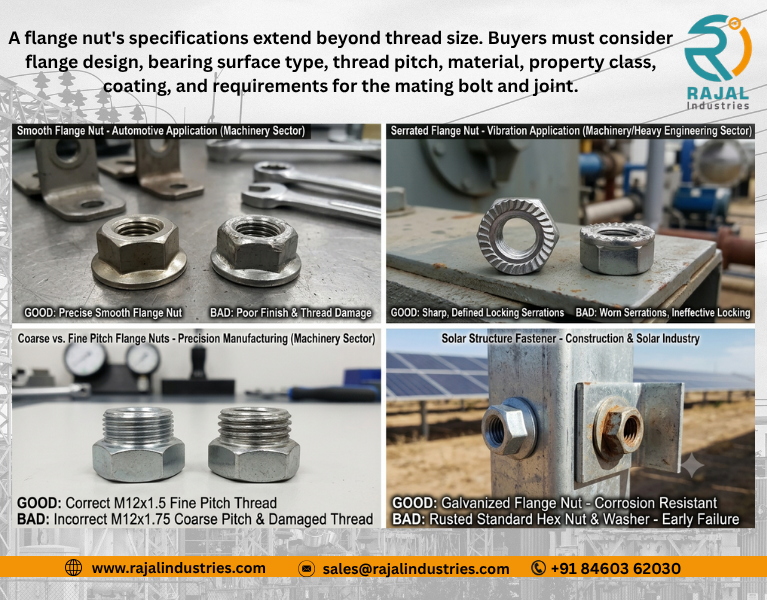
Choosing the right Flange Nut Manufacturer is important when an OEM needs a nut with an integrated flange that provides a larger bearing interface than a conventional hex nut.
Flange nuts are used across automotive, machinery, solar structures, construction equipment and heavy engineering. The integrated flange can simplify an assembly and distribute bearing contact over a wider area, depending on the joint design.
However, buyers should not select a flange nut only by thread size.
A better specification sequence is:
Application → Thread → Flange Nut Type → Standard → Material → Property Class → Flange Design → Serration → Coating → Mating Fastener → Joint Validation
Rajal Industries can evaluate standard and drawing-based Hex Flange Nut requirements for OEM and industrial applications, subject to technical and manufacturing feasibility.
Quick Answer: What Should Buyers Look for in a Flange Nut Manufacturer?
A capable Flange Nut Manufacturer should control the internal thread, nut dimensions, flange geometry, material, mechanical properties, surface finish and serrations where specified. Buyers should also confirm the mating bolt, joint surface, tightening method and applicable product standard before approving mass production.
What Is a Flange Nut?
A flange nut is an internally threaded nut with an integrated flange at its bearing end.
The flange creates a larger contact interface with the joint compared with the basic bearing face of many conventional hex nuts.
Depending on the product design, the flange face can be:
- Smooth
- Serrated
- Locking-feature based
- Customer-specific
This makes flange nut a product family rather than one single design.
Why Is the Flange Integrated Into the Nut?
The integrated flange can perform several functions depending on the application:
- Increase the bearing interface
- Support load distribution at the contact surface
- Simplify some assemblies
- Reduce the need for a separate washer where the joint is specifically designed that way
- Provide a location for serrations
- Support high-volume assembly
However, an integrated flange should not automatically be described as a universal replacement for every washer.
Flange Nut vs Standard Hex Nut
| Feature | Standard Hex Nut | Flange Nut |
| Internal Thread | Yes | Yes |
| Integrated Flange | No | Yes |
| Bearing Interface | Nut bearing face | Larger flange interface |
| Serrated Version | Not typical | Available |
| Separate Washer | Joint dependent | May be reduced in some designed joints |
| OEM Selection | Common | Application specific |
The correct choice depends on the joint design.
What Is a Hex Flange Nut?
- Hexagonal wrenching geometry
- Internal thread
- Integrated flange
The hexagonal body allows conventional wrench or socket engagement, while the flange provides the larger bearing interface.
This type is widely relevant to industrial OEM sourcing.
Main Types of Flange Nuts
Industrial buyers commonly encounter:
1. Smooth Flange Nut
Uses a non-serrated bearing surface.
2. Serrated Flange Nut
Uses serrations on the flange bearing surface.
3. Prevailing-Torque Flange Nut
Combines flange geometry with a locking mechanism.
4. Fine-Pitch Flange Nut
Uses a specified fine-pitch thread.
5. Custom Flange Nut
Manufactured according to an OEM drawing.
These products should not be treated as interchangeable.
Smooth Flange Nut
A smooth flange nut has an integrated flange without locking serrations on the bearing face.
It can be considered where:
- A larger bearing interface is useful
- The joint does not require serrations
- The mating surface should not be intentionally marked by serrations
- The product standard or drawing specifies a smooth flange
The complete joint still determines whether additional locking features are required.
What Is a Serrated Flange Nut?
A Serrated Flange Nut has teeth or serrations on the flange bearing surface.
When tightened against a suitable mating surface, these serrations can interact with that surface and provide resistance to unwanted rotation.
But this requires an important engineering caution:
A serrated flange nut should not be described as universally “vibration proof.”
Joint preload, surface material, coating, vibration, transverse movement and installation conditions still matter.
How Serrated Flange Nuts Work
The serrations interact mechanically with the mating surface.
This can increase resistance to relative rotation at the nut-bearing interface.
Performance depends on:
- Serration geometry
- Mating surface hardness
- Surface coating
- Installation preload
- Joint movement
- Reuse
- Environmental conditions
So serration performance should be evaluated as part of the joint.
Serrated vs Smooth Flange Nut
| Factor | Smooth Flange Nut | Serrated Flange Nut |
| Flange | Smooth | Serrated |
| Surface Interaction | Lower mechanical biting action | Serrations interact with surface |
| Surface Marking | Generally lower risk from teeth | Can mark mating surface |
| Locking Feature | Not inherent | Serration-based resistance |
| Painted/Soft Surface | Joint-specific | Requires careful review |
| Reuse | Application dependent | Serration effectiveness can be affected |
Serrated Flange Nuts Can Damage Some Surfaces
The same serrations that help resist rotation can also:
- Mark painted surfaces
- Damage soft materials
- Disrupt protective coatings
- Affect appearance
- Change surface contact during reuse
Therefore, a Serrated Flange Nut should not be specified automatically for every vibration-prone application.
Flange Nut Is Not Automatically a Lock Nut
This distinction is important.
A smooth flange nut provides an integrated flange, but that does not automatically make it a locking nut.
Similarly:
Flange ≠ Locking
A separate locking mechanism may still be required depending on the application.
Flange Nut Is Not Automatically a Serrated Nut
Another common mistake is treating the terms as identical.
Flange Nut
Broad product category.
Serrated Flange Nut
A flange nut with serrations on its bearing face.
Prevailing-Torque Flange Nut
A flange nut incorporating a prevailing-torque locking feature.
These are different technical descriptions.
Current ISO Standard for Coarse-Thread Hexagon Flange Nuts
A key international product standard is ISO 4161:2012, Hexagon nuts with flange, style 2 — Coarse thread.
ISO states that the standard covers metric coarse threads from M5 through M20. Product grade A applies through M16, while product grade B applies above M16 within the standard’s scope. ISO last reviewed and confirmed the 2012 edition in 2022, so it remains current. (ISO)
Is ISO 4161:1999 Still Current?
No.
ISO lists ISO 4161:1999 as withdrawn and shows ISO 4161:2012 as its current revision. (ISO)
For a new specification, buyers should check the current standard.
However, if an existing controlled customer drawing explicitly references an older edition, do not silently change it.
Use:
Drawing Review → Standard Edition Review → Engineering Approval → Customer Approval if Required
Current ISO Standard for Fine-Pitch Flange Nuts
ISO’s current nut catalogue lists ISO 10663:2012, Hexagon nuts with flange, style 2 — Fine pitch thread as a published/current standard. (ISO)
This matters because a flange nut specified only as “M10” or “M12” may be incomplete if the application requires a fine-pitch thread.
Coarse vs Fine Thread Flange Nuts
| Requirement | Coarse Thread | Fine Thread |
| Product Standard Example | ISO 4161 | ISO 10663 |
| Pitch | Larger | Smaller |
| General Availability | Often broad | More specification-specific |
| Mating Bolt | Must match | Must match |
| Interchangeability | No automatic substitution | No automatic substitution |
The approved drawing should control the pitch.
Prevailing-Torque Flange Nuts
Some Industrial Nuts combine a flange with a prevailing-torque locking mechanism.
ISO currently lists separate standards for these product families, including ISO 7043:2012 for flange nuts with a non-metallic insert and ISO 7044:2012 for all-metal prevailing-torque flange nuts. (ISO)
These should not be confused with an ordinary smooth ISO 4161 flange nut.
Fine-Pitch Prevailing-Torque Flange Nuts
ISO also lists separate fine-pitch standards:
- ISO 12125:2012 for prevailing-torque flange nuts with a non-metallic insert
- ISO 12126:2012 for all-metal prevailing-torque flange nuts
Both are currently listed as published standards in ISO’s fastener catalogue. (ISO)
This demonstrates why buyers should specify the complete nut type rather than writing only “flange lock nut.”
Important Standards Comparison
| Standard | Product Family |
| ISO 4161:2012 | Hexagon flange nut, coarse thread |
| ISO 10663:2012 | Hexagon flange nut, fine pitch |
| ISO 7043:2012 | Prevailing-torque flange nut with non-metallic insert |
| ISO 7044:2012 | All-metal prevailing-torque flange nut |
| ISO 12125:2012 | Non-metallic insert prevailing-torque flange nut, fine pitch |
| ISO 12126:2012 | All-metal prevailing-torque flange nut, fine pitch |
These standards describe different products. (ISO)
Flange Nut Standards Should Not Be Treated as Exact Equivalents
OEM drawings may reference:
- ISO
- DIN
- EN
- ASME
- Automotive standards
- Customer-specific specifications
A supplier should not automatically replace one standard with another simply because the products appear similar.
Compare:
- Thread
- Nut height
- Width across flats
- Flange diameter
- Flange thickness
- Bearing geometry
- Mechanical requirements
- Product grade
before approving any substitution.
Flange Nut Sizes
Flange Nut Sizes generally begin with the internal thread designation.
Examples in industrial metric applications can include:
- M5
- M6
- M8
- M10
- M12
- M16
- M20
For ISO 4161:2012 specifically, the coarse-thread scope is M5 through M20. (ISO)
But thread size alone does not completely define the nut.
What Does M10 Flange Nut Mean?
“M10 flange nut” identifies the nominal metric thread diameter.
A complete specification may also need:
M10 + Pitch + Standard + Flange Type + Material + Property Class + Finish + Serration Requirement
Without these details, different suppliers may quote different products.
Flange Nut Dimensions Buyers Should Check
Important dimensions can include:
- Thread diameter
- Thread pitch
- Nut height
- Width across flats
- Width across corners
- Flange diameter
- Flange thickness
- Bearing-face geometry
- Serration geometry where applicable
The applicable standard or customer drawing should define the final dimensions.
Why Flange Diameter Matters
The flange diameter affects the interface between the nut and mating component.
A larger bearing interface can influence:
- Contact pressure
- Joint surface interaction
- Clearance
- Nearby features
- Tool access
But “larger flange is always better” is not a valid engineering rule.
Why Nut Height Matters
Nut height affects:
- Thread engagement
- Assembly envelope
- Product geometry
- Mechanical performance
The required height should follow the selected product standard or engineering drawing.
Width Across Flats
Width across flats determines the wrench or socket interface.
This matters for:
- Manual installation
- Nut runners
- Automated assembly
- Tool clearance
An OEM should confirm tool access before finalizing surrounding component geometry.
Flange Nut Thread Selection
The internal thread must match the mating bolt or stud.
Confirm:
Thread System → Diameter → Pitch → Tolerance → Mating Fastener
Do not assume that every M12 flange nut will fit every M12 application correctly.
Thread Pitch Matters
A nut with the correct diameter but wrong pitch can:
- Fail to start
- Bind
- Damage the bolt
- Cross-thread
- Create misleading assembly torque
Thread pitch should be clearly defined in the RFQ.
Flange Nut Material Selection
Common material families can include:
- Carbon steel
- Alloy steel
- Stainless steel
- Customer-specified materials
Material selection depends on:
- Required mechanical properties
- Corrosion environment
- Temperature
- Mating fastener
- Coating
- Industry specification
Carbon Steel Flange Nuts
Carbon and alloy steel flange nuts are relevant across:
- Automotive
- Machinery
- Construction equipment
- Heavy engineering
- General industrial assemblies
The exact steel and processing route should support the required mechanical property class.
Stainless Steel Flange Nuts
Stainless steel flange nuts can be evaluated for:
- Corrosive environments
- Outdoor assemblies
- Equipment requiring stainless construction
- Certain machinery and industrial applications
However:
Stainless steel does not automatically mean SS316.
The required grade should follow the application and customer specification.
Flange Nut Property Class
The nut’s mechanical property class is separate from its flange design.
A flange does not automatically make the nut stronger.
Similarly, serrations do not define the nut’s mechanical strength.
A complete specification should control:
Geometry + Material + Mechanical Properties + Locking Feature
Bolt and Flange Nut Compatibility
The mating bolt and nut should be treated as a system.
Important factors include:
- Thread compatibility
- Mechanical properties
- Coating
- Lubrication
- Joint design
- Installation procedure
Do not choose the nut property class independently from the approved bolted-joint design.
Flange Nut Coatings
Depending on application and customer specification, finishes can include various corrosion-protection systems.
Selection can depend on:
- Corrosion target
- Friction requirement
- Automotive specification
- Outdoor exposure
- Appearance
- Environmental restrictions
The exact coating system should be stated rather than only specifying a colour.
Why Coating Matters Beyond Corrosion
A coating can also influence:
- Thread friction
- Bearing friction
- Tightening behaviour
- Clamp-force relationship
- Serration interaction
- Reuse
This is especially important in torque-controlled assembly.
Do Not Specify Only “Silver Zinc”
Colour alone does not fully define a coating.
A better OEM specification identifies:
- Coating system
- Thickness where applicable
- Corrosion requirement
- Lubrication/topcoat where applicable
- Friction requirement where controlled
This reduces supplier variation.
Serrated Flange Nut and Coating Interaction
A Serrated Flange Nut can mechanically interact with the coating on the mating surface.
Potential outcomes include:
- Coating penetration
- Surface marking
- Changed friction
- Local exposure of substrate
This can affect both locking behaviour and corrosion protection.
The complete joint should therefore be evaluated.
Flange Nut Applications in Automotive
Automotive applications may use flange nuts on suitable:
- Brackets
- Structural assemblies
- Chassis-related components
- Equipment mounts
- Underbody systems
- Engine-adjacent assemblies
- Interior structures
The actual selection should follow the vehicle or component drawing.
Why Automotive OEMs Use Flange Nuts
Potential production advantages include:
- Integrated bearing interface
- Reduced separate-component handling in suitable designs
- Good suitability for automated installation
- Compact assembly architecture
However, the OEM still needs to control tightening behaviour and joint performance.
Automotive Flange Nut Quality Priorities
Automotive buyers may focus on:
- Thread consistency
- Flange geometry
- Mechanical properties
- Coating
- Friction
- Serration geometry where used
- Traceability
- Automated assembly performance
- PPAP/customer documentation
Flange Nut Applications in Machinery
Machinery may use Hex Flange Nut products in:
- Frames
- Motor mounts
- Guards
- Brackets
- Pumps
- Compressors
- Equipment structures
- Industrial assemblies
Selection depends on load, vibration, maintenance and environment.
Flange Nut Applications in Solar Structures
Potential solar applications can include suitable:
- Mounting structures
- Equipment brackets
- Support assemblies
- Tracker-related components
- Auxiliary structures
Outdoor exposure makes corrosion protection especially important.
Final fastener selection should follow the structural design and project specification.
Solar Flange Nut Selection
Solar project buyers should consider:
- Outdoor corrosion
- Structural specification
- Mating bolt
- Coating compatibility
- Installation tooling
- Maintenance
- Galvanic/material compatibility
A serrated nut should not automatically be selected merely because the installation is outdoors or exposed to vibration.
Flange Nuts in Construction Equipment
Construction equipment can experience:
- Vibration
- Dirt
- Moisture
- Cyclic loading
- Maintenance
- Harsh service environments
Nut selection should consider both mechanical and environmental requirements.
Flange Nuts in Heavy Engineering
Heavy engineering applications may include:
- Industrial machinery
- Fabricated equipment
- Material-handling systems
- Plant equipment
- Equipment frames
The correct fastener should follow the approved engineering specification rather than a generic “heavy-duty” label.
Industries That Use Flange Nuts
Major sectors include:
Automotive | Machinery | Solar | Construction Equipment | Heavy Engineering | Fabrication | Industrial Equipment | Agricultural Equipment | General Engineering
The required flange nut design can differ significantly between industries.
Application Selection Matrix
| Industry | Important Buyer Concern |
| Automotive | Friction + automation + traceability |
| Machinery | Vibration + maintenance |
| Solar | Corrosion + structural specification |
| Construction Equipment | Vibration + environment |
| Heavy Engineering | Mechanical requirement + reliability |
Flange Nut vs Washer + Hex Nut
A flange nut may simplify certain assemblies by integrating the bearing flange into the nut.
Potential advantages can include:
- Fewer separate components
- Simplified handling
- Faster assembly
- Larger integrated bearing interface
But this does not mean:
Flange nut always eliminates the washer.
Some joints still require a washer for specific design reasons.
When a Separate Washer May Still Be Required
Depending on engineering design, a washer may still be used for:
- Surface protection
- Special load distribution
- Slotted holes
- Oversized holes
- Structural requirements
- Isolation
- Customer specification
The joint drawing should control.
Flange Nut vs Lock Nut
A flange nut describes geometry.
A lock nut describes locking function.
A product can be:
- Flange nut without locking feature
- Serrated flange nut
- Prevailing-torque flange lock nut
These should not be confused.
Flange Nut vs Nyloc Nut
A Nyloc-type nut uses a non-metallic insert to generate prevailing torque.
A standard flange nut does not.
A flange nut can also incorporate a non-metallic locking insert under a different product standard.
Selection depends on the application.
Flange Nut vs Serrated Flange Nut
Choose between them based on:
- Surface material
- Coating
- Locking requirement
- Reuse
- Appearance
- Joint movement
A serrated flange nut is not automatically superior.
Flange Nut vs Weld Nut
A flange nut remains a removable threaded fastener in a conventional bolted assembly.
A weld nut is permanently welded to a component before the mating fastener is installed.
These products solve different assembly problems.
Flange Nut Manufacturing Process
A typical manufacturing route can include:
Raw Material → Forming → Piercing/Hole Formation → Threading → Flange Formation → Serration Formation if Required → Heat Treatment if Required → Coating → Inspection → Packing
The actual route depends on:
- Nut design
- Material
- Size
- Property requirement
- Production volume
Cold Forming for Flange Nuts
Cold forming can be suitable for high-volume flange nut production because it can support:
- Production efficiency
- Repeatability
- Material utilization
- Integrated flange geometry
Tooling control is particularly important for flange and serration consistency.
Thread Manufacturing
The internal thread should comply with the applicable:
- Diameter
- Pitch
- Tolerance
- Product standard
- Customer drawing
Thread inspection should use appropriate calibrated gauges or measurement methods.
Serration Manufacturing
For serrated designs, manufacturing control may include:
- Serration count
- Tooth geometry
- Tooth height
- Orientation
- Uniformity
- Damage
The exact requirements should follow the drawing or product specification.
Heat Treatment
Where required by material and property class, heat treatment can influence:
- Strength
- Hardness
- Mechanical performance
Heat-treatment control should be linked to the specified fastener properties.
Surface Treatment
Coating should be applied according to:
- Corrosion requirement
- Friction requirement
- Customer specification
- Environmental requirement
Final production parts should be inspected in the finished condition where applicable.
Flange Nut Quality Inspection
A typical inspection plan may include:
Dimensional
- Nut height
- Width across flats
- Flange diameter
- Flange geometry
- Serrations
Thread
- GO/NO-GO gauging or applicable inspection
Material/Mechanical
- Material verification
- Hardness
- Required mechanical tests
Finish
- Coating
- Appearance
- Specified corrosion/friction requirements
Why Final-Coated Inspection Matters
Coating can affect:
- Thread fit
- Dimensions
- Friction
- Assembly behaviour
Therefore, final approval should reflect the production-finished part where required.
Flange Nut Testing
Depending on the specification, testing can include:
- Dimensional inspection
- Thread gauging
- Proof/mechanical testing
- Hardness
- Coating testing
- Friction testing
- Serration-related functional evaluation
- Customer-specific assembly testing
Do not invent universal test values when the applicable standard or OEM specification controls them.
Common Flange Nut Buying Mistakes
Avoid:
- Ordering only by thread size.
- Assuming every flange nut is serrated.
- Assuming every serrated nut is vibration proof.
- Assuming flange means locking.
- Treating a flange nut as an automatic washer replacement.
- Ignoring thread pitch.
- Ignoring property class.
- Ignoring flange diameter.
- Ignoring mating surface material.
- Ignoring coating/friction.
- Using serrations on sensitive surfaces without review.
- Ignoring automated tooling access.
- Substituting standards without approval.
- Specifying only coating colour.
- Comparing supplier prices before confirming equal specifications.
Poor Flange Nut RFQ
Need M10 flange nuts. Send best rate.
This does not tell the supplier whether the requirement is:
- Smooth or serrated
- Coarse or fine pitch
- Standard or locking
- Carbon steel or stainless
- Specific property class
- Specific coating
Better Flange Nut RFQ
We require M10 hex flange nuts for an automotive assembly. Please quote according to the attached drawing and confirm thread pitch, applicable standard, smooth/serrated flange design, material, property class, coating, inspection documentation, sample lead time, tooling if required and annual-volume pricing.
This gives the Flange Nut Supplier a much clearer specification.
Flange Nut RFQ Checklist
| Parameter | Buyer Should Specify |
| Product | Hex flange nut |
| Thread Size | Exact requirement |
| Pitch | Coarse/fine as drawing |
| Standard | ISO/DIN/OEM drawing |
| Flange Type | Smooth/serrated |
| Locking Feature | If required |
| Material | Exact specification |
| Property Class | Required class |
| Coating | Full coating requirement |
| Friction | If controlled |
| Mating Bolt | Relevant specification |
| Application | Automotive/machinery/etc. |
| Testing | Required inspection/tests |
| Documentation | MTC/PPAP/etc. as required |
| Quantity | Order quantity |
| Annual Volume | Forecast |
Questions to Ask a Flange Nut Manufacturer
Before approving a Flange Nut Manufacturer, ask:
- Which flange nut types can you manufacture?
- Which metric sizes are within your capability?
- Can you produce smooth and serrated flange nuts?
- Which standards can you manufacture against?
- Can you manufacture customer drawing-based parts?
- Which materials and property classes can be evaluated?
- How is flange diameter controlled?
- How are serrations inspected?
- How is thread quality checked?
- How is heat treatment controlled where required?
- Which coatings can be supplied?
- Can you control friction where specified?
- Can you support samples and inspection reports?
- Can you support PPAP/customer documentation?
- What is the production capacity?
Flange Nut Supplier Comparison
| Requirement | Supplier A | Supplier B | Supplier C |
| Direct Manufacturer | |||
| Standard Capability | |||
| Custom Drawing Capability | |||
| Smooth Flange Nut | |||
| Serrated Flange Nut | |||
| Thread Inspection | |||
| Mechanical Testing | |||
| Coating Control | |||
| Traceability | |||
| PPAP Support | |||
| Capacity | |||
| Lead Time | |||
| Price |
What Is a Flange Nut?
A flange nut is an internally threaded nut with an integrated flange at its bearing end. The flange creates a larger contact interface with the mating surface and can simplify certain assemblies. Flange nuts are available in smooth, serrated and locking configurations depending on the application.
What Is a Hex Flange Nut?
A Hex Flange Nut combines a hexagonal wrenching body with an integrated flange. It is used in automotive, machinery, construction equipment and other industrial assemblies where the joint design benefits from an integrated bearing interface.
What Is a Serrated Flange Nut?
A Serrated Flange Nut has teeth on the flange bearing surface that interact with a suitable mating surface to resist unwanted rotation. Serrations can mark or penetrate coatings, so the joint surface, corrosion protection and reuse requirements should be reviewed before selection.
What Standard Covers Hex Flange Nuts?
ISO 4161:2012 covers style 2 hexagon nuts with flange and metric coarse threads from M5 through M20. ISO confirmed the edition in 2022, so it remains current. Fine-pitch flange nuts are covered separately by ISO 10663:2012. (ISO)
Does a Flange Nut Replace a Washer?
A flange nut can reduce the need for a separate washer in some assemblies because the flange provides an integrated bearing interface. However, it is not a universal washer replacement. Washers may still be required for surface protection, slotted holes, structural requirements or other joint-specific reasons.
Is a Flange Nut a Lock Nut?
Not necessarily. A standard smooth flange nut does not automatically provide a locking function. Serrated flange nuts and prevailing-torque flange nuts use additional features to resist unwanted rotation, but they should be selected according to the complete joint requirement.
Where Are Flange Nuts Used?
Flange nuts are used in automotive, machinery, solar structures, construction equipment, heavy engineering, fabrication and other industrial assemblies. The correct type depends on thread, material, mechanical properties, flange design, surface condition, coating and joint requirements.
Can Rajal Industries Manufacture Flange Nuts?
Rajal Industries can evaluate standard and customer drawing-based Hex Flange Nut, smooth flange nut and Serrated Flange Nut requirements for automotive, machinery, solar, construction equipment and heavy engineering applications, subject to technical feasibility, tooling and customer specifications.
For evaluation, provide:
Drawing / Standard + Thread + Flange Type + Material + Property Class + Coating + Application + Quantity
Conclusion: Select a Flange Nut as Part of the Complete Bolted Joint
Choosing the right Flange Nut Manufacturer involves more than sourcing an M8, M10 or M12 nut with an integrated flange.
Industrial buyers should evaluate:
Thread → Standard → Flange Geometry → Material → Property Class → Smooth/Serrated Surface → Coating → Mating Bolt → Joint Surface → Installation → Validation
A smooth Hex Flange Nut, Serrated Flange Nut and prevailing-torque flange nut perform different functions and should not be treated as interchangeable.
For automotive, machinery, solar, construction equipment and heavy engineering applications, the best flange nut is the one that meets the controlled drawing and works consistently within the complete assembly.
Rajal Industries can evaluate standard and customer drawing-based flange nuts for OEM and industrial applications, subject to technical and manufacturing feasibility.