

Different Weld Nut Types are designed to create permanent threaded attachment points on suitable metal components through welding. They are widely used in automotive, EV, sheet metal, appliances, fabrication and industrial assemblies where a loose nut would be difficult, slow or impractical to hold during final assembly.
However, selecting a weld nut involves much more than choosing M6, M8 or M10.
Industrial buyers should evaluate:
Weld Nut Type → Thread Size → Pitch → Dimensions → Projection Design → Material → Sheet Material → Sheet Thickness → Surface Condition → Welding Process → Testing
A hexagon weld nut, square weld nut and flange Projection Weld Nut may share the same nominal thread but have very different dimensions, projection geometry and welding behaviour.
This guide explains how to compare Weld Nut Sizes, dimensions, materials, standards and applications before releasing an OEM purchase order.
Quick Answer: What Are the Main Weld Nut Types?
Common Weld Nut Types include hexagon weld nuts, square weld nuts, hexagon flange weld nuts, projection weld nuts and custom drawing-based weld nuts. Many resistance-welded designs use raised projections to concentrate welding current and pressure at controlled contact points.
The correct type depends on the sheet-metal design, thread, sheet thickness, welding process, required attachment performance and OEM specification.
What Is a Weld Nut?
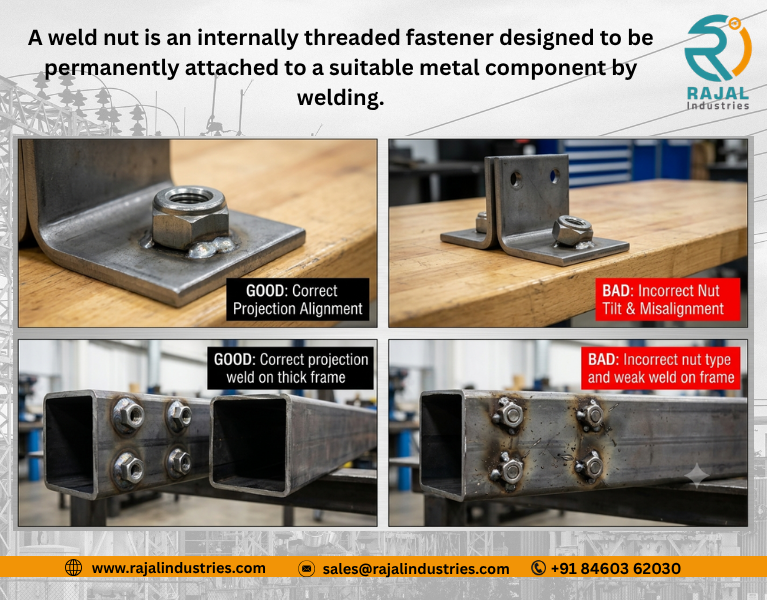
A weld nut is an internally threaded fastener designed to be permanently attached to a suitable metal component by welding.
After installation, it creates a captive female thread for a mating:
- Bolt
- Screw
- Stud
- Other compatible externally threaded fastener
Instead of holding a loose nut during final assembly, the threaded attachment is already fixed to the component.
Why Weld Nuts Are Important in OEM Manufacturing
Weld nuts can simplify production where access to the back side of an assembly is difficult.
They can support:
- One-side final assembly
- Permanent threaded locations
- Automated production
- Reduced loose hardware
- Repeatable thread positioning
- Fast component assembly
- Sheet-metal design integration
This is one reason Automotive Weld Nuts are common in high-volume stamped and fabricated assemblies.
How Weld Nuts Work
Many industrial weld nuts are installed using resistance projection welding.
A simplified process is:
Nut Positioned → Projections Contact Sheet → Electrode Force Applied → Current Flows → Localized Heating → Projections Collapse → Weld Forms
The exact process depends on the weld nut and sheet-metal combination.
Projection Weld Nut Explained
A Projection Weld Nut contains raised features that concentrate electrical current and mechanical pressure at selected locations during resistance welding.
These projections are functional manufacturing features.
They can influence:
- Heat concentration
- Projection collapse
- Weld location
- Nut alignment
- Weld consistency
- Attachment performance
Therefore, projection geometry should be controlled as part of the product specification.
Main Weld Nut Types
Industrial buyers commonly encounter the following categories.
| Weld Nut Type | Basic Geometry | Typical Selection Reason |
| Hexagon Weld Nut | Hex body | General industrial/OEM use |
| Square Weld Nut | Square body | Stable orientation and specific sheet designs |
| Hexagon Flange Weld Nut | Hex body with flange | Larger interface and standardized designs |
| Projection Weld Nut | Raised welding projections | Resistance projection welding |
| Pilot Weld Nut | Locating feature | Positioning/alignment |
| Custom Weld Nut | Drawing-specific | Special OEM requirements |
These categories can overlap. For example, a hexagonal flange nut can also be a projection weld nut.
Type 1: Hexagon Weld Nut
A hexagon weld nut has a hexagonal external body and features designed for welded attachment.
Potential applications include:
- Automotive brackets
- Sheet-metal structures
- Appliance frames
- Electrical equipment
- Fabricated components
The exact design can include projections, flange geometry or locating features depending on the standard or customer drawing.
DIN 929 Hexagon Weld Nuts
A major dimensional reference for hexagon weld nuts is DIN 929:2013-12.
DIN Media currently lists DIN 929:2013-12 as a current standard. It specifies hexagon weld nuts with metric coarse threads from M3 to M16 and fine-pitch metric threads with nominal diameters from 8 mm to 16 mm, in product grade A.
This is useful when an OEM drawing specifically calls for DIN 929.
Type 2: Square Weld Nut
A square weld nut uses a square external body.
Square geometry can help with:
- Part orientation
- Contact area
- Fixture design
- Specific projection layouts
- OEM sheet-metal geometry
The product should still be selected according to the applicable standard or drawing.
DIN 928 Square Weld Nuts
DIN 928:2013-12 is a current DIN standard for square weld nuts.
DIN Media states that it covers square weld nuts with metric coarse threads from M4 to M16 and fine-pitch metric threads with nominal diameters from 8 mm to 16 mm, in product grade A.
This immediately shows why one universal Weld Nut Sizes table is risky: DIN 928 and DIN 929 do not even begin at the same minimum coarse-thread size.
Square Weld Nut vs Hexagon Weld Nut
| Feature | Square Weld Nut | Hexagon Weld Nut |
| External Shape | Square | Hexagonal |
| Example DIN Standard | DIN 928 | DIN 929 |
| Coarse Thread Range in Those Standards | M4–M16 | M3–M16 |
| Product Grade | A | A |
| Welding Design | Standard/drawing dependent | Standard/drawing dependent |
| Interchangeable? | No automatic substitution | No automatic substitution |
The buyer should use the exact standard required by the drawing.
Type 3: Hexagon Weld Nut With Flange
A flange weld nut combines an internally threaded nut body with a flange designed as part of the welded attachment geometry.
Potential reasons for using a flange include:
- Defined sheet interface
- Product-standard geometry
- Projection positioning
- OEM assembly design
The flange is part of the engineered product and should not be treated as only an oversized bearing surface.
ISO 21670:2014 Hexagon Weld Nuts With Flange
ISO 21670:2014 is the current international standard for hexagon weld nuts with flange. ISO states that it was reviewed and confirmed in 2024, so the 2014 edition remains current.
Its scope includes:
- M5 to M16 metric coarse threads
- Fine-pitch threads with nominal diameters from 8 mm to 16 mm
- Product grade A
ISO also states that weld nuts conforming to ISO 21670:2014 are suitable for use with bolts up to property class 10.9 according to ISO 898-1, within the conditions of the standard.
Is ISO 21670:2003 Still Current?
No.
ISO lists ISO 21670:2003 as withdrawn and identifies ISO 21670:2014 as the revised/current edition.
However, if an old controlled customer drawing specifies the 2003 edition, do not silently change the requirement.
Use:
Drawing Review → Edition Comparison → Engineering Review → Customer Approval
before changing standards.
Type 4: Projection Weld Nut
A Projection Weld Nut is defined by its welding method and projection features rather than only its outside body shape.
A projection weld nut can be:
- Square
- Hexagonal
- Flanged
- Round
- Custom shaped
depending on the design.
This is an important terminology point for buyers.
Projection Weld Nut Is Not One Single Shape
A common purchasing mistake is to treat “projection weld nut” as one fixed dimensional product.
In reality:
Projection Weld Nut = Welding/Feature Category
while:
Square / Hexagon / Flange = Geometric Product Description
A square weld nut can have projections.
A hexagon weld nut can have projections.
A flange weld nut can have projections.
Type 5: Pilot Weld Nut
Some weld nuts include a pilot or locating feature.
This can help position the nut relative to:
- A sheet hole
- Stamped feature
- Welding fixture
- Electrode
- Automated placement system
The pilot dimensions should match the parent component design.
Why Pilot Dimensions Matter
An incorrect pilot can create:
- Poor positioning
- Excessive clearance
- Nut tilt
- Interference with sheet hole
- Feeding problems
- Bolt alignment problems
Pilot geometry should therefore be included in the controlled drawing where applicable.
Type 6: Round Weld Nut
Round weld nuts may be used for particular customer-specific or standardized assembly designs.
Possible features can include:
- Circular flange
- Projections
- Pilot
- Special locating geometry
Do not assume that a round weld nut is interchangeable with a square or hexagon design.
Type 7: Custom OEM Weld Nut
A standard nut is not always suitable for the component design.
Custom weld nuts may require:
- Special flange diameter
- Custom height
- Special projections
- Custom pilot
- Non-standard thread
- Special material
- Special surface treatment
- Special orientation feature
- Automated feeding feature
The approved customer drawing should control the final product.
Standard vs Custom Weld Nut
| Requirement | Standard Weld Nut | Custom Weld Nut |
| Existing Standard Geometry | Yes | Not necessarily |
| Tooling | Existing may be possible | Often application-specific |
| Development Time | Usually lower | Usually higher |
| OEM Flexibility | Limited | High |
| Projection Geometry | Standard controlled | Drawing controlled |
| Special Pilot | Limited | Can be designed |
| Volume Consideration | Standard sourcing | Tooling economics important |
Weld Nut Sizes Explained
Weld Nut Sizes normally begin with the internal thread designation.
Examples can include:
- M4
- M5
- M6
- M8
- M10
- M12
- M16
But these examples should not be interpreted as one universal range covering every weld nut type.
For example, current DIN 928 covers coarse-thread square weld nuts from M4 to M16, DIN 929 covers coarse-thread hexagon weld nuts from M3 to M16, and ISO 21670 covers coarse-thread hexagon flange weld nuts from M5 to M16.
What Does M8 Weld Nut Mean?
An M8 weld nut has an internal metric thread with an 8 mm nominal diameter.
But “M8” alone does not completely specify the product.
A complete requirement can also need:
- Thread pitch
- Weld nut type
- Product standard
- Nut dimensions
- Projection geometry
- Material
- Surface condition
- Sheet details
- Welding requirement
Weld Nut Size Is Not the Same as Nut Dimensions
This distinction is important for SEO and engineering.
Weld Nut Size
Usually refers first to the thread designation.
Weld Nut Dimensions
Can include:
- Width
- Height
- Flange diameter
- Projection geometry
- Pilot dimensions
- Hole relationship
- Other product-specific features
Therefore:
M8 tells you the thread family, but it does not tell you the complete weld nut geometry.
Weld Nut Dimensions Buyers Should Check
Depending on the Weld Nut Types, important dimensions can include:
| Dimension | Why It Matters |
| Nominal Thread Diameter | Mating fastener compatibility |
| Thread Pitch | Correct thread engagement |
| Width Across Flats | External geometry/tooling |
| Nut Height | Space and product geometry |
| Flange Diameter | Sheet interface |
| Flange Thickness | Product/weld geometry |
| Projection Height | Welding behaviour |
| Projection Width | Welding behaviour |
| Projection Position | Weld distribution |
| Pilot Diameter | Location |
| Pilot Height | Sheet/fixture relationship |
| Hole Relationship | Bolt alignment |
Not every weld nut contains every feature in this table.
Why We Should Not Publish One Generic Weld Nut Dimension Chart
A search for “M8 weld nut dimensions” can return different values because the result may refer to:
- DIN 928 square nut
- DIN 929 hexagon nut
- ISO 21670 flange nut
- Automotive OEM nut
- Custom projection weld nut
Therefore, any dimensional table on Rajal Industries’ website should be titled against the exact standard.
For example:
DIN 928:2013-12 Square Weld Nut Dimensions
is much safer than:
Universal M4–M16 Weld Nut Dimensions
Exact numerical tables should be populated only from properly licensed or otherwise verified standard data.
DIN 928 vs DIN 929 vs ISO 21670
| Standard | Product | Coarse Thread Scope |
| DIN 928:2013-12 | Square weld nuts | M4–M16 |
| DIN 929:2013-12 | Hexagon weld nuts | M3–M16 |
| ISO 21670:2014 | Hexagon weld nuts with flange | M5–M16 |
All three are currently listed as current by their respective standards bodies.
They should not be described as dimensional equivalents.
Metric Coarse vs Fine Thread Weld Nuts
Weld nuts can be specified with coarse or fine metric threads where supported by the applicable standard.
The thread pitch must match the mating bolt.
Coarse Thread
Common across many industrial applications.
Fine Thread
Used where the design specifically requires it.
Neither should be selected only from general preference.
Why Fine Pitch Must Be Written Clearly
Suppose the RFQ says:
M10 weld nut
The supplier may interpret this as the normal coarse-thread product.
If the OEM drawing actually requires a fine pitch, the quoted part can be wrong.
A better RFQ states:
M10 × specified pitch, weld nut type and standard
where necessary.
Weld Nut Thread Compatibility
Check:
Thread Diameter + Pitch + Thread Form + Tolerance + Mating Fastener
Do not test compatibility by simply forcing a production bolt through the nut.
Controlled thread inspection should be used.
Weld Nut Material Selection
Common material directions can include:
- Carbon steel
- Other specification-controlled steels
- Stainless steel
- Customer-specific materials
Material selection is more complicated for a weld nut than for a conventional loose nut because weldability matters.
Carbon Steel Weld Nuts
Steel weld nuts are widely used in:
- Automotive
- EV components
- Appliances
- Sheet-metal fabrication
- Electrical equipment
- Machinery
The exact grade and mechanical properties should follow the product standard or customer drawing.
Stainless Steel Weld Nuts
Stainless steel weld nuts can be evaluated where:
- Stainless construction is required
- Corrosion resistance is important
- The welding process is suitable
- The parent material is compatible
But “stainless” alone is not a complete specification.
The exact grade should be defined.
Weldability vs Corrosion Resistance
A material that offers strong corrosion resistance is not automatically the best material for every welded assembly.
Selection should consider:
Material Strength + Weldability + Parent Sheet + Corrosion + Process + Cost
This is particularly important when different materials are joined.
Weld Nut Material and Parent Sheet
The nut cannot be selected independently from the sheet.
The buyer should tell the supplier:
- Sheet material
- Sheet grade where relevant
- Sheet thickness
- Sheet coating
- Final corrosion treatment
These inputs help evaluate the welding application.
Coated Sheet and Weld Nuts
Many automotive and appliance components use coated steel.
Coatings can influence:
- Contact resistance
- Heat generation
- Electrode wear
- Weld process stability
- Surface fumes
- Corrosion behaviour
Weld validation should therefore use the actual production material where practical.
Weld Nut Surface Finish
Potential approaches include:
- Uncoated/bare condition for welding
- Weld-compatible surface treatment
- Customer-approved coating
- Post-weld corrosion protection
There is no single best coating for every weld nut.
Why Finish Must Be Defined Before Production
Consider:
Sample Nut = Bare Steel
Mass Production Nut = Coated
The welding behaviour may change.
For OEM qualification, the tested sample should represent the intended production condition as closely as required by the approved process.
Weld Nut Applications in Automotive
Automotive is one of the most important Weld Nut Applications.
Potential uses can include threaded attachment points in:
- Stamped components
- Brackets
- Body structures
- Seat-related structures
- Underbody assemblies
- Equipment mounts
- Interior structures
The actual part must follow the vehicle/OEM specification.
Why Automotive Uses Projection Weld Nuts
A Projection Weld Nut can support high-volume automotive production because it can be:
- Automatically fed
- Positioned
- Resistance welded
- Process monitored
- Integrated before downstream assembly
This reduces the need to manually hold a loose nut during final assembly.
Automotive Weld Nut Quality Priorities
Automotive buyers may prioritize:
- Projection consistency
- Feeding reliability
- Nut position
- Weld consistency
- Thread functionality
- Surface condition
- Traceability
- Process capability
- OEM documentation
A low-cost nut that causes repeated line stoppages can create a much higher total manufacturing cost.
Weld Nut Applications in EVs
EV platforms can use weld nuts in suitable:
- Body assemblies
- Brackets
- Frames
- Underbody structures
- Equipment housings
- Enclosure structures
However, battery-related applications may introduce additional requirements.
EV Battery-Related Weld Nut Caution
A fastener used around an EV battery system may involve:
- Structural performance
- Sealing
- Corrosion
- Electrical requirements
- Thermal conditions
- Crash requirements
- Serviceability
Therefore, a general-purpose weld nut should not automatically be described as suitable for battery-critical applications.
The OEM drawing and validation plan should be controlled.
Weld Nut Applications in Sheet Metal
Weld nuts can provide captive threads in:
- Brackets
- Frames
- Covers
- Panels
- Cabinets
- Fabricated structures
They are particularly useful when the final installer cannot easily access the back side to hold a loose nut.
Weld Nut Applications in Appliances
Potential appliance applications include:
- Structural frames
- Motor brackets
- Sheet-metal housings
- Equipment supports
- Internal assemblies
High-volume appliance manufacturing can place strong emphasis on:
- Cost
- Feeding
- Repeatability
- Welding speed
- Corrosion protection
Weld Nut Applications in Fabrication
Fabricators can use weld nuts where a component needs a permanent threaded attachment before:
- Painting
- Assembly
- Installation
- Shipping
Potential fabricated products include:
- Machine guards
- Frames
- Enclosures
- Equipment brackets
- Cabinets
- Structural sheet-metal assemblies
Weld Nut Application Matrix
| Industry | Typical Buyer Priority |
| Automotive | Automation + weld consistency |
| EV | OEM validation + structural/environmental requirements |
| Sheet Metal | Sheet compatibility + assembly access |
| Appliances | High-volume repeatability + cost |
| Fabrication | Ease of assembly + reliable attachment |
Weld Nut vs Rivet Nut
Both create captive internal threads, but their installation methods differ.
| Factor | Weld Nut | Rivet Nut |
| Installation | Welding | Mechanical deformation |
| Heat Input | Yes | No |
| Welding Equipment | Required | Not required |
| Parent Material | Must suit process | Must suit mechanical installation |
| High-Volume Automation | Possible | Possible |
| One-Side Installation | Process dependent | Common advantage |
| Selection | Joint specific | Joint specific |
Neither is universally better.
Weld Nut vs Self-Clinching Nut
A weld nut is welded to the component.
A self-clinching nut is pressed into suitable sheet material.
The choice depends on:
- Sheet properties
- Thickness
- Heat restrictions
- Production equipment
- Required attachment performance
- OEM design
This distinction will be covered more deeply in the self-clinching nut cluster.
Weld Nut vs Cage Nut
A cage nut normally provides a retained nut that can allow some positional movement.
A weld nut becomes permanently fixed by welding.
Use a cage nut where its retained/floating assembly concept is required.
Use a weld nut where the design requires a welded captive thread.
Weld Nut vs Tapped Sheet Metal
Directly tapping sheet metal can be limited by available material thickness and required thread engagement.
A weld nut adds a dedicated threaded component to the sheet.
However, the correct choice depends on:
- Sheet thickness
- Required thread
- Load
- Manufacturing process
- Cost
- Service requirements
Selecting Weld Nut Types by Application
A practical first-stage selection table is:
| Requirement | Type to Evaluate |
| Standard square geometry | DIN 928-type direction |
| Standard hex geometry | DIN 929-type direction |
| Hexagon flange geometry | ISO 21670-type direction |
| Resistance projection welding | Projection weld nut |
| Improved locating requirement | Pilot-type design |
| Special OEM geometry | Custom weld nut |
This is a screening guide only. The controlled drawing or specification remains final.
How to Select Weld Nut Sizes
Start with the mating fastener.
Step 1: Determine Thread Diameter
Example: M6, M8 or M10.
Step 2: Confirm Pitch
Coarse or specified fine pitch.
Step 3: Select Product Type
Square, hexagon, flange or custom.
Step 4: Select Standard
DIN, ISO or OEM drawing.
Step 5: Check External Dimensions
Ensure the nut fits the available sheet geometry.
Step 6: Validate Welding
Confirm the selected design works with the actual parent sheet.
How to Select Weld Nut Dimensions
The external geometry should be checked against:
- Available space
- Sheet hole
- Nearby bends
- Flanges
- Spot welds
- Other fasteners
- Welding electrode access
- Assembly bolt access
A dimensionally correct nut can still be impossible to weld if the electrode cannot reach it.
Electrode Access Is Often Overlooked
Before finalizing the component drawing, ask:
Can the production welding electrodes physically reach and correctly clamp the weld nut location?
This can prevent costly tooling changes later.
Sheet Thickness and Weld Nut Type
There is no single universal sheet-thickness rule for all weld nuts.
Suitability depends on:
- Nut geometry
- Projection geometry
- Sheet grade
- Sheet thickness
- Coating
- Weld schedule
- Required attachment performance
Therefore, avoid generic claims such as:
“M8 weld nut works from X mm to Y mm sheet.”
unless tied to a verified product specification and validated assembly.
Projection Geometry and Sheet Thickness Work Together
A projection designed for one sheet condition may behave differently on another.
The OEM should evaluate:
Projection Geometry + Sheet Thickness + Material + Coating + Welding Parameters
as one system.
Weld Nut Inspection
Inspection can be divided into three levels.
1. Dimensional Inspection
Check geometry against standard/drawing.
2. Thread Inspection
Check internal thread requirements.
3. Weld Validation
Check the nut after installation on the actual or representative sheet.
All three serve different purposes.
Dimensional Inspection Checklist
Depending on product type, inspect:
- Nut width
- Height
- Thread
- Flange
- Pilot
- Projection geometry
- Flatness
- Drawing-specific features
Do not create one inspection sheet for every weld nut type without adapting it to the product.
Projection Inspection
For a Projection Weld Nut, inspection may include:
- Projection count
- Height
- Location
- Shape
- Damage
- Symmetry
These characteristics can affect the welding process.
Thread Inspection
Internal threads should be inspected according to the applicable specification using appropriate calibrated gauges or measurement methods.
A random production bolt is not a substitute for proper thread inspection.
Post-Weld Inspection
Depending on the application, post-weld checks can include:
- Thread functionality
- Nut position
- Nut tilt
- Weld appearance
- Torque-out performance
- Push-out performance
- Customer-specific destructive testing
Acceptance values should come from the approved design or process specification.
Weld Nut Torque-Out Testing
Torque-out testing evaluates the resistance of the welded nut to rotation relative to the parent sheet.
This matters because the nut experiences rotational load when the mating fastener is installed or removed.
There is no universal torque-out value for all M6, M8 or M10 weld nuts.
Weld Nut Push-Out Testing
Push-out testing evaluates resistance to separation from the sheet in a defined direction.
Performance depends on:
- Nut design
- Sheet
- Welding process
- Weld quality
- Test setup
Use customer or validated process requirements rather than generic web values.
Common Weld Nut Selection Mistakes
Avoid:
- Selecting only by thread size.
- Assuming all projection weld nuts have the same geometry.
- Treating DIN 928 and DIN 929 as equivalent.
- Treating DIN and ISO products as automatically interchangeable.
- Ignoring thread pitch.
- Ignoring sheet thickness.
- Ignoring sheet material.
- Ignoring sheet coating.
- Ignoring projection dimensions.
- Ignoring electrode access.
- Using generic welding parameters.
- Using generic torque-out values.
- Approving only an uncoated prototype when production conditions differ.
- Ignoring post-weld thread condition.
- Changing a controlled standard edition without customer approval.
Better Weld Nut RFQ
Instead of:
Need M8 weld nut. Send price.
Use:
We require M8 projection weld nuts for an automotive sheet-metal application. Please quote according to the attached drawing/standard and confirm thread pitch, weld nut type, projection geometry, material, surface condition, dimensional inspection, tooling, MOQ, sample lead time and production price. Sheet material and thickness are available for technical review.
Weld Nut RFQ Checklist
| Requirement | Buyer Should Provide |
| Weld Nut Type | Square / hex / flange / custom |
| Thread | Metric / inch |
| Size | Exact nominal size |
| Pitch | Exact pitch |
| Standard | DIN / ISO / OEM drawing |
| Drawing Revision | Current controlled revision |
| Material | Required material |
| Projection | Exact design |
| Pilot | If applicable |
| Surface Finish | Production condition |
| Sheet Material | Exact requirement |
| Sheet Thickness | Required |
| Sheet Coating | If applicable |
| Welding Process | Production method |
| Weld Testing | Customer requirement |
| Quantity | Order quantity |
| Annual Demand | Forecast |
| Documentation | OEM requirement |
Questions Buyers Should Ask a Weld Nut Supplier
Before supplier approval, ask:
- Which Weld Nut Types can you manufacture?
- Can you manufacture DIN 928-type square weld nuts?
- Can you manufacture DIN 929-type hexagon weld nuts?
- Can you evaluate ISO 21670 flange weld nuts?
- Which Weld Nut Sizes are within your manufacturing capability?
- How are projections manufactured?
- How are projection dimensions inspected?
- How is thread quality controlled?
- Can you manufacture custom pilots?
- Which materials can be evaluated?
- Can you support OEM weld trials?
- Can you provide dimensional reports?
- Can you support PPAP where required?
- What tooling is required?
- What are sample and production lead times?
What Are the Main Weld Nut Types?
The main Weld Nut Types include square weld nuts, hexagon weld nuts, flange weld nuts, projection weld nuts, pilot weld nuts and custom OEM designs. The categories can overlap because square, hexagon or flange nuts may also use projections for resistance welding.
What Sizes Do Weld Nuts Come In?
Weld Nut Sizes depend on the product standard. Current DIN 928 covers coarse-thread square weld nuts from M4 to M16, DIN 929 covers coarse-thread hexagon weld nuts from M3 to M16, and ISO 21670 covers coarse-thread hexagon flange weld nuts from M5 to M16.
What Are Weld Nut Dimensions?
Weld Nut Dimensions can include thread diameter, pitch, nut height, width, flange diameter, projection dimensions and pilot geometry. Exact values depend on the weld nut type and standard, so buyers should use a standard-specific dimensional table rather than a universal weld nut chart.
What Is DIN 928?
DIN 928:2013-12 is the current DIN standard for square weld nuts. It covers metric coarse threads from M4 to M16 and specified fine-pitch threads from nominal diameter 8 mm to 16 mm, in product grade A.
What Is DIN 929?
DIN 929:2013-12 is the current DIN standard for hexagon weld nuts. Its scope includes metric coarse threads from M3 to M16 and fine-pitch threads with nominal diameters from 8 mm to 16 mm, in product grade A.
What Is ISO 21670?
ISO 21670:2014 is the current international standard for hexagon weld nuts with flange. It covers coarse-thread sizes M5 to M16 and specified fine-pitch sizes from 8 mm to 16 mm in product grade A. ISO reconfirmed the standard in 2024.
Are DIN 928, DIN 929 and ISO 21670 Interchangeable?
No. DIN 928 covers square weld nuts, DIN 929 covers hexagon weld nuts, and ISO 21670 covers hexagon weld nuts with flange. Their geometry and dimensional requirements differ, so matching thread size alone does not make the products interchangeable.
Conclusion: Weld Nut Types Must Be Selected as Part of the Complete Assembly
Choosing between Weld Nut Types requires more than selecting an M6, M8 or M10 thread.
The buyer should review:
Thread → Product Type → Standard → Dimensions → Projection Geometry → Material → Sheet → Welding Process → Validation
Square, hexagon, flange and custom Projection Weld Nut designs can all behave differently during production.
For automotive, EV, sheet-metal, appliance and fabrication applications, the best weld nut is the one that fits the drawing, welds consistently to the actual parent sheet and meets the required functional tests.
Rajal Industries can evaluate standard and drawing-based weld nut requirements for OEM and industrial applications, subject to technical and manufacturing feasibility.