

Introduction – Real Site Observation
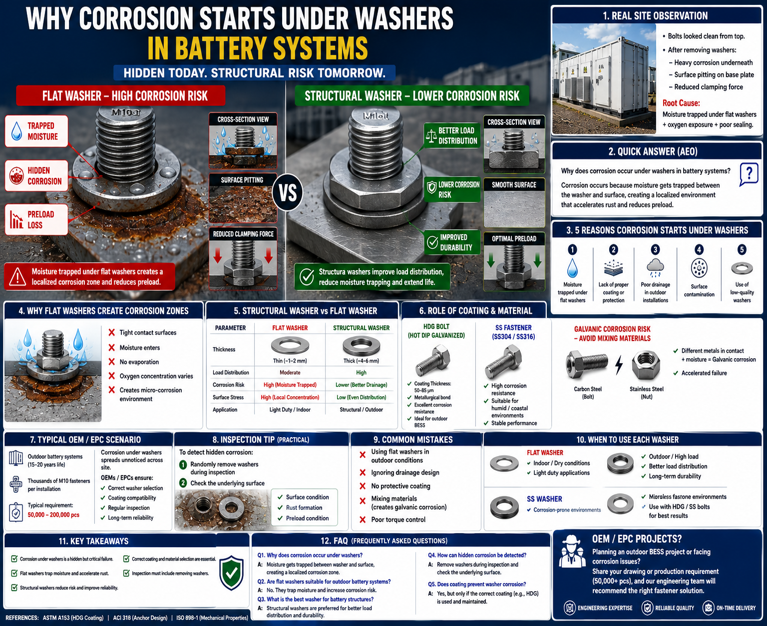
During inspection of a battery installation, bolts appeared clean from the top. No visible rust on heads or threads.
But after removing a few washers:
👉 Heavy corrosion found underneath
👉 Surface pitting on base plate
👉 Reduced clamping force
Failure was hidden.
Root cause:
👉 Moisture trapped under flat washers
👉 Poor sealing + oxygen exposure
👉 Localized corrosion zone
This is one of the most overlooked failure modes in battery systems.
In OEM and EPC projects using 50,000–200,000 pcs, this issue spreads across thousands of joints without early detection.
Quick Answer
Why does corrosion occur under washers in battery systems?
Corrosion occurs because moisture gets trapped between the washer and surface, creating a localized environment that accelerates rust and reduces preload.
What is Washer Corrosion?
Washer corrosion is the localized degradation of metal surfaces beneath washers due to trapped moisture, oxygen, and contaminants.
5 Reasons Corrosion Starts Under Washers
- Moisture trapped under flat washers
- Lack of proper coating or protection
- Poor drainage in outdoor installations
- Surface contamination
- Use of low-quality washers
Why Corrosion Under Washers is Dangerous
It is not visible during routine inspection.
Effects
- Reduction in bolt diameter
- Loss of preload
- Surface weakening
- Structural instability
Key Risk
👉 Failure occurs silently until it becomes critical
Why Flat Washers Create Corrosion Zones
Flat washers create:
👉 Tight contact surfaces
Problem
- Moisture enters
- No evaporation
- Oxygen concentration varies
👉 This creates a micro-corrosion environment
Structural Washer vs Flat Washer
Flat Washer
✔ Simple load distribution
❌ Traps moisture
❌ Accelerates corrosion
Structural Washer
✔ Thicker design
✔ Better load distribution
✔ Reduces localized stress
✔ Improves durability
Comparison – Washer Types
| Parameter | Flat Washer | Structural Washer |
| Thickness | Thin | Thick |
| Load Distribution | Moderate | High |
| Corrosion Risk | High | Lower |
| Application | Light duty | Structural |
Role of Coating and Material
Using proper material reduces corrosion:
✔ HDG bolts → better outdoor protection
✔ SS fasteners → corrosion resistance
Risk
Mixing materials:
- Creates galvanic corrosion
- Accelerates failure
Typical OEM / EPC Scenario
In battery systems:
- Thousands of M10 fasteners used
- Typical requirement: 50,000–200,000 pcs
- Corrosion under washers spreads unnoticed
OEMs ensure:
✔ Correct washer selection
✔ Coating compatibility
✔ Regular inspection
Inspection Tip
To detect hidden corrosion:
👉 Randomly remove washers during inspection
Check:
- Surface condition
- Rust formation
- Preload condition
Common Mistakes
- Using flat washers in outdoor conditions
- Ignoring drainage design
- No protective coating
- Mixing materials
👉 These lead to hidden failures
When to Use Each Washer
✔ Flat washer → indoor dry conditions
✔ Structural washer → outdoor / heavy load
✔ SS washer → corrosion-prone environments
Key Takeaways
• Corrosion under washers is a hidden failure
• Flat washers trap moisture
• Structural washers reduce risk
• Coating and material selection matter
• Inspection must include washer removal
FAQ
Q1: Why does corrosion occur under washers?
Because moisture gets trapped between the washer and surface, creating a localized corrosion zone.
Q2: Are flat washers suitable for outdoor battery systems?
No. They increase the risk of moisture trapping and corrosion.
Q3: What is the best washer for battery structures?
Structural washers are preferred for better load distribution and durability.
Q4: How can hidden corrosion be detected?
By removing washers during inspection and checking the underlying surface.
Q5: Does coating prevent washer corrosion?
Yes, but only if the correct coating (like HDG) is used and maintained.
Conclusion
Corrosion under washers is not visible—but it is one of the most damaging failure modes in battery systems.
Ignoring this issue leads to silent degradation and sudden structural failure.
In large-scale OEM and EPC projects, prevention and correct component selection are critical.
👉 We work with OEMs and production-scale orders (MOQ 50,000+ pcs) for battery and industrial fasteners.
Facing corrosion issues in battery installations or planning new projects?
Share your drawing or production requirement (50,000+ pcs), and our engineering team will recommend the correct fastener and washer solution.
References
- Corrosion engineering principles
- ISO fastener standards
- Industrial maintenance practices