

Introduction – Real Site Hook
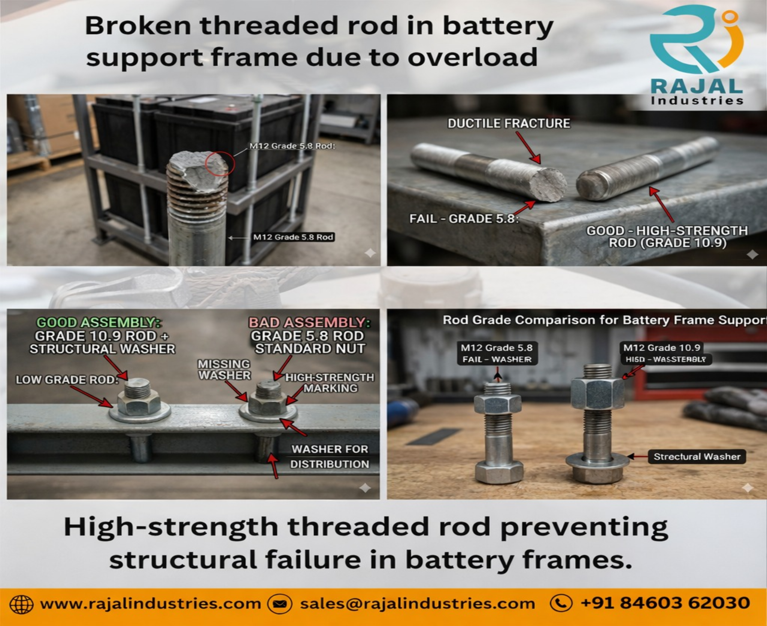
During inspection of a multi-tier battery support frame, one vertical bracing rod had snapped near the nut interface. The frame carried approximately 1.8 tons of battery weight across multiple levels.
Rod size: M12 threaded rod
Grade used: 5.8
Torque applied: unknown
The fracture surface showed ductile overload.
This is a classic case of battery threaded rod failure.
The issue was not rod diameter.
It was strength grade selection.
Threaded rods in battery structures are often treated as simple connectors.
In reality, they carry tensile and sometimes bending load.
Why Battery Threaded Rod Failure Happens
Threaded rods in battery support frames handle:
- • Vertical tension load
- • Dynamic vibration
- • Lateral bracing force
- • Maintenance stress
Common causes of failure:
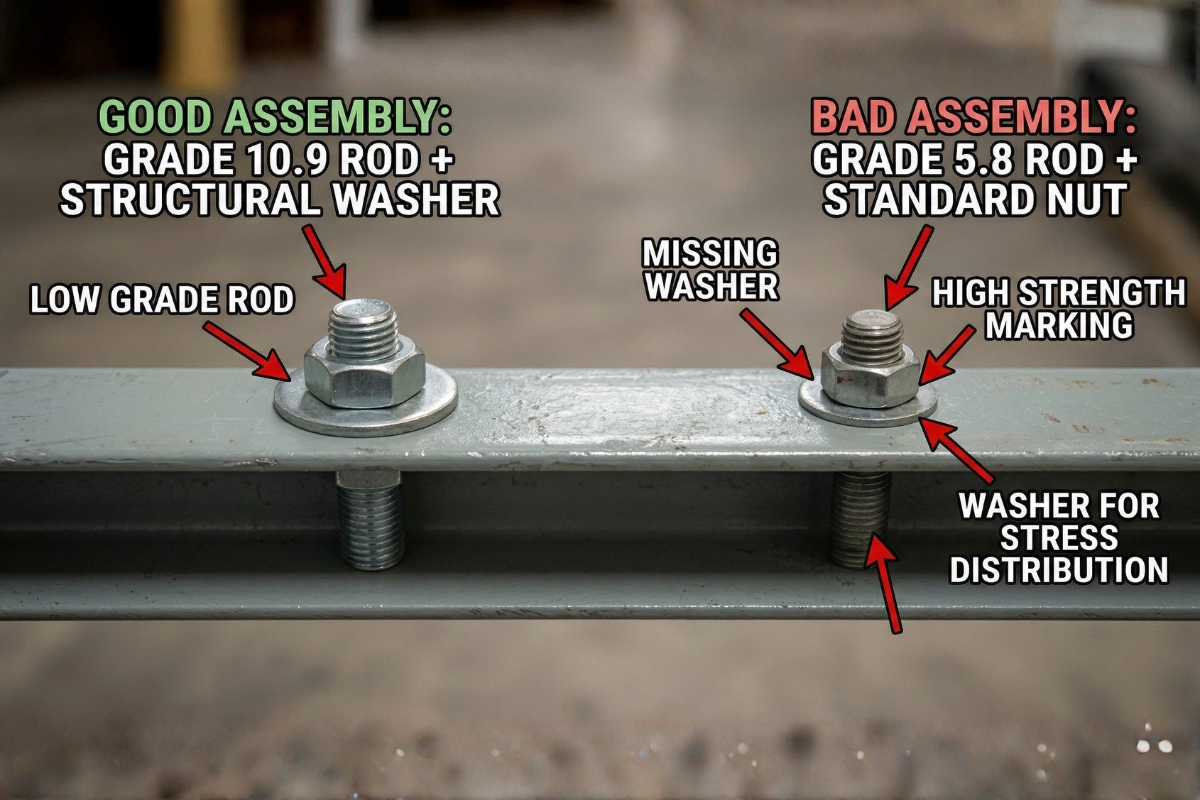
- • Low strength grade (5.8 or mild steel)
- • Insufficient preload
- • No structural washer
- • Excess bending load
- • Corrosion reducing cross-section
Thread roots are stress concentration points.
If yield strength is low, failure begins at thread root.
Case Study: M12 Grade 5.8 Rod Failure
Mechanical properties (ISO 898-1 equivalent):
Grade 5.8:
- • Yield strength ≈ 400 MPa
- • Ultimate strength ≈ 500 MPa
Tensile stress area for M12 ≈ 84.3 mm²
Yield load:
400 × 84.3 = 33,720 N
≈ 33.7 kN
Load on rod estimated: 30–32 kN
The rod operated near yield limit continuously.
After repeated vibration cycles, fatigue crack formed.
Failure was inevitable.
Strength Formula for Grade 10.9 M12 Threaded Rod
Grade 10.9 properties:
- • Yield strength = 900 MPa
- • Ultimate tensile strength = 1000 MPa
Tensile stress area (M12) ≈ 84.3 mm²
Yield load:
900 × 84.3 = 75,870 N
≈ 75.8 kN
Grade 10.9 provides more than double yield capacity compared to 5.8.
Safety margin improves significantly.
Why Grade 10.9 Rod Is Recommended for Battery Support Frames
Advantages:
- • Higher tensile strength
- • Better fatigue resistance
- • Improved preload retention
- • Reduced elongation under load
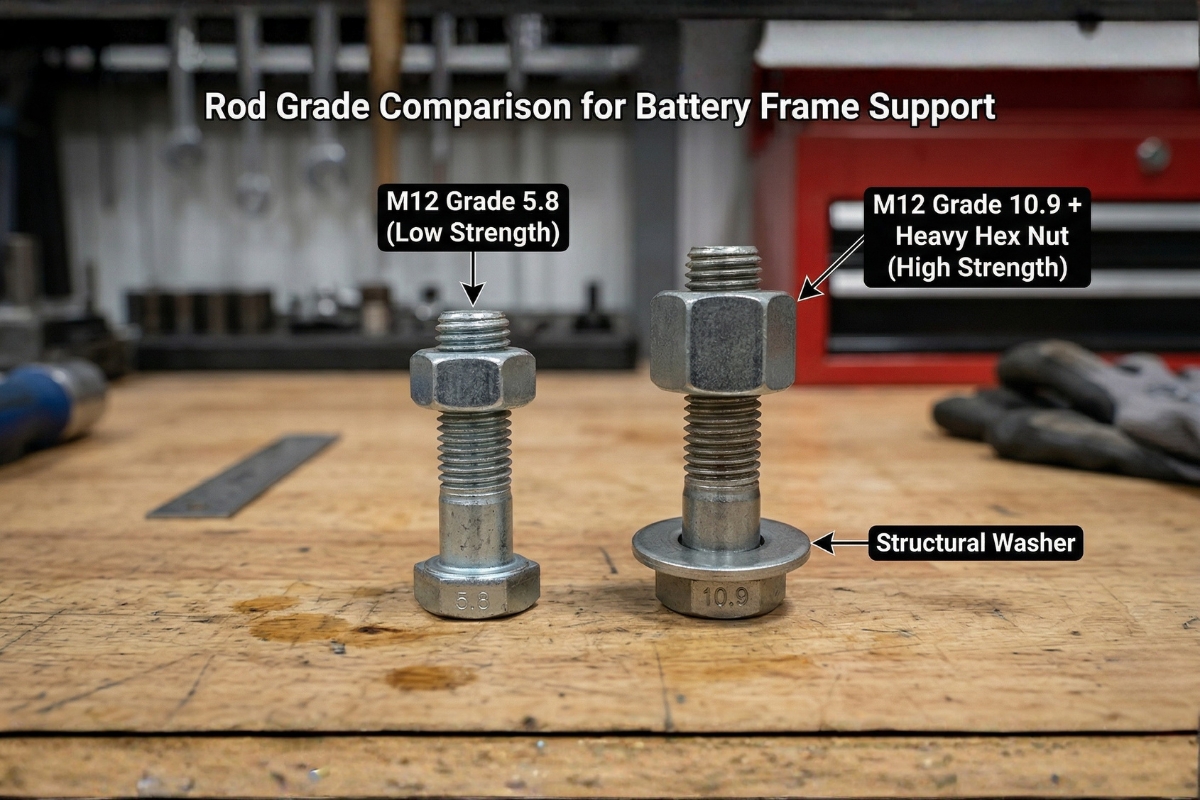
For heavy multi-tier battery systems, use:
👉 M12 Grade 10.9 Threaded Rod for Structural Battery Frames
Pair with:
👉 Heavy Hex Nut M12 for High-Strength Applications
Use:
👉 Structural Washer M12 for Load Distribution
Proper assembly prevents localized stress.
Torque Recommendation for M12 Threaded Rod
| Rod Grade | Recommended Torque |
| M12 Grade 8.8 | 75–85 Nm |
| M12 Grade 10.9 | 110–120 Nm |
| M12 SS304 | 60–70 Nm |
Correct torque ensures proper clamp force.
Under-torque reduces preload.
Over-torque risks thread yielding.
Role of Heavy Hex Nut and Structural Washer
Heavy hex nut:
- • Larger bearing surface
- • Higher thread engagement
- • Better strength distribution
Structural washer:
- • Prevents plate embedding
- • Reduces stress concentration
- • Maintains joint stiffness
Without washer, threaded rod load may concentrate at plate hole edge.
Failure Modes of Threaded Rod in Battery Frames
Tensile overload
Fatigue crack at thread root
Corrosion pitting leading to crack initiation
Bending due to misalignment
Improper torque causing uneven load
Threaded rods must be aligned vertically and loaded axially.
Comparison Table: 5.8 vs 8.8 vs 10.9 Rod
| Grade | Yield Strength | M12 Yield Load | Suitable for Heavy Battery Frame |
| 5.8 | 400 MPa | 33.7 kN | No |
| 8.8 | 640 MPa | 53.9 kN | Moderate |
| 10.9 | 900 MPa | 75.8 kN | Yes |
Grade 10.9 provides better safety margin.
Inspection Checklist for Battery Threaded Rods
✔ Check grade marking
✔ Inspect for necking near threads
✔ Check torque annually
✔ Look for corrosion
✔ Ensure washer present
✔ Verify alignment
Threaded rods should never be reused if deformed.
FAQ
Q1: Why does battery threaded rod failure occur in support frames?
Because low-grade rods operate near yield limit and fail under repeated load cycles.
Q2: Is M12 grade 8.8 sufficient for heavy battery racks?
It depends on load. For high-capacity multi-tier racks, grade 10.9 provides better safety margin.
Q3: How do I calculate rod strength?
Multiply tensile stress area by yield strength. For M12 grade 10.9, yield load ≈ 75.8 kN.
Q4: Should heavy hex nuts be used with threaded rods?
Yes. Heavy hex nuts improve load distribution and strength.
Q5: Does corrosion weaken threaded rod significantly?
Yes. Pitting corrosion reduces effective cross-section and accelerates fatigue failure.
Q6: How often should threaded rods be inspected?
At least annually in industrial battery installations.
Conclusion
Battery threaded rod failure is usually caused by low strength grade and improper load calculation.
Upgrade to:
- • M12 Grade 10.9 threaded rod
- • Heavy hex nuts
- • Structural washers
- • Correct torque control
Ensures structural safety in battery support frames.
Need load-based rod selection for your battery structure?
Contact our engineering team for structural fastener recommendations.
References
ISO 898-1 – Mechanical properties of fasteners
EN 1993 – Structural steel design
VDI 2230 – Bolted joint calculation
Machinery’s Handbook – Tensile stress area values