

Introduction – Real Site Hook
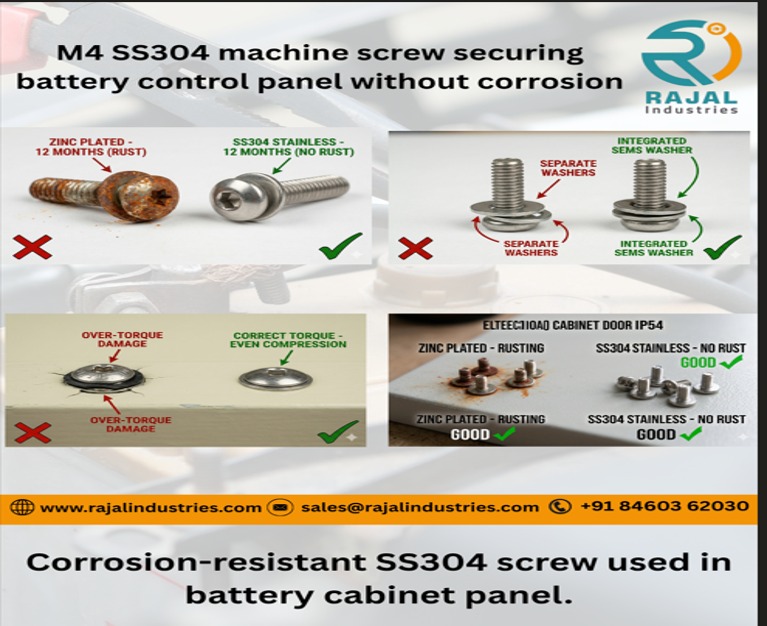
During inspection of a battery control cabinet in a telecom shelter, multiple M4 screws on the panel door showed red rust. The paint coating was intact. The enclosure rating was IP54. But corrosion had started at the screw head and washer interface.
Humidity inside cabinet: 68%.
Temperature variation: 15–42°C daily.
Fastener type: zinc plated M4 machine screw.
This is a common issue with battery panel fasteners.
Panel corrosion rarely begins from the metal sheet.
It begins at the screw.
Why Battery Panel Fasteners Corrode First
Battery control panels experience:
- • Condensation
- • Humidity cycles
- • Limited ventilation
- • Possible acid vapor exposure
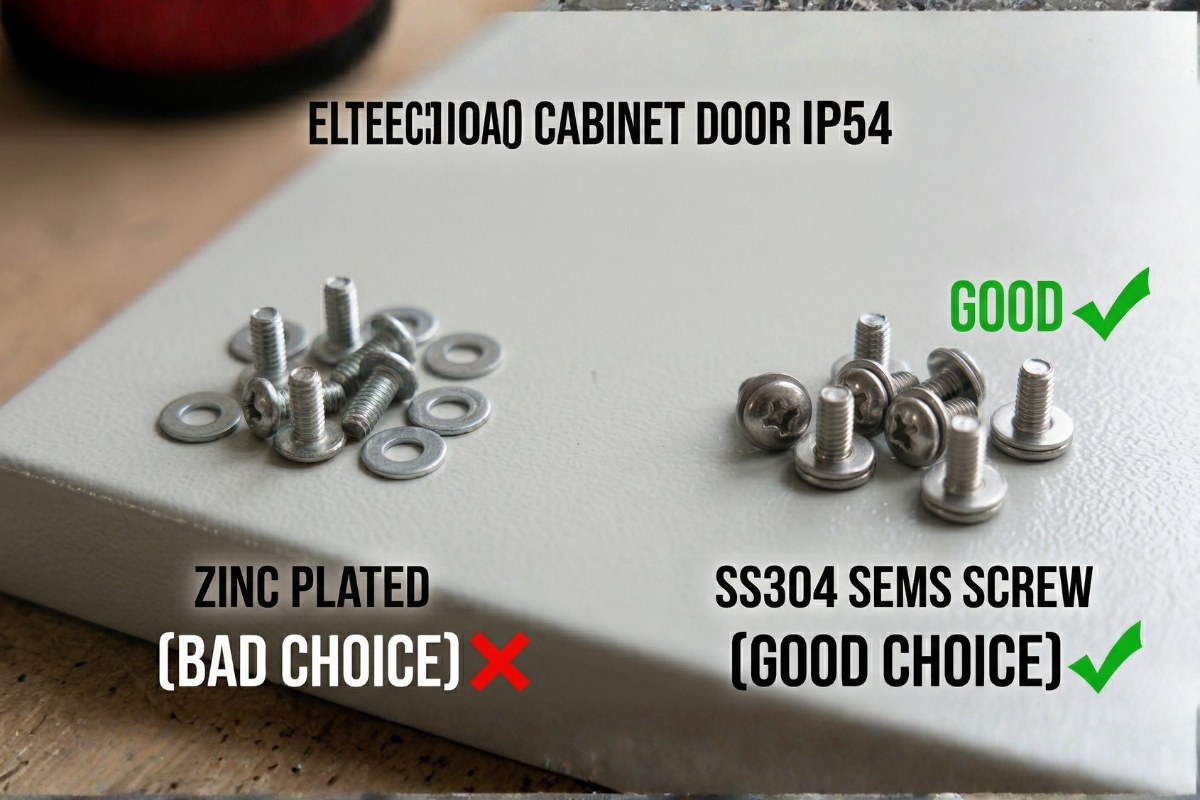
Zinc plated screws:
- • Have thin coating (8–12 microns)
- • Scratch easily during installation
- • Corrode faster at edges
Once corrosion starts:
- • Screw head weakens
- • Threads degrade
- • Removal becomes difficult
- • Panel seal may be compromised
Small fasteners can create large maintenance problems.
Case Study: Rusted M4 Screws in Control Cabinet
Findings:
- • M4 zinc machine screws used
- • Standard flat washer used
- • No captive mechanism
- • Some screws reused during maintenance
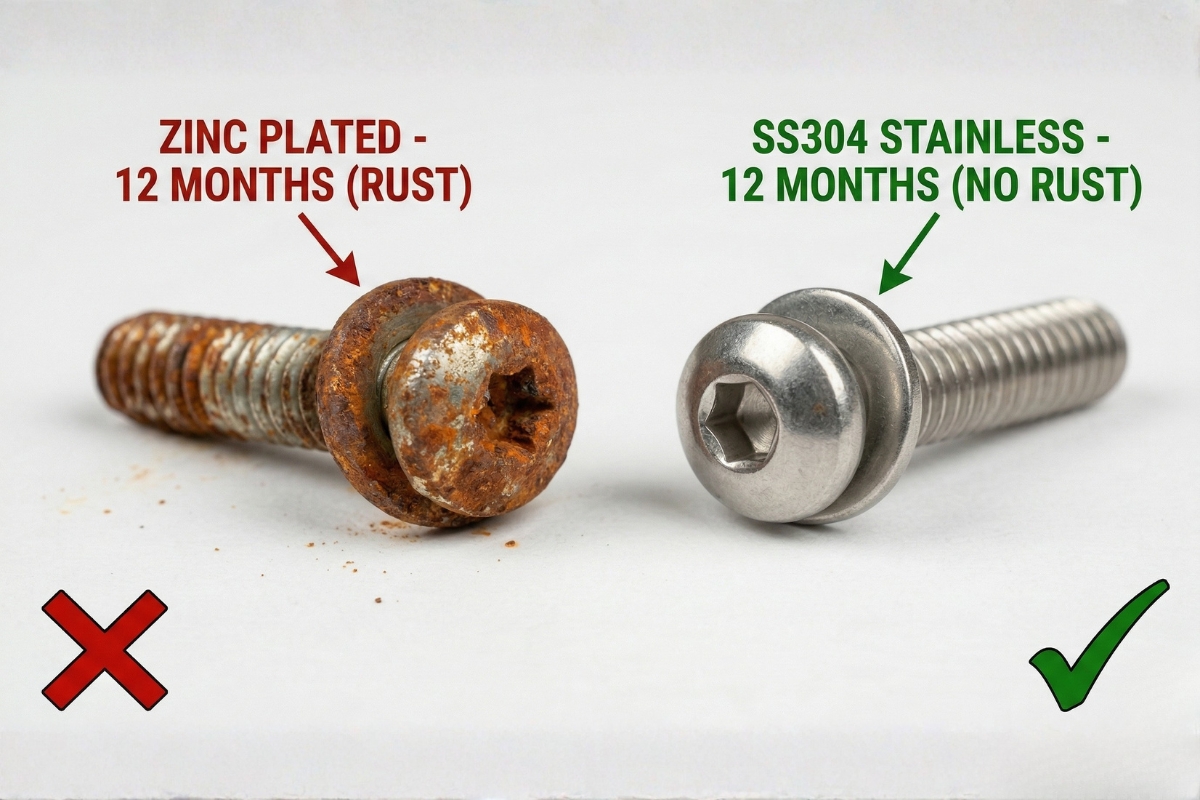
After 12 months:
- • Rust visible on head
- • Thread corrosion in rivet nut
- • Torque reduced
- • Panel gasket compression uneven
The problem was not panel design.
It was incorrect material selection.
Why SS304 Screw Is Recommended for Panels
SS304 advantages:
- • High corrosion resistance
- • Stable mechanical strength
- • Suitable for humid environment
- • Compatible with aluminum and steel panels
For battery control panels, recommended fastener:
- • M4 SS304 Machine Screw
- • Captive panel screw (for removable panels)
- • Stainless rivet nut
- • Optional SEMS screw (integrated washer type)
You can review specifications for our
👉 M4 SS304 Machine Screws for Battery Panels
For removable doors use:
👉 Captive Panel Screws in Stainless Steel
For thin sheet mounting use:
👉 M4 Stainless Rivet Nuts for Panel Installation
Torque Recommendation for M4 Screws
Thread size: M4 coarse
Recommended torque:
| Screw Type | Torque |
| M4 Zinc Screw | 1.5–2 Nm |
| M4 SS304 Screw | 1.2–1.8 Nm |
| M4 SEMS Screw | 1.5 Nm |
Important:
Over-tightening can strip rivet nuts.
Under-tightening reduces panel sealing.
Small screws require precise torque control.
Tensile Capacity of M4 SS304 Screw
Tensile stress area (M4) ≈ 8.8 mm²
Yield strength (SS304 approx.) ≈ 450 MPa
Yield load:
450 × 8.8 = 3,960 N
≈ 4 kN
Although load capacity is low compared to structural bolts, correct preload ensures:
- • Proper gasket compression
- • Panel rigidity
- • Vibration resistance
Corrosion reduces cross-section quickly at this small size.
SEMS Screw vs Standard Machine Screw
SEMS screw features:
- • Integrated washer
- • Improved load distribution
- • Faster assembly
- • Reduced washer loss
For battery panels with vibration, SEMS screws improve reliability.
Comparison: Zinc vs SS304 for Battery Panel Fasteners
| Parameter | Zinc Screw | SS304 Screw |
| Corrosion Resistance | Moderate | High |
| Humid Cabinet Suitability | Limited | Recommended |
| Long-Term Appearance | Rust Stains | Clean Finish |
| Maintenance Requirement | High | Lower |
Switching to stainless reduces maintenance calls.
Inspection Checklist for Battery Panel Screws
✔ Inspect screw heads for rust
✔ Check torque annually
✔ Replace corroded fasteners
✔ Avoid reusing damaged screws
✔ Use stainless rivet nuts
✔ Ensure uniform gasket compression
Prevent corrosion before it spreads.
FAQ
Q1: Why do battery panel fasteners rust inside closed cabinets?
Humidity and condensation inside battery enclosures create corrosive conditions for zinc plated screws.
Q2: Is SS304 suitable for battery control panels?
Yes. SS304 screws provide corrosion resistance and maintain mechanical integrity in humid environments.
Q3: Should rivet nuts also be stainless steel?
Yes. Mixing stainless screws with zinc rivet nuts may cause galvanic corrosion.
Q4: What torque is safe for M4 stainless screw?
Typically 1.2–1.8 Nm depending on panel thickness and thread condition.
Q5: Are captive panel screws necessary?
They prevent screw loss during maintenance and reduce incorrect replacements.
Q6: Can SEMS screws improve panel reliability?
Yes. Integrated washer improves load distribution and reduces vibration loosening.
Conclusion
Battery panel fasteners may be small, but they control enclosure integrity.
Using:
- • M4 SS304 machine screws
- • Captive panel screws
- • Stainless rivet nuts
- • Correct torque control
Prevents corrosion and maintains panel sealing.
Need stainless fastener upgrade for your battery control panels?
Contact our engineering team for enclosure-specific recommendations.
References
ISO 3506 – Stainless steel fastener properties
IEC 60529 – IP rating for enclosures
ASTM A240 – Stainless steel specification
ISO 9223 – Corrosion environment classification