

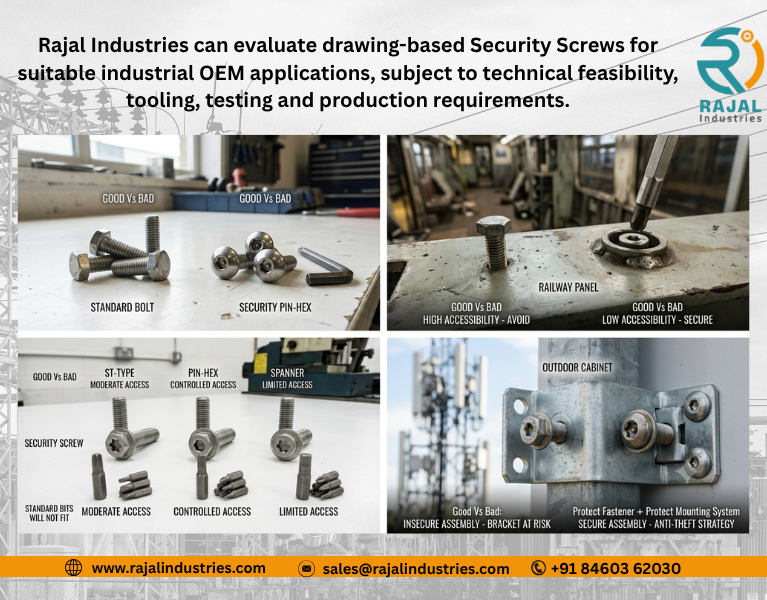
Selecting a Security Screw starts with understanding what you are trying to protect, who should be able to remove the fastener and how the equipment will be serviced.
The most unusual drive is not automatically the best choice.
A practical selection process is:
Security Risk → Authorized Access → Service Frequency → Standard or Custom Drive → Head → Thread → Size → Material → Mechanical Properties → Finish → Matching Tool → Installation → Testing
For Anti Theft Screws and Tamper Proof Fasteners, the fastener should make unauthorized removal more difficult without creating unnecessary problems for legitimate assembly and maintenance.
This Security Screw Guide explains how industrial OEMs can select the right combination for their actual application.
Quick Answer: How Do I Select a Security Screw?
To select a Security Screw, first define the tampering or theft risk and determine whether authorized users need to remove the fastener.
Then select:
- Security drive
- Reusable or difficult-removal design
- Head style
- Thread
- Diameter and length
- Material
- Mechanical properties
- Surface finish
- Matching tool
Finally, validate the production-intended screw, finish, tool and actual or representative assembly before bulk approval.
Security Screw Selection Formula
A useful engineering formula is:
Security Level + Service Access + Drive + Tool + Head + Thread + Size + Material + Properties + Finish + Application + Validation
Leaving out any major element can create problems later.
Step 1: Define Why You Need a Security Screw
Do not begin by asking:
Which security drive should we use?
Begin with:
What problem are we trying to prevent?
Potential objectives include:
- Casual tampering
- Unauthorized opening
- Vandalism
- Component theft
- Unauthorized adjustment
- Restricted maintenance access
- Easy removal using common tools
Different problems can require different solutions.
Security Objective Matrix
| Security Objective | Typical Situation | Selection Direction |
| Discourage Casual Opening | Equipment panel | Common security drive may be enough |
| Reduce Vandalism | Public equipment | Specialized drive |
| Restrict Maintenance | Industrial enclosure | Controlled reusable drive |
| Discourage Component Theft | Valuable component | Anti-theft system review |
| Prevent Casual Adjustment | Machinery control | Restricted tool |
| Permanent-Type Installation | Public fixture | One-way may be evaluated |
| Higher Tool Control | OEM equipment | Custom drive may be evaluated |
This is a conceptual selection matrix, not a certified security classification.
Step 2: Identify Who Can Access the Fastener
Ask:
- Is the equipment inside a factory?
- Can the general public reach it?
- Is it inside a railway passenger area?
- Is it an outdoor telecom cabinet?
- Is it a utility enclosure?
- Is it accessible only to technicians?
- Is the fastener hidden or exposed?
Physical access changes the security requirement.
Public Access vs Restricted Access
Publicly Accessible
Greater attention may be needed for:
- Tool availability
- Head accessibility
- Vandalism
- Theft
- Outdoor corrosion
Restricted Industrial Area
The requirement may focus more on:
- Preventing unauthorized adjustments
- Separating operator access from technician access
- Controlled maintenance
Do not automatically specify the same Tamper Proof Fasteners for both environments.
Step 3: Define the Expected Threat
A security fastener can discourage certain types of unauthorized access, but it cannot solve every security problem.
A useful distinction is:
Casual Tampering
Someone attempts to open the equipment using ordinary available tools.
Deliberate Tampering
Someone intentionally obtains specialized tools.
Component Theft
Someone wants to remove the component or equipment.
These are increasingly different challenges.
Casual Tampering
For casual tampering, the main objective may simply be:
Prevent Removal with Common Phillips, Slotted, Hex or Standard Drive Tools
A commercially available security drive may be sufficient for some applications.
Deliberate Tampering
If someone is expected to obtain specialized bits, a commonly available security drive may provide limited additional control.
The equipment designer may need to consider:
- Less-common drive
- Custom drive
- Restricted head access
- Controlled tool
- Locks or other access controls
The screw should be considered within the complete product design.
Component Theft
For Anti Theft Screws, ask:
If this screw cannot be removed, can the component still be stolen another way?
Possible alternative removal paths include:
- Removing another fastener
- Accessing the rear side
- Breaking the surrounding component
- Cutting a bracket
- Sliding the component from its mount
A secure screw on an insecure assembly provides limited protection.
Anti-Theft Design Principle
Use:
Protect Fastener + Protect Head Access + Protect Mounting System + Protect Alternate Removal Paths
This is more effective than relying on drive geometry alone.
Step 4: Determine Service Frequency
One of the biggest selection mistakes is ignoring future maintenance.
Ask:
- Will the equipment ever be opened?
- How frequently?
- Who will open it?
- Will the same screw be reused?
- How long is the equipment expected to remain in service?
- Will replacement tools still be available?
Service Frequency Matrix
| Service Frequency | Fastener Direction |
| Frequent | Reusable security drive |
| Periodic | Reusable drive strongly preferred |
| Rare | Reusable or difficult-removal depending on application |
| Essentially Never | One-way may be evaluated |
| Unknown | Avoid difficult-removal design until clarified |
Step 5: Choose Reusable or One-Way Security Screws
Reusable Security Screws
Designed for installation and authorized removal using a matching tool.
Suitable direction for many:
- Electrical panels
- Telecom cabinets
- Railway equipment covers
- Machinery panels
- Service enclosures
One-Way Security Screws
Designed to make conventional reverse removal difficult.
Can be considered for selected:
- Permanent fixtures
- Public signs
- Non-serviceable components
Reusable vs One-Way Comparison
| Factor | Reusable Security Screw | One-Way Screw |
| Authorized Removal | Practical with correct tool | Difficult |
| Regular Service | Suitable | Generally poor |
| Maintenance Cost | Easier to manage | Can increase |
| Tool Requirement | Matching reusable tool | Installation/removal strategy |
| Permanent Installation | Possible | Can be suitable |
| Future Repair | More practical | More difficult |
When Not to Use One-Way Screws
Avoid selecting a one-way design only because it appears more secure.
It may be unsuitable where:
- Panels require inspection
- Electronics require repair
- Equipment has replaceable components
- Railway technicians need regular access
- Telecom field service is expected
- Electrical maintenance is required
Security should not make legitimate maintenance unnecessarily destructive.
Step 6: Choose the Security Drive
Common drive concepts can include:
- Security Torx-type
- Pin hex
- Spanner
- Triangle
- Specialty multi-lobe drives
- One-way
- Custom OEM profile
The drive should match the required security and service model.
Security Drive Selection Matrix
| Drive Concept | Serviceability | Tool Availability | Typical Selection Direction |
| Security Torx-Type | Good | Relatively accessible | General tamper resistance |
| Pin Hex | Good | Specialized but obtainable | Controlled access |
| Spanner | Moderate | Less common | Public equipment |
| Triangle | Moderate | Application dependent | Specialized equipment |
| Specialty Multi-Lobe | Good-Moderate | Application dependent | OEM equipment |
| One-Way | Low | Removal difficult | Permanent-type use |
| Custom OEM | Designed as required | Controlled | Higher tool control |
This table does not represent a formal security rating.
Security Torx-Type Screws
A security Torx-type drive can be practical when the buyer needs:
- Reusable access
- Good tool engagement
- Powered installation potential
- A more restricted drive than standard Torx
However, matching security bits can be commercially available.
Therefore, it should generally be considered tamper-resistant rather than impossible to remove.
Pin Hex Security Screws
Pin hex designs use an internal hex with a center feature that prevents a conventional matching hex tool from fully engaging.
Check:
- Hex geometry
- Pin diameter
- Pin position
- Drive depth
- Matching tool
Pin quality is a functional requirement.
Spanner Security Screws
Spanner-style drives can discourage removal using common screwdrivers and hex tools.
Potential uses include selected:
- Public fixtures
- Signage
- Enclosures
Consider tool engagement and installation requirement before selection.
Triangle & Specialty Drives
Specialty profiles can provide less-common tool access.
But always ask:
How difficult is the matching tool actually to obtain?
An unusual-looking drive is not automatically a high-security system.
Step 7: Standard Drive or Custom Security Drive?
Custom security geometry may be useful where:
- Standard security bits are considered too accessible
- OEM-specific access control is required
- Existing imported security fasteners need localization
- A unique head/drive combination is required
But customization adds complexity.
Standard vs Custom Security Screw
| Factor | Standard Security Drive | Custom Security Drive |
| Development | Lower | Higher |
| Tooling | Usually simpler | Custom tooling |
| Matching Tool | Easier to source | Custom tool |
| Replacement Tool | Easier | Must be managed |
| MOQ | Often more flexible | Can be higher |
| Lead Time | Usually shorter | Development required |
| Access Control | Moderate/application dependent | Potentially greater |
| Revision Control | Simpler | Screw + tool |
When Should You Choose a Custom Drive?
Consider customization when the additional tool control creates a real benefit.
Do not customize merely to make the screw look proprietary.
The buyer should be able to explain:
Why the standard security drive is insufficient.
Custom Security Screw Development
A practical sequence is:
Security Requirement → Drive Concept → Screw Drawing → Matching Tool Drawing → Manufacturing Review → Tooling → Samples → Tool-Fit Test → Assembly Test → Approval
Custom Screw and Tool Are One System
For custom Tamper Proof Fasteners, control:
Security Screw Drawing ↔ Matching Driver Drawing
A change to one may affect the other.
This should be considered during revision control.
Custom Does Not Mean Impossible to Copy
A custom security drive can restrict ordinary tool access.
It should not be marketed as impossible to reproduce.
The practical security level also depends on:
- Physical accessibility
- Tool distribution
- Component design
- Time available
- Alternative removal methods
Step 8: Choose the Head Style
Common head directions can include:
- Pan head
- Button head
- Countersunk head
- Raised countersunk
- Low-profile head
- Custom head
The head affects both assembly and security.
Pan Head Security Screw
Pan heads can provide:
- Useful recess depth
- Reasonable bearing surface
- Space for security-drive geometry
They can be considered for many industrial enclosures and panels.
Button Head Security Screw
Button heads can provide:
- Lower profile
- Rounded appearance
- Reduced projection
But lower head height can limit security-drive depth.
Countersunk Security Screw
Countersunk heads can provide a flush or near-flush surface when correctly matched to the mating countersink.
Check:
- Head angle
- Head diameter
- Countersink
- Drive depth
- Material around recess
Do not assume every countersunk head uses the same angle.
Low-Profile Security Screw
Reducing external gripping access can support tamper resistance.
But there is a trade-off:
Lower Head → Less Space for Drive
The head must still support reliable tool engagement.
Head Accessibility
Security is influenced not only by the drive but also by whether someone can grip the outside of the head.
Evaluate:
- External head access
- Recessed installation
- Surrounding geometry
- Authorized tool clearance
Do not restrict access so much that the correct driver cannot align properly.
Step 9: Select the Thread Type
Security describes the access feature.
It does not define the thread.
- Metric machine thread
- Unified machine thread
- Self-tapping thread
- Other customer-specified threads
Machine-Thread Security Screws
Machine threads are suitable where the joint uses:
- Tapped holes
- Nuts
- Threaded inserts
- Other defined mating threads
These can be practical for repeatedly serviced equipment.
Self-Tapping Security Screws
A security drive can also be combined with a self-tapping thread for suitable applications.
Selection must consider:
Mating Material + Thickness + Pilot Hole + Thread + Point + Installation
Do not focus only on the security drive.
Machine Thread vs Self-Tapping
| Requirement | Machine Thread | Self-Tapping |
| Pre-Existing Internal Thread | Yes | Not necessarily |
| Suitable Sheet Metal | Possible with insert/nut | Can be suitable |
| Repeated Service | Often practical | Must be evaluated |
| Pilot Hole | Application dependent | Important |
| Installation | Tightening | Tapping + seating |
Step 10: Select Screw Diameter
Do not choose diameter from the security requirement alone.
Diameter can affect:
- Thread engagement
- Head size
- Security-drive size
- Joint performance
- Available space
Use the approved mechanical design.
Security Drive vs Screw Diameter
Small diameters provide less head space for:
- Security recess
- Center pin
- Drive depth
- Material around the drive
Therefore, a complex security profile may become difficult to manufacture reliably in a very small screw.
Step 11: Select Screw Length
Length should provide the required engagement without interfering with surrounding components.
Review:
Component Stack + Thread Engagement + Point/End + Internal Clearance
Screw Length in Electrical Equipment
Pay particular attention to:
- Wiring
- Terminals
- Electronic components
- Internal brackets
- Moving mechanisms
A longer screw is not automatically safer.
Step 12: Select Material
Common material categories can include:
- Carbon steel
- Suitable alloy steel
- Stainless steel
- Customer-specified materials
Choose material from:
Mechanical Requirement + Environment + Corrosion + Manufacturing + Customer Specification
Carbon Steel Security Screws
Suitable carbon steel can be practical for many industrial applications.
Define:
- Material requirement
- Mechanical properties
- Heat treatment where applicable
- Finish
Do not specify only “MS security screw” where controlled properties are important.
Alloy Steel Security Screws
Suitable alloy steel may be used where the product specification requires particular mechanical properties.
Do not select alloy steel simply because it appears stronger.
The entire fastener specification must be compatible.
Stainless Steel Security Screws
Stainless steel can be considered where corrosion resistance is important.
Common directions can include suitable:
- 304 / A2-type
- 316 / A4-type
Final selection depends on the application.
SS304 vs SS316 Security Screws
| Factor | SS304 / A2-Type | SS316 / A4-Type |
| General Corrosion Resistance | Good for many applications | Improved in certain environments |
| Chloride Exposure | More limited | Often considered |
| Indoor Equipment | Common direction | May be unnecessary |
| Coastal Exposure | Requires evaluation | Often evaluated |
| Cost | Generally lower | Generally higher |
| Final Selection | Environment/specification | Environment/specification |
Outdoor Does Not Automatically Mean SS316
Outdoor equipment can range from:
- Sheltered urban cabinets
- Open industrial equipment
- Coastal infrastructure
- High-humidity installations
The actual environment should determine the material and finish.
Step 13: Consider Galvanic Compatibility
Fastener material should also be reviewed against the mating component.
For example:
Stainless Security Screw + Aluminium Panel + Moisture
may require galvanic-corrosion consideration.
Evaluate the complete material combination.
Step 14: Define Mechanical Properties
Security does not replace mechanical performance.
Depending on the screw type and application, requirements can include:
- Strength
- Hardness
- Toughness
- Torsional behaviour
- Thread performance
- Head/drive integrity
Use the approved specification.
Higher Hardness Is Not Automatically Better
Too little hardness can contribute to:
- Drive deformation
- Thread damage
Excessive hardness can contribute to brittleness in unsuitable designs.
Target the specified property range rather than maximum hardness.
Step 15: Select the Surface Finish
Possible finish systems can include:
- Zinc-based coatings
- Black finishes
- Engineered corrosion-resistant coatings
- Passivation for suitable stainless products
- Customer-specified finishes
Choose based on:
Environment + Corrosion + Appearance + Functional Fit + Customer Specification
Do Not Specify Only “Black”
A black screw can use different surface treatments.
Colour alone does not define corrosion performance.
A better specification defines:
Finish System + Required Performance
Coating Can Change Security Drive Fit
A security recess can contain small features.
Coating buildup can affect:
- Drive width
- Pin clearance
- Recess depth
- Tool engagement
This is especially important for small security screws.
Final-Finish Tool Testing
Where practical, test:
Production-Intended Screw + Final Finish + Matching Driver
Do not rely only on an unfinished sample.
Step 16: Define the Matching Tool
The matching tool is a critical part of reusable Tamper Proof Fasteners.
Specify:
- Tool profile
- Size
- Part number
- Revision
- Bit/driver format
- Replacement process
For custom drives, a controlled tool drawing may be appropriate.
Tool Availability vs Security
There is a trade-off:
Easy Tool Availability → Easier Maintenance, Lower Access Control
Restricted Tool Availability → Greater Access Control, More Maintenance Complexity
Neither is automatically better.
The application determines the right balance.
Tool Distribution Strategy
Ask:
- Who receives the tools?
- Factory assembly team?
- Installer?
- Maintenance contractor?
- Service center?
- End customer?
Tool distribution is part of the practical security system.
Replacement Tool Strategy
For long-life industrial equipment, consider what happens when:
- A bit is lost
- A tool wears out
- A service contractor changes
- Equipment remains in service for 10+ years
A security system without a replacement-tool strategy can become a maintenance problem.
Step 17: Check Screw-to-Tool Fit
The tool must:
Enter → Engage → Transfer Installation Load → Release → Re-Engage for Service
Poor fit can cause:
- Slipping
- Drive damage
- Tool wear
- Pin damage
- Failed authorized removal
Tool Fit Too Tight
Possible problems:
- Tool cannot enter
- Jamming
- Coating damage
- Slow assembly
Investigate screw and tool dimensions rather than forcing the bit.
Tool Fit Too Loose
Possible problems:
- Poor engagement
- Slipping
- Rounded drive
- Increased tool wear
Both screw and bit should be inspected.
Step 18: Consider Installation Method
How will the Security Screw be installed?
- Manual tool
- Powered screwdriver
- Semi-automatic station
- Automated production equipment
Drive selection should support the actual assembly process.
Manual Installation
Review:
- Tool ergonomics
- Access
- Alignment
- Drive engagement
- Operator consistency
Powered Installation
Review:
- Bit engagement
- Driver alignment
- Speed
- Installation setting
- Tool wear
- Head condition
Do not assume settings used for a conventional screw will automatically suit a different security drive.
Automated OEM Assembly
High-volume production may require:
Feeding → Orientation → Delivery → Tool Engagement → Installation → Seating
Custom head or drive geometry can affect automated handling.
Discuss production method early with the manufacturer.
Step 19: Consider Authorized Removal
If the screw is reusable, selection should not stop at installation.
Test:
Installation → Service Exposure → Authorized Removal
Where repeated maintenance is expected, consider:
Install → Remove → Inspect → Reinstall
Repeated Service
Repeated access can affect:
- Security recess
- Center pin
- Tool
- Thread
- Finish
The acceptable number of service cycles should be determined from the actual equipment requirement rather than a generic internet value.
Step 20: Check the Complete Assembly
A good Security Screw Guide should never treat the screw in isolation.
Review:
Fastener + Tool + Component + Access + Environment + Service Process
Complete Security System
A practical model is:
Security Screw + Matching Tool + Head Accessibility + Mounting Design + Authorized Service Process
The weakest element can determine the practical security level.
Common Selection Mistake 1: Choosing the Most Unusual Drive
An unusual drive may:
- Cost more
- Require custom tooling
- Create tool-supply problems
- Delay maintenance
without providing a meaningful security improvement.
Select according to actual risk.
Common Selection Mistake 2: Calling Everything Tamper Proof
Tamper Proof Fasteners is a useful commercial term, but many designs are better described technically as tamper-resistant.
Avoid implying that unauthorized removal is impossible.
Common Selection Mistake 3: Ignoring Maintenance
A difficult-removal screw can create a major service problem.
Always define:
Who Removes It + How Often + With Which Tool
before approving the design.
Common Selection Mistake 4: Forgetting the Matching Tool
A custom security screw without a controlled matching driver is an incomplete system.
Approve both together.
Common Selection Mistake 5: Selecting Material Only for Security
The drive controls tool access.
The material controls other important properties.
Do not use:
“Security screw material”
as though security defines the material.
Common Selection Mistake 6: Ignoring Coating Buildup
Detailed recesses and small pins can lose functional clearance after finishing.
Tool-fit testing should use final-finish parts where appropriate.
Common Selection Mistake 7: Ignoring Alternative Removal Paths
Anti Theft Screws provide limited benefit if the protected component can easily be removed another way.
Review the entire assembly.
Common Selection Mistake 8: No Application Testing
A screw can meet dimensional inspection but still:
- Fit the tool poorly
- Be difficult to install
- Damage the panel
- Be difficult to remove
- Interfere with nearby components
Functional testing is important.
Common Selection Mistake 9: Approving Only the Screw
For reusable security systems, approve:
Screw + Matching Tool + Actual/Representative Assembly
not the screw alone.
Common Selection Mistake 10: Comparing Price Before Technical Compliance
A lower-priced screw is not equivalent if:
- Drive geometry differs
- Tool does not fit
- Material differs
- Finish differs
- Thread differs
- Testing is missing
Establish technical equivalence first.
Security Screw Selection Checklist
Before requesting samples, confirm:
Security
☐ Tampering risk
☐ Theft risk
☐ Public accessibility
☐ Authorized users
☐ Required service access
Geometry
☐ Drive
☐ Head
☐ Diameter
☐ Thread
☐ Length
Material
☐ Material grade
☐ Mechanical properties
☐ Heat treatment where required
Finish
☐ Coating/passivation
☐ Corrosion requirement
☐ Appearance
Tool
☐ Matching driver
☐ Tool availability
☐ Replacement strategy
☐ Revision control
Application
☐ Mating component
☐ Installation access
☐ Internal clearance
☐ Environment
☐ Service frequency
Security Screw Selection by Industry
| Industry/Application | First Priority | Second Priority | Third Priority |
| Railway Equipment | Authorized service | Tamper resistance | Environment |
| Electrical Panel | Controlled access | Clearance | Service |
| Telecom Cabinet | Security | Field maintenance | Corrosion |
| Public Infrastructure | Vandal resistance | Environment | Service |
| Utility Cabinet | Access control | Tool management | Corrosion |
| Public Signage | Anti-removal | Weather | Replacement |
| Industrial Machinery | Restricted access | Maintenance | Joint function |
| Public Electronics | Tamper resistance | Service | Electrical clearance |
Selection Example: Railway Access Panel
Requirement
Passenger-accessible equipment panel requiring periodic maintenance.
Selection Logic
Public Access → Tamper Resistance → Periodic Maintenance → Reusable Drive → Suitable Head → Approved Thread → Environment-Appropriate Material/Finish → Controlled Tool → Functional Validation
The responsible railway OEM or authority remains responsible for the final approved specification.
Selection Example: Electrical Cabinet
Requirement
Outdoor electrical enclosure requiring technician access.
Selection Logic
Unauthorized Access → Reusable Drive → Panel Thread → Correct Length → Corrosion Requirement → Matching Tool → Electrical Clearance → Validation
The security screw supplements rather than replaces required electrical access-control and safety systems.
Selection Example: Telecom Cabinet
Requirement
Remote outdoor telecom enclosure.
Selection Logic
Tampering Risk → Field Service → Reusable Security Drive → Tool Availability → Outdoor Material/Finish → Functional Removal Test
Here, tool availability may be almost as important as the drive itself.
Selection Example: Public Sign
Requirement
Public sign repeatedly removed using common tools.
Selection Logic
Removal Risk → Low Service Frequency → Specialized Drive → Head Access Review → Outdoor Finish → Matching Maintenance Tool
Also inspect brackets and alternate removal paths.
Selection Example: Valuable Public Component
Requirement
Component theft is the main concern.
Selection Logic
Do not begin only with the screw.
Use:
Component Theft Risk → Complete Mounting Review → Alternative Removal Paths → Head Accessibility → Security Drive → Tool Control → Material/Finish → Validation
This is where Anti Theft Screws should form part of a broader anti-theft strategy.
Selecting a Security Screw Manufacturer
For custom OEM requirements, evaluate whether the manufacturer can control:
- Drawing
- Head forming
- Security-drive geometry
- Thread
- Material
- Heat treatment where required
- Finish
- Tooling
- Matching driver
- Inspection
- Tool-fit testing
- Samples
- Pilot production
- Traceability
Rajal Industries: Security Screw Selection Review
Rajal Industries can evaluate standard and drawing-based Security Screw requirements for suitable industrial OEM applications.
Depending on technical feasibility and customer specifications, projects can be reviewed for:
- Anti Theft Screws
- Tamper Proof Fasteners
- Reusable Security Screws
- Suitable One-Way Security Screws
- Security Torx-Type Drives
- Pin-Hex Security Drives
- Specialty Security Drives
- Custom OEM Security Drives
- Machine-Thread Security Screws
- Suitable Self-Tapping Security Screws
- Pan, Button and Countersunk Heads
- Custom Head Geometry
- Carbon Steel
- Suitable Alloy Steel
- Stainless Steel
- Customer-Specified Finishes
- Matching Driver Requirements
- Custom Tooling
- Sample Development
- Dimensional Inspection
- Material/Mechanical Verification
- Tool-Fit Testing
- Functional Application Testing
- Pilot Production
- Bulk OEM Manufacturing
Final feasibility should be confirmed against the approved drawing, security-drive geometry, matching tool, application, material, mechanical properties, finish, testing and required quantity.
Bulk Buyer Quick Answer
What should I send when asking for a custom Security Screw?
Send:
Approved Drawing + Application + Security Objective + Drive + Head + Thread + Length + Material + Mechanical Properties + Finish + Matching Tool Requirement + Service Requirement + Quantity
If replacing an imported or existing fastener, also provide the approved existing screw and matching driver where available.
Security Risk-to-Drive Decision Matrix
Start with the expected risk.
| Risk | Typical Situation | Drive Direction | Service Strategy |
| Low | Casual access | Standard security drive | Reusable |
| Low-Medium | Public-access panel | Specialized reusable drive | Reusable |
| Medium | Vandal-prone equipment | Less-common security drive | Controlled tool |
| Medium-High | Valuable accessible component | Security + protected head | Controlled tool |
| Higher Tool-Control Need | Restricted OEM equipment | Custom drive may be evaluated | Controlled custom tool |
| Permanent-Type Installation | Non-serviceable fixture | One-way may be evaluated | Removal planning required |
This matrix is conceptual. It is not a certified security rating.
Anti-Theft vs Tamper-Resistant Selection
These terms describe different practical objectives.
Tamper Resistance
The objective is normally to make unauthorized:
- Opening
- Adjustment
- Access
- Fastener removal
more difficult.
Anti-Theft
The objective is to make removal of a valuable component or assembly more difficult.
For Anti Theft Screws, the complete mounting system becomes especially important.
Anti Theft Screws Need Assembly-Level Review
Imagine a public electronic component secured with four custom security screws.
The drive may be difficult to access.
But if the entire mounting bracket can be removed with two standard hex bolts, the custom screws provide limited anti-theft value.
Therefore, evaluate:
Protected Component → Fastener → Head Access → Bracket → Rear Access → Alternative Fasteners → Alternative Removal Paths
Anti-Theft Selection Hierarchy
A useful approach is:
Reduce Physical Access → Protect Mounting System → Protect Fastener Head → Select Security Drive → Control Tool → Protect Alternative Removal Paths
The security fastener is one layer.
Tamper Proof Fasteners: What Does “Proof” Mean?
The term Tamper Proof Fasteners is widely used commercially.
Technically, many products are better described as tamper-resistant because a determined person may still remove them using:
- Specialized tools
- Modified tools
- Destructive methods
- Access to the surrounding assembly
Avoid guaranteeing that a screw is impossible to remove.
Standard vs Custom Security Drive Decision
Before developing custom tooling, ask:
Question 1
Does a standard security drive provide sufficient protection?
Question 2
Are matching tools too widely available for the intended security level?
Question 3
Is the expected order volume sufficient to justify custom tooling?
Question 4
Can replacement tools be controlled for the product’s service life?
Question 5
Does the custom drive create a measurable practical benefit?
If the answer to the final question is no, a standard security drive may be more practical.
Standard Security Drive Advantages
Potential advantages include:
- Lower development complexity
- Easier tool sourcing
- Faster sample development
- Easier field maintenance
- Lower replacement-tool risk
The trade-off is that tools may be more widely available.
Custom Security Drive Advantages
A custom drive can potentially provide:
- Greater control over tool distribution
- OEM-specific geometry
- Integration with custom head design
- Replacement of specialized imported fasteners
- Reduced compatibility with commonly available bits
But it also creates responsibilities.
Custom Security Drive Responsibilities
The buyer should plan for:
- Screw tooling
- Driver tooling
- Tool drawing
- Tool revision
- Replacement tools
- Tool distribution
- Minimum quantities
- Development lead time
- Sample approval
- Future spare-part support
A custom drive is a small technical ecosystem, not merely a different recess.
Security Screw + Tool Revision Control
For custom designs:
Screw Revision A ↔ Driver Revision A
If the drive changes:
Screw Revision B ↔ Driver Revision B
Do not assume an older tool will automatically remain compatible.
When Standard Security Screws Are Better
A standard security drive can be preferable where:
- Security risk is moderate
- Equipment requires frequent servicing
- Multiple maintenance contractors are involved
- Replacement tools must be readily available
- Production quantity is limited
When Custom Security Screws May Be Better
Custom development can be considered where:
- Tool access must be more tightly controlled
- Product value justifies the development
- Large OEM volumes support tooling
- Existing proprietary/imported fasteners require localization
- The customer has a defined tool-control process
One-Way vs Reusable: Final Decision
Ask one simple question:
Could anyone reasonably need to open this assembly during its service life?
If yes, strongly evaluate a reusable security system.
One-Way Application Example
Public Sign
The sign is expected to remain installed for years with minimal servicing.
A difficult-removal fastener may be evaluated.
But the organization should still decide how the sign will eventually be replaced.
Reusable Application Example
Telecom Cabinet
Technicians may access the cabinet repeatedly.
A reusable security drive with controlled field tools is generally more practical than a one-way design.
Reusable Application Example: Railway Panel
Passenger-accessible panel:
Tamper Risk + Regular Maintenance
This usually points toward a reusable security system rather than destructive removal.
Final selection remains subject to railway OEM requirements.
Reusable Application Example: Electrical Enclosure
An electrical enclosure may require authorized inspection or component replacement.
The security system should therefore allow qualified personnel to obtain reliable access.
Security screws should supplement required locks, interlocks and electrical safety systems rather than replace them.
Head-Access Strategy
The security drive is not the only way to make removal more difficult.
Head accessibility also matters.
Potential design strategies can include:
- Recessed head location
- Low-profile head
- Limited external gripping surface
- Surrounding geometry that restricts pliers or similar tools
However, the authorized driver still needs adequate access.
Head Access vs Tool Access
A design can become too restrictive.
If the driver cannot enter straight, problems can include:
- Partial engagement
- Slipping
- Drive damage
- Tool wear
- Pin damage
The goal is:
Restrict Unauthorized Access Without Preventing Correct Tool Alignment
Head Selection Matrix
| Requirement | Head Direction to Evaluate |
| General Industrial Panel | Pan/button |
| Low Projection | Button/low profile |
| Flush Surface | Countersunk |
| Public-Facing Equipment | Low-profile/security-oriented geometry |
| Large Internal Drive | Head with sufficient material |
| Custom OEM Appearance | Custom head subject to feasibility |
Countersunk Security Screw Selection
For countersunk designs, control both:
Screw Head + Component Countersink
Check:
- Head angle
- Head diameter
- Countersink angle
- Countersink diameter
- Drive depth
- Remaining head material
A security drive cannot compensate for an incorrectly matched countersink.
Small Security Screw Selection
Very small security screws can create a design conflict:
Small Head ↔ Complex Drive ↔ Center Pin ↔ Required Depth
Before finalizing the drawing, confirm manufacturing feasibility.
A simpler drive can sometimes provide more reliable production than an extremely detailed miniature profile.
Machine Thread vs Self-Tapping Selection
Use the mating component to make this decision.
Tapped Hole / Nut / Insert
Evaluate a machine-thread security screw.
Suitable Sheet Metal Without Existing Thread
A self-tapping security screw may be evaluated.
Self-Tapping Security Screw Checklist
Confirm:
☐ Mating material
☐ Material grade where relevant
☐ Material thickness
☐ Pilot-hole diameter
☐ Hole process
☐ Thread form
☐ Point geometry
☐ Screw material/properties
☐ Finish
☐ Installation method
☐ Service frequency
The security drive does not determine the correct pilot hole.
Repeated Service with Self-Tapping Screws
If a self-tapping security screw will be repeatedly removed and reinstalled, evaluate whether the mating thread remains acceptable throughout the required service cycle.
Where frequent servicing is expected, another thread system may be more appropriate.
Material Selection Matrix
| Condition | Material Direction to Evaluate | Main Check |
| Indoor Industrial | Coated carbon steel / suitable stainless | Specification |
| Humid Indoor | Corrosion-resistant system | Environment |
| General Outdoor | Suitable coated steel or stainless | Exposure |
| Coastal | Suitable corrosion-resistant system | Chlorides |
| Higher Mechanical Requirement | Specified steel/property system | Mechanical properties |
| Public Infrastructure | Application-specific | Corrosion + vandalism |
| Customer-Controlled OEM | Drawing material | Compliance |
Carbon Steel vs Stainless Steel
Do not ask:
Which material is better?
Ask:
Which material meets this application’s mechanical, corrosion, manufacturing and commercial requirements?
Carbon Steel Selection
Suitable carbon steel can offer:
- Mechanical-property flexibility
- Multiple finish options
- Practical high-volume manufacturing
- Competitive cost
But corrosion protection should be defined where required.
Stainless Steel Selection
Stainless steel can provide useful corrosion resistance but still requires correct grade selection.
Evaluate:
- Environment
- Mating material
- Thread system
- Installation
- Galling risk
- Customer specification
SS304 vs SS316 Selection
Consider SS304/A2-Type When
The environment and specification permit general-purpose stainless corrosion resistance.
Consider SS316/A4-Type When
More demanding chloride-related exposure makes the grade appropriate.
Neither should be selected only from a marketing description.
Outdoor Security Screw Selection
“Outdoor” is not a complete corrosion specification.
Define:
- Rain exposure
- Humidity
- Condensation
- Industrial pollution
- Coastal exposure
- Chemical exposure where applicable
Then select the material and finish.
Coastal Security Screw Selection
For coastal equipment, review:
Fastener Material + Mating Material + Finish + Chloride Exposure + Water Retention + Service Life
Stainless grade selection alone may not answer every corrosion question.
Galvanic Compatibility
Different metals can create corrosion concerns when electrically connected in a suitable electrolyte.
Potential combinations to review include:
Stainless Screw + Aluminium Enclosure
and other dissimilar-metal assemblies.
The complete joint should be evaluated rather than the screw alone.
Coating Selection
A coating should be selected from performance requirements such as:
- Corrosion
- Appearance
- Friction where relevant
- Compatibility with mating material
- Security-drive fit
Do not specify only:
Black coating
or:
Silver coating
Colour does not define performance.
Security Drive After Coating
Final coating can change small functional dimensions.
Potential issues include:
- Bit will not enter
- Center pin clearance reduces
- Recess becomes shallow
- Tool jams
- Engagement becomes inconsistent
Final-finish tool-fit testing can identify these problems.
Installation Validation
A practical test sequence is:
Correct Tool → Full Engagement → Installation → Seating → Inspection
Where the screw is serviceable:
Authorized Removal → Inspection → Reinstallation Where Required
Installation Window
Production should have a stable process that avoids:
Too Little Installation
Possible incomplete seating or inadequate joint condition.
Excessive Installation
Possible:
- Drive damage
- Thread damage
- Component damage
- Screw failure
The approved installation process should be based on the actual joint rather than a generic security-screw torque value.
Why Generic Torque Charts Can Be Risky
Required installation behaviour can vary with:
- Diameter
- Thread
- Material
- Mechanical properties
- Coating
- Mating thread
- Joint design
- Lubrication
- Installation equipment
Therefore, avoid assigning a universal torque simply because two screws have the same nominal diameter.
Powered Installation Validation
For powered assembly, evaluate:
- Correct bit
- Bit condition
- Driver alignment
- Speed
- Installation setting
- Seating
- Drive condition
- Tool wear
Automated Assembly
Custom security fasteners used in high-volume OEM production may also need consistent:
- Head geometry
- Straightness
- Feeding behaviour
- Orientation
- Bit engagement
Discuss automation requirements before finalizing custom geometry.
Authorized Removal Testing
For serviceable Tamper Proof Fasteners, removal performance is part of the design.
Test:
Tool Entry → Engagement → Breakaway/Removal → Screw Condition → Tool Condition
The exact acceptance criteria should come from the product requirement.
Repeated Service Testing
Where required:
Install → Remove → Inspect → Reinstall → Repeat to Defined Requirement
Observe:
- Drive wear
- Pin condition
- Tool wear
- Thread condition
- Coating damage
Do not invent a universal cycle requirement.
Security Screw Troubleshooting Guide
| Problem | Possible Causes | First Checks |
| Bit Will Not Enter | Recess/coating/tool | Dimensions + tool |
| Bit Too Loose | Drive variation/tool wear | Screw + bit |
| Bit Slips | Poor engagement/alignment | Depth + installation |
| Drive Rounds | Tool/setting/material | Fit + process |
| Pin Breaks | Geometry/misalignment | Pin + tool |
| Head Cracks | Geometry/properties/process | Head + material |
| Screw Breaks | Joint/installation/properties | Application |
| Screw Will Not Remove | Corrosion/drive damage | Environment + drive |
| Tool Wears Quickly | Poor fit/process | Screw-to-tool fit |
| Different Lots Fit Differently | Process variation | Drive dimensions |
| Coated Parts Do Not Fit | Coating buildup | Final dimensions |
| Panel Damages | Head/seating/process | Joint design |
Problem: Bit Does Not Fit
Do not immediately modify the tool.
Check:
- Is it the correct tool revision?
- Is the screw the correct revision?
- Does an unfinished screw fit?
- Has coating changed the recess?
- Is the center pin within specification?
- Is the drive centered?
Problem: Drive Rounding
Possible causes:
- Wrong bit
- Worn bit
- Shallow engagement
- Misalignment
- Excessive installation
- Drive variation
- Material/property issue
Determine the root cause before changing drive geometry.
Problem: Center Pin Breakage
Investigate:
- Pin dimensions
- Pin alignment
- Tool-hole dimensions
- Tool alignment
- Material condition
- Coating
- Handling damage
Problem: Screw Cannot Be Removed After Service
Potential causes include:
- Corrosion
- Contamination
- Drive damage
- Tool wear
- Thread condition
- Incorrect tool
For outdoor equipment, removal after environmental exposure can be an important validation consideration.
Problem: Unauthorized Removal Still Occurs
Do not automatically make the drive more complicated.
Investigate how removal is happening.
Is the person:
- Using a commercially available bit?
- Gripping the head?
- Removing another fastener?
- Accessing the rear?
- Breaking the bracket?
Solve the actual failure path.
Tool-Control Strategy
Tool management can determine whether a security fastener works operationally.
A practical system may define:
Tool Part Number → Revision → Authorized Users → Distribution → Replacement → Inventory
Tool Control for OEM Production
The factory may require tools for:
- Assembly
- Rework
- Quality
- Maintenance
Determine how many tools are required and where they are controlled.
Tool Control for Field Service
For railway, telecom, utility and infrastructure equipment, determine:
- Which technicians receive the tool
- Whether contractors receive it
- How lost tools are replaced
- Whether old revisions remain usable
- How tools are identified
Security vs Maintenance Trade-Off
| More Common Tool | More Restricted Tool |
| Easier maintenance | Greater access control |
| Easy replacement | More difficult replacement |
| Lower service risk | Higher tool-management requirement |
| Potentially lower security | Potentially higher control |
The correct position depends on the application.
Sample Development Process
For custom Security Screw projects:
Technical Requirement → Drawing → Feasibility → Screw Tooling → Driver Tooling → Samples → Inspection → Final Finish → Tool-Fit Test → Application Test → Customer Approval
Sample Approval Checklist
Confirm:
☐ Correct drawing revision
☐ Diameter
☐ Thread
☐ Length
☐ Head diameter
☐ Head height
☐ Security-drive geometry
☐ Drive depth
☐ Center pin where applicable
☐ Material
☐ Mechanical properties
☐ Finish
☐ Matching tool
☐ Tool entry
☐ Tool engagement
☐ Installation
☐ Authorized removal
☐ Application fit
Why Pilot Production Matters
A few development samples may be produced under close attention.
Bulk production introduces:
- Multiple tooling cycles
- Larger material batches
- Longer production runs
- Coating batches
- More inspection data
A pilot lot can provide additional confidence before high-volume production.
Pilot-Lot Validation
Review:
Dimensional Consistency + Drive Consistency + Tool Fit + Thread + Material + Properties + Finish + Functional Installation + Packaging + Traceability
Quality-Control Flow
A suitable quality flow can include:
Raw Material Verification → In-Process Dimensions → Security Drive Inspection → Thread Inspection → Heat-Treatment Verification Where Required → Finish Inspection → Final Dimensions → Tool-Fit Test → Functional Test → Packaging Verification
The exact control plan should match the product specification.
Critical Security Drive Characteristics
Depending on design:
- Recess width
- Drive depth
- Center pin diameter
- Pin height
- Pin location
- Concentricity
- Head dimensions
These features can directly affect tool engagement.
Functional Testing Is Important
Dimensional inspection asks:
Does the screw match the drawing?
Functional testing asks:
Does the screw work with the approved tool and assembly?
For security fasteners, both can matter.
Supplier Qualification
A buyer sourcing Anti Theft Screws or custom security fasteners should evaluate more than catalogue availability.
Ask whether the supplier can control:
- Drawing
- Tooling
- Drive forming
- Threading
- Material
- Mechanical properties
- Finish
- Inspection
- Matching driver
- Functional testing
- Traceability
- Production capacity
Security Screw Supplier Qualification Matrix
| Capability | Why It Matters |
| Drawing Review | Confirms technical requirement |
| Security Drive Tooling | Produces drive geometry |
| Matching Driver | Ensures authorized access |
| Material Control | Mechanical/corrosion requirement |
| Thread Control | Joint function |
| Heat-Treatment Control | Properties where required |
| Coating Control | Corrosion + tool fit |
| Drive Inspection | Tool compatibility |
| Tool-Fit Testing | Functional verification |
| Application Testing | Joint performance |
| Pilot Production | Process validation |
| Traceability | Batch control |
| Capacity | Bulk supply |
| Documentation | OEM quality support |
Manufacturer vs Supplier
For custom security fasteners, determine who actually controls:
Manufacturing + Tooling + Driver + Inspection
A trading supplier may still be commercially useful, but the OEM should understand the actual manufacturing and quality-control chain.
Imported Security Screw Localization
Localization can be practical when an OEM wants to replace an imported security fastener with a locally manufactured alternative.
Start with:
Approved Drawing + Existing Screw + Matching Driver + Material + Finish + Application + Quantity
Localization Without a Drawing
If only a physical sample is available, some dimensions may be measured.
However, the sample may not reveal:
- Original tolerance
- Material specification
- Mechanical properties
- Heat treatment
- Coating specification
- Original drive tolerances
- Revision
- Performance requirements
Do not assume sample measurement alone recreates the approved specification.
Localization Workflow
Existing Fastener → Drawing/Specification Review → Sample Measurement → Tool Review → Material Verification → Finish Review → Manufacturing Feasibility → Tooling → Samples → Tool-Fit Test → Application Validation → Pilot Lot → Approval
Screw and Tool Localization
For custom drives, localizing only the screw may leave the buyer dependent on imported bits.
Where appropriate, evaluate:
Security Screw + Matching Driver
as one localization project.
Supplier Comparison
| Factor | Supplier A | Supplier B | Supplier C |
| Drawing Compliance | Compare | Compare | Compare |
| Security Drive Capability | Compare | Compare | Compare |
| Screw Tooling | Compare | Compare | Compare |
| Matching Tool | Compare | Compare | Compare |
| Material | Compare | Compare | Compare |
| Mechanical Properties | Compare | Compare | Compare |
| Finish | Compare | Compare | Compare |
| Tool-Fit Test | Compare | Compare | Compare |
| Application Test | Compare | Compare | Compare |
| Pilot Lot | Compare | Compare | Compare |
| Traceability | Compare | Compare | Compare |
| MOQ | Compare | Compare | Compare |
| Capacity | Compare | Compare | Compare |
| Lead Time | Compare | Compare | Compare |
| Price | Compare Last | Compare Last | Compare Last |
First confirm technical equivalence.
Then compare commercial terms.
Complete OEM RFQ Checklist
Application
☐ Industry
☐ Equipment/component
☐ Security objective
☐ Tampering risk
☐ Theft risk
☐ Public accessibility
☐ Service frequency
☐ Environment
Screw
☐ Approved drawing
☐ Drawing revision
☐ Diameter
☐ Thread
☐ Length
☐ Head style
☐ Head dimensions
☐ Security drive
☐ Drive dimensions
☐ Drive depth
☐ Center pin where applicable
Material
☐ Material grade
☐ Mechanical properties
☐ Heat treatment where required
Finish
☐ Coating/passivation
☐ Coating specification
☐ Corrosion requirement
☐ Appearance
Matching Tool
☐ Driver/bit requirement
☐ Tool drawing
☐ Tool revision
☐ Tool quantity
☐ Replacement requirement
Application Interface
☐ Mating material
☐ Mating thread/hole
☐ Installation method
☐ Installation access
☐ Internal clearance
☐ Authorized removal
☐ Repeated service
Quality
☐ Dimensional inspection
☐ Material certificate
☐ Mechanical testing
☐ Coating requirement
☐ Tool-fit testing
☐ Functional testing
☐ Pilot approval
☐ Traceability
Commercial
☐ Sample quantity
☐ Pilot quantity
☐ MOQ
☐ First order
☐ Annual demand
☐ Packaging
☐ Delivery location
Example OEM RFQ
We require a Security Screw for a publicly accessible industrial enclosure. The fastener must discourage unauthorized removal while allowing periodic service with an approved matching tool. Please review the attached drawing, security-drive geometry, thread, material, mechanical properties, finish, mating component and tool requirement. Please confirm manufacturing and tooling feasibility, samples, tool-fit testing, pilot quantity, MOQ, capacity and quotation.
Common Buyer Mistakes
1. Asking Only for “Tamper Proof”
Define the actual risk.
2. Selecting Drive Before Application
Understand who needs access first.
3. Choosing One-Way for Service Equipment
Plan maintenance before selection.
4. Ignoring Tool Availability
The authorized user needs reliable access.
5. Customizing Without Benefit
Custom tooling should solve a defined problem.
6. Ignoring Head Access
External gripping can reduce security.
7. Ignoring Material & Corrosion
Security does not prevent rust.
8. Ignoring Coating Buildup
Final finish can affect tool fit.
9. Using Generic Torque Values
Validate the actual joint.
10. Approving Only Unfinished Samples
Check final-finish parts.
11. Approving Screw Without Driver
Approve the system.
12. Ignoring Future Replacement Tools
Plan for the equipment’s service life.
13. Assuming Security Means Vibration Resistance
These are separate requirements.
14. Assuming Stainless Means Maintenance-Free
Environment and material combinations still matter.
15. Comparing Price First
Technical equivalence comes first.
Frequently Asked Questions
What is a Security Screw?
A Security Screw uses a specialized drive or other access feature intended to make unauthorized removal more difficult than with a conventional fastener. The screw must still meet the application’s thread, mechanical, corrosion and installation requirements.
How do I choose a Security Screw?
Start with the security risk, authorized users and maintenance requirement. Then select reusable or difficult-removal design, drive, head, thread, size, material, finish and matching tool. Validate the complete assembly before production approval.
What are Anti Theft Screws?
Anti Theft Screws are fasteners used as part of an assembly designed to make unauthorized component removal more difficult. They should be combined with secure mounting geometry and protection against alternative removal paths.
Are Tamper Proof Fasteners impossible to remove?
No. The term is widely used commercially, but many products are more accurately described as tamper-resistant. Specialized or destructive methods may still allow removal.
Which security drive is best?
There is no universal best drive. Selection depends on tampering risk, service access, tool availability, head geometry, installation method and desired level of tool control.
Should I use security Torx-type or a custom drive?
A commercially available security drive can be practical for general tamper resistance and easier servicing. A custom drive may be considered where tighter tool control justifies additional tooling and maintenance complexity.
Should I use a one-way security screw?
One-way designs can be considered for selected permanent-type applications. They are generally less practical where equipment requires regular inspection, repair or maintenance.
Can a Security Screw be removed and reused?
Reusable security-drive designs can allow authorized removal. Whether the same screw should be reused depends on the fastener, thread, joint and approved service procedure.
Can security screws use machine threads?
Yes. Security drives can be combined with suitable metric, Unified and other specified machine threads.
Can security screws be self-tapping?
Yes, suitable security drives can be combined with self-tapping thread designs. Mating material, thickness, pilot hole, thread and point must still be validated.
Which material is best for security screws?
There is no universal best material. Carbon steel, alloy steel and stainless steel may be appropriate depending on mechanical requirements, corrosion environment and customer specification.
Is SS316 required for outdoor security screws?
No. Outdoor environments vary considerably. Material and finish should be selected from the actual corrosion exposure and product specification.
Does coating affect security screw performance?
It can. Coating buildup may change security-drive clearance and tool engagement, particularly in small recesses or pin-type designs.
Should a custom security screw include a matching bit?
Yes, where a custom drive is used, the screw and matching driver should normally be developed and functionally reviewed together.
What should I send a manufacturer for a Security Screw quotation?
Send the approved drawing, application, security objective, drive, head, thread, length, material, mechanical properties, finish, matching tool requirement, testing requirements and expected quantity.
AEO Quick Answers
How do you select the right Security Screw?
Select a Security Screw by first defining the tampering or theft risk, authorized access and maintenance frequency. Then choose the drive, head, thread, size, material, finish and matching tool. Validate the final-finish screw with the intended tool and actual or representative assembly before bulk approval.
What is the difference between Anti Theft Screws and tamper-resistant screws?
Anti Theft Screws focus on making component removal more difficult, while tamper-resistant screws primarily restrict unauthorized fastener access or opening. Anti-theft applications require the complete mounting system and alternative removal paths to be evaluated.
Should I use standard or custom Tamper Proof Fasteners?
Use a standard security drive when it provides enough access control and practical maintenance. Consider a custom drive when tighter tool control creates a real security benefit and the project can support custom tooling, driver management and future replacement tools.
Are one-way screws better for security?
Not automatically. One-way screws can make normal reverse removal difficult, but they can create serious maintenance problems. For serviceable equipment, a reusable security drive is often more practical.
What information is required to manufacture a custom Security Screw?
A strong manufacturing package includes the approved screw drawing, security-drive geometry, head, thread, material, mechanical properties, finish, matching driver requirement, application, inspection/testing requirements and production quantity.
Final Security Screw Selection Checklist
Before approving the final product:
Security Requirement
☐ Tampering risk understood
☐ Theft risk understood
☐ Authorized users defined
☐ Public accessibility reviewed
☐ Alternative removal paths reviewed
Service
☐ Service frequency defined
☐ Reusable vs one-way decided
☐ Tool availability planned
☐ Replacement tools planned
Screw
☐ Drive selected
☐ Head selected
☐ Thread selected
☐ Diameter confirmed
☐ Length confirmed
☐ Drawing approved
Material
☐ Material grade defined
☐ Mechanical properties defined
☐ Heat treatment defined where required
Corrosion
☐ Environment defined
☐ Finish defined
☐ Galvanic compatibility reviewed where relevant
☐ Final coating approved
Tool
☐ Matching driver approved
☐ Tool revision controlled
☐ Screw-to-tool fit validated
☐ Tool distribution planned
Installation
☐ Tool access checked
☐ Installation method validated
☐ Seating verified
☐ Internal clearance checked
Validation
☐ Final-finish sample approved
☐ Dimensional inspection completed
☐ Material verification completed
☐ Specified mechanical testing completed
☐ Tool-fit testing completed
☐ Installation test completed
☐ Removal test completed where required
☐ Pilot lot approved where appropriate
☐ Traceability defined
Key Takeaways
Select the Security Screw from the actual threat, not from appearance.
- Tampering and component theft are different problems.
- Anti Theft Screws should be part of a complete mounting-security strategy.
- Commercial Tamper Proof Fasteners should generally not be described as impossible to remove.
- Determine maintenance requirements before choosing the drive.
- Reusable security drives are generally more practical for serviceable equipment.
- One-way designs can create significant maintenance problems.
- A standard security drive may be better than unnecessary customization.
- Custom drives require management of both screw and matching tool.
- Head accessibility affects practical tamper resistance.
- Very small heads can limit complex security-drive geometry.
- Thread selection remains an independent engineering decision.
- Self-tapping security screws require mating-material and pilot-hole validation.
- Material selection should consider mechanical and environmental requirements.
- SS316 is not automatically required outdoors.
- Galvanic compatibility can matter in dissimilar-metal assemblies.
- Coating can change security-drive fit.
- Generic torque values should not replace actual joint validation.
- Final-finish samples should be tested with the approved driver.
- Functional testing complements dimensional inspection.
- Technical compliance should be established before comparing supplier price.
Conclusion
The best Security Screw is not necessarily the screw with the most unusual drive.
The correct selection is the fastener that provides the required balance of:
Tamper Resistance + Authorized Access + Joint Performance + Corrosion Protection + Tool Control + Serviceability + Manufacturing Consistency
For Anti Theft Screws, the surrounding assembly and alternative removal paths are equally important.
For Tamper Proof Fasteners, the matching tool and maintenance strategy should be planned from the beginning.
Using the selection process in this Security Screw Guide helps OEM buyers move from a vague requirement such as “we need a tamper-proof screw” to a controlled technical specification that can be manufactured, inspected, installed and serviced reliably.
Rajal Industries can evaluate drawing-based security fasteners for suitable industrial OEM applications, subject to manufacturing feasibility, customer specifications, tooling, matching-driver requirements, testing and production quantity.