

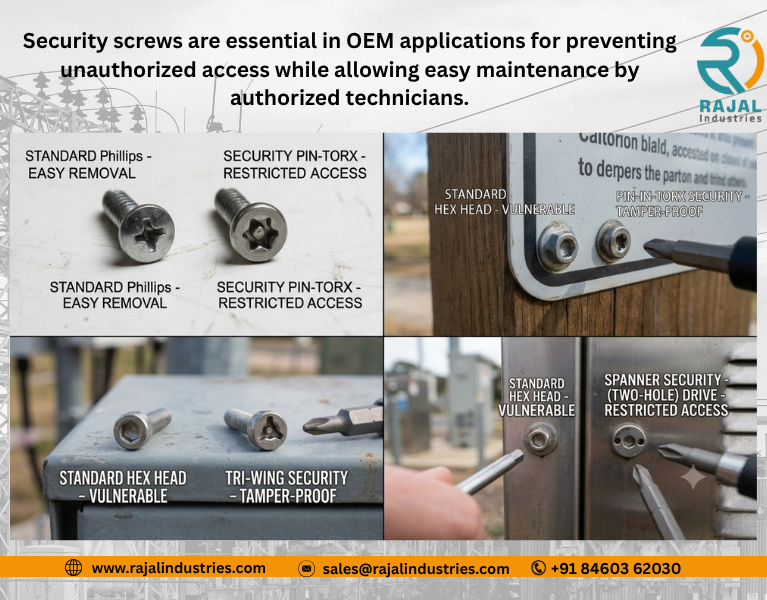
Security Screw Applications are found wherever unauthorized fastener removal, casual tampering, vandalism or uncontrolled access can create a practical problem.
Unlike a standard screw chosen only for assembly, a security screw adds another requirement:
The joint must remain serviceable for authorized users while becoming more difficult for unauthorized users to open.
This is why Tamper Proof Screws, Railway Screws and specialized Panel Fasteners are commonly considered for equipment that is publicly accessible, installed outdoors, used in transportation systems or serviced only by trained personnel.
Typical application areas can include:
- Railway equipment
- Electrical panels
- Telecom cabinets
- Public infrastructure
- Utility equipment
- Transportation systems
- Street equipment
- Public signage
- Industrial machinery
- Public-access enclosures
- Outdoor electronic equipment
- OEM products requiring controlled maintenance access
The correct fastener should still be selected according to the complete application:
Security Requirement + Joint Function + Service Access + Thread + Head + Material + Finish + Matching Tool + Installation + Validation
Quick Answer: Where Are Security Screws Used?
Security screws are commonly used on equipment where ordinary fasteners could allow easy unauthorized access or component removal.
Typical Security Screw Applications include:
- Railway interior and equipment panels
- Electrical control cabinets
- Meter enclosures
- Telecom cabinets
- Public information displays
- Outdoor utility enclosures
- Street equipment
- Public fixtures
- Industrial machine covers
- Transportation equipment
The actual fastener must still meet the application’s mechanical, corrosion and maintenance requirements.
Why Security Screws Are Used
A normal screw may be completely acceptable mechanically but still provide too-easy access with common tools.
A security fastener can help:
- Discourage casual opening
- Reduce vandalism
- Make component theft more difficult
- Restrict service access
- Reduce unauthorized adjustments
- Protect public-facing equipment
However, security screws should be treated as one part of the equipment’s overall access-control strategy.
Security Screw Applications by Industry
| Industry | Typical Application | Main Requirement |
| Railways | Panels, covers, fixtures | Tamper resistance + service |
| Electrical | Cabinets, enclosures | Controlled access |
| Telecom | Outdoor cabinets | Security + corrosion |
| Public Infrastructure | Street/public equipment | Vandal resistance |
| Utilities | Meter/control enclosures | Restricted access |
| Transportation | Public-access components | Tamper resistance |
| Industrial Machinery | Covers/controls | Authorized access |
| Signage | Public signs/boards | Anti-removal |
| Outdoor Electronics | Housings | Security + environment |
| OEM Equipment | Custom access points | Controlled tool system |
Security Screws for Railways
Railway systems contain many components that can be exposed to:
- Passengers
- Maintenance personnel
- Vibration
- Weather
- Repeated servicing
- Long operating life
Suitable Railway Screws with security-drive features may be considered for selected non-structural and equipment-access applications.
Railway Passenger-Area Applications
Passenger areas can include:
- Interior panels
- Equipment covers
- Information displays
- Signage
- Seat-area components
- Access covers
- Public-facing fixtures
Where an ordinary Phillips or hex screw would provide easy public access, a security drive may be specified.
The objective is usually to reduce:
- Vandalism
- Unauthorized removal
- Missing fasteners
- Panel opening
Railway Interior Panels
Interior rail panels can require both:
Appearance + Controlled Access
Potential examples include:
- Wall panels
- Ceiling access covers
- Service covers
- Interior equipment panels
Important fastener considerations include:
- Low-profile head
- Surface appearance
- Matching security tool
- Repeated maintenance
- Vibration behaviour of the complete joint
Railway Equipment Covers
Suitable security fasteners may be considered for certain:
- Electrical equipment covers
- Communication equipment
- Control housings
- Equipment-access panels
These applications can require regular maintenance.
Therefore, a reusable security drive is often more practical than a one-way fastener where the equipment is designed for service access.
Railway Signage
Public-facing signs and identification plates can be exposed to:
- Tampering
- Unauthorized removal
- Vandalism
Security fasteners may help reduce casual removal.
Other design factors still include:
- Corrosion
- Head appearance
- Panel material
- Tool access
- Replacement requirements
Railway Electrical Enclosures
Railway electrical and control equipment can use suitable security fasteners on selected enclosure components.
Potential goals include:
- Limiting passenger access
- Restricting casual opening
- Providing authorized technician access
Important requirements can include:
Security + Electrical Clearance + Corrosion + Serviceability
Railway Exterior Equipment
Exterior railway equipment can face:
- Rain
- Humidity
- Temperature cycles
- Dirt
- Industrial pollutants
- Other location-specific exposure
For outdoor Railway Screws, material and coating should follow the approved environmental specification.
Security drive selection should not be made without considering corrosion.
Tamper Resistance vs Vibration in Railways
These are separate requirements.
A security drive can help make the screw harder to remove with common tools.
It does not automatically make the joint vibration-resistant.
Therefore:
Tamper Resistance ≠ Vibration Resistance
Vibration performance depends on the complete joint, including:
- Thread
- Mating component
- Clamp condition
- Installation
- Approved locking method
- Service conditions
Railway Safety-Critical Limitation
General-purpose Tamper Proof Screws should not automatically be proposed for safety-critical railway connections.
Examples requiring separate engineering and approval can include:
- Structural joints
- Track fastening
- Bogie components
- Braking systems
- Other regulated safety-critical assemblies
The railway OEM or authority should define the approved fastener system.
Security Screw Selection for Railway Equipment
A practical review sequence is:
Railway Component → Public Accessibility → Service Frequency → Security Drive → Head → Thread → Material → Finish → Tool → Functional Validation
Railway Application Matrix
| Railway Application | Main Risk | Fastener Focus |
| Interior Panel | Tampering | Reusable security drive |
| Public Signage | Removal | Anti-removal access |
| Service Cover | Unauthorized access | Serviceable drive |
| Electrical Enclosure | Opening | Security + clearance |
| Communication Housing | Public access | Tool control |
| Exterior Equipment | Tampering/weather | Security + corrosion |
| Passenger Fixture | Vandalism | Head + drive + service |
Security Screws for Electrical Panels
Electrical panels are another major area for Security Screw Applications.
Potential uses include:
- Panel covers
- Control cabinets
- Switchgear enclosures
- Meter boxes
- Outdoor electrical cabinets
- Service-access covers
The purpose can be to discourage unauthorized access while allowing trained personnel to open the equipment.
Security Screws for Panel Covers
A conventional panel screw can often be removed using widely available tools.
A security fastener can require a less-common matching bit.
Potential benefits include:
- Reduced casual opening
- Controlled service access
- Better differentiation between user-access and technician-access panels
The fastener should still suit the panel material and thread system.
Security Screw Is Not an Electrical Interlock
A security screw should never be considered a replacement for required:
- Locks
- Electrical interlocks
- Isolation systems
- Enclosure safety design
- Access procedures
- Warning labels
It can supplement these systems where appropriate.
Panel Fasteners for Control Cabinets
Suitable Panel Fasteners may use:
- Machine threads
- Captive thread systems
- Threaded inserts
- Self-tapping threads where approved
The security drive is only one part of the fastener specification.
Machine-Thread Security Panel Screws
Machine-thread designs can be used where the panel assembly includes:
- Tapped hole
- Nut
- Threaded insert
Potential advantages include:
- Controlled reusable thread
- Easier repeated maintenance
- Defined thread engagement
This can be useful for serviceable electrical equipment.
Self-Tapping Security Panel Screws
Some sheet-metal enclosures may use self-tapping security fasteners.
In these applications, verify:
- Panel material
- Sheet thickness
- Pilot hole
- Thread type
- Point geometry
- Service frequency
If repeated opening is expected, evaluate whether the formed thread remains acceptable over the intended service life.
Electrical Panel Screw Length
Length is particularly important in electrical equipment.
An excessively long screw can interfere with:
- Wiring
- Terminals
- Electronic components
- Busbars
- Internal brackets
Always review internal clearance.
Electrical Panel Head Selection
Potential head styles can include:
- Pan head
- Button head
- Countersunk head
- Other approved forms
Selection can depend on:
- Surface requirement
- Tool access
- Head projection
- Drive depth
- Appearance
Security Screws for Meter Boxes
Meter and utility enclosures can be publicly accessible.
Suitable security fasteners can help discourage:
- Unauthorized opening
- Casual tampering
- Easy panel removal
However, utilities may define specific:
- Screw designs
- Seals
- Tamper indicators
- Tooling
- Access procedures
The utility specification should remain controlling.
Public Electrical Equipment
Security fasteners can be considered for suitable:
- Distribution cabinets
- Charging equipment
- Outdoor electrical boxes
- Public lighting control boxes
- Public-access electrical enclosures
Again, the security screw should complement the equipment’s formal safety system.
Electrical Panel Application Matrix
| Application | Primary Concern | Additional Check |
| Control Cabinet | Unauthorized opening | Service access |
| Switchgear Cover | Controlled access | Approved specification |
| Meter Box | Tampering | Utility requirements |
| Outdoor Panel | Security | Corrosion |
| Internal Cover | Restricted access | Clearance |
| Public Electrical Box | Vandalism | Environment |
Security Screws for Telecom Equipment
Telecom infrastructure often combines:
Public Accessibility + Outdoor Exposure + Authorized Maintenance
This makes it a natural application area for Tamper Proof Screws and other security fasteners.
Outdoor Telecom Cabinets
Potential applications include:
- Cabinet doors
- Access covers
- Internal service panels
- External equipment covers
- Communication housings
Important requirements can include:
- Security drive
- Corrosion resistance
- Long service life
- Matching maintenance tool
- Reliable field removal
Telecom Maintenance Access
Telecom equipment can require repeated servicing.
For this reason, a reusable security screw may be more suitable than a one-way design.
Ask:
- How often will technicians open the cabinet?
- Who controls the tool?
- Are replacement tools available?
- Will the same fastener be reused?
Telecom Equipment in Remote Locations
Remote installations can create an additional maintenance challenge.
If a specialized bit is required, service teams must have the correct tool available when they reach the site.
A security system that is too difficult for legitimate service personnel can increase downtime.
Telecom Outdoor Corrosion
Exterior telecom cabinets can be exposed to:
- Rain
- Condensation
- Heat
- Humidity
- Dust
- Coastal or industrial conditions
Material and finish should therefore be selected according to the actual installation environment.
Telecom Cabinet Fastener Matrix
| Application | Security Need | Engineering Consideration |
| External Cover | Tamper resistance | Corrosion |
| Service Panel | Controlled access | Reusability |
| Remote Cabinet | Tool control | Field availability |
| Communication Housing | Unauthorized opening | Head/drive |
| Outdoor Equipment | Public access | Environment |
Security Screws for Public Infrastructure
Public infrastructure often operates in areas where equipment can be reached by anyone.
Potential Security Screw Applications include:
- Street equipment
- Public signage
- Utility cabinets
- Lighting equipment
- Information displays
- Transportation infrastructure
- Public furniture
- Outdoor electronic equipment
Why Public Infrastructure Needs Security Fasteners
Public equipment can face:
- Vandalism
- Unauthorized opening
- Fastener removal
- Component theft
- Weather exposure
- Long periods between maintenance
The selected fastener must therefore balance:
Security + Durability + Serviceability
Security Screws for Public Signage
Security fasteners may be used to attach:
- Direction signs
- Information plates
- Public notices
- Identification boards
- Equipment labels
A less-common drive can discourage casual removal.
Anti-Theft Consideration for Signage
If a sign is valuable or frequently stolen, changing only the screw may not be enough.
Review:
- Screw access
- Sign mounting method
- Rear access
- Bracket design
- Alternative removal paths
This is a recurring principle:
Protect the Assembly, Not Only the Fastener
Security Screws for Street Lighting Equipment
Potential uses can include selected:
- Access covers
- Electrical housings
- Control boxes
- Service panels
Important factors include:
- Outdoor corrosion
- Technician access
- Head accessibility
- Matching tool
- Long-term service
Public Information Displays
Digital displays, ticketing systems and public information equipment may require controlled access to:
- Electronics
- Wiring
- Internal modules
Security fasteners can be considered for suitable enclosure components where approved by the equipment designer.
Public Furniture and Fixtures
Security screws can also be considered for selected:
- Benches
- Public fixtures
- Equipment housings
- Mounted accessories
The required design depends on:
- Theft risk
- Vandalism
- Head accessibility
- Material
- Environment
Security Screws for Utility Equipment
Utility infrastructure can include:
- Electrical cabinets
- Water-related equipment enclosures
- Communication cabinets
- Metering equipment
- Control boxes
These systems may use security fasteners to limit unauthorized access.
Utility Access Control
Fastener security can work alongside:
- Locks
- Seals
- Tamper indicators
- Access-control procedures
The security screw should be treated as one layer, not the entire protection system.
Security Screws for Transportation Infrastructure
Beyond railways, applications can include suitable:
- Bus terminals
- Ticket machines
- Transport information displays
- Station equipment
- Public-access transportation hardware
These installations often require:
Tamper Resistance + Weather Resistance + Maintenance Access
Security Screws for Industrial Machinery
Industrial machinery may use security fasteners where certain covers or adjustment points should not be opened casually.
Potential applications include:
- Control covers
- Calibration covers
- Sensor housings
- Protected adjustment points
- Machine panels
- Equipment enclosures
Restricted Adjustment Points
Some equipment contains settings that should be changed only by authorized personnel.
A security fastener can reduce casual access to the cover.
However, machine safety and process-control requirements should determine the complete design.
Machine Guards
Do not assume that simply installing Tamper Proof Screws makes a machine guard compliant or safe.
Guard design can involve:
- Safety standards
- Interlocking requirements
- Tool-removal requirements
- Risk assessment
The responsible machinery designer should specify the approved fastening system.
Security Screws for Public Electronics
Suitable applications can include:
- Kiosks
- Public terminals
- Charging equipment
- Ticketing equipment
- Displays
- Public communication devices
These systems can combine:
Electronics + Public Access + Frequent Maintenance
making serviceability particularly important.
Security Screws for EV Charging Equipment
Public EV charging equipment can use suitable security fasteners on certain enclosure and access components where approved.
Engineering requirements may include:
- Tamper resistance
- Outdoor corrosion
- Service access
- Electrical clearance
- Head geometry
The equipment’s product and electrical-safety requirements remain controlling.
Security Screws for Solar & Outdoor Energy Equipment
Some outdoor energy equipment may use security fasteners for suitable:
- Electrical enclosures
- Monitoring equipment
- Control boxes
- Access panels
However, a security screw should not be assumed suitable for structural solar connections simply because it is corrosion resistant.
Structural fasteners require their own engineering specification.
Security Screws for Data & Communication Equipment
Potential applications include selected:
- Network cabinets
- Public-access communication hardware
- Edge equipment enclosures
- Outdoor electronics
Where service access is frequent, reusable security drives are generally more practical.
Security Screws for Appliances
Certain commercial or public-use appliances may use security screws to restrict access to:
- Internal electrical components
- Service covers
- Adjustment points
Examples can include equipment installed in:
- Commercial facilities
- Public areas
- Institutions
The manufacturer’s safety and service requirements should determine the fastener.
Application Selection by Security Objective
| Security Objective | Application Example | Fastener Direction |
| Discourage Casual Opening | Indoor equipment panel | Standard security drive |
| Reduce Vandalism | Public signage | Specialized drive |
| Restrict Service Access | Electrical cabinet | Reusable security screw |
| Discourage Theft | Public component | Anti-theft design |
| Protect Adjustment | Industrial equipment | Controlled tool |
| Public Outdoor Access | Telecom/utility cabinet | Security + corrosion |
| Permanent-Type Mounting | Certain fixtures | One-way may be evaluated |
Reusable vs Permanent-Type Applications
Reusable Security Screws
Better suited to:
- Service panels
- Telecom cabinets
- Electrical equipment
- Railway equipment covers
- Machinery access panels
One-Way / Difficult-Removal Designs
Potentially suited to:
- Certain permanent signs
- Public fixtures
- Non-serviceable covers
Do not use permanent-style fastening where future maintenance is likely.
Security Screw Application Questions
Before selecting a security fastener, ask:
- Who can access the equipment?
- What are we trying to prevent?
- Does the equipment require maintenance?
- How often will it be opened?
- Who holds the matching tool?
- Is the screw indoors or outdoors?
- What mating material is used?
- Is the thread machine-type or self-tapping?
- Is corrosion a major concern?
- Is the screw visible?
- Is low-profile geometry required?
- Can the component be removed by another route?
Security Screw Is Not a Complete Anti-Theft System
This is especially important for Anti Theft Screws and public infrastructure.
If an unauthorized person cannot remove the security screw but can easily:
- Break the panel
- Remove another screw
- Access the rear
- Cut the bracket
- Slide the component out
then the overall security design remains weak.
Security Design Hierarchy
A stronger approach is:
Limit Physical Access → Protect Fastener Head → Use Security Drive → Control Tool Availability → Protect Alternate Removal Paths
Head Accessibility
Security can sometimes be improved by reducing physical gripping access around the fastener head.
However, the legitimate tool must still be able to:
- Enter
- Engage
- Install
- Remove where required
Do not create a geometry that maintenance teams cannot use reliably.
Environmental Selection by Application
| Environment | Main Fastener Concern |
| Indoor Dry | General material/finish |
| Indoor Humid | Corrosion |
| Outdoor | Weather protection |
| Industrial Outdoor | Pollution + moisture |
| Coastal | Chloride exposure |
| Public Transport | Wear + maintenance |
| Railway Exterior | Environment + service |
| Telecom Outdoor | Corrosion + tool access |
Carbon Steel Security Screws in Applications
Suitable coated carbon steel can be considered for many industrial and indoor applications where the specified mechanical and corrosion requirements are met.
The coating should be defined by actual performance requirements.
Stainless Security Screws in Applications
Stainless fasteners may be considered for:
- Outdoor public infrastructure
- Telecom equipment
- Certain railway equipment
- Utility enclosures
- Humid environments
Final grade selection should follow the environment and customer specification.
Material Selection Is Application-Specific
Do not use:
Indoor = Carbon Steel
Outdoor = Stainless Steel
as a universal rule.
Outdoor coated-steel solutions can be suitable in some applications, while certain indoor environments can still be corrosive.
Coating in Public Applications
For visible public equipment, coating may need to provide:
- Corrosion protection
- Appearance
- Compatibility with the security drive
- Consistency
Detailed security recesses should be checked after coating.
Why Serviceability Matters
A successful security system should frustrate unauthorized users without frustrating authorized technicians.
This is especially important in:
- Railway maintenance
- Telecom field service
- Electrical-panel maintenance
- Public infrastructure repair
Tool Management by Application
Railway
Maintenance teams may require standardized tool access across fleets or equipment types.
Electrical Panels
Qualified service technicians may need controlled bits.
Telecom
Field teams need tools available at remote sites.
Public Infrastructure
Maintenance contractors may require controlled but replaceable tools.
The drive should fit the operational service model.
Security Fastener Application Validation
Before bulk use, validate:
Actual Screw + Matching Tool + Actual/Representative Component + Production Finish + Installation Method
Where removal is expected, also test:
Authorized Removal + Reinstallation where required
Functional Application Test
Depending on the product, observe:
- Tool entry
- Tool engagement
- Installation
- Seating
- Head condition
- Authorized removal
- Thread condition
- Tool wear
Dimensional inspection alone does not prove application suitability.
Application Failure Analysis
When a security screw does not work correctly, investigate:
Fastener
Drive, head, thread, material, finish.
Tool
Correct size, wear, geometry.
Assembly
Hole, thread, mating component, access.
Installation
Alignment, setting, process.
Environment
Corrosion, contamination, service exposure.
Common Application Problems
| Problem | Possible Application Cause |
| Bit Cannot Access Head | Poor component clearance |
| Screw Cannot Be Removed | Corrosion/service design |
| Drive Damages | Poor tool alignment |
| Technician Uses Wrong Bit | Tool-control issue |
| Component Still Stolen | Alternate removal path |
| Screw Corrodes | Wrong environment specification |
| Security Too Low | Drive/tool widely available |
| Maintenance Too Difficult | Overly restrictive design |
Security Screw Applications: Manufacturer Review
For an application-based RFQ, a manufacturer needs more than:
“We need 50,000 security screws.”
Provide:
Application + Security Objective + Drawing + Head + Drive + Thread + Material + Finish + Matching Tool + Service Requirement + Quantity
Application-Based OEM RFQ Example
We require security screws for a publicly accessible electrical enclosure. The screw must discourage unauthorized removal while allowing authorized maintenance using a matching reusable tool. Please review the attached drawing, panel material, thread requirement, material, finish and service conditions and confirm manufacturing feasibility, tooling, samples and bulk capability.
Rajal Industries: Application Review
Rajal Industries can evaluate drawing-based security fastener requirements for suitable industrial OEM applications, including selected:
- Railway equipment
- Electrical panels
- Telecom cabinets
- Public infrastructure
- Utility equipment
- Transportation equipment
- Industrial machinery
- Outdoor equipment
- Public-access enclosures
Depending on technical feasibility and customer requirements, projects can be reviewed for:
- Tamper Proof Screws
- Railway Screws
- Panel Fasteners
- Reusable Security Screws
- Suitable One-Way Security Screws
- Machine-Thread Security Screws
- Suitable Self-Tapping Security Screws
- Custom Security Drives
- Custom Head Geometry
- Carbon Steel
- Suitable Stainless Steel
- Customer-Specified Finishes
- Matching Driver Requirements
- Sample Development
- Tool-Fit Testing
- Functional Application Testing
- Pilot Production
- Bulk OEM Manufacturing
Final feasibility should be confirmed against the approved drawing, application, security requirement, mating component, thread, material, finish, matching tool, testing and quantity.
Bulk Buyer Quick Answer
What application information should I send for security screws?
Send:
Industry + Component + Security Objective + Service Frequency + Drawing + Thread + Head + Drive + Material + Finish + Matching Tool + Environment + Quantity
For existing equipment, an approved sample and matching driver can also help technical review.
Application Selection Matrix
| Application | Main Risk | Service Need | Key Fastener Priority |
| Railway Interior Panel | Vandalism/tampering | Medium-High | Reusable security drive |
| Railway Equipment Cover | Unauthorized access | High | Serviceability |
| Railway Exterior Equipment | Tampering + weather | Medium-High | Security + corrosion |
| Electrical Cabinet | Unauthorized opening | High | Controlled access |
| Meter Enclosure | Tampering | Application-specific | Utility specification |
| Telecom Cabinet | Unauthorized access | High | Security + field service |
| Public Signage | Removal/vandalism | Low-Medium | Anti-removal + corrosion |
| Street Equipment | Vandalism | Medium | Security + outdoor durability |
| Utility Cabinet | Unauthorized access | High | Tool control |
| Public Electronics | Tampering | High | Serviceable security |
| Industrial Equipment | Unauthorized adjustment | Medium | Controlled access |
| Permanent Fixture | Unauthorized removal | Low | Difficult-removal design |
The table is a starting point. Final fastener selection should follow the responsible customer’s approved design and risk assessment.
Railway Security Screw Applications
For railway equipment, first separate the application into:
Passenger-Accessible
The public can physically reach the fastener.
Restricted Equipment
Normally accessed by railway personnel.
Exterior Equipment
Exposed to weather and operating conditions.
Safety-Critical
Requires specific engineering approval and should not be treated as a general security-screw application.
This classification helps prevent the same Railway Screws from being specified across unrelated applications.
Railway Passenger-Area Selection
For suitable passenger-area components, the main concerns may include:
Tamper Resistance + Appearance + Serviceability
Potential applications can include:
- Interior panels
- Signage
- Equipment covers
- Service-access panels
- Public-facing fixtures
A reusable specialized drive may provide a practical balance where maintenance access is required.
Railway Interior Panel Selection
Consider:
- Panel material
- Mating thread
- Head profile
- Public access
- Required service frequency
- Security drive
- Matching maintenance tool
- Appearance
- Vibration requirements of the complete joint
A low-profile head can reduce projection, but adequate drive engagement must remain available.
Railway Exterior Equipment Selection
Exterior applications add environmental requirements.
Review:
Security + Material + Corrosion Protection + Serviceability
The selected fastener may experience:
- Rain
- Condensation
- Dirt
- Temperature changes
- Industrial exposure
- Location-specific contaminants
Do not simply copy an interior fastener specification to an exterior assembly.
Railway Service Access
Railway equipment can remain in operation for many years.
Maintenance teams may need to remove the same type of fastener repeatedly.
Therefore, consider:
- Tool availability
- Replacement tools
- Drive durability
- Head condition after removal
- Thread condition
- Corrosion
- Tool standardization
A highly unusual drive can create unnecessary maintenance problems if tools become difficult to source.
Railway Vibration Consideration
The term Railway Screws should not imply that the security drive itself solves vibration.
These are separate design questions:
Question 1: How do we discourage unauthorized removal?
Question 2: How does the joint remain secure under its actual mechanical service conditions?
The complete joint design must answer both.
Railway Application Example 1: Passenger Access Cover
Requirement
A removable interior access cover is within passenger reach.
Main Concern
Casual unauthorized opening.
Practical Direction
Evaluate a reusable security drive that requires a matching maintenance tool.
Additional Checks
- Head profile
- Appearance
- Mating thread
- Installation
- Repeated service
- Tool availability
A one-way screw would generally create a service disadvantage if the panel must be opened regularly.
Railway Application Example 2: Exterior Equipment Cover
Requirement
An exterior equipment cover requires authorized maintenance.
Main Concerns
Unauthorized Access + Weather + Service
Review
- Security drive
- Material
- Finish
- Mating material
- Corrosion
- Tool availability
- Removal after environmental exposure
The final specification should follow the railway OEM or responsible authority’s requirements.
Railway Application Example 3: Public Signage
Requirement
A sign should not be easily removed using common tools.
Practical Direction
A suitable specialized security drive may discourage casual removal.
But also inspect:
- Rear access
- Bracket design
- Sign material
- Fastener-head access
If the complete bracket can be removed easily, changing only the screw provides limited benefit.
Security Screws for Electrical Panels
Electrical-panel applications usually combine:
Controlled Access + Maintenance + Internal Clearance
Potential Panel Fasteners should therefore be selected with the complete enclosure in mind.
Electrical Panel Selection Matrix
| Panel Type | Main Requirement | Important Check |
| Indoor Control Cabinet | Controlled access | Serviceability |
| Outdoor Cabinet | Access + corrosion | Material/finish |
| Public Electrical Box | Tamper resistance | Security level |
| Internal Access Cover | Restricted access | Clearance |
| Meter Enclosure | Tamper control | Utility specification |
| Equipment Panel | Maintenance access | Reusable drive |
Electrical Panel Clearance
Always verify the screw from both sides of the panel.
Check whether the installed screw could approach:
- Wiring
- Terminals
- Electronic components
- Internal mechanisms
- Other assemblies
A security screw with the correct drive but excessive length is still the wrong fastener.
Panel Head Selection
Pan Head
Can provide useful head volume for the security recess.
Button Head
Can provide a lower-profile appearance.
Countersunk Head
Can provide a flush installation where the mating panel is designed accordingly.
Select the head from the actual enclosure geometry rather than appearance alone.
Panel Fastener Thread Selection
For serviceable equipment, a machine-thread Panel Fastener may be used with:
- Tapped holes
- Nuts
- Threaded inserts
Suitable self-tapping security screws may also be used in some sheet-metal designs.
If the enclosure will be opened repeatedly, thread durability should be evaluated.
Electrical Panel Example
Application
Outdoor public electrical enclosure.
Security Objective
Discourage unauthorized opening.
Additional Requirements
- Outdoor corrosion resistance
- Authorized technician access
- Internal electrical clearance
- Reliable tool engagement
Selection Path
Reusable Drive → Suitable Head → Approved Thread → Material/Finish → Matching Tool → Finished Assembly Validation
Security Screws for Telecom Cabinets
Telecom equipment creates an important practical challenge:
The fastener must restrict casual access without creating problems for field technicians.
Telecom Application Selection Matrix
| Telecom Application | Main Risk | Main Selection Factor |
| Outdoor Cabinet | Unauthorized opening | Corrosion + security |
| Service Cover | Tampering | Reusability |
| Remote Equipment | Access | Tool availability |
| Public-Facing Cabinet | Vandalism | Security drive |
| Internal Service Panel | Restricted access | Maintenance |
| Communication Housing | Removal | Head/drive |
Telecom Field-Service Requirements
A security drive can look excellent in the design office but fail operationally if technicians arrive at a remote site without the correct bit.
Consider:
- Tool distribution
- Spare tools
- Tool identification
- Tool revision
- Service contractor access
- Replacement availability
This operational side is particularly important for telecom infrastructure.
Telecom Example: Remote Outdoor Cabinet
Application
Remote communication cabinet.
Requirements
Security + Outdoor Exposure + Field Maintenance
Possible Direction
A reusable specialized drive with controlled but practical tool availability.
Validate
- Corrosion system
- Drive engagement
- Field tool
- Authorized removal
- Screw condition after environmental exposure
Public Infrastructure Applications
Public infrastructure can face a wider range of unauthorized interaction than factory equipment.
Possible risks include:
- Casual tampering
- Vandalism
- Fastener removal
- Component theft
- Unauthorized opening
This makes risk classification important.
Public-Access Risk Levels
A practical internal design approach can classify applications as:
Level A: Casual Access
Someone can touch the fastener but has little motivation to remove it.
Level B: Tampering/Vandalism
The equipment may be intentionally interfered with.
Level C: Component Theft
Removing the fastener can expose or release something valuable.
Level D: Restricted Equipment Access
Unauthorized opening can expose controlled or hazardous equipment.
These are conceptual categories, not certified security ratings.
Match the Fastener to the Risk
Do not specify an expensive custom security system for every public screw.
Similarly, do not use a commonly available drive where stronger access control is genuinely required.
Use:
Risk → Required Resistance → Service Need → Drive Selection
Vandalism vs Theft
These problems are related but different.
Vandalism
Goal may be to prevent:
- Casual opening
- Screw removal
- Damage
- Unauthorized adjustment
Theft
Goal is to prevent or slow removal of:
- Valuable components
- Panels
- Electronics
- Fixtures
- Public assets
For theft, the complete mounting system becomes even more important.
Anti-Theft Application Review
Before specifying Tamper Proof Screws, inspect whether an unauthorized person can:
- Grip the head externally
- Access the rear
- Remove another fastener
- Remove the bracket
- Slide the component free
- Break a weak surrounding component
The security screw should protect the weakest realistic access path.
Public Signage Selection
Public signage often requires:
Simple Installation + Outdoor Durability + Reduced Removal
Check:
- Sign material
- Supporting structure
- Screw accessibility
- Head geometry
- Drive type
- Material/finish
- Future replacement
If signs are regularly updated, use a serviceable drive.
Public Signage Example
Problem
Conventional screws are repeatedly removed from public signs.
Engineering Review
Determine:
- How are the screws being removed?
- Are common tools being used?
- Is the fastener head fully accessible?
- Does the sign require future replacement?
- What outdoor environment applies?
Then select the security approach.
This is more reliable than immediately specifying the most unusual drive available.
Street Equipment Applications
Potential applications can include selected:
- Public lighting covers
- Control housings
- Street equipment panels
- Public information systems
- Equipment access doors
Key requirements can include:
Tamper Resistance + Corrosion + Long-Term Service
Utility Cabinet Applications
Utility cabinets can contain important electrical, communication or control equipment.
Security fasteners may supplement:
- Locks
- Seals
- Controlled access
- Tamper indicators
The utility’s approved requirements should remain controlling.
Public Information Equipment
Suitable Security Screw Applications can include:
- Digital information displays
- Ticket machines
- Public terminals
- Kiosks
- Transportation displays
These systems often require frequent maintenance.
Therefore:
Reusable Security Drive + Controlled Tool
can be more practical than a permanent fastening method.
EV Charging Equipment
Suitable enclosure components on public EV charging equipment may use security fasteners where permitted by the equipment design.
Review:
- Public access
- Outdoor corrosion
- Serviceability
- Electrical clearance
- Matching tool
- Head geometry
Security screws should supplement, not replace, required electrical safety systems.
Outdoor Energy Equipment
For suitable non-structural access components, security fasteners may be considered on:
- Monitoring boxes
- Control enclosures
- Electrical housings
- Service covers
Do not automatically extend the same fastener to structural connections.
Security Screws for Industrial Machinery
Industrial Security Screw Applications can be different from public infrastructure.
The concern may be:
- Unauthorized adjustment
- Calibration access
- Control access
- Restricted service covers
rather than theft.
Machinery Application Matrix
| Application | Security Objective |
| Calibration Cover | Restrict adjustment |
| Sensor Housing | Controlled access |
| Control Panel | Restrict opening |
| Service Cover | Authorized maintenance |
| Adjustment Point | Prevent casual changes |
| Equipment Enclosure | Access control |
Machine Safety Limitation
A specialized screw should not be used as evidence that a guard or enclosure is safe.
Machine-safety requirements can involve much more than fastener type.
The responsible machine designer should determine the approved access and guarding system.
Material Selection by Application
| Application | Material/Finish Priority |
| Indoor Railway Panel | Appearance + specified corrosion protection |
| Railway Exterior | Environmental specification |
| Indoor Electrical Panel | Mechanical + finish requirement |
| Outdoor Electrical Panel | Corrosion |
| Telecom Cabinet | Outdoor exposure |
| Public Signage | Weather + appearance |
| Street Equipment | Long-term outdoor protection |
| Coastal Infrastructure | Chloride-related corrosion review |
| Industrial Machinery | Service environment |
Outdoor Does Not Automatically Mean Stainless Steel
A suitable coated carbon-steel fastener may meet some outdoor specifications.
Stainless steel may be preferred in other environments.
Select using:
Required Corrosion Performance + Environment + Mating Material + Mechanical Requirement + Customer Specification
Coastal Infrastructure
For coastal or chloride-exposed equipment, review:
- Stainless grade where applicable
- Coating system
- Mating material
- Galvanic interaction
- Water retention
- Service life
- Customer corrosion specification
Do not rely on the word “stainless” alone.
Galvanic Compatibility in Public Equipment
A common combination is:
Stainless Fastener + Aluminium Enclosure
In wet environments, material compatibility may require engineering review.
Possible considerations include:
- Material combination
- Surface treatment
- Isolation
- Environment
The security requirement does not remove corrosion-engineering requirements.
Coating and Security Drive
Detailed security recesses can be sensitive to coating buildup.
After final finishing, verify:
Tool Entry → Full Engagement → Installation → Authorized Removal
This is particularly important for small pin-type drives.
Application-Specific Head Selection
Public Equipment
A low-profile head may reduce external gripping access.
Electrical Panel
Head must also provide adequate tool access and internal clearance.
Railway Interior
Appearance and low projection may matter.
Telecom Cabinet
Field-service practicality may be more important than appearance.
The same drive can therefore use different head designs for different applications.
Head Accessibility and Tamper Resistance
Security can sometimes be improved by controlling physical access around the screw head.
For example, a head located inside a recess can be harder to grip externally.
But the authorized driver must still have sufficient access.
Installation Access
Before approving the fastener, confirm:
- Straight driver access
- Space around the head
- Bit length
- Driver diameter
- Nearby components
- Installation direction
A security screw cannot function correctly if the tool cannot fully engage.
Service Access
For maintenance applications, also consider what the equipment may look like after years of use.
Potential changes include:
- Dirt
- Corrosion
- Paint
- Coating damage
- Wear
Serviceability should be considered at the design stage.
Functional Application Validation
A useful test setup is:
Production-Intended Screw + Matching Bit + Production-Intended Finish + Representative Component + Intended Installation Tool
Test:
- Tool entry
- Full engagement
- Installation
- Seating
- Head condition
- Authorized removal
- Thread condition
- Reinstallation where required
Why Finished Samples Matter
An unfinished sample may fit the driver perfectly.
After coating, clearance can change.
Therefore, final approval should preferably include the intended finish.
Application Validation Matrix
| Test | What It Checks |
| Tool Entry | Accessibility |
| Tool Fit | Drive compatibility |
| Installation | Assembly performance |
| Seating | Head/component interface |
| Removal | Serviceability |
| Reinstallation | Repeated maintenance |
| Corrosion Test | Environmental requirement |
| Visual Inspection | Drive/head condition |
| Tool Wear Review | Production/service suitability |
Testing requirements should follow the actual product specification.
Common Application Failure: Correct Screw, Wrong Tool
Symptoms can include:
- Bit does not fully enter
- Slipping
- Drive damage
- Pin damage
- Tool wear
Always confirm tool part number and revision before rejecting the screw.
Common Application Failure: Correct Screw, Poor Access
The fastener may be technically correct, but:
- Nearby wall blocks the tool
- Recess is too deep in the assembly
- Driver body cannot reach
- Tool cannot align straight
This is an assembly-design issue.
Common Application Failure: Security Too Low
If unauthorized users can easily obtain the correct bit, the selected drive may not provide the required level of access control.
Possible response:
Re-evaluate the actual risk and determine whether:
- Better head protection
- Different drive
- Controlled tool
- Custom geometry
- Other enclosure security
is appropriate.
Common Application Failure: Security Too High
Over-specifying security can also create problems:
- Maintenance delays
- Lost tools
- Expensive replacement bits
- Difficult field repairs
- Destructive removal
The objective is appropriate security, not maximum inconvenience.
Troubleshooting Matrix
| Problem | First Investigation |
| Unauthorized Removal Still Easy | Drive/tool availability |
| Component Still Stolen | Complete mounting system |
| Maintenance Difficult | Service strategy |
| Bit Does Not Fit | Screw + tool geometry |
| Drive Damages | Tool fit + installation |
| Screw Corrodes | Environment + material/finish |
| Screw Cannot Be Removed | Corrosion + drive condition |
| Tool Wears Rapidly | Screw-to-tool fit |
| Panel Damages | Head/seating/installation |
| Screw Interferes Internally | Length/clearance |
Application Failure Analysis
Use five areas:
1. Security Requirement
Was the actual risk understood correctly?
2. Fastener
Is the drive, head, thread, material and finish correct?
3. Matching Tool
Is it correct and in acceptable condition?
4. Assembly
Does the component provide correct access and mating geometry?
5. Environment & Service
Has corrosion, contamination or repeated use affected performance?
Selecting Reusable vs One-Way Fasteners
| Application | Reusable | One-Way |
| Railway Service Cover | ✓ | Usually poor fit |
| Electrical Cabinet | ✓ | Usually poor fit |
| Telecom Cabinet | ✓ | Usually poor fit |
| Public Signage | ✓ | Can be evaluated |
| Permanent Public Fixture | Possible | Can be evaluated |
| Machinery Service Panel | ✓ | Usually poor fit |
| Frequently Opened Equipment | ✓ | Poor fit |
Final selection remains application dependent.
OEM Localization of Existing Security Fasteners
Railway, telecom and industrial OEMs may already use imported security screws.
Localization can begin with:
Approved Drawing + Existing Screw + Matching Tool + Material Specification + Finish + Application Information
Localization Workflow
Existing Part → Drawing Review → Sample Measurement → Tool Review → Material/Finish Confirmation → Manufacturing Feasibility → Tooling → Samples → Functional Test → Pilot Lot → Approval
Why the Matching Tool Is Important for Localization
Two screws can appear visually similar but use slightly different drive geometry.
The existing matching bit can help verify:
- Fit
- Engagement
- Drive depth
- Pin clearance
Do not assume visual similarity means tool compatibility.
Supplier Qualification for Application-Based Security Fasteners
Ask the supplier:
- Have you produced similar security-drive geometry?
- Can you manufacture the required head?
- Can you develop custom tooling?
- Can you support the matching driver?
- How is drive geometry inspected?
- Can final-finish samples be supplied?
- Can tool-fit testing be performed?
- Can the application be functionally tested?
- How is material controlled?
- How is coating controlled?
- Can a pilot lot be produced?
- Is batch traceability available?
- What documentation is available?
- What is the MOQ?
- What is production capacity?
- What is the bulk lead time?
Supplier Comparison Matrix
| Factor | Supplier A | Supplier B | Supplier C |
| Drawing Compliance | Compare | Compare | Compare |
| Application Understanding | Compare | Compare | Compare |
| Drive Capability | Compare | Compare | Compare |
| Matching Tool | Compare | Compare | Compare |
| Material | Compare | Compare | Compare |
| Finish | Compare | Compare | Compare |
| Tool-Fit Testing | Compare | Compare | Compare |
| Application Testing | Compare | Compare | Compare |
| Pilot Lot | Compare | Compare | Compare |
| Traceability | Compare | Compare | Compare |
| MOQ | Compare | Compare | Compare |
| Capacity | Compare | Compare | Compare |
| Lead Time | Compare | Compare | Compare |
| Price | Compare Last | Compare Last | Compare Last |
Technical equivalence should come before unit-price comparison.
OEM RFQ Checklist
Application
☐ Railway / Electrical / Telecom / Infrastructure / Other
☐ Component description
☐ Security objective
☐ Public accessibility
☐ Vandalism risk
☐ Theft risk
☐ Service frequency
☐ Environment
Fastener
☐ Drawing
☐ Drawing revision
☐ Diameter
☐ Thread
☐ Length
☐ Head
☐ Security drive
☐ Drive dimensions
☐ Pin geometry where applicable
☐ Material
☐ Mechanical properties
☐ Finish
Tool
☐ Matching bit
☐ Tool drawing
☐ Tool part number
☐ Tool revision
☐ Installation requirement
☐ Removal requirement
Application Interface
☐ Mating material
☐ Mating thread/hole
☐ Installation access
☐ Internal clearance
☐ Repeated removal requirement
Quality & Commercial
☐ Sample quantity
☐ Functional testing
☐ Inspection requirements
☐ Documentation
☐ Pilot quantity
☐ MOQ
☐ First order quantity
☐ Annual demand
☐ Packaging
☐ Delivery location
Frequently Asked Questions
Where are security screws commonly used?
Common Security Screw Applications include railway equipment, electrical panels, telecom cabinets, utility enclosures, public signage, transportation equipment, street equipment, industrial machinery and other public-access assemblies.
Why are security screws used in railways?
Suitable Railway Screws with security drives can help discourage unauthorized removal from passenger-accessible panels, equipment covers, signage and certain enclosures while still allowing authorized maintenance.
Can security screws be used for railway structural connections?
A general security screw should not automatically be used for structural or safety-critical railway joints. Those applications require the appropriate engineering specification, qualification and approval.
What security screws are suitable for electrical panels?
The correct design depends on the panel, thread, service frequency and required access control. Reusable security drives can be practical where qualified technicians require regular access.
Can security screws replace electrical panel locks?
No. They can supplement locks, interlocks and access-control systems but should not automatically replace required electrical-safety features.
Can self-tapping security screws be used as Panel Fasteners?
They can be considered for suitable sheet-metal applications when the mating material, thickness, pilot hole, thread and service requirements have been validated.
Why are security screws used in telecom cabinets?
Telecom cabinets may be publicly accessible and outdoors while still requiring regular field maintenance. Security fasteners can help discourage unauthorized opening while providing controlled technician access.
What security screw is best for outdoor public infrastructure?
There is no universal best design. Select according to tampering risk, service requirement, tool availability, material, corrosion exposure and complete equipment design.
Are Tamper Proof Screws impossible to remove?
No. The term is widely used commercially, but tamper-resistant is often more technically accurate. Security screws increase removal difficulty rather than guaranteeing that removal is impossible.
Should public signage use one-way screws?
One-way screws can be evaluated where removal is rarely required. If signs require regular replacement or maintenance, a reusable security drive may be more practical.
Can stainless security screws be used outdoors?
Yes, suitable stainless grades can be considered, but final material selection should depend on the actual environment, mating material and customer specification.
Are security screws suitable for coastal infrastructure?
They can be, provided material, coating and galvanic compatibility are evaluated for the specific chloride exposure and service environment.
Do security screws prevent component theft?
They can make unauthorized removal more difficult, but the complete mounting system must also prevent alternate removal paths.
Why should security screws be tested with the matching tool?
Drive geometry, coating, manufacturing variation and tool condition can affect engagement. Functional testing verifies that authorized installation and removal work correctly.
What should I send a manufacturer for an application review?
Send the application, security objective, approved drawing, mating component, drive, thread, head, material, finish, matching tool, service requirement, environment and expected quantity.
AEO Quick Answers
What are the main Security Screw Applications?
Security Screw Applications include railway equipment, electrical panels, telecom cabinets, public infrastructure, utility equipment, transportation systems, industrial machinery and public-access enclosures. They are generally used where unauthorized fastener removal, tampering or uncontrolled access needs to be made more difficult.
Why are Tamper Proof Screws used in public infrastructure?
Tamper Proof Screws are used in suitable public infrastructure to discourage casual removal, vandalism and unauthorized access. The fastener should also meet environmental, corrosion and service requirements and should form part of the complete equipment-security design.
What fasteners are used for railway access panels?
Suitable Railway Screws can include reusable security-drive fasteners where passenger-accessible or controlled-access panels require authorized maintenance. The final screw must follow the railway OEM or responsible authority’s approved mechanical, environmental and safety requirements.
How do I select security Panel Fasteners?
Select Panel Fasteners by defining the panel material, mating thread, security objective, service frequency and internal clearance. Then choose the security drive, head, material, finish and matching tool and validate the complete assembly before production approval.
How do I choose security screws for telecom cabinets?
For telecom cabinets, consider public accessibility, outdoor environment, corrosion, service frequency and field-tool availability. A reusable security drive is often practical where technicians need repeated access, but the final design should follow the equipment specification.
Final Application Checklist
Before approving a security fastener, confirm:
Security
☐ Unauthorized-access risk
☐ Vandalism risk
☐ Theft risk
☐ Required access control
☐ Alternative removal paths
Application
☐ Railway / panel / telecom / infrastructure / other
☐ Component function
☐ Public accessibility
☐ Indoor/outdoor environment
☐ Service frequency
Fastener
☐ Head
☐ Drive
☐ Thread
☐ Length
☐ Material
☐ Mechanical properties
☐ Finish
Tool & Installation
☐ Matching tool
☐ Tool availability
☐ Installation access
☐ Driver clearance
☐ Internal clearance
☐ Authorized removal
Validation
☐ Final-finish sample
☐ Tool-fit test
☐ Installation test
☐ Removal test where required
☐ Reinstallation where required
☐ Environmental requirement
☐ Pilot lot where appropriate
☐ Traceability
Key Takeaways
- Security Screw Applications vary significantly by industry.
- Railway passenger areas, exterior railway equipment and safety-critical railway joints should not be treated as the same application.
- A security drive does not automatically provide vibration resistance.
- Railway Screws should follow the responsible OEM or authority’s approved requirements.
- Electrical-panel security fasteners should not replace locks or electrical safety systems.
- Screw length and internal clearance are particularly important for electrical enclosures.
- Telecom cabinets require a balance between tamper resistance and field-service access.
- Remote service teams need reliable access to the correct tool.
- Public infrastructure requires both security and environmental durability.
- Vandalism and component theft are different design problems.
- Tamper Proof Screws cannot protect a component if another removal path remains easier.
- One-way designs can be unsuitable for regularly serviced equipment.
- Low-profile heads can reduce gripping access but must retain sufficient drive engagement.
- Material selection should follow the actual environment rather than simple indoor/outdoor rules.
- Coating can affect security-drive fit.
- Final-finish screws should be tested with the intended tool.
- Application testing complements dimensional inspection.
- Supplier technical capability should be established before comparing price.
Conclusion
The right security fastener depends on where and how it will be used.
For railways, the priority may be:
Tamper Resistance + Vibration Consideration + Maintenance
For electrical panels:
Controlled Access + Electrical Clearance + Serviceability
For telecom:
Security + Outdoor Durability + Field Maintenance
For public infrastructure:
Vandal Resistance + Anti-Removal + Corrosion + Long-Term Service
This is why Security Screw Applications should be evaluated from the complete equipment requirement rather than selecting a drive from a catalogue.
Rajal Industries can evaluate drawing-based Railway Screws, Tamper Proof Screws, Panel Fasteners and other security fasteners for suitable industrial OEM applications, subject to manufacturing feasibility, customer specifications, tooling, testing and production requirements.