

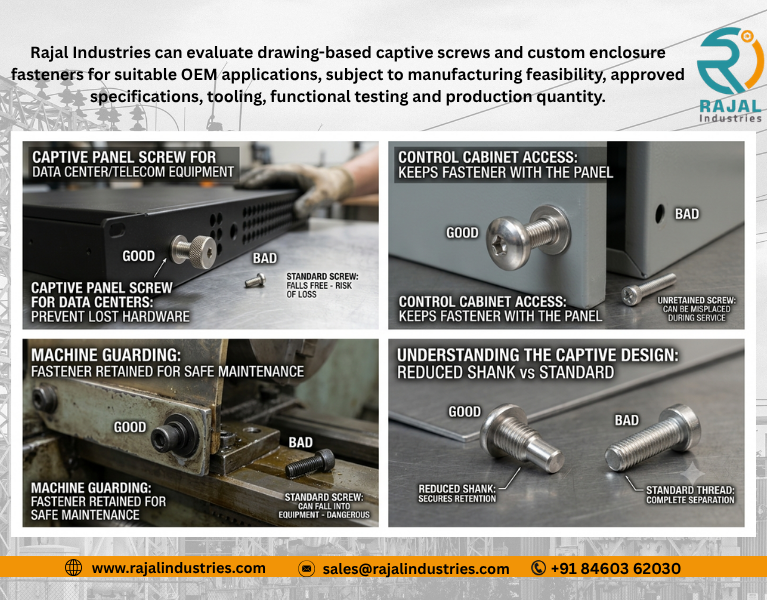
A Captive Panel Screw Manufacturer supplies fasteners designed to remain attached to a panel, cover or enclosure even after the screw is disengaged from its mating thread.
This retained-fastener concept is useful where loose screws can create problems during:
- Maintenance
- Assembly
- Field service
- Equipment access
- High-frequency panel opening
- Controlled industrial operations
Typical applications include:
- Electrical panels
- Control cabinets
- Switchgear enclosures
- Telecom equipment
- Data-center racks and equipment
- Electronics housings
- Industrial machinery
- Test equipment
- Service covers
- OEM access panels
The correct captive screw should be selected as a complete system:
Panel + Retention Method + Screw + Thread + Head + Drive + Length + Material + Finish + Installation + Service Requirement
A captive feature prevents the fastener from becoming completely loose from the panel. It does not replace the mechanical requirements of the joint.
Quick Answer: What Is a Captive Panel Screw?
A captive panel screw is a screw retained in a panel, cover or enclosure so that it remains attached when disengaged from the mating component.
The design can help:
- Prevent lost screws
- Simplify maintenance
- Reduce loose hardware
- Improve field-service handling
- Keep the fastener with the panel
For OEM applications, the screw, retention geometry and mating thread should be evaluated together.
Why OEMs Use Captive Panel Screws
A conventional screw can completely separate from the panel when removed.
This can create several practical problems:
- Screw falls inside equipment
- Fastener gets lost during maintenance
- Wrong replacement screw is fitted
- Service time increases
- Loose hardware remains in the work area
A captive design keeps the fastener associated with the correct panel.
Captive Screw vs Standard Panel Screw
| Feature | Standard Panel Screw | Captive Panel Screw |
| Can fully leave panel | Yes | Designed to remain retained |
| Risk of losing screw | Higher | Reduced |
| Field maintenance | Conventional | Often easier |
| Retention feature | No | Yes |
| Panel integration | Basic | Must be considered |
| Custom geometry | Sometimes | Common in OEM applications |
Captive Does Not Mean Permanently Tight
This distinction is important.
Released from the Mating Thread
while still:
Remaining Attached to the Panel
Therefore:
Captive ≠ Permanently Fastened
The retained screw can still allow the cover or panel to open where the equipment design permits.
What Makes a Screw Captive?
The screw needs a feature or assembly arrangement that prevents it from passing completely through or separating from the panel.
Depending on the design, retention can involve features such as:
- Reduced shank section
- Shoulder
- Retaining washer
- Captive washer arrangement
- Panel-retention hardware
- Special head/shank geometry
- Customer-specific retention design
The exact method should be confirmed from the approved drawing.
Captive Screw System
A better way to view the product is:
Captive Screw + Retention Feature + Panel Geometry + Mating Thread
All four affect functionality.
Captive Panel Screw Applications
Typical industrial applications can include:
| Application | Why Captive Fasteners Are Useful |
| Electrical Panel | Prevent loose screws during servicing |
| Control Cabinet | Keep fasteners with access cover |
| Telecom Cabinet | Improve field maintenance |
| Data-Center Equipment | Reduce loose hardware during service |
| Switchgear Enclosure | Controlled panel access |
| Electronics Housing | Retained service screw |
| Machinery Cover | Prevent lost fasteners |
| Test Equipment | Frequent opening/closing |
| OEM Service Panel | Fastener stays with component |
Captive Panel Screws for Electrical Enclosures
Electrical equipment is one of the strongest use cases for Panel Screws with a captive design.
Potential applications can include:
- Electrical cabinet doors
- Access panels
- Terminal covers
- Control-panel covers
- Internal service plates
- Switchgear access panels
The key requirement is usually:
Reliable Panel Fastening + Controlled Service + No Loose Screw
Why Loose Screws Can Be a Problem in Electrical Equipment
A loose metallic fastener inside equipment can be undesirable because it may:
- Become difficult to retrieve
- Interfere with components
- Create maintenance problems
- Become foreign hardware inside the enclosure
The complete electrical-safety implications remain the responsibility of the equipment designer.
A captive fastener can help reduce the chance of a service screw being unintentionally dropped or lost.
Captive Panel Screws for Control Cabinets
Control cabinets may require repeated access for:
- Inspection
- Maintenance
- Wiring
- Component replacement
- Troubleshooting
In these applications, the service technician can loosen the fastener without completely separating it from the panel.
This can simplify panel handling.
Captive Panel Screws for Switchgear
Suitable Enclosure Fasteners can be used on selected access panels and covers in switchgear and related equipment where approved by the OEM.
Important considerations include:
- Mating thread
- Panel thickness
- Retention design
- Head geometry
- Tool access
- Required mechanical properties
- Surface finish
- Electrical clearance
A captive screw should not be assumed to replace required locks, interlocks or safety systems.
Captive Screws for Telecom Cabinets
Telecom equipment frequently requires field servicing.
Potential uses include:
- Outdoor cabinet access panels
- Communication equipment covers
- Internal service covers
- Electronics housings
- Network equipment enclosures
Captive fasteners can help technicians keep the correct screw with the correct panel during maintenance.
Telecom Field-Service Advantage
For a remote cabinet, losing a small screw can create an unnecessary service problem.
A captive screw can reduce:
- Dropped hardware
- Missing screws
- Replacement mismatch
- Service delays
This makes captivity especially useful in equipment frequently opened in the field.
Captive Panel Screws for Outdoor Telecom Equipment
Outdoor telecom installations can add environmental requirements.
Review:
Captive Function + Corrosion + Tool Access + Serviceability
The retention feature should continue to function after the intended surface finish is applied.
Captive Panel Screws for Data Centers
Data-center equipment can require:
- Frequent maintenance
- Controlled equipment access
- Hardware changes
- High equipment density
- Reliable service procedures
Suitable captive screws can be considered for:
- Equipment access panels
- Rack-mounted hardware
- Network equipment covers
- Server-related enclosures
- Power-distribution equipment
- Cooling-system access panels
The exact fastener must follow the equipment manufacturer’s approved design.
Why Captive Fasteners Can Help in Data Centers
In dense equipment environments, maintaining control of loose hardware can be valuable.
Captive fasteners can help by keeping screws attached to:
- Covers
- Panels
- Service doors
- Equipment modules
This can reduce the chance of a removed screw becoming misplaced during maintenance.
Data Center Application Considerations
For data-center equipment, evaluate:
- Service frequency
- Tool access
- Head projection
- Equipment clearance
- Thread type
- Retention method
- Material
- Finish
- Repeated removal/reinstallation
A captive feature should not interfere with quick authorized maintenance.
Captive Screws for Electronics Enclosures
Electronics housings often use small fasteners.
Captive designs can be useful where:
- The enclosure is serviced repeatedly
- Fasteners must remain with the cover
- Loose screws are undesirable
- Assembly uses standardized tools
Small captive screws require careful manufacturing control because head, shank, thread and retention geometry occupy limited space.
Captive Screws for Industrial Machinery
Potential uses include selected:
- Machine access panels
- Control covers
- Inspection covers
- Sensor housings
- Service doors
- Equipment covers
The captive function can reduce loose hardware during maintenance.
Machinery Safety Limitation
A captive screw should not be treated as proof that a machine guard or enclosure meets safety requirements.
Machine guarding and access design may involve:
- Risk assessment
- Safety standards
- Interlocks
- Tool-removal requirements
- Locking systems
The responsible machinery designer should define the approved fastening system.
Captive Panel Screw vs Captive Fastener Assembly
Not every retained panel fastener is manufactured as a single screw geometry.
Some applications may use:
- Screw + washer
- Screw + retainer
- Screw + panel hardware
- Multi-piece captive assembly
Therefore, the buyer should specify whether the requirement is for:
Captive Screw Only
or
Complete Captive Fastener Assembly
Captive Screw Retention Concepts
The exact geometry varies by design, but common engineering directions can include:
Reduced Shank
A smaller-diameter section can work with a retaining feature.
Shoulder
A defined shoulder can limit movement or support retention.
Retaining Washer
A washer or retainer can prevent the screw from leaving the panel.
Integrated Captive Assembly
Multiple features can work together as a system.
Custom OEM Retention
A customer drawing may define a unique retention arrangement.
Reduced-Shank Captive Screws
A reduced shank can allow the screw to move axially while remaining associated with a retainer or panel feature.
Critical dimensions can include:
- Thread diameter
- Reduced diameter
- Reduced-section length
- Shoulder transition
- Overall length
These dimensions should be controlled from the approved drawing.
Shoulder-Type Captive Screws
A shoulder can create a controlled transition between the head, shank and threaded section.
Potential functions can include:
- Retention
- Positioning
- Controlled panel movement
The shoulder should not be defined without considering the actual panel assembly.
Captive Washer Screw Systems
Some designs use a washer or retaining element to keep the screw with the panel.
This is different from a conventional loose washer.
The assembly should be evaluated for:
- Washer retention
- Screw movement
- Panel fit
- Installation
- Repeated service
Captive SEMS vs Captive Panel Screw
These terms should not automatically be treated as identical.
SEMS Screw
Typically refers to a screw with one or more preassembled washers retained on the screw.
Captive Panel Screw
Refers more broadly to a fastener intended to remain retained in or on the panel when disengaged from its mating thread.
A SEMS arrangement may be part of some captive designs, but not every SEMS screw is necessarily a captive panel fastener.
Captive Screw Head Types
Potential head types can include:
- Pan head
- Button head
- Knurled head
- Countersunk head
- Socket-type head
- Hex-type head
- Thumb-actuated head
- Custom head
The correct head depends on:
Tool + Access + Required Torque + Space + Panel Design + Appearance
Pan Head Captive Screws
Pan heads can provide:
- Conventional tool engagement
- Useful bearing area
- Familiar OEM geometry
They can be suitable for many enclosure applications.
Button Head Captive Screws
Button heads can provide:
- Lower profile
- Rounded appearance
- Reduced projection
Check whether enough head volume remains for the required drive.
Countersunk Captive Screws
A countersunk captive screw can be used where the approved design requires a flush surface.
Control:
- Head angle
- Head diameter
- Countersink
- Retention geometry
- Screw movement
Captivity can make countersunk design more complex because the screw still needs the required retained movement.
Knurled Captive Panel Screws
Knurled-head designs may allow convenient manual handling in suitable applications.
Potential advantages can include:
- Hand starting
- Tool-free or reduced-tool operation where designed
- Easier servicing
However, tool-free operation may not be desirable where access should be restricted.
Thumb-Operated Captive Screws
Some equipment uses hand-operated captive fasteners for frequently accessed panels.
These may be useful where:
- Rapid access is important
- Security is not the primary requirement
- Hand operation is acceptable
Do not use thumb-operated designs where accidental or unauthorized opening is a concern.
Drive Types for Captive Panel Screws
Potential drive styles can include:
- Phillips
- Slotted
- Hex socket
- Torx
- Combination drives
- Security drives
- Customer-specific drives
The captive function and drive type are separate design decisions.
Captive + Security Screw Combination
Some equipment may require both:
Captive Retention + Tamper Resistance
For example:
- Public telecom cabinet
- Controlled electrical panel
- Transport equipment
- Public-access enclosure
In such cases, the fastener may combine a captive system with a security drive.
Captive Does Not Automatically Mean Tamper Resistant
A captive screw prevents the screw from becoming separated from the panel.
It does not necessarily prevent someone from loosening it.
Therefore:
Captive Function ≠ Security Function
If both are required, specify both.
Thread Types
Captive panel screws can use suitable:
- Metric machine threads
- Unified machine threads
- Other customer-specified threads
Machine threads are common where the panel mates with:
- Tapped holes
- Nuts
- Threaded inserts
- Cage nuts or other approved hardware
Metric Captive Panel Screws
For metric requirements, the drawing should define:
Nominal Diameter + Pitch + Thread Length + Overall Geometry
For example:
M4 × 0.7
defines the thread but does not fully define the captive screw.
Unified Captive Screws
For equipment designed around Unified threads, requirements can include UNC or UNF depending on the approved drawing.
Do not convert automatically between metric and inch fasteners.
Captive Screw Thread Length
Thread length must allow:
- Sufficient engagement with the mating component
- Required screw travel
- Proper disengagement
- Retention of the screw in the panel
This makes thread-length selection more complex than for some conventional screws.
Captive Screw Travel
A captive screw may need controlled axial movement.
When loosened, it should move enough to release the mating thread while remaining retained.
The design may therefore include a defined:
Captive Travel
or movement range.
Why Screw Travel Matters
Too little movement can prevent the panel from fully releasing.
Too much movement can:
- Increase projection
- Interfere with surrounding parts
- Affect handling
- Reduce stability
The required travel should come from the assembly design.
Panel Thickness
The panel is an important part of the captive system.
Define:
- Panel material
- Panel thickness
- Hole diameter
- Retention geometry
- Any washer/retainer
- Surface finish
Do not select the screw independently from the panel.
Thin-Sheet Enclosures
Thin sheet can provide limited space for captive retention.
Potential issues can include:
- Panel distortion
- Retainer fit
- Limited bearing area
- Loose screw movement
- Manufacturing tolerance sensitivity
The captive system should be validated in the actual sheet thickness.
Thick Panels
A thicker panel may provide more retention space, but it can also change:
- Screw travel
- Reduced-shank length
- Thread engagement
- Overall length
Again, the complete assembly determines dimensions.
Panel Hole Size
The panel hole can affect:
- Screw movement
- Retention
- Alignment
- Assembly
Do not use a generic hole chart unless it applies to the exact captive design.
Mating Thread Selection
The mating component may use:
- Tapped hole
- Threaded insert
- Nut
- Cage nut
- Other approved threaded hardware
Select based on the enclosure and service requirements.
Captive Screws with Threaded Inserts
Threaded inserts can be useful where:
- The panel is thin
- Repeated servicing is expected
- A durable machine thread is needed
The captive screw and insert still need to be validated as a complete joint.
Captive Screws with Cage Nuts
Some equipment may use captive panel screws with cage-nut-type mating hardware.
This can be relevant in certain rack/enclosure systems.
Review:
- Thread compatibility
- Screw length
- Alignment
- Available float
- Access
Diameter Selection
Diameter should be based on the joint and mating thread, not simply on panel size.
Review:
- Required mechanical performance
- Mating component
- Panel geometry
- Head size
- Retention feature
- Available space
Length Selection
Captive fastener length can involve several dimensions:
Head + Retention Section + Panel Stack + Threaded Engagement + Required Travel
Using only overall length can be insufficient for a custom drawing.
Captive Panel Screw Dimension Chain
A useful drawing review is:
Head → Under-Head Geometry → Retention Section → Shoulder/Reduced Shank → Thread → End
Each section should have a functional purpose.
Captive Screw Materials
Common material directions can include:
- Carbon steel
- Suitable alloy steel where required
- Stainless steel
- Customer-specified materials
Selection should consider:
Mechanical Requirement + Corrosion + Manufacturing + Mating Material + Customer Specification
Carbon Steel Captive Screws
Suitable carbon steel can be practical for many indoor electrical and industrial applications.
Define:
- Material specification
- Mechanical properties where required
- Heat treatment where applicable
- Finish
Stainless Steel Captive Panel Screws
Stainless can be considered for:
- Outdoor telecom equipment
- Humid environments
- Corrosion-sensitive equipment
- Suitable data-center or electrical applications where specified
Final grade should follow the actual environment and OEM requirement.
SS304 vs SS316
SS304 / A2-Type
Can be suitable for many general indoor and industrial environments.
SS316 / A4-Type
May be evaluated for more demanding chloride-related environments.
Do not select SS316 only because the enclosure is outdoors.
Galvanic Compatibility
Where a stainless captive screw is used with aluminium or another dissimilar material, evaluate the environment and complete material combination.
Potential concern:
Stainless Screw + Aluminium Panel + Moisture
The equipment designer should review galvanic compatibility where relevant.
Surface Finish
Possible finishes can include:
- Zinc-based coatings
- Black finishes
- Engineered corrosion-resistant coatings
- Passivation for suitable stainless parts
- Customer-specified finishes
Selection should follow the actual performance requirement.
Finish Can Affect Captive Function
Coating can change:
- Reduced-shank diameter
- Washer clearance
- Retention fit
- Thread dimensions
- Screw movement
Therefore:
Unfinished Captive Fit ≠ Guaranteed Finished Captive Fit
Final-Finish Functional Testing
Where appropriate, validate:
Finished Screw + Finished Panel/Retainer + Mating Thread
Check:
- Screw retention
- Free movement
- Thread engagement
- Tightening
- Disengagement
- Captive retention after release
Mechanical Properties
Depending on the application, important requirements can include:
- Strength
- Hardness
- Toughness
- Drive integrity
- Thread integrity
Captivity itself does not define the required mechanical properties.
Manufacturing a Captive Panel Screw
A custom production route may involve operations such as:
Raw Material → Heading → Shank/Shoulder Forming → Thread Production → Retention Feature Preparation → Heat Treatment Where Required → Finish → Assembly Where Required → Inspection → Functional Captive Test → Packaging
The exact route depends on the design.
Cold Heading for Captive Screws
Cold forming can be suitable for many high-volume captive screw designs.
The manufacturer must evaluate:
- Head geometry
- Shoulder
- Reduced shank
- Material
- Production volume
Complex geometries may require dedicated tooling.
Secondary Operations
Depending on geometry, secondary machining or forming may be required for features such as:
- Reduced shank
- Shoulder
- Special grooves
- Custom retention geometry
The exact method should be selected from manufacturing feasibility.
Thread Rolling
Thread rolling can be suitable for many screw designs.
Important factors include:
- Thread diameter
- Pitch
- Thread length
- Transition from reduced shank
- Material
Custom captive geometry can require careful control around the thread transition.
Retention Assembly
If the product uses a washer, retainer or another component, the assembly process should ensure:
- Correct component
- Correct orientation
- Reliable retention
- Required movement
- No unintended separation
Critical Dimensions
For a custom captive screw, important dimensions can include:
- Head diameter
- Head height
- Drive
- Overall length
- Shoulder diameter
- Shoulder length
- Reduced-shank diameter
- Reduced-shank length
- Thread diameter
- Pitch
- Thread length
- Retention groove where applicable
The actual critical dimensions should come from the customer drawing and functional design.
Functional Captive Test
A useful functional sequence can be:
Install in Panel → Verify Retention → Engage Mating Thread → Tighten → Loosen → Fully Disengage Thread → Confirm Screw Remains Captive
This tests the feature that makes the product different from a conventional screw.
Repeated Service Testing
Where the panel will be serviced repeatedly, evaluate:
Engage → Tighten → Loosen → Disengage → Retain → Repeat to Defined Requirement
Observe:
- Thread condition
- Retainer condition
- Screw movement
- Washer/retention wear
- Finish damage
There is no universal cycle requirement for all captive screws.
Captive Screw Inspection
Inspection can include:
Dimensional
- Head
- Length
- Shank
- Shoulder
- Thread
- Retention geometry
Material
- Material verification
Mechanical
- Required properties where specified
Finish
- Coating/passivation requirement
Functional
- Captive retention
- Movement
- Thread engagement
Common Captive Screw Defects
Possible issues can include:
- Screw pulls out of panel
- Screw does not move freely
- Screw cannot fully disengage
- Excessive axial movement
- Retaining washer separates
- Thread does not engage smoothly
- Head/drive damaged
- Coating interferes with movement
Problem: Screw Is Not Retained
Investigate:
- Retention diameter
- Panel hole
- Retaining washer
- Groove
- Shoulder
- Assembly process
This is a captive-system issue, not necessarily a thread issue.
Problem: Screw Cannot Fully Release the Panel
Possible causes include:
- Insufficient captive travel
- Excessive thread length
- Incorrect shoulder length
- Panel stack thicker than expected
- Mating thread engagement too long
Review the complete dimensional chain.
Problem: Screw Is Too Loose in Panel
Some axial movement may be intentional.
But excessive movement can result from:
- Oversized panel hole
- Wrong retention geometry
- Incorrect shank diameter
- Washer/retainer mismatch
Acceptance criteria should be defined by the product design.
Problem: Screw Binds After Coating
Check:
- Coating buildup
- Shank clearance
- Retainer clearance
- Thread fit
- Panel finish
Final-finish samples are particularly useful for captive systems.
OEM Drawing Requirements
A captive screw drawing should clearly define applicable:
- Thread
- Length
- Head
- Drive
- Shoulder
- Reduced shank
- Retention feature
- Material
- Mechanical properties
- Finish
- Tolerances
- Mating panel information
- Functional requirements
Complete Captive Panel Screw Specification
A robust specification can look like:
Thread + Head + Drive + Length + Shoulder + Reduced Shank + Retention Feature + Material + Mechanical Properties + Finish + Panel Thickness + Mating Thread + Required Travel + Functional Test
This is more complete than:
M4 captive screw, zinc plated
Standard vs Custom Captive Panel Screws
Standard
Can be suitable when an available product matches the equipment design.
Custom
May be required for:
- Special panel thickness
- Unique travel
- Special shoulder
- Reduced shank
- Custom head
- Special drive
- Specific retainer
- Existing imported part localization
When Customization Makes Sense
Customization should solve a specific assembly requirement.
Avoid unnecessary custom geometry because it can add:
- Tooling
- Sample development
- MOQ
- Inspection complexity
- Lead time
Captive Screw Supplier Evaluation
A capable Captive Screw Supplier should understand more than the nominal thread.
Ask whether the supplier can review:
- Panel thickness
- Retention concept
- Required screw travel
- Reduced-shank geometry
- Shoulder
- Mating thread
- Head/drive
- Material
- Finish
- Functional testing
Manufacturer vs Simple Catalogue Supplier
For a standard catalogue requirement, an established distributor can be sufficient for some buyers.
For a custom OEM product, determine who controls:
- Manufacturing
- Retention feature
- Secondary operations
- Washer/retainer assembly
- Threading
- Finish
- Inspection
- Functional testing
Supplier Capability Matrix
| Capability | Why It Matters |
| Drawing Review | Confirms geometry |
| Heading/Forming | Head and base geometry |
| Secondary Machining | Shoulder/reduced shank if required |
| Thread Control | Mating function |
| Retainer Assembly | Captive function |
| Material Control | Mechanical/corrosion |
| Finish Control | Environment + fit |
| Dimensional Inspection | Drawing compliance |
| Functional Retention Test | Captive performance |
| Samples | OEM approval |
| Pilot Lot | Production validation |
| Traceability | Lot control |
| Capacity | Bulk supply |
Rajal Industries: Captive Panel Screw Manufacturing Review
Rajal Industries can evaluate standard and drawing-based Captive Panel Screw Manufacturer requirements for suitable industrial OEM applications.
Depending on technical feasibility and customer specifications, projects can be reviewed for:
- Captive Panel Screws
- Captive Screws
- Panel Screws
- Enclosure Fasteners
- Electrical Panel Screws
- Telecom Enclosure Screws
- Data-Center Equipment Fasteners
- Machine-Thread Captive Screws
- Reduced-Shank Screws
- Shoulder-Type Captive Screws
- Suitable Captive Washer Assemblies
- Pan Head
- Button Head
- Countersunk Head
- Socket/Torx/Other Suitable Drives
- Standard or Custom Dimensions
- Metric Threads
- Customer-Specified Unified Threads
- Carbon Steel
- Suitable Alloy Steel
- Stainless Steel
- Customer-Specified Finishes
- Tooling
- Samples
- Dimensional Inspection
- Material/Mechanical Verification
- Functional Captive Testing
- Pilot Production
- Bulk OEM Manufacturing
Final capability should be confirmed against the approved drawing, panel geometry, retention method, screw travel, thread, material, finish, functional requirements and production quantity.
Bulk Buyer Quick Answer
What should I send a Captive Panel Screw Manufacturer?
Send:
Approved Drawing + Panel Thickness + Retention Method + Required Screw Travel + Thread + Head + Drive + Length + Material + Finish + Mating Thread + Testing Requirement + Quantity
If replacing an existing imported fastener, provide the approved sample and mating panel or detailed assembly drawing where possible.
Complete OEM RFQ Checklist
Application
☐ Electrical enclosure
☐ Telecom equipment
☐ Data-center equipment
☐ Industrial machinery
☐ Other OEM application
Panel
☐ Panel material
☐ Panel thickness
☐ Hole diameter
☐ Panel finish
☐ Retention geometry
Screw
☐ Drawing
☐ Thread
☐ Length
☐ Head
☐ Drive
☐ Shoulder
☐ Reduced shank
☐ Required travel
☐ Retention feature
Material
☐ Material grade
☐ Mechanical properties
☐ Heat treatment if required
Finish
☐ Coating/passivation
☐ Corrosion requirement
☐ Appearance
Mating Component
☐ Tapped hole
☐ Insert
☐ Nut
☐ Cage nut
☐ Other threaded feature
Validation
☐ Dimensional report
☐ Material certificate
☐ Mechanical testing
☐ Functional captive test
☐ Repeated-service test if required
☐ Final-finish sample
Commercial
☐ Sample quantity
☐ Pilot quantity
☐ MOQ
☐ First order
☐ Annual demand
☐ Packaging
☐ Delivery location
Common Buyer Mistakes
1. Specifying Only Thread Size
M4 captive screw is not enough.
Retention geometry matters.
2. Forgetting Panel Thickness
The panel is part of the captive system.
3. No Required Travel
The screw may remain captive but fail to release the cover properly.
4. Treating Captive as Security
Captive retention and tamper resistance are different functions.
5. Ignoring Final Coating
Finish can affect movement and retention.
6. No Functional Test
Dimensions alone may not prove captive performance.
7. Ignoring Repeated Service
Frequently opened panels may require durability validation.
8. Incorrect Thread Length
The screw may fail to disengage fully.
9. Comparing Supplier Price Before Geometry
Two captive screws with the same thread can function very differently.
10. Reverse Engineering from Screw Alone
The panel and retainer may be equally important.
Bulk Manufacturing Considerations
High-volume OEM orders should control consistency in:
- Material
- Head geometry
- Shank
- Shoulder
- Thread
- Retention feature
- Finish
- Retainer assembly
- Functional movement
- Packaging
- Traceability
A captive screw that works in the sample stage but varies in production can create assembly-line or field-service problems.
Sample Approval Process
A practical development process is:
Drawing Review → Panel Review → Retention Review → Manufacturing Feasibility → Tooling → Samples → Dimensional Inspection → Final Finish → Panel Assembly → Captive Test → Thread Engagement Test → Customer Approval
For high-volume production:
Approved Samples → Pilot Lot → Production Trial → Bulk Manufacturing
Sample Approval Checklist
☐ Correct drawing revision
☐ Head dimensions
☐ Drive
☐ Thread
☐ Thread length
☐ Overall length
☐ Reduced-shank geometry
☐ Shoulder geometry
☐ Retention feature
☐ Material
☐ Mechanical properties
☐ Finish
☐ Panel fit
☐ Free movement
☐ Screw remains captive
☐ Mating thread engages
☐ Screw fully disengages
☐ Panel releases correctly
☐ Repeated service where specified
How to Select Captive Panel Screws for OEM Enclosures
Selecting a captive fastener is different from selecting an ordinary machine screw.
A conventional screw primarily needs to fasten the joint correctly. A captive screw must do that and remain retained in the panel after disengagement.
A practical selection sequence is:
Application → Panel → Retention Method → Required Travel → Mating Thread → Head & Drive → Diameter → Length → Material → Finish → Installation → Captive Function → Repeated Service → Validation
For a Captive Panel Screw Manufacturer, the panel and retention design are therefore just as important as the screw thread itself.
Quick Selection Matrix
| Requirement | What to Define |
| Application | Electrical, telecom, data center, machinery |
| Panel | Material, thickness, hole |
| Retention | Shoulder, reduced shank, retainer, washer or custom |
| Travel | Movement needed to release panel |
| Mating Thread | Tapped hole, insert, nut, cage nut |
| Screw | Diameter, thread, length |
| Head | Pan, button, knurled, countersunk, custom |
| Drive | Phillips, Torx, hex socket, security, other |
| Material | Carbon steel, stainless, customer specified |
| Finish | Corrosion + fit requirement |
| Service | Opening frequency |
| Validation | Retention + engagement + disengagement |
Step 1: Understand the Captive Function
The first question should be:
What exactly must happen when the technician loosens the screw?
A typical required sequence is:
Tightened → Loosened → Thread Fully Disengaged → Panel Released → Screw Remains Captive
If this sequence does not work correctly, the captive design has failed even if every individual screw dimension appears acceptable.
Captive Retention Design Comparison
Different OEM assemblies can use different retention concepts.
| Retention Concept | Basic Principle | Important Controls |
| Reduced Shank | Smaller section works with retention feature | Diameter + length |
| Shoulder | Shoulder controls movement/position | Shoulder dimensions |
| Retaining Washer | Washer retains screw | Washer + groove/geometry |
| Panel Retainer | Separate panel hardware retains screw | Screw-to-retainer fit |
| Multi-Piece Assembly | Multiple components provide retention | Assembly control |
| Custom OEM Design | Drawing-specific geometry | Complete drawing |
There is no universal best retention method.
Reduced-Shank Captive Panel Screws
A reduced-shank design can be useful where the screw needs controlled axial movement after disengaging from its mating thread.
The geometry can include:
Head → Full/Defined Shank → Reduced Section → Thread
depending on the design.
Critical dimensions can include:
- Reduced diameter
- Reduced-section length
- Thread diameter
- Thread length
- Shoulder transition
- Overall length
Why Reduced-Shank Diameter Matters
The reduced section may need to move through or interact with the panel’s retaining feature.
If the diameter is too large:
- Movement may bind
- Retainer assembly may become difficult
- Coating may create interference
If it is too small:
- Excessive movement may occur
- Retention geometry may become unsuitable
The approved assembly should determine the dimension and tolerance.
Shoulder-Type Captive Screws
A shoulder can provide a defined section between the head and thread.
Depending on the design, it may support:
- Retention
- Panel positioning
- Controlled axial movement
- Defined spacing
The shoulder diameter and length should be selected from the panel assembly rather than copied from an unrelated screw.
Reduced Shank vs Shoulder
| Factor | Reduced Shank | Shoulder |
| Controlled Diameter Section | Yes | Yes |
| Can Support Retention | Depending on design | Depending on design |
| Axial Travel | Can be designed | Can be designed |
| Panel Geometry Important | Yes | Yes |
| Custom Manufacturing | Often | Often |
| Drawing Control | Essential | Essential |
The terminology alone does not define how the captive system functions.
Retaining Washer Systems
Some captive assemblies use a washer or retaining element.
A practical sequence can be:
Screw Inserted Through Panel → Retainer Installed → Screw Cannot Leave Panel → Screw Remains Axially Movable
The actual assembly method depends on the design.
Retainer Selection
Review:
- Retainer material
- Internal diameter
- Outside diameter
- Thickness
- Retention method
- Fit with screw
- Fit with panel
- Required movement
- Repeated service
If the retainer separates during maintenance, the captive function is lost.
Captive Washer vs SEMS Washer
Do not automatically treat them as the same product.
A SEMS washer is retained on a screw.
A captive panel system is intended to retain the fastener with the panel or assembly.
The functions can overlap in some designs, but the buyer should define the required final behaviour.
Step 2: Define Panel Material
The panel can be made from:
- Carbon steel sheet
- Stainless steel sheet
- Aluminium
- Suitable plastic
- Other engineered materials
Panel material can affect:
- Hole geometry
- Retention method
- Bearing behaviour
- Corrosion compatibility
- Assembly process
Step 3: Define Panel Thickness
Panel thickness directly influences captive geometry.
Consider:
Panel Thickness + Retainer Thickness + Required Travel + Thread Engagement
If the panel thickness changes after screw approval, the captive design may need to be reviewed again.
Thin Panel Selection
Thin sheet can create challenges such as:
- Limited retention space
- Panel deformation
- Reduced bearing area
- Greater tolerance sensitivity
Validate the actual production sheet rather than only a nominal CAD model.
Thick Panel Selection
Thicker panels can affect:
- Shoulder length
- Reduced-shank length
- Screw projection
- Required travel
- Overall length
The screw should still fully disengage from the mating thread before the panel is expected to open.
Step 4: Define the Panel Hole
Panel-hole diameter can influence:
- Screw insertion
- Axial movement
- Lateral movement
- Retention
- Alignment
A generic clearance-hole value should not automatically be used for a custom captive assembly.
Panel Hole Too Small
Possible results:
- Screw binds
- Retention assembly becomes difficult
- Finish is damaged
- Screw does not move freely
Panel Hole Too Large
Possible results:
- Excessive movement
- Poor alignment
- Reduced retention depending on design
- Panel rattle
Acceptance should follow the approved assembly requirement.
Step 5: Define Required Captive Travel
Captive travel is one of the most important dimensions in a serviceable panel.
The screw needs enough movement to:
Fully Disengage the Mating Thread
while remaining:
Retained in the Panel
Captive Travel Concept
Think of the screw in two positions.
Position A: Fastened
The thread is engaged and the panel is secured.
Position B: Released
The thread is completely disengaged, but the screw remains attached to the panel.
The movement between these positions is part of the captive design.
Insufficient Travel
If travel is too short:
- Thread may remain partly engaged
- Panel may not open
- Technician may force the panel
- Mating thread may be damaged
Excessive Travel
If travel is unnecessarily large:
- Screw can project too far
- Panel handling can become awkward
- Screw may tilt
- Nearby components may be affected
Select only the movement the assembly requires.
Step 6: Select the Mating Thread System
Common options can include:
- Tapped hole
- Threaded insert
- Nut
- Cage nut
- Other approved threaded hardware
The mating thread is part of the service-life design.
Captive Screw + Tapped Hole
A direct tapped hole can provide a simple machine-thread connection where sufficient material and thread engagement are available.
Consider repeated service where applicable.
Captive Screw + Threaded Insert
An insert may be useful in suitable:
- Thin panels
- Soft materials
- Frequently serviced assemblies
The insert can provide a defined reusable mating thread.
The screw, insert and panel should be tested together.
Captive Screw + Cage Nut
Cage nuts or similar floating threaded hardware can be useful in some rack and enclosure applications.
Consider:
- Thread
- Alignment
- Float
- Screw length
- Access
- Panel stack
Data-Center Rack Consideration
Rack and enclosure systems can contain multiple layers or floating hardware.
Do not determine captive screw length only from the front panel.
Review the entire stack:
Captive Panel + Gap + Bracket/Rail + Cage Nut/Insert + Required Engagement
Step 7: Select the Head
Head selection affects:
- Tool access
- Bearing surface
- Projection
- Manual operation
- Appearance
- Available drive space
Pan Head
Suitable direction for many general-purpose Panel Screws because it can provide practical drive space and bearing area.
Button Head
Useful where lower projection is desired.
Check:
- Drive depth
- Tool engagement
- Head strength
- Required bearing area
Countersunk Head
Useful where flush mounting is required.
But the captive movement and countersink geometry need to work together.
Knurled Head
Can improve finger grip for suitable manually operated captive fasteners.
Useful for frequently serviced equipment where tool-free or assisted hand operation is intentionally allowed.
Thumb Screw Style
Thumb-operated captive screws can improve service speed.
They are less appropriate where:
- Unauthorized opening is a concern
- High tightening requirement exists
- Space is limited
Step 8: Select the Drive
Possible options include:
- Phillips
- Slotted
- Torx
- Hex socket
- Combination
- Security drive
- Customer-specific drive
Drive selection should reflect the installation and maintenance process.
Manual vs Tool-Operated Captive Screws
| Requirement | Manual/Thumb Type | Tool-Operated |
| Frequent Access | Strong option | Suitable |
| Fast Servicing | High | Moderate-High |
| Controlled Access | Lower | Higher |
| Tight Space | Head dependent | Often practical |
| Tool Required | No/optional | Yes |
| Public Equipment | Often less suitable | Often preferable |
Captive + Security Fastener
Some applications need two functions:
Captive
The screw stays with the panel.
Security
Unauthorized loosening is made more difficult.
This can be useful in suitable:
- Public telecom cabinets
- Transportation equipment
- Controlled electrical enclosures
- Public-access equipment
Captive + Security Selection Chain
Use:
Retention Requirement → Security Requirement → Service Access → Captive Geometry → Security Drive → Matching Tool → Validation
Do not assume adding a security recess to an existing captive screw is automatically manufacturable.
Step 9: Select Diameter
Diameter should support:
- Required thread
- Joint requirement
- Head size
- Retention geometry
- Panel space
For very small captive screws, manufacturing tolerances can become particularly important.
Step 10: Determine Length
A useful captive screw length review is:
Panel Stack + Retention Section + Required Travel + Thread Engagement + Internal Clearance
Do not select only from nominal overall length.
Internal Clearance
This is especially important in:
- Electrical panels
- Telecom electronics
- Data-center equipment
- Control systems
An excessively long screw can interfere with:
- Wiring
- PCB assemblies
- Busbars
- Connectors
- Fans
- Internal mechanisms
Step 11: Select Material
Material should follow:
Mechanical Requirement + Environment + Mating Material + Manufacturing Feasibility + Customer Specification
Material Selection Matrix
| Environment/Application | Direction to Evaluate |
| Indoor Electrical Cabinet | Suitable coated steel or stainless |
| Control Panel | Application-specific |
| Indoor Data-Center Equipment | Application-specific material/finish |
| Outdoor Telecom Cabinet | Corrosion-resistant system |
| Humid Equipment | Enhanced corrosion consideration |
| Coastal Telecom | Chloride exposure review |
| Industrial Machinery | Mechanical + environmental requirement |
Carbon Steel Captive Screws
Suitable coated carbon steel can provide a practical solution for many indoor industrial OEM applications.
Specify the actual:
- Material
- Mechanical properties
- Finish
rather than only “MS.”
Stainless Steel Captive Screws
Stainless can be evaluated for suitable:
- Outdoor telecom equipment
- Humid equipment
- Corrosion-sensitive enclosures
Material selection should still consider the mating component.
SS304 vs SS316
SS304/A2-type stainless may suit many general applications.
SS316/A4-type stainless may be evaluated for more demanding chloride exposure.
Do not automatically specify SS316 for every outdoor cabinet.
Galvanic Compatibility
For combinations such as:
Stainless Captive Screw + Aluminium Enclosure
consider galvanic compatibility where the service environment makes it relevant.
Step 12: Select Finish
Finish should be defined by:
- Corrosion performance
- Appearance
- Fit
- Customer specification
Possible directions include suitable:
- Zinc-based finishes
- Engineered corrosion-resistant coatings
- Black finishes with defined performance
- Stainless passivation
- Customer-specific systems
Why Coating Matters More in Captive Assemblies
A conventional screw primarily needs acceptable thread and drive fit.
A captive assembly can also contain close clearances between:
- Screw and retainer
- Reduced shank and panel
- Washer and groove
- Shoulder and hole
Coating changes can therefore affect movement.
Final-Finish Captive Test
A strong approval sequence is:
Final-Finish Screw → Production-Representative Panel → Retainer → Mating Thread → Functional Test
Electrical Enclosure Selection Example
Requirement
Serviceable control-panel cover.
Objective
The technician should loosen four screws, open the cover and retain all four screws with the panel.
Selection Logic
Repeated Service → Captive Retention → Machine Thread → Defined Travel → Tool-Operated Head → Suitable Material/Finish → Functional Testing
Electrical Enclosure Checks
Confirm:
- Screw cannot fall inside equipment
- Screw fully disengages
- Panel releases
- Screw remains captive
- Screw does not interfere internally
- Thread re-engages smoothly
Telecom Cabinet Selection Example
Requirement
Outdoor cabinet opened by field technicians.
Priorities
Retention + Corrosion + Repeated Service
Selection should review:
- Outdoor material/finish
- Captive travel
- Thread durability
- Tool access
- Final-finish movement
Data-Center Equipment Selection Example
Requirement
Frequently serviced equipment cover in a high-density equipment environment.
Priorities
Fast Service + Retained Hardware + Clearance
Review:
- Head projection
- Tool access
- Rack/equipment clearance
- Mating hardware
- Repeated service
- Screw retention
Data-Center Serviceability
Captive fasteners can support maintenance procedures by keeping panel hardware together.
However, they do not automatically make equipment:
- Hot-swappable
- Tool-less
- Electrically safe to service
- Compliant with a specific data-center standard
Those are separate equipment-level requirements.
Captive Panel Screws for Power Distribution Equipment
Suitable captive fasteners may be considered on selected service covers or access panels.
Electrical safety requirements remain independent.
A captive screw should not replace required:
- Interlocks
- Locks
- Isolation
- Protective enclosure design
Captive Screws for Cooling Equipment
Data centers and telecom facilities can also contain cooling equipment requiring service access.
Suitable captive screws can help retain access-panel hardware during maintenance.
The equipment manufacturer should define:
- Mechanical requirements
- Vibration requirements
- Corrosion exposure
- Service access
Repeated-Service Testing
For frequently opened equipment, a useful conceptual test is:
Engage → Tighten → Loosen → Fully Disengage → Verify Retention → Re-Engage
Repeat according to the OEM’s defined service-life requirement.
What to Inspect During Repeated Service
Look for:
- Thread wear
- Retainer wear
- Excessive looseness
- Binding
- Coating damage
- Head/drive wear
- Loss of captive function
There is no universal number of cycles suitable for every application.
Captive Screw Failure Troubleshooting
| Problem | Possible Cause | First Check |
| Screw Falls Out | Retention failure | Retainer/geometry |
| Screw Binds | Clearance/coating | Shank + hole |
| Panel Will Not Release | Insufficient travel | Thread/travel |
| Excessive Movement | Retention clearance | Hole/shank/retainer |
| Thread Will Not Start | Misalignment | Screw + mating thread |
| Thread Strips | Joint/thread issue | Engagement/material |
| Retainer Comes Off | Assembly failure | Retainer design |
| Screw Corrodes | Environment mismatch | Material/finish |
| Screw Interferes Internally | Excessive length/travel | Clearance |
| Drive Wears | Tool/process | Drive + tool |
| Works Uncoated, Fails Coated | Coating buildup | Final dimensions |
| Rattles in Service | Excessive clearance | Retention system |
Problem: Screw Falls Out
Investigate the complete retention chain:
Screw Geometry → Retainer → Panel Hole → Assembly Process
Do not solve it by randomly increasing screw diameter.
Problem: Panel Does Not Release
Check whether the screw actually clears the mating thread.
Possible causes:
- Too much thread length
- Too little captive travel
- Incorrect panel stack
- Incorrect shoulder
- Wrong screw length
Problem: Difficult Thread Re-Engagement
Possible causes include:
- Screw tilting
- Excessive lateral float
- Misaligned mating thread
- Damaged thread
- Poor lead-in
- Panel positioning
Captivity alone does not guarantee easy re-engagement.
Problem: Screw Rattles When Disengaged
Some movement can be normal depending on design.
If unacceptable, review:
- Hole clearance
- Reduced-shank diameter
- Retainer fit
- Required travel
Do not remove all clearance without checking free movement.
Problem: Retainer Separates
Review:
- Retainer geometry
- Assembly method
- Material
- Retention feature
- Repeated service
- Production consistency
The retainer itself can be a critical component.
Problem: Coating Causes Binding
Compare dimensions:
Before Finish vs After Finish
Check all close-clearance surfaces.
Do not remove coating from functional areas without engineering approval.
Manufacturing Control Plan
A captive fastener requires control of both fastening and retention features.
A practical flow can be:
Raw Material → Forming → Secondary Geometry → Threading → Heat Treatment Where Required → Retention Components → Finish → Assembly → Dimensional Inspection → Captive Functional Test → Packaging
Exact operations vary by design.
Critical-to-Function Features
Depending on design:
- Thread
- Thread length
- Reduced-shank diameter
- Reduced-shank length
- Shoulder
- Retention groove
- Retainer
- Overall length
- Head
- Drive
The control plan should identify the dimensions that directly affect captive performance.
Functional Gauge Concept
For high-volume production, the manufacturer and customer may evaluate suitable functional checking that represents the critical assembly conditions.
The goal is to verify practical fit efficiently.
Any gauge design and acceptance limits should be based on the approved drawing and customer quality plan.
100% Inspection vs Sampling
Not every characteristic automatically requires 100% inspection.
The control plan can consider:
- Criticality
- Process capability
- Customer requirement
- Defect risk
- Production volume
Critical captive-function requirements may justify additional functional controls.
Sample Approval Process
A strong development sequence is:
Drawing Review → Panel/Assembly Review → Manufacturing Feasibility → Tooling → Samples → Dimensions → Final Finish → Panel Assembly → Captive Function → Thread Engagement → Customer Approval
For volume production:
Approved Sample → Pilot Lot → Production Trial → Bulk Production
Pilot Lot
A pilot lot can help verify whether sample-stage performance is repeatable under production conditions.
Review:
- Dimensional consistency
- Retention
- Movement
- Thread engagement
- Finish
- Assembly
- Packaging
Imported Captive Screw Localization
OEMs may want to localize an existing imported captive fastener.
The strongest input package is:
Approved Drawing + Existing Screw + Panel/Retainer + Mating Thread + Material Specification + Finish + Application
Why the Screw Alone Is Not Enough
A loose captive screw sample may reveal dimensions, but it may not show:
- Panel-hole tolerance
- Required travel
- Retainer specification
- Mating-thread location
- Original material properties
- Coating requirements
- Service-life expectations
Therefore, reverse engineering should include the assembly where possible.
Localization Workflow
Existing Assembly → Drawing Review → Screw Measurement → Panel/Retainer Review → Mating Thread → Material/Finish Verification → Manufacturing Feasibility → Tooling → Samples → Final-Finish Functional Test → Pilot → Approval
Captive Assembly Localization
Where the original design uses a separate retainer, consider localizing:
Screw + Retainer
rather than sourcing the screw in isolation.
This can improve dimensional compatibility.
Supplier Qualification Questions
Ask a potential Captive Screw Supplier:
- Can you manufacture the exact screw geometry?
- Can you produce the reduced shank or shoulder?
- Can you support the required thread?
- Can you supply or assemble the retainer if needed?
- Can you control final-finish clearances?
- Can you test captive retention?
- Can you test thread engagement?
- Can you work from the panel assembly drawing?
- Can you develop custom tooling?
- Can you provide finished samples?
- Can you support pilot production?
- What material verification is available?
- What dimensional reports are available?
- What mechanical testing is available where specified?
- Can you provide batch traceability?
- What is the MOQ?
- What is monthly capacity?
- What is tooling lead time?
- What is sample lead time?
- What is bulk lead time?
Supplier Comparison Matrix
| Factor | Supplier A | Supplier B | Supplier C |
| Drawing Compliance | Compare | Compare | Compare |
| Captive Design Understanding | Compare | Compare | Compare |
| Reduced Shank/Shoulder | Compare | Compare | Compare |
| Retainer Capability | Compare | Compare | Compare |
| Thread Control | Compare | Compare | Compare |
| Material | Compare | Compare | Compare |
| Finish | Compare | Compare | Compare |
| Final-Finish Fit | Compare | Compare | Compare |
| Functional Captive Test | Compare | Compare | Compare |
| Repeated-Service Test | Compare | Compare | Compare |
| Pilot Production | Compare | Compare | Compare |
| Traceability | Compare | Compare | Compare |
| Capacity | Compare | Compare | Compare |
| Lead Time | Compare | Compare | Compare |
| Price | Compare Last | Compare Last | Compare Last |
First establish functional equivalence.
Then compare price.
Manufacturer vs Trader for Custom Captive Screws
For standard catalogue products, buyers may have multiple sourcing options.
For custom Enclosure Fasteners, determine who actually controls:
Forming → Secondary Machining → Threading → Retainer → Finish → Inspection → Functional Testing
This matters when a dimensional or functional problem needs root-cause analysis.
Complete OEM RFQ Checklist
Application
☐ Electrical enclosure
☐ Telecom cabinet
☐ Data-center equipment
☐ Switchgear
☐ Industrial machinery
☐ Electronics enclosure
☐ Other
Panel
☐ Panel drawing
☐ Panel material
☐ Panel thickness
☐ Hole diameter
☐ Hole tolerance
☐ Panel finish
Captive Function
☐ Retention method
☐ Required axial travel
☐ Retainer details
☐ Required panel release
☐ Repeated-service requirement
Screw
☐ Drawing/revision
☐ Diameter
☐ Thread
☐ Thread length
☐ Overall length
☐ Head
☐ Drive
☐ Shoulder
☐ Reduced shank
☐ Retention groove/features
Material & Finish
☐ Material grade
☐ Mechanical properties
☐ Heat treatment where required
☐ Finish
☐ Corrosion requirement
Mating Component
☐ Tapped hole
☐ Insert
☐ Nut
☐ Cage nut
☐ Thread specification
☐ Required engagement
Quality
☐ Dimensional report
☐ Material certificate
☐ Mechanical testing where specified
☐ Coating inspection
☐ Functional captive test
☐ Repeated-service test where required
☐ Pilot lot
☐ Traceability
Commercial
☐ Tooling
☐ Sample quantity
☐ Pilot quantity
☐ MOQ
☐ First order quantity
☐ Annual demand
☐ Packaging
☐ Delivery location
Frequently Asked Questions
What is a captive panel screw?
A captive panel screw is designed to remain retained in a panel, cover or enclosure after its thread is disengaged from the mating component. This can reduce lost or dropped hardware during assembly and maintenance.
Why are captive panel screws used in electrical enclosures?
They can keep service fasteners attached to covers and panels during maintenance, reducing loose hardware and simplifying reassembly.
Where are captive screws commonly used?
Common applications include electrical enclosures, telecom cabinets, data-center equipment, electronics housings, control panels, switchgear and industrial machinery.
How does a captive screw stay in the panel?
The exact method depends on the design. It may use a reduced shank, shoulder, retaining washer, separate retainer or another customer-specified retention arrangement.
What is captive screw travel?
Captive travel is the permitted axial movement that allows the screw to disengage from its mating thread while remaining retained in the panel.
How much captive travel is required?
There is no universal value. It depends on panel thickness, mating-thread engagement, retention geometry and the movement needed to release the panel.
Are captive screws the same as SEMS screws?
Not necessarily. SEMS generally refers to screws with preassembled retained washers, while a captive panel screw is intended to remain retained in the panel or assembly after disengagement.
Are captive screws tamper proof?
Not automatically. Captivity keeps the screw with the panel. Tamper resistance requires a suitable security feature or drive where needed.
Can a captive screw use a security drive?
Yes. Suitable captive designs can also use specialized security drives where both fastener retention and controlled access are required.
Can captive screws be used with cage nuts?
Suitable captive screws can be designed to engage cage nuts or other approved threaded hardware where the thread, length, alignment and assembly geometry are compatible.
Can captive screws be used in data centers?
Yes, suitable captive fasteners can be considered for service-access panels and equipment covers where retaining loose hardware supports the equipment design and maintenance process.
Which material is best for captive panel screws?
There is no universal best material. Carbon steel, stainless steel or another specified material can be selected according to mechanical, corrosion, mating-material and OEM requirements.
Does coating affect captive screw operation?
It can. Coating can change close clearances around reduced shanks, retainers, washers, grooves and threads, so final-finish functional testing can be important.
How do you test a captive panel screw?
A practical functional test verifies that the screw remains retained in the panel, engages and tightens into the mating thread, fully disengages when loosened, releases the panel and still remains captive.
What information should I send to a Captive Panel Screw Manufacturer?
Send the screw and panel drawings, panel material and thickness, retention method, required travel, thread, head, drive, material, finish, mating hardware, functional testing requirements and quantity.
AEO Quick Answers
What does a captive panel screw do?
A captive panel screw remains attached to a panel or enclosure after it is loosened and fully disengaged from the mating thread. This helps reduce dropped or lost screws during maintenance while allowing the panel to be opened when designed correctly.
How do I select a captive panel screw?
Select a captive panel screw by defining the panel material and thickness, retention method, required screw travel, mating thread, head, drive, material and finish. Then validate retention, movement, thread engagement, complete disengagement and repeated service in the actual or representative assembly.
Why are captive screws used in telecom and data-center equipment?
Captive screws keep service fasteners attached to access panels during maintenance. In telecom and data-center equipment, this can reduce loose hardware, simplify reassembly and help technicians maintain control of fasteners during repeated equipment access.
What is the difference between a captive screw and a normal screw?
A normal screw can normally be removed completely from the panel. A captive screw includes or works with a retention feature so that it remains attached to the panel after disengaging from its mating thread.
Can a captive panel screw also be tamper resistant?
Yes. A captive fastener can combine panel retention with a specialized security drive where both captive functionality and controlled access are required. The retention and security functions should be specified and validated separately.
Final Buyer Checklist
Before approving a captive fastener, confirm:
Application
☐ Equipment identified
☐ Service frequency known
☐ Panel opening method understood
Panel
☐ Material
☐ Thickness
☐ Hole diameter/tolerance
☐ Finish
Captive Design
☐ Retention method
☐ Retainer
☐ Required axial travel
☐ Panel release confirmed
☐ Screw cannot escape
Screw
☐ Head
☐ Drive
☐ Thread
☐ Thread length
☐ Overall length
☐ Reduced shank
☐ Shoulder
☐ Retention feature
Material & Finish
☐ Material grade
☐ Mechanical requirements
☐ Corrosion requirement
☐ Final finish
Mating System
☐ Tapped hole/insert/nut/cage nut
☐ Thread compatibility
☐ Required engagement
☐ Alignment
Functional Approval
☐ Final-finish sample
☐ Captive retention
☐ Free movement
☐ Thread engagement
☐ Full disengagement
☐ Panel release
☐ Re-engagement
☐ Repeated service where required
Production
☐ Tooling approved
☐ Pilot lot approved where appropriate
☐ Inspection plan
☐ Functional control
☐ Traceability
☐ Packaging
Key Takeaways
- A captive fastener is a system, not only a screw.
- Panel geometry is part of the design.
- The screw must fully disengage while remaining retained.
- Required captive travel should be defined from the assembly.
- Reduced-shank, shoulder and retainer designs solve different assembly requirements.
- Do not assume every SEMS screw is a captive panel screw.
- Captive and tamper-resistant are separate functions.
- Panel thickness and hole diameter can directly affect retention.
- Mating thread and thread engagement remain critical.
- Frequently serviced equipment should be evaluated for repeated use.
- Data-center and telecom applications require attention to serviceability and clearance.
- Outdoor telecom applications also require corrosion review.
- Coating can affect captive movement.
- Final-finish functional testing is valuable.
- A screw sample alone may be insufficient for localization.
- For custom products, provide the panel or assembly drawing.
- Functional captive performance should be verified in addition to dimensional compliance.
- Supplier capability should be established before comparing unit price.
Conclusion
Choosing the right captive fastener requires more than selecting a thread diameter and screw length.
The complete system is:
Captive Screw + Panel + Retention Feature + Required Travel + Mating Thread + Material + Finish + Service Requirement
For electrical enclosures, the priority may be:
Retention + Internal Clearance + Reliable Maintenance
For telecom cabinets:
Retention + Repeated Field Service + Corrosion Protection
For data-center equipment:
Retained Hardware + Serviceability + Equipment Clearance
A capable Captive Panel Screw Manufacturer should therefore review the screw together with the panel and mating assembly.
Rajal Industries can evaluate drawing-based Panel Screws, captive screws and custom Enclosure Fasteners for suitable OEM applications, subject to manufacturing feasibility, approved specifications, required tooling, functional testing and production quantity.