

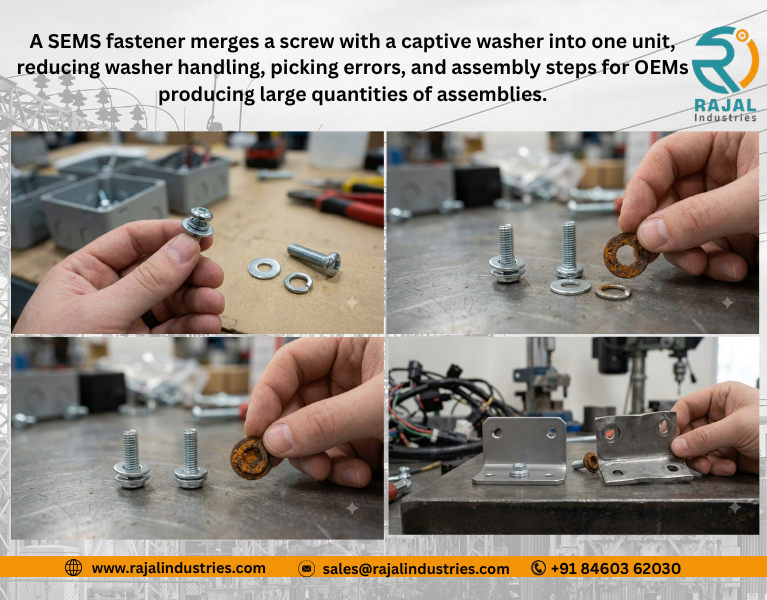
Choosing the right SEMS screw manufacturer is important for OEMs that need fast, repeatable assembly and consistent fastening quality.
SEMS screws combine a screw with one or more captive washers into a pre-assembled fastener. Because the washer is retained on the screw, operators do not need to pick and position a separate washer during every assembly operation.
This makes SEMS screws useful for high-volume production in:
- Electrical Equipment
- Switchgear
- Control Panels
- Electronics
- Home Appliances
- Industrial Machinery
- Automotive Components
- Telecom Equipment
- Power Equipment
- Battery and Energy Equipment
For an OEM producing thousands or millions of assemblies, reducing even one loose component from an assembly operation can improve handling, inventory control and production efficiency.
Rajal Industries can evaluate standard and custom SEMS screw requirements for bulk OEM production based on customer drawings, dimensions, materials, washer configurations, surface finishes and annual quantities.
Quick Answer: What Is a SEMS Screw?
A SEMS screw is a pre-assembled fastener consisting of a screw and one or more captive washers.
A typical configuration can be:
Machine Screw + Captive Washer
or
Machine Screw + Spring Washer + Plain Washer
The washer is retained on the screw so that the complete fastener can be handled and installed as one unit.
This can help OEM assembly lines reduce:
- Separate washer handling
- Missing washers
- Assembly steps
- Loose component inventory
- Picking errors
- Installation time
The exact performance depends on the screw, washer, joint and assembly design.
What Does SEMS Mean in Fasteners?
The term SEMS screw is widely used for screws supplied with captive or permanently pre-assembled washers.
Instead of supplying:
1 Screw + 1 Washer
as two loose components, the supplier provides:
1 Pre-Assembled SEMS Fastener
Depending on the specification, a SEMS assembly can contain:
- Screw + Plain Washer
- Screw + Spring Washer
- Screw + Plain Washer + Spring Washer
- Other specified captive washer configurations
This makes SEMS especially useful where repeatable assembly is important.
SEMS Screw Construction
A typical SEMS fastener contains two main elements:
Screw
The screw may have a specified:
- Diameter
- Thread
- Length
- Head
- Drive
- Material
- Strength requirement
- Surface finish
Captive Washer
The washer may be:
- Plain Washer
- Spring Lock Washer
- Toothed Washer
- Conical Washer
- Other Application-Specific Washer
The exact washer configuration should be selected according to the customer’s drawing and joint requirement.
How Does a Captive Washer Screw Work?
In a captive washer screw, the washer is retained on the screw and cannot normally fall away during standard handling.
The washer remains free enough to perform its intended function while being retained as part of the assembly.
This creates a single fastener assembly that can be:
Picked → Positioned → Driven
instead of:
Pick Screw → Pick Washer → Position Washer → Position Screw → Drive
For repetitive production, removing separate component-handling steps can be valuable.
SEMS Screw vs Standard Machine Screw
| Feature | SEMS Screw | Standard Machine Screw |
| Screw | Included | Included |
| Captive Washer | Yes | No |
| Separate Washer Handling | Reduced | Required when washer is needed |
| Assembly Components | Combined | Separate |
| High-Volume Assembly | Strong application | Common |
| Missing Washer Risk | Reduced | Depends on assembly process |
| OEM Automation | Can be useful | Application dependent |
| Custom Configuration | Available by specification | Available |
A standard machine screw is not inferior. The correct choice depends on whether the joint requires a washer and whether pre-assembly adds value to the production process.
SEMS Screw vs Screw + Loose Washer
Consider an assembly requiring one screw and one washer.
Conventional Method
The operator handles:
Screw + Separate Washer
For 500,000 finished assemblies:
500,000 screws + 500,000 separately handled washers
SEMS Method
The operator handles:
500,000 pre-assembled SEMS screws
The number of fastener components still exists, but the production operator handles them as one assembly.
This can simplify:
- Line-side feeding
- Component picking
- Kitting
- Installation
- Inventory handling
The actual productivity improvement should be validated on the OEM’s production line.
Why OEMs Use SEMS Screws
The main reason is assembly efficiency.
SEMS fasteners can help simplify repetitive fastening where a washer is already required by the joint design.
Potential benefits include:
Fewer Separate Components
The washer is already assembled with the screw.
Reduced Washer Handling
Operators do not need to position a loose washer for every fastening point.
Reduced Missing-Washer Risk
Because the washer is retained with the screw, the chance of accidentally omitting it during assembly can be reduced.
Faster Assembly
Removing a separate handling step may reduce assembly time.
Easier Kitting
A screw-and-washer combination can be managed as one assembly item.
Better Production Consistency
The specified washer is already paired with the correct screw.
Why SEMS Screws Matter in High-Volume OEM Production
Consider an appliance manufacturer producing:
1,000,000 products per year
If each product uses four screw-and-washer fastening points, the factory performs:
4,000,000 fastening operations per year.
If separate washers are required, operators or automated systems must also manage millions of washer-handling events.
This is why even a small improvement in assembly time can matter at OEM scale.
The business case for SEMS should therefore consider:
Fastener Cost + Assembly Time + Handling + Inventory + Errors + Rework
rather than screw price alone.
Major Industries Using SEMS Screws
| Industry | Typical Use |
| Electrical Equipment | Enclosures, assemblies, components |
| Switchgear | Panels and internal assemblies |
| Control Panels | Electrical component fastening |
| Electronics | Equipment housings and assemblies |
| Home Appliances | Internal and external assemblies |
| Industrial Machinery | Covers, brackets and components |
| Automotive Components | Production assemblies |
| Telecom Equipment | Cabinets and electronic equipment |
| Battery Equipment | Enclosures and electrical assemblies |
| Solar / Power Equipment | Electrical and control equipment |
| HVAC Equipment | Panels and internal components |
| Contract Manufacturing | Repetitive OEM assembly |
The final SEMS specification should always follow the actual joint requirement.
SEMS Screws for Electrical Equipment
Electrical equipment manufacturers are an important market for SEMS fasteners.
Potential applications include:
- Electrical Enclosures
- Distribution Equipment
- Control Equipment
- Terminal Assemblies
- Internal Brackets
- Covers
- Mounting Components
In repetitive assembly, the captive washer can reduce the need to handle a separate washer at each fastening point.
Important buyer requirements can include:
- Screw dimensions
- Washer dimensions
- Head type
- Drive
- Material
- Surface finish
- Thread fit
- Torque requirement
- Corrosion requirement
SEMS Screws for Switchgear
Switchgear manufacturers can use large numbers of screws across production.
Possible applications include:
- Switchgear Cabinets
- Internal Mounting Components
- Covers
- Brackets
- Electrical Assemblies
- Control Components
For these OEMs, fastener consistency matters because the same assembly may be repeated thousands of times.
A suitable SEMS design can help simplify the fastening operation when the joint requires both a screw and washer.
SEMS Screws for Electrical Panels
Electrical panel manufacturing involves repetitive installation of:
- Components
- Covers
- Brackets
- Mounting Parts
- Internal Assemblies
Where washers are required, captive washer screws can help reduce separate washer handling.
For production buyers, important considerations include:
- Fast installation
- Consistent drive engagement
- Washer retention
- Correct thread
- Surface finish
- Dimensional consistency
- Batch traceability
SEMS Screws for Electronics OEMs
Electronics manufacturers often work with repetitive assembly processes where small components need to be controlled carefully.
Potential SEMS applications include:
- Electronic Enclosures
- Equipment Housings
- Power Supply Units
- Control Equipment
- Industrial Electronics
- Communication Equipment
A pre-assembled fastener can help reduce loose-component handling during production.
However, the washer type and screw design must match the actual electronics assembly.
SEMS Screws for Home Appliances
Appliance manufacturing is another strong high-volume application.
Potential products include:
- Washing Machines
- Refrigerators
- Air Conditioners
- Water Heaters
- Kitchen Appliances
- Commercial Appliances
- Electrical Appliances
SEMS screws may be considered where the product design requires both a screw and washer.
For appliance OEMs producing hundreds of thousands of units, assembly speed and component consistency can become important procurement factors.
SEMS Screws for HVAC Equipment
HVAC manufacturers assemble products containing:
- Sheet Metal Panels
- Electrical Components
- Covers
- Brackets
- Control Systems
- Internal Equipment
Depending on the joint design, SEMS fasteners can simplify repetitive assembly.
The buyer should define:
- Base material
- Thread requirement
- Screw size
- Washer configuration
- Surface finish
- Required mechanical performance
SEMS Screws for Industrial Machinery
Industrial machinery can contain many removable covers, panels, brackets and electrical components.
Possible applications include:
- Machine Covers
- Control Cabinets
- Electrical Boxes
- Mounting Brackets
- Internal Components
- Equipment Assemblies
For machinery OEMs, SEMS screws may provide value where repeated screw-and-washer assembly is required.
SEMS Screws for Telecom Equipment
Telecom and communication equipment can contain high numbers of small fastening points.
Applications can include:
- Telecom Cabinets
- Equipment Racks
- Electronic Enclosures
- Communication Hardware
- Power Equipment
- Control Assemblies
For these applications, buyers may require tight control of:
- Dimensions
- Drive recess
- Washer retention
- Finish
- Corrosion performance
- Batch consistency
SEMS Screws for Battery & Energy Equipment
Battery, inverter, UPS and energy-equipment manufacturers can have repetitive electrical and mechanical fastening requirements.
Possible applications include:
- Battery Cabinets
- UPS Equipment
- Inverter Enclosures
- Power Electronics
- Control Cabinets
- Energy Storage Equipment
- Internal Brackets
Depending on the joint design, a SEMS fastener can simplify the screw-and-washer assembly process.
For electrical applications, final fastener suitability must be confirmed against the OEM’s drawing and engineering requirements.
SEMS Screws for Automotive Components
Automotive and mobility component manufacturers often require:
- Repeatable assembly
- Tight dimensional control
- Controlled coatings
- Batch traceability
- Consistent mechanical performance
- Supplier quality documentation
SEMS screws can be considered for suitable assemblies where a screw and washer are required together.
Potential applications include:
- Electrical Components
- Brackets
- Control Modules
- Interior Assemblies
- Equipment Housings
- Auxiliary Systems
Automotive requirements can be customer-specific, so the approved drawing and quality plan should control production.
SEMS Screws for Contract Manufacturers
Contract manufacturers assemble products for multiple OEM customers.
They may work with:
- Electronics
- Electrical Products
- Appliances
- Industrial Equipment
- Telecom Products
- Energy Equipment
Reducing loose components can simplify:
- Kitting
- Line-side inventory
- Work instructions
- Component control
For this reason, captive fastener designs may be useful in repetitive contract manufacturing.
Common SEMS Screw Head Types
Depending on customer requirements, SEMS screws may use different head configurations.
Examples can include:
- Pan Head
- Hex Head
- Hex Washer Head
- Combination Head
- Other Drawing-Specified Heads
Head selection depends on:
- Available installation space
- Tool access
- Required bearing area
- Appearance
- Assembly process
- Torque requirement
The head should be selected together with the washer rather than as an independent feature.
Common Drive Types for SEMS Screws
Possible drive configurations include:
- Phillips
- Pozidriv
- Slotted
- Combination Drive
- Hex
- Hex Socket
- Torx-Type Drive
- Customer-Specified Drive
For automated or high-volume assembly, drive consistency becomes particularly important.
Poor drive geometry can cause:
- Cam-out
- Bit slipping
- Head damage
- Tool wear
- Slower production
Common SEMS Washer Configurations
SEMS assemblies can use different washer arrangements.
| Configuration | General Purpose |
| Screw + Plain Washer | Bearing/load distribution |
| Screw + Spring Washer | Application-specific locking function |
| Screw + Plain + Spring Washer | Combined assembly |
| Screw + Toothed Washer | Application-specific contact/locking |
| Custom Washer | Drawing-based requirement |
Washer function should be determined by the joint design. A washer should not be selected only because it is commonly available.
Plain Washer SEMS Screw
A plain washer can provide a larger bearing surface under the screw head.
Depending on the joint, this may help:
- Distribute bearing load
- Protect the component surface
- Support the fastening interface
The washer dimensions should match the screw and application.
Spring Washer SEMS Screw
Some SEMS configurations use a spring washer.
The complete assembly may be:
Screw + Captive Spring Washer
or:
Screw + Captive Spring Washer + Plain Washer
The suitability of a spring washer for preventing loosening should not be assumed universally. Joint design, preload, vibration and the OEM’s engineering specification should determine the locking method.
Why Washer Retention Matters
The washer must remain captive during normal:
- Manufacturing
- Inspection
- Packaging
- Transportation
- Feeding
- Handling
- Installation
If washer retention is inconsistent, one of the main advantages of a SEMS assembly is lost.
For bulk OEM supply, retention should therefore be included in the inspection plan.
How Are SEMS Screws Manufactured?
A typical manufacturing route can involve:
Raw Material → Cold Heading → Washer Assembly → Thread Rolling → Heat Treatment if Required → Surface Finishing → Inspection → Packing
The exact process depends on:
- Screw design
- Washer type
- Material
- Thread
- Strength requirement
- Surface finish
One important manufacturing principle is that the washer must be captured while still allowing the required functional movement.
Why Thread Rolling Is Important for SEMS Screws
In many SEMS designs, the washer is assembled before the final thread geometry prevents it from coming off the screw.
Thread rolling forms the thread by material displacement rather than cutting.
Process control is important for:
- Major diameter
- Pitch
- Thread profile
- Thread fit
- Washer retention
The exact manufacturing sequence depends on the SEMS design.
SEMS Screw Materials
Depending on the customer’s specification, materials may include:
- Carbon Steel
- Alloy Steel
- Stainless Steel
- Other Specified Materials
Material selection depends on:
- Required strength
- Forming requirements
- Corrosion conditions
- Electrical equipment requirements
- Operating environment
- Customer drawing
Do not specify material only as “metal” or “steel” for OEM production.
SEMS Screw Surface Finishes
Possible finishes can include:
- Zinc Plating
- Zinc-Based Coatings
- Black Finish
- Passivation
- Customer-Specified Coating
The exact finish should be selected according to:
- Corrosion requirement
- Appearance
- Electrical application
- Operating environment
- OEM specification
Where corrosion resistance matters, specify measurable performance rather than coating color alone.
What OEM Buyers Should Specify
A professional SEMS screw RFQ should include:
- Screw diameter
- Thread pitch
- Screw length
- Head type
- Drive type
- Washer type
- Number of washers
- Washer dimensions
- Material
- Strength / hardness requirement
- Surface finish
- Corrosion requirement
- Application
- Mating component
- Drawing or standard
- Required testing
- Annual volume
- Delivery schedule
This helps manufacturers quote the same technical requirement rather than different interpretations of “SEMS screw.”
Example of a Better SEMS Screw RFQ
Instead of:
Need M4 SEMS screws. Send price.
Use:
Requirement: M4 SEMS screws for electrical equipment assembly. Please quote against our drawing and confirm screw length, thread pitch, pan head, drive type, captive plain/spring washer configuration, material, surface finish, required mechanical properties, testing capability and monthly production capacity. Estimated annual requirement: 1,200,000 pcs.
This gives the manufacturer enough information to perform a meaningful technical and commercial review.
What Should Be Tested Before OEM Approval?
Depending on the drawing and application, buyers may evaluate:
- Screw diameter
- Length
- Thread
- Head dimensions
- Drive recess
- Washer dimensions
- Washer retention
- Washer movement
- Material
- Hardness
- Surface finish
- Coating thickness
- Corrosion performance
- Torque performance
- Thread fit
- Installation performance
For high-volume OEM applications, practical assembly trials can also be useful.
Why Rajal Industries for Bulk SEMS Screw Requirements?
As a SEMS screw manufacturer, Rajal Industries can evaluate bulk OEM fastener requirements based on customer drawings and technical specifications.
Subject to manufacturing feasibility and customer approval, requirements can be evaluated for:
- SEMS Screws
- Captive Washer Screws
- Machine Screw + Washer Assemblies
- Plain Washer SEMS Screws
- Spring Washer SEMS Screws
- Multiple-Washer Configurations
- Custom Head Types
- Custom Drive Types
- Different Thread Sizes
- Carbon Steel Requirements
- Stainless Steel Requirements
- Surface Finishing
- Drawing-Based Manufacturing
- Dimensional Inspection
- Mechanical Testing as Specified
- Batch Traceability
- OEM Packaging
- Scheduled Bulk Supply
Potential customers include:
- Electrical Equipment OEMs
- Switchgear Manufacturers
- Control Panel Manufacturers
- Electronics OEMs
- Appliance Manufacturers
- HVAC Manufacturers
- Telecom Equipment Manufacturers
- Battery & Energy Equipment Manufacturers
- Industrial Machinery OEMs
- Automotive Component Manufacturers
- Contract Manufacturers
- Fastener Distributors
Final manufacturing capability should always be confirmed against the customer’s drawing, washer design, material, surface finish, testing requirements and annual volume.
Bulk Buyer Quick Answer
What information should I send to a SEMS screw manufacturer?
Send:
Screw Diameter + Length + Thread + Head + Drive + Washer Type + Washer Dimensions + Material + Finish + Quantity
For OEM sourcing, also provide:
- Technical drawing
- Application
- Mating component
- Mechanical requirements
- Corrosion requirement
- Required tests
- Sample quantity
- Monthly requirement
- Annual requirement
- Packaging
- Delivery schedule
This allows the SEMS screw manufacturer to review both manufacturing feasibility and commercial requirements.
SEMS Screw Sizes & Common Configurations
A SEMS screw manufacturer can produce different screw-and-washer combinations depending on the OEM drawing and assembly requirement.
The complete specification normally includes:
Screw Diameter + Thread + Length + Head + Drive + Washer Type + Material + Finish
Common metric thread sizes used in OEM assemblies can include:
- M2
- M2.5
- M3
- M4
- M5
- M6
- M8
Availability depends on the design, washer configuration, material and manufacturing capability.
For OEM purchasing, specifying only “M4 SEMS screw” is not enough.
Common SEMS Screw Configuration Guide
| Configuration | Typical Description | Potential Application |
| Screw + Plain Washer | Single captive flat washer | Electrical and equipment assembly |
| Screw + Spring Washer | Captive spring washer | Drawing-specified assemblies |
| Screw + Spring + Plain Washer | Two captive washers | OEM equipment |
| Screw + Toothed Washer | Captive toothed washer | Application-specific assemblies |
| Custom SEMS Assembly | Drawing-specific configuration | OEM products |
The correct washer configuration should be selected according to the joint design, not simply from general availability.
Single-Washer SEMS Screws
A single-washer SEMS assembly commonly consists of:
Machine Screw + Captive Washer
The washer may provide:
- Bearing-area distribution
- Surface protection
- Application-specific locking or contact function
- Easier assembly
This design can be useful when the OEM already requires one washer at each fastening point.
Instead of purchasing and handling two loose parts, the assembly line receives one pre-assembled fastener.
Double-Washer SEMS Screws
Some applications require two washers.
A typical configuration may be:
Machine Screw + Spring Washer + Plain Washer
The two washers remain captive on the screw.
Potential benefits include:
- Reduced loose-component handling
- Correct washer combination supplied together
- Lower risk of missing one washer
- Easier kitting
- Faster repetitive assembly
The order and function of the washers should follow the customer’s approved drawing.
Why Washer Order Matters
For a multi-washer SEMS assembly, the washer sequence should not be assumed.
The customer drawing should define:
- Washer closest to the screw head
- Washer closest to the mating surface
- Washer dimensions
- Washer thickness
- Washer function
- Required free movement
Incorrect washer order can change how the joint behaves.
For this reason, an OEM drawing should clearly show the complete assembly.
Captive Washer Engineering
A key feature of a SEMS screw is that the washer remains captive.
This sounds simple, but it requires control of several dimensions.
Important characteristics include:
- Screw blank diameter
- Thread major diameter
- Washer hole diameter
- Washer thickness
- Washer outside diameter
- Thread rolling process
- Washer movement
- Retention after assembly
The washer needs to remain on the screw while still performing its intended function.
How Is the Washer Made Captive?
A common SEMS manufacturing principle is to assemble the washer onto the screw before the final thread is rolled.
The manufacturing sequence can generally be:
Screw Blank → Washer Assembly → Thread Rolling
After thread rolling, the formed thread outside diameter can retain the washer on the screw.
The exact production sequence depends on the fastener design and manufacturing process.
This is why SEMS screws are not simply ordinary finished screws with washers added afterward.
Why Washer Hole Diameter Matters
The washer hole needs to work with both:
- The screw before final thread formation
- The finished threaded portion
If the hole is too large, retention may be poor.
If it is too small, manufacturing or washer movement can be affected.
For custom OEM screws, the screw and washer should therefore be engineered as one assembly.
Washer Movement in a SEMS Screw
“Captive” does not necessarily mean that the washer is rigidly fixed to the screw.
Depending on the design, the washer may have controlled movement while remaining retained.
This can allow the washer to:
- Rotate
- Move along the permitted portion of the screw
- Seat against the mating component
The required movement should be defined by the design and application.
SEMS Screw vs Standard Machine Screw
| Factor | SEMS Screw | Standard Machine Screw |
| Screw | Yes | Yes |
| Washer | Pre-assembled | Separate if required |
| Washer Retention | Captive | Not applicable |
| Number of Loose Parts | Reduced | Higher when washer is required |
| Kitting | Simpler in suitable applications | Separate components |
| Assembly Steps | Can be reduced | More if washer is separate |
| Missing Washer Risk | Reduced | Higher if manually assembled |
| Automated Assembly | Potential advantage | Application dependent |
| Unit Price | May be higher | Usually simpler product |
| Total Assembly Cost | Can be lower | Depends on process |
The commercial comparison should therefore consider the complete assembly operation, not only fastener price.
SEMS Screw vs Loose Screw + Washer
Assume an OEM needs:
2,000,000 fastening points per year.
Loose Components
The production system manages:
- 2,000,000 screws
- 2,000,000 washers
That means 4,000,000 individual components must be purchased, stored, fed and controlled.
SEMS Fasteners
The production system manages:
2,000,000 pre-assembled screw-and-washer units.
The same functional components remain in the product, but line-side handling can be simplified.
For a high-volume OEM, this difference can be commercially important.
When Should an OEM Consider SEMS Screws?
SEMS screws are worth evaluating when:
- Every screw requires a washer
- Production volume is high
- Manual assembly is repetitive
- Washer omission is a recurring issue
- Kitting complexity is high
- Automated feeding is planned
- Assembly time matters
- Inventory simplification has value
They may offer less benefit where:
- Production volume is very low
- Washers are rarely required
- The joint needs frequent washer changes
- The fastener configuration changes regularly
The decision should be based on the actual assembly economics.
SEMS Screws for Automated Assembly
High-volume OEMs increasingly use powered or automated fastening systems.
A pre-assembled fastener can reduce the need to separately feed:
Screw + Washer
However, automation suitability depends on the actual SEMS design.
Important factors can include:
- Head geometry
- Overall dimensions
- Washer outside diameter
- Washer movement
- Drive recess
- Fastener orientation
- Feeding equipment
- Installation torque
OEMs planning automated feeding should test production samples with the actual feeding and installation equipment.
SEMS Screws for Electrical OEMs
Electrical equipment manufacturers should select SEMS screws according to the actual joint.
Possible assemblies include:
- Switchgear
- Electrical Panels
- Distribution Equipment
- Control Cabinets
- Electrical Enclosures
- Mounting Components
Important selection factors include:
- Thread
- Screw length
- Head
- Drive
- Washer type
- Surface finish
- Corrosion requirement
- Assembly torque
Where electrical contact, grounding or other electrical performance is required, the complete joint should be validated by the OEM.
SEMS Screws for Electronics OEMs
Electronics applications may require smaller screws and controlled assembly.
Buyer requirements can include:
- Small thread sizes
- Controlled head dimensions
- Consistent drive recess
- Controlled washer dimensions
- Surface finish
- Low assembly rejection
- Batch consistency
Potential applications include:
- Electronic Housings
- Power Supplies
- Industrial Electronics
- Control Devices
- Communication Equipment
- Electronic Cabinets
For high-volume electronics production, dimensional consistency can be especially important for automated assembly.
SEMS Screws for Appliance OEMs
Appliance manufacturers can have very high annual fastener consumption.
Applications may include:
- Washing Machines
- Refrigerators
- Air Conditioners
- Water Heaters
- Kitchen Appliances
- Commercial Appliances
OEM buyers may focus on:
- Cost per assembly
- Fast installation
- Consistent washer retention
- Drive quality
- Surface finish
- Corrosion resistance
- Production capacity
- Delivery reliability
This makes appliance manufacturing an attractive bulk market for SEMS fasteners.
SEMS Screws for Switchgear & Control Panels
Switchgear and panel manufacturers often perform repetitive fastening operations.
A captive washer arrangement can be useful where the assembly specification already requires a washer.
Typical buyer concerns include:
- Correct screw length
- Thread fit
- Washer retention
- Washer configuration
- Drive consistency
- Finish
- Torque performance
- Traceability
For repeated production, the fastener should be tested on the actual component assembly.
SEMS Screws for Telecom Equipment
Telecom equipment manufacturers may use SEMS screws in:
- Equipment Cabinets
- Racks
- Electronic Enclosures
- Power Systems
- Control Equipment
- Communication Hardware
The exact design should consider:
- Installation space
- Tool access
- Washer diameter
- Corrosion requirement
- Electrical requirements
- Service environment
SEMS Screws for Battery, UPS & Inverter Equipment
Energy-equipment OEMs can use large numbers of fasteners in:
- Battery Cabinets
- BESS Enclosures
- UPS Systems
- Inverters
- Power Electronics
- Electrical Cabinets
- Internal Assemblies
A captive washer screw may help simplify assembly where a separate washer would otherwise be required.
However, electrical, grounding, thermal and mechanical requirements should be defined by the OEM engineering team.
SEMS Screws for Automotive OEM Supply
Automotive applications can require stronger supplier controls.
Depending on the customer, requirements may include:
- Approved drawing
- Material certification
- Dimensional reports
- Mechanical testing
- Coating validation
- Corrosion testing
- Lot traceability
- PPAP-related documentation
- Process control
- Packaging specifications
A manufacturer should confirm the customer’s exact quality requirements before quotation and production.
How to Select the Correct SEMS Screw
A practical selection process is:
Step 1: Define the Joint
Identify what components are being fastened.
Step 2: Select the Screw Thread
Confirm:
- Diameter
- Pitch
- Thread tolerance
- Mating thread
Step 3: Select Screw Length
Determine the required engagement and joint thickness.
Step 4: Select Head & Drive
Consider:
- Tool access
- Torque
- Available space
- Assembly method
Step 5: Select Washer Type
Determine whether the application requires:
- Plain Washer
- Spring Washer
- Toothed Washer
- Multiple Washers
- Custom Washer
Step 6: Define Material
Specify the required screw and washer materials.
Step 7: Define Surface Finish
Specify the coating and required performance.
Step 8: Define Testing
Confirm dimensional, mechanical, coating and application tests.
Step 9: Test Samples
Evaluate the proposed fastener in the actual OEM assembly.
SEMS Screw Selection Checklist
| Parameter | Buyer Should Define |
| Thread Diameter | M2, M3, M4, M5 etc. |
| Thread Pitch | Drawing / standard |
| Screw Length | Application based |
| Head | Drawing / requirement |
| Drive | Tool based |
| Washer Type | Plain / spring / other |
| Number of Washers | One / multiple |
| Washer OD | Drawing |
| Washer ID | Drawing |
| Washer Thickness | Drawing |
| Screw Material | Specification |
| Washer Material | Specification |
| Mechanical Properties | As required |
| Finish | Application based |
| Corrosion Requirement | As specified |
| Installation Torque | As required |
| Annual Quantity | Commercial planning |
Common SEMS Screw Problems & Solutions
1. Washer Falls Off
Possible causes:
- Incorrect washer hole
- Insufficient retention
- Thread dimensions
- Manufacturing variation
- Incorrect assembly process
What to Check
Washer ID + Thread Major Diameter + Manufacturing Sequence + Retention Test
Washer retention should be checked before bulk approval.
2. Washer Does Not Move Correctly
Possible causes include:
- Incorrect washer dimensions
- Excessive coating
- Burrs
- Deformation
- Assembly-process issue
The required washer movement should be defined by the approved design.
3. Screw Does Not Fit the Mating Thread
Possible causes include:
- Incorrect pitch
- Thread dimensional variation
- Coating buildup
- Thread damage
- Wrong fastener specification
Thread gauges should be used according to the specified thread requirement.
4. Driver Bit Slips
Possible causes include:
- Incorrect bit
- Poor drive geometry
- Worn bit
- Excessive torque
- Misalignment
For automated assembly, drive consistency is especially important.
5. Screw Breaks During Assembly
Possible causes can include:
- Excessive installation torque
- Material problem
- Heat-treatment issue
- Insufficient core strength
- Incorrect screw selection
The screw should be tested against the actual joint and specified installation torque.
6. Washer Deforms During Tightening
Possible causes include:
- Incorrect washer thickness
- Material mismatch
- Excessive load
- Incorrect washer selection
- Joint-design issue
Washer dimensions and mechanical requirements should be defined by the application.
7. Surface Finish Fails Early
Possible causes include:
- Incorrect coating
- Insufficient coating performance
- Handling damage
- Environmental exposure
- Storage conditions
Specify measurable corrosion requirements where required.
8. Washer Installed in Wrong Sequence
This is especially relevant for multi-washer assemblies.
Possible causes include:
- Poor process control
- Incorrect work instructions
- Mixed components
The supplier should control washer sequence according to the approved drawing.
SEMS Screw Troubleshooting Table
| Problem | Possible Cause | First Check |
| Washer Falls Off | Retention issue | Washer ID + thread |
| Washer Jammed | Dimensions / coating | Washer clearance |
| Wrong Washer Order | Assembly control | Drawing + process |
| Thread Does Not Fit | Pitch / dimensions | Thread gauge |
| Bit Slipping | Drive geometry | Bit fit |
| Screw Breakage | Torque / material | Mechanical performance |
| Washer Deformation | Washer design | Thickness + material |
| Early Corrosion | Finish mismatch | Coating requirement |
Common Engineering Mistakes
Mistake 1: Specifying Only “M4 SEMS Screw”
This does not define the complete fastener.
An OEM should also specify:
- Pitch
- Length
- Head
- Drive
- Washer
- Material
- Finish
- Mechanical requirements
Mistake 2: Selecting the Washer Separately
The screw and washer should be treated as one engineered assembly.
Washer ID and screw thread geometry directly affect retention.
Mistake 3: Assuming Every Spring Washer Prevents Loosening
A spring washer should not automatically be treated as a universal anti-loosening solution.
Joint preload, vibration, surface conditions and application requirements matter.
The locking method should be validated for the actual joint.
Mistake 4: Ignoring Coating Thickness
Coating can affect:
- Thread fit
- Washer movement
- Appearance
- Corrosion performance
This can be important on small fasteners with tight dimensional tolerances.
Mistake 5: Ignoring Automated Feeding
A fastener may meet the drawing but still create feeding problems in automated production.
OEMs should test:
Fastener + Feeder + Driver + Actual Assembly
before high-volume approval.
Common Procurement Mistakes
Buying Only on Price per 1,000 Pieces
A SEMS fastener may cost more than a standard screw because it includes an additional component and manufacturing operations.
But buyers should compare:
Fastener Cost + Washer Cost + Handling + Assembly Labour + Kitting + Inventory + Errors + Rework
This provides a more useful commercial comparison.
Comparing Suppliers Without a Common Drawing
Supplier A may quote:
Screw + Plain Washer
while Supplier B quotes:
Screw + Spring Washer + Plain Washer
These are not equivalent products.
Every supplier should quote against the same:
- Drawing
- Material
- Washer configuration
- Finish
- Testing requirement
- Packaging
- Quantity
Not Sharing Annual Volume
SEMS screws are particularly suitable for repeat OEM production.
Share:
- Prototype quantity
- Sample quantity
- Trial order
- Monthly demand
- Annual demand
- Delivery schedule
This helps the manufacturer evaluate tooling, production planning and commercial pricing.
SEMS Screw Quality Inspection Checklist
| Inspection Item | Check |
| Approved Drawing | ✓ |
| Thread Diameter | ✓ |
| Thread Pitch | ✓ |
| Thread Fit | ✓ |
| Screw Length | ✓ |
| Head Diameter | ✓ |
| Head Height | ✓ |
| Drive Recess | ✓ |
| Washer OD | ✓ |
| Washer ID | ✓ |
| Washer Thickness | ✓ |
| Washer Type | ✓ |
| Washer Sequence | ✓ |
| Washer Retention | ✓ |
| Washer Movement | ✓ |
| Screw Material | ✓ |
| Washer Material | ✓ |
| Mechanical Properties | As Specified |
| Hardness | As Specified |
| Surface Finish | ✓ |
| Coating Thickness | As Specified |
| Corrosion Performance | As Required |
| Torque Test | As Required |
| Installation Test | ✓ |
| Visual Inspection | ✓ |
| Batch Traceability | ✓ |
The actual inspection plan should follow the customer’s drawing and quality requirements.
OEM SEMS Screw RFQ Checklist
Send the manufacturer:
☐ Screw Diameter
☐ Thread Pitch
☐ Thread Tolerance
☐ Screw Length
☐ Head Type
☐ Head Dimensions
☐ Drive Type
☐ Drive Size
☐ Washer Type
☐ Number of Washers
☐ Washer Sequence
☐ Washer OD
☐ Washer ID
☐ Washer Thickness
☐ Screw Material
☐ Washer Material
☐ Strength Requirement
☐ Hardness Requirement
☐ Surface Finish
☐ Coating Thickness
☐ Corrosion Requirement
☐ Mating Component
☐ Installation Torque
☐ Drawing / Standard
☐ Required Tests
☐ Sample Quantity
☐ First Order Quantity
☐ Monthly Requirement
☐ Annual Requirement
☐ Packaging
☐ Delivery Schedule
Questions to Ask a SEMS Screw Manufacturer
Before selecting a bulk supplier, ask:
- Are you the actual manufacturer?
- Which SEMS screw sizes can you manufacture?
- Which captive washer configurations are available?
- Can you manufacture double-washer SEMS screws?
- Can you manufacture according to our drawing?
- Which head types are available?
- Which drive types are available?
- Which screw materials can you process?
- Which washer materials can you process?
- How is washer retention controlled?
- How is washer movement checked?
- How do you control washer sequence?
- How are threads inspected?
- How is drive-recess geometry controlled?
- Which surface finishes are available?
- Can you control coating thickness?
- Can corrosion testing be provided where required?
- Can mechanical and torque tests be performed?
- Can you support assembly trials?
- Is batch traceability available?
- Can you provide dimensional inspection reports?
- Can you support PPAP or customer-specific documentation where agreed?
- What is your MOQ?
- What is your monthly capacity?
- Can you support scheduled OEM deliveries?
- Can you provide custom or private-label packaging?
Why Rajal Industries for OEM SEMS Screws?
As a SEMS screw manufacturer in India, Rajal Industries can evaluate drawing-based captive washer screw requirements for bulk OEM applications.
Subject to technical feasibility and customer approval, requirements can be evaluated for:
- SEMS Screws
- Captive Washer Screws
- Plain Washer SEMS
- Spring Washer SEMS
- Double-Washer SEMS
- Custom Washer Configurations
- Machine Screw + Washer Assemblies
- Different Head Types
- Different Drive Types
- Metric Threads
- Carbon Steel
- Stainless Steel
- Customer-Specified Materials
- Surface Finishing
- Drawing-Based Manufacturing
- Dimensional Inspection
- Mechanical Testing as Specified
- Washer Retention Inspection
- Application Testing
- Batch Traceability
- OEM Packaging
- Scheduled Bulk Production
Potential bulk customers include:
- Electrical Equipment Manufacturers
- Switchgear Manufacturers
- Electrical Panel Manufacturers
- Electronics OEMs
- Appliance Manufacturers
- HVAC Equipment Manufacturers
- Telecom Equipment Manufacturers
- Battery / BESS Manufacturers
- UPS & Inverter Manufacturers
- Industrial Machinery OEMs
- Automotive Component Manufacturers
- Contract Manufacturers
For custom requirements, buyers should share their drawing, annual demand and application information for manufacturing feasibility review.
Bulk Buyer Quick Answer
What should I send when requesting a SEMS screw quotation?
Send:
Thread Size + Pitch + Length + Head + Drive + Washer Configuration + Washer Dimensions + Materials + Finish + Annual Quantity
For a custom OEM requirement, also send:
- Drawing
- Application
- Mating component
- Installation torque
- Mechanical requirements
- Coating requirement
- Testing requirement
- Sample quantity
- Monthly demand
- Annual demand
- Packaging requirement
This allows the SEMS screw manufacturer to evaluate the complete fastener rather than only the screw diameter.
Frequently Asked Questions About SEMS Screws
What is a SEMS screw?
A SEMS screw is a screw supplied with one or more captive washers already assembled onto the fastener.
What is a captive washer screw?
A captive washer screw retains the washer on the screw so the two components can be handled and installed as one assembly.
Why are SEMS screws used?
They are commonly used to reduce separate washer handling, simplify assembly, reduce missing-washer risk and improve repetitive production processes.
Where are SEMS screws used?
SEMS screws can be used in suitable electrical equipment, switchgear, electronics, appliances, HVAC equipment, telecom products, industrial machinery and other OEM assemblies.
What washer types can be used with SEMS screws?
Depending on the design, configurations can include plain washers, spring washers, toothed washers or multiple washers.
Can a SEMS screw have two washers?
Yes. Some SEMS assemblies use two captive washers, such as a spring washer and plain washer, when required by the approved design.
How is the washer retained on a SEMS screw?
A common manufacturing method places the washer on the screw before final thread rolling. The formed thread can then prevent the washer from coming off during normal handling.
Does the washer rotate on a SEMS screw?
Depending on the design, the captive washer may retain controlled rotational or axial movement while remaining attached to the screw.
What sizes are available for SEMS screws?
SEMS screws can be manufactured in various metric and other thread sizes depending on the manufacturer’s capability and the customer’s specification.
Are SEMS screws better than standard machine screws?
Not in every application. SEMS screws can provide an assembly advantage when the joint already requires a washer and production volume makes pre-assembly useful.
Do SEMS screws reduce assembly time?
They can reduce separate washer handling and may shorten assembly time. The actual saving depends on the OEM’s production process.
Are SEMS screws suitable for automated assembly?
They can be, but the exact fastener should be tested with the OEM’s feeder, driver and assembly equipment.
Can SEMS screws be customized?
Yes. Custom SEMS requirements can be developed around the screw dimensions, thread, head, drive, washer configuration, material, finish and customer drawing, subject to manufacturing feasibility.
What materials are used for SEMS screws?
Depending on the specification, materials can include carbon steel, stainless steel and other suitable materials.
Which finish is used on SEMS screws?
Zinc-based finishes and other customer-specified coatings can be used depending on corrosion, appearance and application requirements.
How do I choose the right SEMS screw?
Define the mating joint first, then specify thread, length, head, drive, washer type, material, finish, mechanical requirements and installation conditions.
What is the difference between a SEMS screw and a screw with a loose washer?
A SEMS screw retains the washer on the screw before installation. With a conventional screw-and-washer arrangement, the two components are supplied and handled separately.
What should I check before approving a SEMS screw supplier?
Check manufacturing capability, dimensions, thread quality, washer dimensions, retention, materials, finish, testing, traceability, capacity and consistency.
Key Takeaways
- A SEMS screw combines a screw and one or more captive washers into one assembly.
- SEMS fasteners are particularly useful for repetitive OEM production.
- Common configurations include plain washer, spring washer and double-washer assemblies.
- Washer retention is one of the key quality characteristics.
- Screw and washer dimensions should be engineered together.
- SEMS screws can reduce separate washer handling and missing-washer risk.
- The commercial comparison should include assembly cost, not only fastener price.
- Electrical, electronics and appliance OEMs are strong applications for SEMS screws.
- Automated assembly should be validated with the actual fastener and production equipment.
- Bulk buyers should provide drawings, annual demand and testing requirements before quotation.
Conclusion
Choosing the right SEMS screw manufacturer is especially important for electrical, electronics, appliance and industrial OEMs that depend on repeatable high-volume assembly.
A properly specified SEMS fastener combines:
Screw + Captive Washer + Correct Material + Surface Finish + Controlled Manufacturing
into one ready-to-install assembly.
Instead of evaluating only the screw price, OEM buyers should consider the complete production impact:
Fastener Cost + Washer Handling + Assembly Time + Inventory + Kitting + Errors + Rework
For large annual volumes, even a small improvement in assembly efficiency can become commercially important.
Rajal Industries can evaluate standard and custom SEMS screws and captive washer screws for bulk OEM requirements based on customer drawings, technical specifications, application details and annual production quantities.