

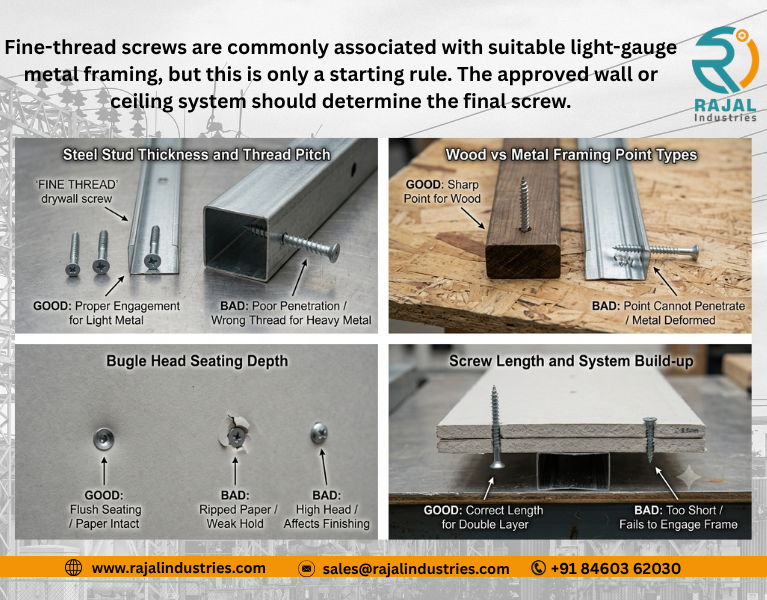
Choosing the correct drywall screw is not only about selecting a common size. The fastener must match the gypsum board, number of layers, supporting frame, metal thickness, thread type, point design, screw length, head geometry and installation method.
For high-volume construction work, the wrong fastener can create problems such as:
- Slow installation
- Poor metal penetration
- Screw breakage
- Driver-bit slipping
- Head over-driving
- Board-facing damage
- Rework
- Project delays
The correct approach is to treat the screw as part of the complete fastening system:
Gypsum Board + Frame + Screw + Driver Bit + Installation Tool
This practical drywall guide explains how to select screws for gypsum board, metal studs, ceiling systems and other suitable interior construction applications.
Quick Answer: How Do You Select a Drywall Screw?
Before selecting a drywall fastener, confirm:
- Gypsum board thickness
- Number of board layers
- Supporting frame material
- Metal frame thickness, if applicable
- Screw diameter
- Screw length
- Fine or coarse thread
- Point type
- Bugle head geometry
- Drive type
- Material
- Heat treatment
- Surface finish
- Required penetration
- Installation tool
- Applicable wall or ceiling system
For professional projects, the approved system specification should always control the final screw selection.
Step 1 – Identify the Gypsum Board
Start with the board itself.
Check:
- Board type
- Board thickness
- Number of layers
- Wall or ceiling application
- Approved system
Drywall screws are used across:
- Partition Walls
- False Ceilings
- Suspended Ceiling Systems
- Commercial Interiors
- Prefabricated Walls
- Modular Building Interiors
- Residential Interiors
The same screw should not automatically be used across every board assembly.
Why Board Thickness Matters
Board thickness affects:
- Required screw length
- Frame penetration
- Installation depth
- Head seating
- Total fastening stack
A thicker board or multi-layer system needs more screw length before the fastener reaches the supporting frame.
This is why screw length should be selected from the complete assembly rather than a generic chart alone.
Step 2 – Identify the Supporting Frame
This is one of the most important selection steps.
The frame may be:
- Light-Gauge Metal Stud
- Metal Channel
- Wood Stud
- Other Approved Framing System
The supporting material affects thread and point selection.
A screw suitable for wood framing may not be the right choice for metal studs.
Step 3 – Confirm Metal Stud Thickness
For gypsum board attached to metal framing, the actual metal thickness should be known.
Do not specify only:
For metal stud.
Also provide:
- Metal type
- Metal thickness
- Frame profile, where relevant
Metal thickness can affect:
- Starting
- Penetration
- Thread engagement
- Point design
- Installation torque
This is especially important for project procurement and OEM supply.
Step 4 – Fine Thread or Coarse Thread?
A common buyer question is:
Should I use fine-thread or coarse-thread drywall screws?
A simple starting rule is:
Light-Gauge Metal Framing → Fine Thread
Wood Framing → Coarse Thread
| Feature | Fine Thread Screws | Coarse Thread Screws |
| Thread Pitch | Fine | Coarse |
| Common Application | Light-gauge metal | Wood framing |
| Thread Frequency | Higher | Lower |
| Thread Depth | Relatively finer | Relatively deeper |
| Selection Basis | Metal/application | Wood/application |
This is only a general guide. The approved wall or ceiling system should still determine the final screw.
Step 5 – Select the Correct Point Type
Point geometry affects how the screw starts and penetrates the frame.
Common options include:
Sharp Point
Often suitable for:
- Wood Framing
- Suitable Light-Gauge Metal
- General Drywall Applications
Drill-Type Point
May be required for certain metal-framing applications where greater penetration capability is needed.
The point should be selected according to:
- Frame material
- Metal thickness
- Screw design
- Required penetration
Why Point Geometry Matters
A poor or unsuitable point may cause:
- Slow starting
- Screw wandering
- High installation force
- Failure to penetrate metal
- Screw breakage
- Tool wear
For large projects, point consistency should remain stable across the entire production batch.
Step 6 – Select the Correct Screw Diameter
Common drywall screw diameters may include sizes around:
- 3.5 mm
- 3.8 mm
- 4.2 mm
- 4.8 mm
The actual diameter should match:
- Board system
- Supporting frame
- Thread design
- Required mechanical performance
- Approved specification
A larger diameter is not automatically better.
Step 7 – Select the Correct Screw Length
Screw length should be selected from:
Board Thickness + Number of Layers + Required Frame Penetration
Important factors include:
- Total board thickness
- Supporting frame
- Point length
- Required engagement
- Installation depth
A screw that is too short may not engage the frame correctly.
A screw that is unnecessarily long may increase installation resistance and protrusion.
Single-Layer Gypsum Board
For a single-layer system, consider:
- Board thickness
- Frame material
- Frame thickness
- Required penetration
- Screw length
The approved drywall system should define the final requirement.
Multi-Layer Gypsum Board
For multi-layer systems, the screw must pass through more board material before engaging the frame.
Check:
- Total board thickness
- Layer sequence
- Supporting frame
- Screw length
- Required penetration
- Installation equipment
Do not simply use the same screw as a single-layer wall without confirming suitability.
Step 8 – Select the Head Style
The bugle head is commonly associated with drywall screws.
Its shape helps the fastener seat into the gypsum-board surface.
Important head characteristics include:
- Head diameter
- Head profile
- Head height
- Transition under the head
- Drive position
Poor head geometry can cause:
- Head remaining too high
- Excessive board penetration
- Surface damage
- Poor finishing
Why Bugle Head Seating Matters
Correct seating should allow the head to sit properly without unnecessarily damaging the board facing.
If the head remains too high:
- Joint finishing can be difficult
- Surface preparation may be affected
If driven too deeply:
- Paper facing may tear
- Board support around the head may reduce
- Installation quality may fall
The screw and installation tool should work together to control depth.
Step 9 – Select the Correct Drive Type
Drywall screws commonly use a cross-recess drive.
Drive selection affects:
- Bit engagement
- Torque transfer
- Installation speed
- Cam-out
- Tool wear
- Screw rejection
For high-volume construction, drive-recess consistency can directly affect productivity.
Why Driver-Bit Fit Matters
Poor bit fit may cause:
- Slipping
- Head damage
- Cam-out
- Higher bit wear
- Reduced installation speed
For bulk approval, test:
Screw + Correct Bit + Actual Installation Tool
This gives more useful information than inspecting the screw visually only.
Step 10 – Select the Screw Material
Heat-treated carbon steel is widely used for drywall fasteners.
Material choice should support:
- Cold forming
- Thread rolling
- Heat treatment
- Torsional performance
- Point performance
- Surface finishing
The exact steel grade should follow the approved product specification.
Why Heat Treatment Matters
Heat treatment affects:
- Hardness
- Toughness
- Torsional strength
- Point performance
- Thread durability
Poor heat-treatment control can contribute to:
- Screw breakage
- Brittle failure
- Point deformation
- Thread damage
- Inconsistent installation
For OEM and bulk projects, mechanical consistency is important.
Step 11 – Select the Surface Finish
Common finishes may include:
- Black Phosphate
- Grey Phosphate
- Zinc-Based Coating
- Customer-Specified Finish
The final finish should be selected according to:
- Interior environment
- Humidity
- Storage conditions
- Corrosion requirement
- Project specification
A black appearance alone does not prove a certain corrosion-performance level.
Step 12 – Check Corrosion Requirements
Most standard drywall systems are used indoors, but exposure conditions can vary.
Consider:
- Humidity
- Coastal environment
- Storage before installation
- Moisture exposure
- Building conditions
- Customer requirements
Where corrosion performance matters, specify:
- Coating type
- Required test
- Test duration
- Acceptance criteria
Avoid vague descriptions such as:
High corrosion resistance required.
Step 13 – Define Required Penetration
Required penetration depends on the approved drywall system.
The screw must:
- Pass through the gypsum board
- Reach the supporting frame
- Develop sufficient engagement
- Seat correctly
There is no useful universal penetration rule for every drywall application.
Follow the system or project requirement.
Step 14 – Consider Installation Depth
Correct depth is critical.
Too Shallow
Can cause:
- Head above surface
- Finishing problems
- Uneven board surface
Too Deep
Can cause:
- Torn paper facing
- Board damage
- Reduced local support
- Poor installation
The installation tool should provide controlled screw depth.
Step 15 – Check Installation Torque
Excessive torque can cause:
- Screw breakage
- Recess damage
- Over-driving
- Board damage
Insufficient torque can result in:
- Poor head seating
- Loose fastening
- Incomplete installation
When installation feels unusually difficult, do not simply increase tool torque. Check the screw, point, substrate and frame thickness.
Step 16 – Match the Screw to the Application
Gypsum Board to Light-Gauge Metal
Main factors:
- Fine thread commonly considered
- Metal thickness
- Point design
- Board thickness
- Required penetration
- Screw length
Gypsum Board to Wood
Main factors:
- Coarse thread commonly considered
- Wood substrate
- Board thickness
- Screw length
- Required engagement
False Ceiling
Main factors:
- Approved ceiling system
- Board thickness
- Ceiling framing
- Screw type
- Thread
- Point
- Installation depth
Prefabricated Interior Systems
Main factors:
- Repeatability
- Driver compatibility
- Batch consistency
- Installation speed
- Mechanical performance
- Scheduled supply
Drywall Screw Selection by Application
| Application | Main Selection Focus |
| Gypsum to Light Metal | Fine thread, metal thickness, point |
| Gypsum to Wood | Coarse thread, length, engagement |
| Partition Wall | Board layers, framing |
| False Ceiling | Approved ceiling system |
| Multi-Layer Wall | Total thickness + frame engagement |
| Prefab Interior | Repeatability and installation speed |
| Modular Construction | Batch consistency |
| Commercial Project | Quality + delivery reliability |
How to Select Construction Screws for Drywall Systems
The term construction screws is broad.
Not every construction screw is suitable for drywall.
For drywall applications, prioritize:
- Gypsum-board compatibility
- Bugle head
- Correct thread
- Correct point
- Frame compatibility
- Proper installation depth
For metal-to-metal framing connections, another type of construction fastener may be required.
Gypsum Fasteners for Ceiling Systems
For ceiling applications, the buyer should confirm:
- Board type
- Board thickness
- Metal frame
- Frame thickness
- Fastener spacing
- Screw specification
- Installation method
Do not use a general drywall screw simply because the project also uses gypsum board.
The approved ceiling-system specification should control.
How to Build a Better Drywall Screw RFQ
Instead of:
Need drywall screws, send best rate.
Use:
Requirement: drywall screws for gypsum board fixed to light-gauge metal framing. Please quote according to our approved specification. Confirm diameter, length, fine-thread configuration, point design, bugle head, drive, carbon steel material, heat treatment, black phosphate finish, testing documentation and production capacity. Estimated monthly requirement: 500,000 pcs.
This gives the supplier enough information to evaluate both technical and commercial requirements.
What Should Be Tested Before Bulk Approval?
For a serious OEM or project requirement, test:
- Dimensions
- Thread geometry
- Point geometry
- Head profile
- Drive recess
- Material
- Heat treatment
- Hardness, where specified
- Surface finish
- Torsional performance
- Installation behaviour
A practical trial should use:
Actual Gypsum Board + Actual Metal/Wood Frame + Screw + Driver Bit + Installation Tool
Application Test Checklist
During a practical trial, check:
Starting Performance
Does the screw start quickly and consistently?
Penetration
Does it penetrate the specified metal or wood frame correctly?
Driver Engagement
Does the bit remain properly engaged?
Screw Integrity
Does the fastener withstand normal installation?
Head Seating
Does the bugle head seat correctly without unnecessary surface damage?
Repeatability
Do multiple samples perform consistently?
This is particularly important for projects using hundreds of thousands or millions of screws.
Fine Thread vs Coarse Thread: Final Selection Guide
One of the most important decisions when selecting a drywall screw is choosing the correct thread type.
The basic starting point is:
Light-Gauge Metal Framing → Fine Thread
Wood Framing → Coarse Thread
But this should not be treated as a universal rule.
| Selection Factor | Fine Thread | Coarse Thread |
| Common Substrate | Light-gauge metal | Wood |
| Thread Spacing | Closer | Wider |
| Thread Depth | Relatively finer | Relatively deeper |
| Metal Stud Use | Common in suitable applications | Generally not the first choice |
| Wood Stud Use | Application dependent | Common |
| Main Buyer Check | Metal thickness | Wood substrate |
| Final Selection | System specification | System specification |
For project procurement, the buyer should provide the actual substrate details instead of asking only for “fine” or “coarse” thread screws.
How Metal Stud Thickness Affects Drywall Screw Selection
A common purchasing mistake is specifying:
without providing the metal thickness.
The thickness of the metal can affect:
- Point penetration
- Thread engagement
- Installation torque
- Starting performance
- Required screw design
A screw suitable for one light-gauge steel section may not perform the same way in a thicker section.
Therefore, your RFQ should include:
Metal Type + Metal Thickness + Gypsum Board Thickness + Screw Requirement
Sharp Point or Drill Point for Metal Studs?
The point should be matched to the actual framing.
Sharp Point
A sharp-point drywall screw may be suitable for specified light-gauge metal framing.
Its advantages in a suitable application can include:
- Quick starting
- Simple installation
- Fast powered driving
However, its penetration capability is limited by the screw design and substrate.
Drill-Type Point
A drilling-type point may be required where the metal framing requires greater penetration capability.
It can drill into suitable metal while the screw is being installed.
Quick Comparison
| Feature | Sharp Point | Drill-Type Point |
| Point | Sharp tapered | Drilling profile |
| Light-Gauge Metal | Common in suitable systems | Application dependent |
| Thicker Metal | May be unsuitable | May be more suitable |
| Wood | Common for suitable designs | Not normally primary use |
| Selection Basis | Frame specification | Metal thickness + drilling requirement |
Do not choose a drill point simply because the frame is metal. Check the actual metal thickness and approved system.
Drywall Screw Size Selection Guide
A buyer searching for the “best drywall screw size” should first understand that there is no single best size.
Selection depends on:
- Board thickness
- Number of board layers
- Frame material
- Frame thickness
- Required penetration
- Screw design
Common market diameters may include sizes around:
- 3.5 mm
- 3.8 mm
- 4.2 mm
- 4.8 mm
Common lengths can include:
- 19 mm
- 25 mm
- 30 mm
- 32 mm
- 35 mm
- 38 mm
- 41 mm
- 45 mm
- 50 mm
- 55 mm
- 60 mm
- 65 mm
- 75 mm
These are general market examples, not a universal recommendation.
The approved construction-system specification should define the final size.
How to Choose Drywall Screw Length
Use the complete fastening stack:
Board Thickness + Additional Board Layers + Required Frame Penetration
For example, two projects using the same board thickness may still require different screws if:
- One uses wood studs
- One uses metal studs
- Metal thickness differs
- One uses multiple board layers
- The approved system requires different engagement
Therefore, screw length should never be selected from board thickness alone.
Drywall Screw Selection Matrix
| Question | Why It Matters |
| What gypsum board is being used? | Defines the application |
| What is the board thickness? | Affects screw length |
| How many board layers? | Changes total fastening thickness |
| What is behind the board? | Determines thread selection |
| What is the metal thickness? | Affects point and penetration |
| Fine or coarse thread? | Must match substrate |
| Sharp or drill point? | Affects starting and penetration |
| What screw diameter? | Affects geometry and strength |
| What screw length? | Determines frame engagement |
| What head type? | Affects board seating |
| What drive? | Affects installation |
| What material? | Affects mechanical performance |
| What heat treatment? | Affects hardness and toughness |
| What finish? | Affects surface/corrosion performance |
| Which installation tool? | Affects torque and depth |
| Which standard/system? | Controls final approval |
This checklist is more reliable than choosing from a general screw-size chart alone.
Common Drywall Screw Selection Problems & Solutions
1. Screw Will Not Penetrate the Metal Stud
Possible Causes
- Metal thickness higher than expected
- Incorrect point
- Incorrect screw type
- Poor point geometry
- Installation equipment issue
What to Check
Confirm:
Metal Thickness → Point Design → Screw Specification → Installation Tool
Do not automatically solve the problem by increasing installation torque.
2. Drywall Screw Keeps Breaking
Possible causes include:
- Excessive installation torque
- Incorrect heat treatment
- Screw too brittle
- Insufficient core strength
- Incorrect point for the substrate
- Installation misalignment
Repeated screw breakage should be investigated as a system problem rather than automatically blaming one factor.
3. Screw Does Not Tighten
Possible causes include:
- Thread stripping
- Poor frame engagement
- Incorrect screw/thread selection
- Damaged substrate
- Excessive tightening
The screw should develop reliable engagement without requiring excessive torque.
4. Driver Bit Keeps Slipping
Possible causes include:
- Incorrect bit
- Worn bit
- Poor drive-recess geometry
- Recess dimensional variation
- Misalignment
- Excessive torque
For a large construction project, poor recess quality can significantly reduce installation productivity.
5. Screw Head Stays Above the Board
Possible causes include:
- Incorrect depth setting
- High installation resistance
- Head geometry
- Incorrect screw
- Tool setting
The head should seat correctly according to the approved installation requirement.
6. Screw Head Goes Too Deep
Possible causes include:
- Excessive driving depth
- Incorrect tool adjustment
- Excessive torque
- Poor installation control
Over-driving can damage the gypsum-board facing and reduce local support around the head.
7. Gypsum Board Paper Tears
Possible causes include:
- Excessive installation depth
- Incorrect head seating
- Excessive torque
- Poor tool adjustment
The solution is not simply to change screw length. Check the complete installation process.
8. Screw Starts Slowly
Possible causes include:
- Poor point geometry
- Incorrect substrate match
- Damaged point
- Incorrect installation angle
- Metal thickness
For high-volume installations, even a small increase in starting time can affect labour productivity.
9. Screws Show Corrosion During Storage or Service
Possible causes include:
- Unsuitable coating
- Moisture exposure
- Poor storage
- High humidity
- Environmental conditions beyond the coating specification
Where corrosion resistance matters, define the required performance rather than specifying only a coating color.
Quick Troubleshooting Table
| Problem | Possible Cause | First Check |
| Poor Metal Penetration | Point / metal mismatch | Metal thickness |
| Screw Breakage | Torque / heat treatment | Installation + mechanical properties |
| Bit Slipping | Recess / bit mismatch | Drive fit |
| Head Too High | Installation resistance | Tool setting |
| Head Too Deep | Over-driving | Depth control |
| Board Facing Damage | Head / depth / torque | Installation process |
| Screw Spins | Poor thread engagement | Thread + substrate |
| Slow Starting | Point problem | Point geometry |
| Corrosion | Coating/environment | Finish requirement |
Drywall Screw vs Self-Tapping Screw
Buyers often search for the difference between drywall screws and self-tapping screws.
| Feature | Drywall Screw | Self-Tapping Screw |
| Primary Application | Gypsum-board systems | Various suitable substrates |
| Typical Head | Bugle common | Many head styles |
| Gypsum Board | Primary use | Application dependent |
| Metal Fastening | Specific designs | Common |
| Thread | Drywall/application specific | Substrate specific |
| Selection | Board + frame | Joint + substrate |
Do not substitute the two simply because their diameter and length are similar.
Drywall Screw vs Self-Drilling Screw
A self-drilling screw has a drilling-type point.
| Feature | Drywall Screw | Self-Drilling Screw |
| Main Application | Gypsum-board systems | Metal fastening |
| Drill Point | Product dependent | Yes |
| Gypsum Board | Primary use | Application dependent |
| Metal-to-Metal | Not general primary use | Common |
| Roofing / PEB | Not primary use | Common |
| Metal Studs | Suitable drywall designs | Application dependent |
For metal framing, select the fastener based on the actual joint and metal thickness.
Drywall Screw vs Chipboard Screw
| Feature | Drywall Screw | Chipboard Screw |
| Primary Application | Gypsum board | Engineered wood |
| Common Head | Bugle | Countersunk |
| Metal Studs | Suitable designs | Not primary application |
| Wood Stud Drywall | Suitable designs | Not automatically suitable |
| MDF Furniture | Not primary use | Common |
| Particle Board | Not primary use | Common |
Similar appearance does not mean the screws are interchangeable.
Drywall Screw vs General Construction Screw
Construction screws cover a broad range of products used in building applications.
They may be designed for:
- Timber
- Steel
- Roofing
- Cladding
- Interior Construction
- Structural or Non-Structural Connections
A drywall screw is more application-specific.
If a buyer asks for “construction screws,” the supplier should first understand the actual joint.
Common Engineering Mistakes When Selecting Drywall Screws
Mistake 1: Choosing by Diameter and Length Only
A specification such as:
3.5 × 35 mm
does not fully define the fastener.
Also define:
- Thread
- Point
- Head
- Drive
- Material
- Heat treatment
- Finish
Mistake 2: Ignoring Metal Thickness
This can lead to penetration problems and incorrect point selection.
Mistake 3: Assuming All Metal Studs Are the Same
Different framing systems can use different metal sections and thicknesses.
Mistake 4: Using Fine Thread for Every Metal Application
Fine thread is commonly associated with suitable light-gauge metal framing, but the actual substrate and point capability still need to be checked.
Mistake 5: Selecting the Longest Screw Possible
Longer does not automatically mean stronger or better.
Excessive length may:
- Increase installation resistance
- Increase protrusion
- Use more material
- Interfere with components behind the framing
Mistake 6: Ignoring the Driver Bit
The screw, bit and installation tool form one installation system.
Poor bit compatibility can create failures even when the screw itself meets dimensional requirements.
Mistake 7: Ignoring Application Testing
A dimensional inspection cannot fully predict real installation behaviour.
Test the screw in the actual assembly before high-volume approval.
Common Procurement Mistakes
Buying Only on Lowest Unit Price
Suppose Supplier A is slightly cheaper per 1,000 screws but creates more:
- Screw breakage
- Bit slipping
- Slow starting
- Board damage
- Rework
The apparent saving may disappear through installation costs.
For high-volume projects, buyers should consider:
Total fastening cost per successful installation
rather than only price per screw.
Sending an Incomplete RFQ
A weak enquiry:
Need drywall screws. Send your lowest price.
A stronger enquiry:
Need drywall screws for gypsum board installation onto light-gauge steel framing. Please quote against our approved specification and confirm diameter, length, thread, point, head, drive, material, heat treatment, finish, available testing, MOQ and monthly capacity.
The second enquiry reduces the risk of suppliers quoting different products.
Not Sharing Consumption
For OEM or project sourcing, provide:
- Sample quantity
- Trial quantity
- First order
- Monthly requirement
- Annual requirement
- Total project quantity
- Delivery schedule
This helps the manufacturer plan:
- Raw material
- Production
- Heat treatment
- Surface finishing
- Inspection
- Packaging
- Inventory
- Commercial pricing
Drywall Screw Quality Inspection Checklist
| Inspection Item | Check |
| Approved Drawing / Specification | ✓ |
| Nominal Diameter | ✓ |
| Overall Length | ✓ |
| Core Diameter | ✓ |
| Thread Pitch | ✓ |
| Thread Geometry | ✓ |
| Thread Length | ✓ |
| Point Geometry | ✓ |
| Head Diameter | ✓ |
| Head Profile | ✓ |
| Drive Recess | ✓ |
| Material | ✓ |
| Heat Treatment | ✓ |
| Hardness | As Specified |
| Surface Finish | ✓ |
| Coating Performance | As Specified |
| Visual Appearance | ✓ |
| Driver-Bit Fit | ✓ |
| Torsional Performance | As Required |
| Installation Test | ✓ |
| Corrosion Test | As Required |
| Batch Traceability | ✓ |
The final inspection plan should follow the customer’s drawing, applicable specification and approved construction system.
OEM & Project RFQ Checklist
Before requesting a quotation for gypsum fasteners, provide:
☐ Screw Diameter
☐ Screw Length
☐ Fine / Coarse Thread
☐ Thread Specification
☐ Head Type
☐ Drive Type & Size
☐ Point Design
☐ Material
☐ Heat Treatment
☐ Hardness Requirement
☐ Surface Finish
☐ Corrosion Requirement
☐ Gypsum Board Type
☐ Board Thickness
☐ Number of Layers
☐ Frame Material
☐ Metal Thickness
☐ Required Penetration
☐ Wall / Ceiling Application
☐ Drawing / Standard
☐ Required Testing
☐ Sample Quantity
☐ Initial Order Quantity
☐ Monthly Consumption
☐ Annual / Project Quantity
☐ Packaging
☐ Delivery Schedule
Questions to Ask a Drywall Screw Manufacturer
Before approving a bulk supplier, ask:
- Are you the actual manufacturer?
- Which drywall screw sizes can you manufacture?
- Do you manufacture fine and coarse thread screws?
- Which point configurations are available?
- Can you manufacture according to our drawing?
- Which head and drive configurations are available?
- Which steel grades are used?
- How is raw material controlled?
- How is heat treatment controlled?
- How is hardness checked?
- How is thread geometry inspected?
- How is point geometry controlled?
- How is the drive recess inspected?
- Which surface finishes are available?
- Can you provide corrosion testing where required?
- Can you perform torsional testing?
- Can you support application testing?
- Is batch traceability available?
- What is your MOQ?
- What is your monthly production capacity?
- Can you support scheduled deliveries?
- Can you provide OEM or private-label packaging?
For large buyers, supplier capability should be evaluated together with the quoted price.
Why Rajal Industries for Bulk Drywall & Gypsum Fasteners?
Rajal Industries manufactures fasteners for bulk industrial and OEM requirements.
Subject to drawing review, manufacturing feasibility and customer approval, requirements can be evaluated for:
- Drywall Screws
- Gypsum Fasteners
- Construction Screws
- Fine Thread Screws
- Coarse Thread Screws
- Sharp-Point Screws
- Application-Specific Point Designs
- Custom Drawing-Based Screws
- Different Diameters and Lengths
- Bulk OEM Production
- Cold Forming
- Thread Rolling
- Controlled Heat Treatment
- Surface Finishing
- Dimensional Inspection
- Mechanical Testing as Specified
- Application Testing as Required
- Batch Traceability
- OEM / Private-Label Packaging
- Scheduled Bulk Supply
Potential bulk customers include:
- Drywall System Manufacturers
- Gypsum Board Companies
- Ceiling-System Companies
- Building Product OEMs
- Prefabricated Building Manufacturers
- Modular Construction Companies
- Construction Companies
- Interior Fit-Out Companies
- Project Procurement Companies
- Construction Material Distributors
- Fastener Distributors
Final manufacturing capability should be confirmed against the customer’s drawing, screw specification, application, required testing and expected quantity.
Bulk Buyer Quick Answer
What information should I send when buying drywall screws in bulk?
Send:
Screw Size or Drawing + Gypsum Board Thickness + Number of Layers + Frame Material + Metal Thickness + Thread + Point + Finish + Quantity
For OEM and project procurement, also provide:
- Wall or ceiling application
- Applicable specification
- Required testing
- Installation details
- Monthly consumption
- Annual or total project requirement
- Delivery schedule
- Packaging requirement
This allows the manufacturer to review the actual fastening application rather than quote only from a screw size.
Frequently Asked Questions
How do I select the correct drywall screw?
Start with the gypsum board thickness and supporting frame. Then select the screw diameter, length, thread, point, head, drive, material and finish according to the approved drywall system.
What drywall screw should I use for metal studs?
Fine-thread drywall screws are commonly associated with suitable light-gauge metal studs. The actual metal thickness and point requirement should also be checked.
What drywall screw should I use for wood studs?
Coarse-thread drywall screws are commonly associated with suitable wood framing.
Fine thread or coarse thread for metal studs?
Fine thread is commonly selected for suitable light-gauge metal framing. However, metal thickness and the approved system specification should determine final selection.
What screw is used for gypsum board?
Suitable gypsum fasteners or drywall screws are commonly used. The correct specification depends on the board, framing and construction system.
How do I choose drywall screw length?
Consider the total board thickness, number of layers and required engagement in the supporting frame.
Are longer drywall screws stronger?
Not automatically. Screw length should match the assembly. Unnecessary length may increase installation resistance and protrusion without improving the joint.
What is the best drywall screw size?
There is no universal best size. The correct size depends on board thickness, framing material, frame thickness, number of layers and system requirements.
Should I use a sharp point or drill point?
Select according to the substrate and metal thickness. A sharp point may be suitable for specified light-gauge framing, while certain metal applications may require a drilling-type point.
Why do drywall screws break in metal studs?
Possible causes include excessive torque, incorrect point or screw design, metal thickness, heat-treatment problems, insufficient core strength or installation misalignment.
Why does the drywall screw not penetrate the metal stud?
The screw point may not be suitable for the metal thickness, or the fastener may not be designed for that framing application.
Why does the driver bit keep slipping?
Possible causes include the wrong bit, worn tooling, poor drive-recess geometry, excessive torque or installation misalignment.
How deep should a drywall screw be driven?
It should seat according to the approved drywall-system requirement without leaving the head too high or unnecessarily damaging the board facing.
Can drywall screws be used for ceilings?
Suitable drywall or gypsum fasteners can be used in approved ceiling systems. Follow the ceiling manufacturer’s or project’s fastening specification.
Can drywall screws be used for metal-to-metal framing?
A screw intended for gypsum-board-to-frame fastening should not automatically be used for metal-to-metal connections. A suitable self-tapping or self-drilling fastener may be required.
Can drywall screws replace chipboard screws?
They should not automatically be substituted. Chipboard screws are primarily intended for engineered wood and furniture applications, while drywall screws are intended for gypsum-board systems.
What should I check before bulk ordering drywall screws?
Check the dimensions, thread, point, head, drive, material, heat treatment, finish, board and frame compatibility, installation performance, testing and supplier production capability.
Key Takeaways
- Select the drywall screw according to the complete fastening system, not only its size.
- Identify the gypsum board thickness and number of layers first.
- Always identify the supporting frame.
- For metal studs, provide the actual metal thickness.
- Fine-thread screws are commonly associated with suitable light-gauge metal framing.
- Coarse-thread screws are commonly associated with suitable wood framing.
- Point geometry affects starting and metal penetration.
- Longer or larger screws are not automatically better.
- Bugle-head geometry and installation depth affect the gypsum-board surface.
- Material and heat treatment affect installation performance.
- Coating should match the actual environmental requirement.
- Test the screw using the actual board, frame, driver bit and installation tool before large-volume approval.
Conclusion
Selecting the correct drywall screw starts with understanding the actual gypsum-board assembly.
Buyers should evaluate:
Board Thickness + Number of Layers + Frame Material + Metal Thickness + Screw Diameter + Length + Thread + Point + Head + Drive + Material + Heat Treatment + Finish
For gypsum board installed on metal studs, the actual metal thickness is especially important because it can affect thread engagement, point selection and penetration.
For high-volume construction, prefab and OEM applications, the proposed fastener should be tested using:
Actual Gypsum Board + Actual Frame + Proposed Screw + Driver Bit + Production Installation Tool
This can identify penetration, breakage, drive engagement and head-seating problems before bulk purchasing.
Rajal Industries can evaluate standard and custom drywall screws, construction screws and gypsum fasteners for bulk OEM and project requirements based on customer drawings, technical specifications and expected production quantities.