

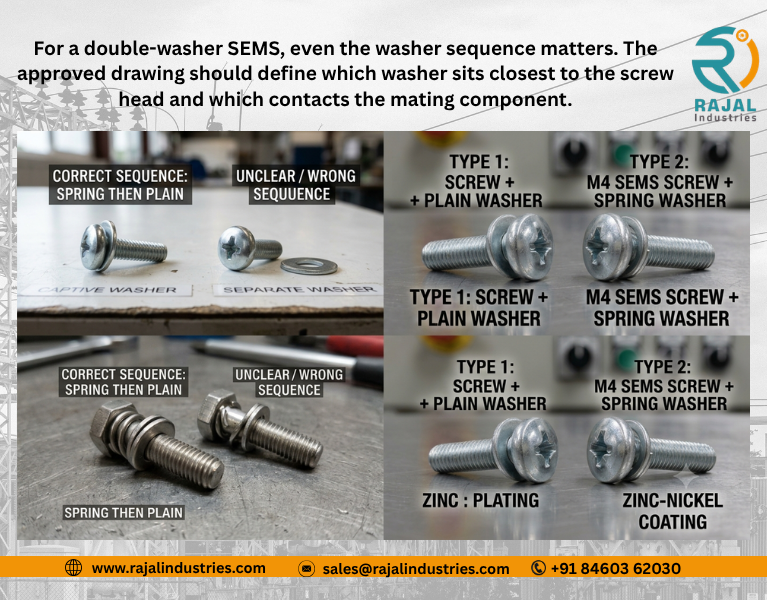
A SEMS screw is a pre-assembled fastener that combines a screw with one or more captive washers.
Instead of supplying the screw and washer separately, the washer remains retained on the screw so the complete assembly can be handled as one fastener.
SEMS screws are widely considered for repetitive OEM assembly in:
- Electrical Equipment
- Switchgear
- Control Panels
- Electronics
- Appliances
- HVAC Equipment
- Telecom Products
- Industrial Machinery
- Automotive Components
- Battery and Power Equipment
However, the term “SEMS screw” does not describe one single fastener design.
Different SEMS products can vary by:
- Screw thread
- Diameter
- Length
- Head style
- Drive
- Washer type
- Number of washers
- Washer dimensions
- Screw material
- Washer material
- Mechanical requirements
- Surface finish
For OEM buyers, the complete SEMS screw specifications should therefore be defined before comparing suppliers.
Quick Answer: What Types of SEMS Screws Are Available?
Common SEMS configurations can include:
- Screw + Plain Washer
- Screw + Spring Washer
- Screw + Plain Washer + Spring Washer
- Screw + Toothed Washer
- Screw + Conical Washer
- Screw + Customer-Specified Captive Washer
- Custom Multi-Washer Assemblies
The screw itself may also vary by:
- Thread size
- Thread pitch
- Length
- Head
- Drive
- Material
- Surface finish
The correct combination depends on the actual joint and OEM drawing.
What Is a SEMS Screw?
A SEMS screw is a screw supplied with one or more washers permanently retained on the fastener for normal handling and installation.
The washer is captive but may still have controlled movement depending on the design.
A typical assembly may look like:
Machine Screw + Plain Washer
or:
Machine Screw + Spring Washer + Plain Washer
The main advantage is that the production line handles one assembled fastener rather than separate screw and washer components.
What Does “Captive Washer” Mean?
A captive washer remains retained on the screw and does not normally fall off during:
- Handling
- Inspection
- Packaging
- Transportation
- Feeding
- Installation
Depending on the design, the washer may still:
- Rotate
- Slide within a controlled range
- Seat against the mating component
The washer should remain captive while still performing its intended function.
Why SEMS Screw Specifications Matter
Two suppliers may both quote an “M4 SEMS screw” while offering technically different products.
Supplier A may quote:
M4 Screw + Plain Washer
Supplier B may quote:
M4 Screw + Spring Washer + Plain Washer
They could also differ in:
- Pitch
- Screw length
- Head
- Drive
- Washer OD
- Washer thickness
- Material
- Finish
Therefore, OEM buyers should compare suppliers against the same approved drawing or specification.
Main SEMS Screw Types
SEMS screws can first be grouped by washer configuration.
The most common categories include:
- Single Plain Washer SEMS
- Single Spring Washer SEMS
- Plain + Spring Washer SEMS
- Toothed Washer SEMS
- Conical Washer SEMS
- Customer-Specified Captive Washer SEMS
Each design serves a different joint requirement.
Type 1 – Screw with Captive Plain Washer
This configuration contains:
Screw + Plain Washer
It is one of the simpler SEMS arrangements.
Potential functions of the plain washer include:
- Increasing bearing area
- Distributing load
- Protecting the mating surface
- Supporting the joint interface
Potential applications include:
- Electrical Equipment
- Control Panels
- Industrial Machinery
- Appliances
- Telecom Equipment
- Electronic Enclosures
The washer dimensions should match the screw and actual joint.
Type 2 – Screw with Captive Spring Washer
This configuration contains:
Screw + Spring Washer
Potential applications depend on the OEM joint design.
Important parameters can include:
- Spring washer size
- Washer thickness
- Washer material
- Washer hardness
- Screw size
- Head geometry
- Surface finish
A spring washer should not automatically be assumed to prevent loosening in every application.
The complete joint design should determine the locking method.
Type 3 – Screw with Plain Washer + Spring Washer
This is a common multi-component SEMS configuration:
Screw + Spring Washer + Plain Washer
The two washers remain captive on the screw.
Potential advantages include:
- Correct washer combination supplied together
- Reduced loose-component handling
- Reduced risk of missing a washer
- Faster repetitive assembly
- Easier line-side kitting
The exact washer sequence should be shown on the approved drawing.
Why Washer Sequence Matters
In a two-washer SEMS assembly, the order of the washers can affect the joint.
For example:
Screw Head → Spring Washer → Plain Washer → Mating Component
may behave differently from another sequence.
The drawing should define:
- Washer closest to the head
- Washer closest to the mating component
- Washer orientation
- Required movement
- Dimensions
Do not allow the washer sequence to depend only on supplier preference.
Type 4 – SEMS Screw with Toothed Washer
Some OEM applications may use a captive toothed washer.
Depending on the design, toothed washers may be selected where the joint requires a particular contact or locking function.
Important factors include:
- Internal or external teeth
- Washer diameter
- Tooth geometry
- Material
- Hardness
- Surface finish
- Mating surface
The actual function should be validated in the complete joint.
Type 5 – SEMS Screw with Conical or Special Washer
Certain OEM products may require:
- Conical Washers
- Belleville-Type Washers
- Special Spring Washers
- Customer-Specific Washers
These are more application-specific than ordinary plain-washer SEMS fasteners.
The buyer should provide:
- Washer drawing
- Material
- Thickness
- Hardness
- Geometry
- Required function
Manufacturing feasibility should be reviewed before production.
Type 6 – Custom SEMS Screw Assemblies
OEMs can also require custom combinations such as:
- Custom Screw + Custom Washer
- Special Head + Standard Washer
- Standard Screw + Special Washer
- Multiple Washer Combinations
- Drawing-Specific Captive Assemblies
This is particularly relevant for:
- Automotive Components
- Electrical Equipment
- Electronics
- Industrial Machinery
- Appliance Manufacturing
For custom parts, the complete assembly should be controlled by an approved drawing.
Common SEMS Screw Sizes
SEMS fasteners can be manufactured in multiple metric sizes depending on the design and supplier capability.
Common metric thread sizes can include:
| Thread Size | Typical OEM Use |
| M2 | Small electronics |
| M2.5 | Electronics / precision assemblies |
| M3 | Electronics, electrical equipment |
| M4 | Panels, appliances, industrial equipment |
| M5 | Machinery and equipment |
| M6 | Industrial assemblies |
| M8 | Larger application-specific assemblies |
These are general application examples.
The exact size should follow the joint design.
SEMS Screw Length
The required screw length depends on:
- Component thickness
- Washer stack
- Required thread engagement
- Mating thread depth
- Clearance behind the joint
- Customer drawing
The washer thickness should also be considered when evaluating the assembled fastener.
A screw that is too short can create insufficient engagement.
A screw that is too long may create unnecessary protrusion or interfere with internal components.
Thread Types Used in SEMS Screws
SEMS screws may use standard or customer-specified threads.
Important thread parameters include:
- Nominal diameter
- Thread pitch
- Major diameter
- Pitch diameter
- Minor diameter
- Thread tolerance
- Thread length
For metric machine screw applications, both coarse and application-specific fine pitches may be possible depending on the drawing.
Why Thread Tolerance Matters
Electrical, electronics and machinery OEMs may require reliable assembly into:
- Tapped Holes
- Weld Nuts
- Clinch Nuts
- Threaded Inserts
- Nuts
- Cast Components
Thread variation can cause:
- Tight assembly
- Cross-threading
- Loose fit
- Installation problems
- Production rejection
For bulk OEM supply, thread gauges should be used according to the specified thread requirement.
Common Head Types for SEMS Screws
Different applications require different screw heads.
Common options can include:
- Pan Head
- Hex Head
- Hex Washer Head
- Truss Head
- Countersunk Head
- Combination Head
- Customer-Specified Head
Head selection should consider:
- Tool access
- Bearing area
- Installation torque
- Available space
- Appearance
- Washer outside diameter
Pan Head SEMS Screws
Pan head designs are common in many electrical and electronics applications.
Potential uses include:
- Control Panels
- Electrical Enclosures
- Electronic Equipment
- Appliances
- Telecom Equipment
The rounded head provides a relatively broad bearing area and is compatible with several drive styles.
Hex Head SEMS Screws
Hex head SEMS screws can be useful where:
- External wrench engagement is preferred
- Higher installation torque is required
- Tool access permits an external hex
Applications can include:
- Industrial Machinery
- Equipment Assemblies
- Electrical Equipment
- Automotive Components
The head and washer dimensions should be evaluated together.
Hex Washer Head SEMS Screws
Hex washer head designs combine an external hex drive with an integral flange-like bearing surface.
A captive washer may also be incorporated where required by the application.
Potential uses include:
- Industrial Equipment
- Electrical Assemblies
- Appliance Components
- Machinery
The exact geometry should follow the customer drawing.
Countersunk SEMS Screws
Countersunk heads may be used where a flush or low-profile installation is required.
The joint should account for:
- Countersink angle
- Head diameter
- Washer arrangement
- Mating component geometry
Not every washer configuration is suitable with every countersunk design.
Common Drive Types
SEMS fasteners may use:
- Phillips
- Pozidriv
- Torx
- Slotted
- Combination Drive
- Hex
- Hex Socket
- Customer-Specified Drives
For high-volume assembly, drive selection affects:
- Bit engagement
- Torque transfer
- Cam-out
- Tool life
- Assembly speed
- Automation compatibility
Phillips Drive SEMS Screws
Phillips drive is widely used for many general electrical and industrial assemblies.
Advantages can include:
- Common tooling
- Easy bit availability
- Familiar assembly process
Drive-recess consistency remains important for high-volume production.
Torx SEMS Screws
Torx-type drives can provide strong tool engagement.
Potential benefits include:
- Good torque transfer
- Reduced cam-out
- Reliable powered installation
- Suitability for repetitive assembly
This can be useful for appliance, machinery and other OEM production.
Combination Drive SEMS Screws
Combination heads may provide more than one driving option.
Depending on the design, this can offer flexibility during:
- Factory assembly
- Field servicing
- Maintenance
The drive combination should be defined clearly in the drawing.
Screw Materials for SEMS Fasteners
Common screw materials may include:
Carbon Steel
Widely used for:
- Electrical Equipment
- Appliances
- Machinery
- General OEM Assemblies
Advantages can include:
- Good cold-forming capability
- Heat-treatment options
- Broad coating compatibility
- Economical bulk production
Stainless Steel
May be considered where higher corrosion resistance is required.
Potential applications include:
- Outdoor Equipment
- Humid Environments
- Specialized Electrical Equipment
- Food-Related Equipment
- Corrosion-Sensitive Assemblies
The grade should match both mechanical and environmental requirements.
Washer Materials
The washer does not always need to use exactly the same material as the screw.
Depending on the application, washer material may be specified separately.
Potential options can include:
- Carbon Steel
- Spring Steel
- Stainless Steel
- Customer-Specified Material
Important properties can include:
- Hardness
- Elastic behaviour
- Corrosion resistance
- Electrical contact requirements
- Wear resistance
The drawing should define the screw and washer materials separately where required.
Material Compatibility
Because a SEMS assembly combines multiple components, buyers should consider material compatibility.
Important factors can include:
- Screw material
- Washer material
- Mating material
- Surface coatings
- Corrosion environment
For demanding environments, material combinations should be reviewed for corrosion and functional performance.
Heat Treatment of SEMS Screws
Depending on material and required mechanical properties, screws may require controlled heat treatment.
Heat treatment can influence:
- Strength
- Hardness
- Torsional performance
- Thread durability
The required mechanical properties should come from the drawing or applicable specification.
Higher hardness is not automatically better.
The correct balance of strength and toughness is more important.
Spring Washer Heat Treatment
Spring washers can have their own material and heat-treatment requirements.
Important characteristics can include:
- Hardness
- Spring behaviour
- Shape
- Dimensional recovery
If a SEMS design contains a spring washer, buyers should define both screw and washer requirements rather than inspecting only the screw.
Surface Finishes for SEMS Screws
Possible finishes may include:
- Zinc Plating
- Zinc-Nickel
- Black Finish
- Passivation
- Other Customer-Specified Coatings
The correct finish depends on:
- Indoor or outdoor application
- Humidity
- Corrosion requirement
- Electrical function
- Appearance
- Customer specification
The complete assembled fastener should be considered when defining the finish.
Zinc-Plated SEMS Screws
Zinc plating is common for many industrial screws.
Potential applications include:
- Electrical Panels
- Appliances
- Indoor Machinery
- Control Equipment
- General OEM Assemblies
The buyer should specify:
- Coating type
- Thickness, where controlled
- Passivation
- Corrosion requirement
rather than simply requesting a “silver finish.”
Zinc-Nickel SEMS Screws
Zinc-nickel may be considered for applications requiring stronger corrosion protection.
Potential uses include:
- Automotive Components
- Outdoor Equipment
- High-Humidity Equipment
- Energy Systems
- Industrial Assemblies
The required coating and test performance should be defined by the customer.
Stainless Steel SEMS Screws
Stainless steel SEMS assemblies may be considered for:
- Corrosive Environments
- Outdoor Equipment
- Certain Food Equipment
- Moisture-Prone Applications
- Specialized Industrial Equipment
The washer material and compatibility should also be considered.
Why Coating Thickness Matters on SEMS Screws
Surface coatings can affect more than corrosion resistance.
Excessive coating thickness may influence:
- Thread fit
- Washer movement
- Drive dimensions
- Assembly
- Appearance
This is especially relevant for smaller SEMS screws with limited dimensional clearance.
SEMS Screw Mechanical Specifications
Depending on the application, an OEM specification can include:
- Tensile-related requirements
- Hardness
- Torsional strength
- Installation torque
- Proof or application-specific testing
- Washer retention
- Washer movement
- Thread fit
Not every application requires every test.
The quality plan should follow the approved drawing and product requirements.
Washer Retention Specification
Washer retention is one of the defining characteristics of a SEMS assembly.
The washer should remain retained during expected:
- Handling
- Inspection
- Packaging
- Transportation
- Feeding
- Installation
For an OEM project, retention can be evaluated through agreed inspection or functional checks.
Washer Freedom of Movement
The washer should not merely stay on the screw.
Where the design requires free movement, buyers should verify that it can move correctly.
Potential problems include:
- Washer jammed against thread
- Coating buildup
- Burrs
- Washer deformation
- Incorrect hole size
The required movement should be defined on the drawing where important.
Why Washer Dimensions Matter
Important washer dimensions can include:
- Outside diameter
- Inside diameter
- Thickness
- Flatness
- Tooth geometry, if applicable
- Spring profile, if applicable
These affect:
- Bearing area
- Retention
- Washer movement
- Joint behaviour
- Assembly clearance
For OEM procurement, washer dimensions should not be treated as secondary information.
SEMS Screw Specification Checklist
A complete SEMS screw specification should identify:
- Thread diameter
- Thread pitch
- Thread tolerance
- Screw length
- Thread length
- Head style
- Head dimensions
- Drive type
- Drive size
- Washer type
- Number of washers
- Washer sequence
- Washer OD
- Washer ID
- Washer thickness
- Screw material
- Washer material
- Heat treatment
- Hardness
- Mechanical requirements
- Surface finish
- Coating thickness
- Corrosion requirement
- Washer retention requirement
- Washer movement requirement
- Application
- Mating thread
- Required tests
- Packaging
- Production quantity
This allows different suppliers to quote and manufacture against the same requirement.
How to Select the Correct SEMS Screw Type
Step 1 – Define the Joint
Identify:
- Components being fastened
- Joint thickness
- Mating thread
- Required clamping
Step 2 – Determine Why a Washer Is Needed
Is the washer required for:
- Bearing area?
- Surface protection?
- Drawing-specific locking?
- Electrical contact?
- Another engineering function?
This determines the washer type.
Step 3 – Select Single or Multiple Washers
Choose:
- Plain Washer
- Spring Washer
- Plain + Spring Washer
- Special Washer
according to the actual joint requirement.
Step 4 – Select Screw Thread & Length
Confirm:
- Diameter
- Pitch
- Length
- Thread tolerance
- Engagement
Step 5 – Select Head & Drive
Match the head and drive to:
- Tooling
- Assembly space
- Torque
- Automation
- Service requirements
Step 6 – Define Materials
Specify screw and washer materials separately where required.
Step 7 – Select the Surface Finish
Match the coating to:
- Environment
- Corrosion requirement
- Thread fit
- Appearance
- OEM specification
Step 8 – Define Quality Requirements
Specify:
- Dimensional inspection
- Thread inspection
- Washer retention
- Mechanical tests
- Coating tests
- Application testing
Example of a Strong OEM SEMS Screw RFQ
Instead of:
Need M4 SEMS screw, please quote.
Use:
Requirement: M4 × 0.7 SEMS screws for electrical panel assembly, pan head, cross recess, captive spring washer + plain washer, carbon steel, zinc plated. Please quote against our drawing and confirm washer dimensions, retention method, mechanical properties, coating capability, available testing, MOQ and monthly production capacity. Estimated annual demand: 1.5 million pcs.
This makes the technical requirement much clearer to the supplier.
What Should Be Tested Before Bulk Approval?
Depending on the application, buyers should check:
- Thread diameter
- Thread pitch
- Thread fit
- Screw length
- Head dimensions
- Drive recess
- Washer OD
- Washer ID
- Washer thickness
- Washer sequence
- Washer retention
- Washer movement
- Screw material
- Washer material
- Hardness
- Surface finish
- Coating thickness
- Mechanical performance
- Installation performance
- Visual quality
- Batch traceability
For high-volume applications, samples should also be tested in the actual OEM assembly.
Why Rajal Industries for SEMS Screw Requirements?
Rajal Industries can evaluate standard and drawing-based industrial screws and SEMS fastener requirements for bulk OEM production.
Subject to technical feasibility and customer approval, requirements can be evaluated for:
- SEMS Screws
- Washer Screws
- Captive Washer Screws
- Single-Washer SEMS
- Double-Washer SEMS
- Plain Washer Assemblies
- Spring Washer Assemblies
- Custom Washer Configurations
- Machine Screw + Washer Assemblies
- Different Head Styles
- Different Drive Types
- Metric Threads
- Carbon Steel
- Stainless Steel
- Surface Finishing
- Drawing-Based Manufacturing
- Dimensional Inspection
- Washer Retention Inspection
- Mechanical Testing as Specified
- Application Testing
- Batch Traceability
- OEM Packaging
- Scheduled Bulk Supply
Potential customers include:
- Electrical Equipment OEMs
- Switchgear Manufacturers
- Control Panel Manufacturers
- Electronics OEMs
- Appliance Manufacturers
- HVAC Companies
- Telecom Equipment Manufacturers
- Battery / BESS Manufacturers
- Industrial Machinery OEMs
- Automotive Component Manufacturers
- Contract Manufacturers
Final capability should always be confirmed against the buyer’s drawing, washer combination, material, finish, testing requirement and production quantity.
Bulk Buyer Quick Answer
What information should I include in a SEMS screw specification?
At minimum, provide:
Thread + Length + Head + Drive + Washer Type + Washer Dimensions + Screw Material + Washer Material + Finish
For an OEM requirement, also include:
- Drawing
- Washer sequence
- Mechanical properties
- Coating requirement
- Mating thread
- Installation torque
- Washer retention requirement
- Required tests
- Monthly and annual volume
This allows the supplier to evaluate the complete fastener assembly.
SEMS Screw Manufacturing & Washer Retention
One of the most important technical features of a SEMS screw is washer retention.
The washer must remain captive during normal:
- Manufacturing
- Inspection
- Packing
- Transportation
- Feeding
- Handling
- Installation
At the same time, the washer may need controlled rotational or axial movement depending on the fastener design.
This means a SEMS fastener must be engineered as a complete assembly rather than as a normal screw with a washer added afterward.
How Is the Washer Retained on a SEMS Screw?
A common manufacturing method is:
Cold Heading → Washer Assembly → Thread Rolling → Heat Treatment / Finishing as Required → Inspection
The washer can be placed over the screw blank before the final thread is rolled.
After thread rolling, the formed thread outside diameter is larger than the washer opening in the required area, helping retain the washer on the screw.
The exact manufacturing sequence depends on:
- Screw geometry
- Thread
- Washer type
- Washer dimensions
- Material
- Surface finish
- Customer specification
For custom washer screws, retention should be confirmed during sample development.
Why Thread Rolling Is Important
Thread rolling forms threads by displacing material rather than cutting it away.
For SEMS fasteners, the relationship between the screw blank, washer hole and finished thread is especially important.
Manufacturing controls can include:
- Blank diameter
- Major diameter
- Pitch diameter
- Thread pitch
- Thread profile
- Thread length
- Washer ID
- Washer movement
- Washer retention
Variation in these features can affect both thread performance and washer retention.
Important SEMS Screw Manufacturing Tolerances
For OEM production, buyers should control more than overall diameter and length.
| Parameter | Why It Matters |
| Thread Diameter | Mating-thread compatibility |
| Thread Pitch | Correct assembly |
| Pitch Diameter | Thread fit |
| Screw Length | Joint engagement |
| Head Diameter | Bearing and clearance |
| Head Height | Assembly clearance |
| Drive Recess | Tool engagement |
| Washer OD | Bearing area / clearance |
| Washer ID | Retention and movement |
| Washer Thickness | Joint stack / function |
| Washer Flatness | Seating |
| Washer Sequence | Joint function |
| Washer Retention | Captive function |
| Washer Movement | Functional operation |
| Coating Thickness | Thread fit and movement |
The final tolerances should follow the customer’s drawing and applicable specification.
Plain vs Spring vs Toothed Washer SEMS Screws
Different washer types perform different functions.
| Washer Type | Main Consideration | Typical OEM Area |
| Plain Washer | Bearing area / surface protection | Electrical, appliance, machinery |
| Spring Washer | Drawing-specific spring/locking function | Equipment assemblies |
| Plain + Spring | Combined washer arrangement | Electrical and industrial OEMs |
| Toothed Washer | Contact / application-specific locking | Electrical and equipment assemblies |
| Conical Washer | Application-specific spring function | Specialized equipment |
| Custom Washer | Customer-defined function | OEM products |
The correct washer should be selected from the joint requirement rather than simply using the most common SEMS configuration.
Plain Washer SEMS Screw vs Spring Washer SEMS Screw
Plain Washer SEMS Screw
A captive plain washer can help provide:
- Larger bearing area
- Load distribution
- Surface protection
- Repeatable assembly
It can be useful where a normal screw-and-plain-washer combination is already specified.
Spring Washer SEMS Screw
A captive spring washer provides a different joint function.
Selection should consider:
- Joint design
- Preload
- Washer material
- Washer hardness
- Vibration conditions
- Installation torque
A spring washer should not automatically be described as a guaranteed anti-loosening solution.
The OEM should validate the complete joint.
When Should You Use a Double-Washer SEMS Screw?
A double-washer SEMS configuration may be useful where the approved joint requires two washers.
A common example is:
Screw + Spring Washer + Plain Washer
Potential advantages include:
- Both washers supplied with the screw
- Correct washer combination
- Fewer loose components
- Reduced washer omission risk
- Easier production-line handling
However, adding more washers does not automatically improve fastening performance.
Use the combination required by the engineering design.
SEMS Screw vs Screw with Loose Washer
This is one of the most important comparisons for OEM buyers.
| Feature | SEMS Screw | Screw + Loose Washer |
| Washer | Captive | Separate |
| Parts Handled at Assembly | One assembly | Multiple components |
| Missing Washer Risk | Reduced | Higher if manually handled |
| Kitting | Simplified | Separate items |
| Line-Side Inventory | Can be simpler | More components |
| Assembly Time | Can be reduced | Additional handling |
| Automated Feeding | Potential advantage | Separate feeding may be required |
| Fastener Unit Cost | Usually higher | Usually lower |
| Total Assembly Cost | Can be lower | Process dependent |
The best commercial decision should consider the complete production process.
Example: Why SEMS Screws Can Matter at OEM Scale
Consider an electrical equipment manufacturer using:
3 SEMS fastening points per product
Annual production:
500,000 products
Total fastening operations:
1,500,000 per year
With loose washers, the production system must separately handle up to:
1,500,000 screws + 1,500,000 washers
With SEMS:
1,500,000 pre-assembled fasteners
The washer still exists physically, but separate washer handling is reduced.
At high volumes, this can affect:
- Assembly labour
- Kitting
- Inventory
- Component feeding
- Error prevention
- Line productivity
OEM buyers should calculate these savings against the additional SEMS fastener cost.
When Is a SEMS Screw the Better Choice?
Consider SEMS fasteners when:
- Every fastening point requires a washer
- Annual volume is high
- Assembly is repetitive
- Washer omission is a concern
- Manual washer handling takes time
- Automated assembly is planned
- Line-side inventory needs simplification
- The screw-and-washer combination is stable
A conventional screw and loose washer may still be practical when volumes are low or the washer configuration changes frequently.
SEMS Screws for Electrical Equipment
Electrical equipment is one of the strongest applications for industrial screws with captive washers.
Potential applications include:
- Electrical Enclosures
- Distribution Equipment
- Switchgear
- Control Panels
- Internal Brackets
- Equipment Covers
- Electrical Components
Important selection factors include:
- Thread
- Screw length
- Washer configuration
- Head
- Drive
- Surface finish
- Torque
- Corrosion requirement
Where grounding or electrical contact is involved, the complete joint should be reviewed and validated by the OEM.
SEMS Screws for Switchgear & Control Panels
Switchgear and control-panel manufacturers often perform large numbers of repetitive fastening operations.
SEMS fasteners may help simplify assembly of:
- Covers
- Brackets
- Mounting Components
- Electrical Devices
- Internal Assemblies
- Cabinet Components
For these buyers, important quality points include:
Thread Fit + Washer Retention + Drive Quality + Finish + Batch Consistency
SEMS Screws for Electronics
Electronics OEMs may require smaller SEMS fasteners with tight dimensional control.
Potential applications include:
- Electronic Enclosures
- Power Supplies
- Industrial Electronics
- Control Units
- Communication Equipment
- Electronic Cabinets
Important factors include:
- Small thread sizes
- Head dimensions
- Drive-recess accuracy
- Washer OD
- Washer thickness
- Coating
- Assembly torque
- Automated feeding
For automated electronics production, small dimensional variation can affect feeding and installation.
SEMS Screws for Appliances
Appliance manufacturers may consume millions of fasteners every year.
Applications can include:
- Washing Machines
- Refrigerators
- Air Conditioners
- Water Heaters
- Kitchen Appliances
- Commercial Appliances
Important procurement factors can include:
- Fast installation
- Consistent thread
- Washer retention
- Drive engagement
- Surface finish
- Corrosion performance
- High production capacity
- Reliable scheduled supply
This makes appliances a strong bulk market for SEMS fasteners.
SEMS Screws for HVAC Equipment
HVAC equipment contains:
- Sheet Metal Components
- Electrical Controls
- Covers
- Brackets
- Internal Assemblies
- Equipment Panels
Where the joint requires a separate washer, a captive SEMS arrangement may reduce component handling.
The final fastener should match:
Joint + Thread + Washer Function + Environment + Assembly Process
SEMS Screws for Telecom Equipment
Possible applications include:
- Telecom Cabinets
- Communication Equipment
- Electronic Racks
- Power Equipment
- Control Systems
- Equipment Housings
Buyers should consider:
- Available installation space
- Head size
- Washer OD
- Tool access
- Coating
- Corrosion environment
- Electrical requirements
SEMS Screws for Battery, BESS, UPS & Inverter Equipment
Power and energy equipment can contain many repetitive fastening points.
Potential applications include:
- BESS Cabinets
- Battery Enclosures
- UPS Systems
- Inverters
- Power Electronics
- Electrical Cabinets
- Control Equipment
SEMS fasteners may be useful where the design already requires a screw-and-washer combination.
Electrical and mechanical suitability should be validated against the OEM specification.
SEMS Screws for Industrial Machinery
Industrial machinery manufacturers may use SEMS screws for:
- Machine Covers
- Control Cabinets
- Mounting Brackets
- Electrical Components
- Equipment Panels
- Internal Assemblies
Important buyer considerations include:
- Thread engagement
- Installation torque
- Washer function
- Service conditions
- Corrosion requirement
- Repeated assembly, where applicable
SEMS Screws for Automotive Components
Automotive applications can require stronger process and documentation controls.
Depending on the customer, requirements may include:
- Approved Drawing
- Material Certificate
- Dimensional Inspection Report
- Mechanical Test Report
- Coating Verification
- Corrosion Testing
- Lot Traceability
- PPAP Documentation
- Process Controls
- Customer-Specific Packaging
The supplier should confirm these requirements before quotation.
How to Select SEMS Screws by Application
| Application | Main Selection Factors |
| Electrical Panels | Thread, washer, finish |
| Switchgear | Washer retention, drive, consistency |
| Electronics | Small dimensions, drive, automation |
| Appliances | Cost, speed, coating, volume |
| HVAC | Environment, washer function |
| Telecom | Clearance, finish, electrical requirements |
| BESS / UPS | Electrical + mechanical specification |
| Machinery | Torque, strength, service conditions |
| Automotive | Drawing, testing, traceability |
This table is a starting point only. The approved OEM drawing should control final selection.
SEMS Screws for Automated Assembly
SEMS fasteners can be attractive for automated production because the washer does not require a separate feeding operation.
However, a SEMS screw is not automatically suitable for every automatic feeder.
Check:
- Head geometry
- Washer outside diameter
- Washer movement
- Overall length
- Drive
- Screw orientation
- Feeder design
- Driver system
- Installation torque
Before mass production, test:
SEMS Screw + Feeder + Driver + Actual OEM Component
This can identify feeding or installation problems before a large order.
Common SEMS Screw Problems & Solutions
1. Washer Falls Off the Screw
Possible causes:
- Washer ID too large
- Thread major diameter incorrect
- Poor retention design
- Manufacturing variation
- Incorrect process sequence
Check:
Washer ID → Blank Diameter → Finished Thread → Retention
This should be treated as a major functional issue.
2. Washer Is Jammed
Possible causes:
- Washer ID too small
- Excessive coating
- Burrs
- Washer deformation
- Incorrect thread geometry
Check whether the washer is required to move freely according to the drawing.
3. Washer Sequence Is Wrong
This can occur in multi-washer SEMS screws.
Possible causes:
- Incorrect assembly process
- Mixed components
- Poor work instructions
- Inadequate inspection
The approved drawing should clearly define washer order.
4. Thread Does Not Fit
Possible causes:
- Wrong pitch
- Pitch diameter variation
- Thread damage
- Coating buildup
- Incorrect tolerance
Check using the specified thread gauges and mating component.
5. Screw Breaks During Installation
Possible causes:
- Excessive torque
- Material issue
- Heat-treatment problem
- Incorrect fastener
- Joint misalignment
Investigate both the fastener and installation process.
6. Driver Bit Slips
Possible causes:
- Wrong bit
- Poor recess geometry
- Worn tooling
- Excessive torque
- Misalignment
Drive consistency becomes especially important in automated assembly.
7. Washer Deforms
Possible causes:
- Incorrect thickness
- Incorrect material
- Excessive load
- Wrong washer design
- Joint-design issue
Check the washer specification and actual installation load.
8. Corrosion Appears Early
Possible causes:
- Incorrect coating
- Insufficient coating performance
- Coating damage
- Poor storage
- Environmental exposure
Specify measurable coating and corrosion requirements where necessary.
SEMS Screw Troubleshooting Guide
| Problem | Possible Cause | First Check |
| Washer Falls Off | Retention problem | Washer ID + thread |
| Washer Jammed | Clearance / coating | Washer movement |
| Wrong Washer Order | Process control | Drawing |
| Thread Too Tight | Tolerance / coating | Thread gauge |
| Screw Breakage | Torque / material | Mechanical test |
| Bit Slipping | Recess / bit | Drive fit |
| Washer Deformation | Washer design | Material + thickness |
| Feeding Problem | Geometry | Feeder trial |
| Early Corrosion | Coating | Finish specification |
Common Engineering Mistakes with SEMS Screws
Mistake 1: Specifying Only the Screw
The washer is part of the fastener.
A complete specification must include both.
Mistake 2: Ignoring Washer ID
Washer ID affects:
- Assembly
- Retention
- Movement
It is a critical dimension for a SEMS fastener.
Mistake 3: Assuming Every Washer Has the Same Function
Plain, spring, toothed and conical washers serve different purposes.
Select the washer based on the joint.
Mistake 4: Assuming More Washers Are Better
Adding a spring washer or second washer does not automatically improve the joint.
Use only what the engineering design requires.
Mistake 5: Ignoring Coating Build-Up
Coating can affect:
- Thread fit
- Washer movement
- Drive dimensions
- Assembly performance
This becomes more important as fastener size decreases.
Mistake 6: Ignoring the Mating Thread
A technically correct SEMS screw still needs to work with the actual:
- Nut
- Tapped hole
- Insert
- Weld nut
- Clinch nut
Sample testing should use the real mating component where possible.
Mistake 7: Ignoring Automatic Feeding
A screw can meet dimensional requirements and still perform poorly in a feeder.
Automated assembly should be validated separately.
Common Procurement Mistakes
Comparing Only Piece Price
Do not compare:
SEMS Screw Price vs Standard Screw Price
alone.
A better comparison is:
SEMS Fastener Cost
versus
Standard Screw + Washer + Handling + Kitting + Assembly Labour + Error Cost
This gives a more realistic total assembly cost.
Comparing Different Washer Configurations
If Supplier A quotes:
M4 + Plain Washer
and Supplier B quotes:
M4 + Spring Washer + Plain Washer
their prices are not directly comparable.
Use one approved specification for all RFQs.
Not Sharing Annual Demand
For OEM sourcing, tell the manufacturer:
- Sample Quantity
- Trial Quantity
- First Order
- Monthly Consumption
- Annual Consumption
- Expected Project Life
- Delivery Schedule
Annual volume can affect:
- Tooling
- Automation
- Production planning
- Packaging
- Inventory strategy
- Pricing
SEMS Screw Quality Inspection Checklist
| Inspection Item | Requirement |
| Approved Drawing | Confirm |
| Thread Diameter | Inspect |
| Thread Pitch | Inspect |
| Thread Fit | GO / NO-GO as specified |
| Screw Length | Inspect |
| Thread Length | Inspect |
| Head Diameter | Inspect |
| Head Height | Inspect |
| Drive Recess | Inspect |
| Washer Type | Confirm |
| Number of Washers | Confirm |
| Washer Sequence | Confirm |
| Washer OD | Inspect |
| Washer ID | Inspect |
| Washer Thickness | Inspect |
| Washer Flatness | As specified |
| Washer Retention | Functional check |
| Washer Movement | Functional check |
| Screw Material | Verify |
| Washer Material | Verify |
| Heat Treatment | As specified |
| Hardness | As specified |
| Mechanical Properties | As specified |
| Surface Finish | Verify |
| Coating Thickness | As specified |
| Corrosion Test | As required |
| Torque Test | As required |
| Installation Test | As required |
| Visual Inspection | Check |
| Batch Traceability | Verify |
OEM SEMS Screw RFQ Checklist
Before asking a manufacturer for quotation, provide:
☐ Thread Diameter
☐ Thread Pitch
☐ Thread Tolerance
☐ Screw Length
☐ Thread Length
☐ Head Type
☐ Head Dimensions
☐ Drive Type
☐ Drive Size
☐ Washer Type
☐ Number of Washers
☐ Washer Sequence
☐ Washer OD
☐ Washer ID
☐ Washer Thickness
☐ Screw Material
☐ Washer Material
☐ Heat Treatment
☐ Hardness
☐ Mechanical Requirements
☐ Surface Finish
☐ Coating Thickness
☐ Corrosion Requirement
☐ Washer Retention Requirement
☐ Washer Movement Requirement
☐ Mating Component
☐ Installation Torque
☐ Drawing / Standard
☐ Required Tests
☐ Sample Quantity
☐ First Order Quantity
☐ Monthly Consumption
☐ Annual Consumption
☐ Packaging Requirement
☐ Delivery Schedule
Questions to Ask a SEMS Screw Supplier
Before approving a supplier, ask:
- Are you the actual manufacturer?
- Which SEMS screw sizes do you manufacture?
- Which washer combinations can you manufacture?
- Can you manufacture single and double-washer SEMS screws?
- Can you manufacture custom washer configurations?
- Can you manufacture according to our drawing?
- Which screw materials can you process?
- Which washer materials can you process?
- Which head types are available?
- Which drive types are available?
- How is washer retention controlled?
- How is washer movement inspected?
- How is washer sequence controlled?
- How are thread dimensions inspected?
- Which thread gauges are used?
- How is drive-recess geometry controlled?
- How is heat treatment controlled?
- Which surface finishes can you provide?
- Can coating thickness be controlled?
- Can corrosion testing be provided?
- Can mechanical testing be provided?
- Can you test the fastener in our mating component?
- Can you support automated assembly trials?
- Is batch traceability available?
- Can you provide dimensional reports?
- Can you support PPAP or customer-specific quality documents where agreed?
- What is the MOQ?
- What is monthly production capacity?
- Can you support scheduled OEM deliveries?
- Can you provide customer-specific packaging?
Why Rajal Industries for SEMS & Industrial Screws?
Rajal Industries can evaluate bulk and drawing-based SEMS screw requirements for industrial and OEM applications.
Subject to technical feasibility and customer approval, requirements can be evaluated for:
- SEMS Screws
- Captive Washer Screws
- Washer Screws
- Industrial Screws
- Plain Washer SEMS
- Spring Washer SEMS
- Double-Washer SEMS
- Custom Washer Configurations
- Machine Screw + Washer Assemblies
- Custom Head Styles
- Custom Drive Types
- Metric Threads
- Carbon Steel
- Stainless Steel
- Customer-Specified Materials
- Surface Finishing
- Dimensional Inspection
- Thread Inspection
- Washer Retention Inspection
- Mechanical Testing as Specified
- Application Testing
- Batch Traceability
- OEM Packaging
- Scheduled Bulk Supply
Potential OEM customers include:
- Electrical Equipment Manufacturers
- Switchgear Manufacturers
- Control Panel Manufacturers
- Electronics OEMs
- Appliance Manufacturers
- HVAC Manufacturers
- Telecom Equipment Manufacturers
- Battery & BESS Manufacturers
- UPS & Inverter Manufacturers
- Industrial Machinery OEMs
- Automotive Component Manufacturers
- Contract Manufacturers
Final capability should be confirmed against the buyer’s drawing, materials, washer configuration, testing requirements and expected production quantity.
Bulk Buyer Quick Answer
What information should I send when sourcing SEMS screws?
Send:
Thread Size + Pitch + Length + Head + Drive + Washer Type + Washer Dimensions + Materials + Finish + Quantity
For an OEM project, also provide:
- Technical drawing
- Washer sequence
- Mating component
- Mechanical properties
- Installation torque
- Coating requirement
- Retention requirement
- Required testing
- Monthly demand
- Annual demand
- Packaging
This allows the supplier to evaluate the complete SEMS screw specifications.
Frequently Asked Questions About SEMS Screws
What is a SEMS screw?
A SEMS screw is a pre-assembled fastener consisting of a screw and one or more captive washers.
What types of SEMS screws are available?
Common types include screws with captive plain washers, spring washers, plain + spring washer combinations, toothed washers and customer-specific washers.
What is the difference between a SEMS screw and a normal screw?
A normal screw is supplied without a captive washer. A SEMS screw has one or more washers retained on the fastener.
Can a SEMS screw have two washers?
Yes. A SEMS screw can use two captive washers when required by the joint design, such as a spring washer plus plain washer.
How is a washer retained on a SEMS screw?
A common manufacturing approach places the washer onto the screw before final thread rolling. The formed thread then helps retain the washer.
Can the washer rotate on a SEMS screw?
Depending on the design, the washer may have controlled rotational or axial movement while remaining captive.
What are common SEMS screw sizes?
Metric sizes such as M2, M2.5, M3, M4, M5 and M6 can be used in OEM applications, with larger or custom sizes depending on manufacturing capability and design.
What materials are used for SEMS screws?
Carbon steel and stainless steel are common options. Other materials can be considered according to the customer specification.
Are the screw and washer always made from the same material?
No. The screw and washer can have different material requirements depending on the joint and washer function.
Which washer is best for a SEMS screw?
There is no universal best washer. The correct washer depends on bearing, surface, locking, electrical and other joint requirements.
What is a double-washer SEMS screw?
It is a screw supplied with two captive washers. A common configuration is a spring washer combined with a plain washer.
What surface finishes are available for SEMS screws?
Possible options include zinc plating, zinc-nickel and other customer-specified finishes depending on the material and application.
Why does coating thickness matter?
Excessive coating can affect thread fit, washer movement and dimensional clearance, particularly on smaller fasteners.
Are SEMS screws suitable for electrical panels?
Yes, suitable SEMS screws can be used in electrical-panel and switchgear assemblies when specified by the equipment design.
Are SEMS screws used in electronics?
Yes. Small SEMS fasteners can be used in suitable electronics and equipment assemblies where captive washers simplify production.
Can SEMS screws be used in automated assembly?
Yes, but the fastener should be tested with the actual feeder, driver and production component before approval.
What should be checked on a SEMS screw?
Important checks include thread dimensions, screw length, head and drive, washer dimensions, washer sequence, retention, movement, materials, coating and mechanical requirements.
How do I specify a SEMS screw for an RFQ?
Provide the thread, pitch, length, head, drive, washer configuration, washer dimensions, materials, finish, drawing, testing requirements and expected volume.
What should I send to a SEMS screw manufacturer?
For the best technical review, send the drawing, application, mating component, annual quantity, washer arrangement, materials, finish and required quality documentation.
Key Takeaways
- A SEMS screw combines a screw and one or more captive washers.
- SEMS screws are available with plain, spring, toothed and custom washer configurations.
- Single and double-washer SEMS designs serve different joint requirements.
- Washer ID, OD and thickness are important technical dimensions.
- Washer retention is one of the main functional requirements.
- The washer may still require controlled movement while remaining captive.
- Screw and washer materials should be specified separately where necessary.
- Coating thickness can affect thread fit and washer movement.
- SEMS screws can simplify repetitive OEM assembly.
- Electrical, electronics, appliances, machinery, telecom and energy equipment are important application areas.
- Automated assembly should be tested with the actual feeder and driver.
- Buyers should compare complete specifications rather than generic SEMS screw descriptions.
Conclusion
A SEMS screw should be specified as a complete fastener assembly, not simply by screw diameter and length.
OEM buyers should define:
Thread + Length + Head + Drive + Washer Type + Washer Dimensions + Washer Sequence + Materials + Mechanical Properties + Surface Finish
The correct washer combination depends on the actual joint. A plain washer, spring washer, toothed washer or double-washer arrangement should only be selected when it serves the required engineering function.
For high-volume OEM applications, buyers should also evaluate:
Washer Retention + Thread Fit + Drive Quality + Coating + Installation Performance + Batch Consistency
Rajal Industries can evaluate standard and custom SEMS screws, washer screws and other industrial screws for bulk OEM requirements based on customer drawings, specifications and expected annual quantities.