

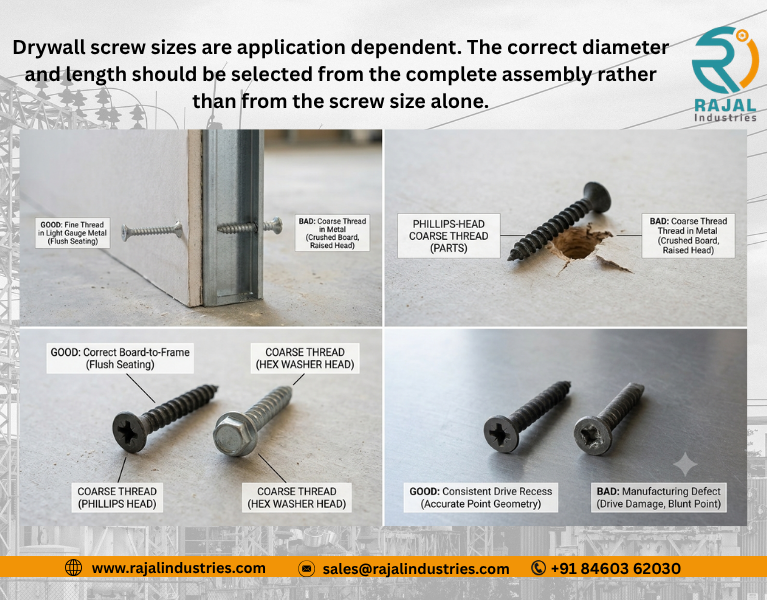
Drywall screw applications cover gypsum board installation, partition walls, ceiling systems, interior construction and many other building applications where gypsum panels need to be fixed to suitable supporting frames.
Drywall screws may be used with:
- Gypsum Board
- Drywall Panels
- Metal Stud Framing
- Wood Framing
- Ceiling Channels
- Interior Partition Systems
- Prefabricated Interior Systems
However, one drywall screw specification should not automatically be used across every application.
The correct screw depends on the:
- Board type
- Board thickness
- Number of board layers
- Supporting frame material
- Frame thickness
- Screw diameter
- Screw length
- Fine or coarse thread
- Point design
- Head geometry
- Drive type
- Surface finish
- Installation method
For large construction projects, a small fastener problem can be repeated across hundreds of thousands of installation points.
This guide explains the major drywall screw applications and what contractors, OEMs and procurement teams should consider when selecting screws for each one.
Quick Answer: Where Are Drywall Screws Used?
Drywall screws are commonly used for fastening gypsum board in:
- Interior Walls
- Drywall Partitions
- Metal Stud Systems
- Wood-Framed Walls
- False Ceilings
- Suspended Ceiling Systems
- Commercial Interiors
- Office Fit-Outs
- Hotel Interiors
- Retail Interiors
- Prefabricated Construction
- Modular Buildings
The correct screw depends mainly on the board, supporting frame, frame thickness and approved construction system.
Fine-thread and coarse-thread drywall screws should not be selected only by screw size. The substrate matters.
Major Industries Using Drywall Screws
The main commercial users of gypsum screws and related interior fasteners include:
| Industry / Buyer | Typical Application |
| Drywall System Companies | Walls and partitions |
| Gypsum Board Companies | Board fastening systems |
| Ceiling-System Companies | False and suspended ceilings |
| Interior Contractors | Walls, ceilings and partitions |
| Commercial Construction | Interior building systems |
| Prefab Manufacturers | Factory-built interior assemblies |
| Modular Construction | Repeatable wall and ceiling systems |
| Hospitality Projects | Hotel rooms and common areas |
| Retail Fit-Out | Shops, malls and display interiors |
| Office Fit-Out | Partitions and ceilings |
| Building Product OEMs | System-specific fastening |
| Fastener Distributors | Bulk construction supply |
For bulk OEM targeting, the strongest opportunities are normally system manufacturers, construction-product companies, prefab manufacturers, major contractors and distributors rather than individual installers
Drywall Screws for Gypsum Board
Gypsum board is the main application associated with drywall screws.
The screw passes through the board and engages the supporting frame.
The frame may be:
- Metal Stud
- Metal Channel
- Wood Stud
- Other approved framing
The fastener specification should match the complete system.
Important factors include:
- Gypsum board thickness
- Number of layers
- Supporting substrate
- Required penetration
- Screw length
- Thread design
- Point type
- Head seating
Why Gypsum Board Thickness Matters
Board thickness directly affects screw selection.
A thicker board or multi-layer assembly requires the fastener to pass through more material before reaching the frame.
Therefore, buyers should provide:
Board Thickness + Number of Layers + Frame Material
rather than asking only for a particular screw length.
The approved drywall-system specification should determine the final fastening requirement.
Drywall Screws for Metal Stud Systems
Metal studs are widely used in commercial drywall and partition systems.
Typical applications include:
- Office Partitions
- Hotel Rooms
- Hospital Interiors
- Retail Spaces
- Commercial Buildings
- Institutional Buildings
- Modular Interiors
For metal framing, important selection factors include:
- Steel thickness
- Thread type
- Point design
- Screw diameter
- Screw length
- Required penetration
- Installation tool
Fine-thread screws are commonly associated with suitable light-gauge metal framing.
However, the actual metal thickness should always be checked.
Why Metal Stud Thickness Matters
Two drywall projects can both use metal studs but still require different screw designs.
For example, metal thickness can affect:
- Starting
- Penetration
- Thread engagement
- Installation torque
- Point requirement
A sharp-point screw that performs well in a suitable light-gauge section may not be suitable for a thicker metal section.
For OEM or project procurement, always include the framing thickness in the RFQ.
Drywall Screws for Wood Studs
Drywall screws can also be used to fasten gypsum board to suitable wood framing.
Typical applications include:
- Residential Interiors
- Wood-Framed Buildings
- Interior Walls
- Timber-Based Construction
- Renovation Projects
Coarse-thread screws are commonly associated with suitable wood-framing applications.
Important selection factors include:
- Wood substrate
- Board thickness
- Screw length
- Required penetration
- Thread geometry
- Installation depth
The approved construction system should still determine final selection.
Fine Thread vs Coarse Thread by Application
| Application | Common Thread Selection |
| Gypsum Board to Light-Gauge Metal | Fine thread commonly used |
| Gypsum Board to Wood | Coarse thread commonly used |
| Metal Ceiling Framing | Application dependent |
| Prefabricated Metal Framing | Frame thickness dependent |
| Multi-Layer Board | Frame + system dependent |
| Special Construction Systems | Approved specification |
This distinction is useful for buyer understanding, but it should not replace the actual project specification.
Drywall Screw Applications in Partition Walls
Partition walls are one of the largest uses for drywall fasteners.
Typical systems can include:
Gypsum Board → Metal Stud Frame → Gypsum Board
or
Gypsum Board → Wood Frame → Gypsum Board
Drywall screws may be used to attach boards on one or both sides of the framing.
Selection depends on:
- Board thickness
- Number of layers
- Frame material
- Frame thickness
- Screw spacing
- Required penetration
- Approved wall system
Commercial Partition Systems
Commercial buildings can contain large areas of drywall partitions.
Applications include:
- Offices
- Hospitals
- Hotels
- Shopping Centres
- Schools
- Airports
- Commercial Buildings
- Industrial Offices
These projects can consume very large quantities of screws.
For procurement teams, repeat quality becomes important because a small defect percentage can affect thousands of installation operations.
Drywall Screws for False Ceilings
False ceilings are another major application for ceiling screws and gypsum fasteners.
Common systems can include:
- Gypsum Board Ceilings
- Suspended Ceilings
- Interior Ceiling Panels
- Decorative Ceiling Systems
- Commercial Ceiling Systems
Fastener selection should follow the approved ceiling-system design.
Important factors include:
- Board thickness
- Ceiling frame material
- Metal thickness
- Screw size
- Thread
- Point
- Head seating
- Installation method
Why Ceiling Applications Need Careful Fastener Selection
Ceiling applications are overhead.
For that reason, fastener selection and installation should not be based on guesswork.
The complete ceiling system should define:
- Supporting structure
- Board type
- Fastener specification
- Fastener spacing
- Installation requirements
The screw is only one component of the complete system.
Drywall Screws for Suspended Ceiling Systems
Suspended gypsum ceiling systems can use metal channels and framing members.
Depending on the system, screws may be used for:
- Gypsum Board Attachment
- Panel Fastening
- Selected Framing Connections
- Interior Ceiling Components
However, the same screw should not automatically be used for both board-to-frame and metal-to-metal connections.
These are different joints and may require different fastener designs.
Board-to-Frame vs Frame-to-Frame Fastening
This distinction is important.
Board-to-Frame
The screw attaches a gypsum board to the supporting metal or wood frame.
Typical requirement:
Drywall / Gypsum Screw
Frame-to-Frame
The screw joins metal framing components.
Depending on the system, this may require another type of fastener, such as a suitable self-tapping or self-drilling screw.
Do not assume one screw should perform every fastening operation in a ceiling or partition system.
Drywall Screws for Interior Construction
Drywall screws are widely used in interior building work.
Typical projects include:
- Office Interiors
- Hotels
- Hospitals
- Schools
- Retail Stores
- Shopping Centres
- Residential Buildings
- Commercial Buildings
- Institutional Buildings
- Public Infrastructure Interiors
The fastener requirement can vary considerably between projects.
For this reason, project buyers should work from approved drawings and system specifications.
Drywall Screws for Office Interiors
Office projects can contain large quantities of:
- Partition Walls
- Meeting Rooms
- Cabins
- Corridors
- False Ceilings
- Service Areas
This creates high-volume demand for interior fasteners.
Large contractors may prioritize:
- Installation speed
- Reliable point performance
- Consistent drive recess
- Correct head seating
- Low screw rejection
- Bulk availability
- Scheduled deliveries
Drywall Screws for Hotel Projects
Hotels often require repeated room layouts, which can create significant fastener demand.
Applications can include:
- Guest Room Partitions
- Corridor Walls
- Ceiling Systems
- Service Areas
- Common Areas
- Interior Fit-Out
Because the same installation can be repeated across hundreds of rooms, fastener consistency becomes important.
A small issue with point geometry, drive recess or head seating can be repeated thousands of times.
Drywall Screws for Hospitals & Healthcare Buildings
Healthcare buildings can use extensive drywall and ceiling systems for:
- Patient Rooms
- Corridors
- Offices
- Service Areas
- Treatment Areas
- Utility Spaces
However, healthcare projects may have specific fire, acoustic, moisture or system requirements.
Fastener selection should therefore follow the approved wall or ceiling assembly rather than a general product recommendation.
Drywall Screws for Retail & Shopping Centres
Retail construction frequently involves:
- Partition Walls
- False Ceilings
- Shop Interiors
- Display Areas
- Service Rooms
- Changing Rooms
- Back-of-House Areas
Fit-out schedules can be tight.
For contractors, reliable gypsum screws can help reduce:
- Installation delays
- Bit slipping
- Screw rejection
- Rework
- Surface-finishing problems
Drywall Screws for Educational Buildings
Schools, colleges and institutional buildings can use drywall systems for:
- Classrooms
- Offices
- Corridors
- Libraries
- Laboratories
- Administrative Areas
Large projects may require staged deliveries over several construction phases.
This makes both product consistency and supply planning important.
Drywall Screws for Prefabricated Construction
Prefab construction is a strong OEM market because components are produced repeatedly under controlled factory conditions.
Drywall screws may be used in suitable:
- Wall Modules
- Interior Panels
- Ceiling Modules
- Prefabricated Rooms
- Building Components
Manufacturers may install thousands of screws per production shift.
This increases the importance of:
- Consistent dimensions
- Reliable starting
- Drive-recess quality
- Head seating
- Mechanical consistency
- Packaging
- Batch traceability
Drywall Screws for Modular Construction
Modular construction can involve factory-built:
- Hotel Rooms
- Residential Units
- Offices
- Site Buildings
- Interior Modules
- Utility Buildings
Fasteners used in repetitive factory assembly need consistent performance.
A low-cost screw that frequently causes bit slipping or breakage can reduce production efficiency.
For modular manufacturers, the relevant question is not simply:
What is the price per 1,000 screws?
A better question is:
What is the fastening cost per successful installation?
Drywall Screws for Building Product OEMs
Building-product manufacturers may integrate drywall or gypsum panels into manufactured systems.
OEM buyers often need more control over:
- Dimensions
- Thread geometry
- Point
- Head
- Drive
- Material
- Heat treatment
- Surface finish
- Packaging
- Batch consistency
These buyers can be particularly valuable for a manufacturer because demand may be repetitive rather than project-only.
Drywall Screws for Construction Material Distributors
Distributors may purchase standard drywall screw sizes in bulk and supply:
- Contractors
- Dealers
- Building Material Stores
- Project Sites
- Interior Companies
- Construction Companies
Distributor requirements may include:
- Multiple sizes
- Standardized packaging
- Private labeling
- Barcode labels
- Carton packing
- Palletized shipments
- Repeat availability
This is a different buying model from direct project procurement.
Drywall Screws for Export Distributors
Export buyers may require additional documentation and packaging controls.
Requirements can include:
- Buyer-Specified Packaging
- Private Label
- Carton Marking
- Batch Identification
- Inspection Reports
- Packing Lists
- Export Documentation
- Pallet Requirements
The exact documentation should be agreed before production.
Why Installation Speed Matters in Large Projects
Consider a contractor using 1,000,000 drywall screws.
If only 1% create installation difficulty, that represents:
10,000 problematic fastening operations.
Problems may include:
- Poor starting
- Bit slipping
- Head damage
- Screw breakage
- Incorrect seating
This is why large buyers should evaluate more than the screw’s purchase price.
Fastener consistency can affect total installation cost.
Why Drive Recess Quality Matters
Drywall installation commonly uses powered tools.
The drive recess should provide reliable engagement with the specified bit.
Poor recess quality can cause:
- Cam-out
- Bit slipping
- Head damage
- Bit wear
- Slower installation
- Screw rejection
For high-volume construction and prefab applications, recess consistency should be treated as an important quality characteristic.
Why Point Consistency Matters
The point controls how quickly the screw begins to penetrate the substrate.
Inconsistent points may cause:
- Slow starting
- Screw wandering
- Higher installation force
- Poor metal penetration
- Installer delays
This becomes especially important when screws are used with metal framing.
Why Head Geometry Matters
The screw head needs to seat correctly into the gypsum-board surface.
Poor head geometry can cause:
- Head remaining above the surface
- Excessive board penetration
- Paper-facing damage
- Finishing problems
For this reason, head profile and installation depth should be controlled together.
Surface Finish by Application
| Application | Main Finish Consideration |
| Standard Interior Drywall | Approved interior finish |
| False Ceiling | System/environment requirement |
| High-Humidity Interior | Increased corrosion consideration |
| Prefab Building | Project specification |
| Coastal Project | Environmental exposure |
| Distributor Stock | Storage + market requirement |
| Export Supply | Customer specification |
Black phosphate is commonly associated with drywall screws, but coating color alone does not define corrosion performance.
Where corrosion resistance matters, buyers should specify the required coating and test performance.
What Project Buyers Should Specify
A professional drywall screw RFQ should include:
- Screw diameter
- Screw length
- Fine or coarse thread
- Head type
- Drive type
- Point design
- Material
- Heat treatment
- Surface finish
- Gypsum board thickness
- Number of layers
- Supporting frame
- Metal thickness, where applicable
- Required penetration
- Applicable drawing or specification
- Required tests
- Quantity
- Delivery schedule
This reduces the risk of comparing technically different products.
Example of a Better Project RFQ
Instead of:
Need drywall screws for our new project. Quote best price.
Use:
Requirement: drywall screws for gypsum board partition systems using light-gauge steel framing. Please quote against our approved drawing/specification and confirm diameter, length, fine-thread configuration, point design, material, heat treatment, black phosphate finish, available test reports and production capacity. Estimated project requirement: 1.5 million pcs.
This gives the manufacturer useful technical and commercial information from the beginning.
What Should Be Tested Before Project Approval?
For high-volume projects, consider evaluating:
- Screw dimensions
- Thread geometry
- Point
- Head profile
- Drive recess
- Material
- Heat treatment
- Hardness, where specified
- Surface finish
- Torsional performance
- Corrosion performance, where required
- Installation performance
A practical application trial should use:
Actual Gypsum Board + Actual Framing + Proposed Screw + Driver Bit + Installation Tool
This can identify problems that may not be visible during dimensional inspection alone.
Drywall Screw Application Testing
During an installation trial, check:
Starting
Does the screw start quickly and consistently?
Penetration
Does it penetrate the specified framing correctly?
Drive Engagement
Does the driver remain properly engaged?
Screw Integrity
Does the screw withstand normal installation without breaking?
Head Seating
Does the head seat correctly without unnecessary board damage?
Repeatability
Do multiple screws perform consistently?
For OEM and large project buyers, repeatability is especially important.
Application-Based Supplier Selection
A supplier should not be evaluated only by whether they can provide the requested drywall screw size.
For bulk procurement, also evaluate:
- Manufacturing capability
- Thread consistency
- Point consistency
- Drive-recess control
- Heat-treatment control
- Surface-finishing capability
- Mechanical testing
- Application testing
- Batch traceability
- Production capacity
- Packaging
- Delivery reliability
This is especially important for OEM, prefab and large construction requirements.
Why Rajal Industries for Bulk Drywall Screw Applications?
Rajal Industries manufactures fasteners for bulk industrial and OEM requirements.
Subject to technical feasibility, drawing review and customer approval, requirements can be evaluated for:
- Drywall Screws
- Gypsum Screws
- Ceiling Screws
- Interior Fasteners
- Fine Thread Screws
- Coarse Thread Screws
- Custom Drawing-Based Screws
- Different Point Configurations
- Bulk OEM Production
- Cold Forming
- Thread Rolling
- Controlled Heat Treatment
- Surface Finishing
- Dimensional Inspection
- Mechanical Testing as Specified
- Application Testing as Required
- Batch Traceability
- OEM Packaging
- Scheduled Bulk Supply
Potential bulk customers include:
- Gypsum Board Companies
- Drywall System Manufacturers
- Ceiling-System Companies
- Building Product OEMs
- Prefabricated Building Manufacturers
- Modular Construction Companies
- Interior Product Manufacturers
- Construction Companies
- Project Procurement Companies
- Construction Material Distributors
- Fastener Distributors
Custom requirements should be reviewed against the buyer’s drawing, application, dimensions, material, finish, testing requirements and expected production quantity.
Bulk Buyer Quick Answer
What information should I send when buying drywall screws for a project?
Send:
Screw Size or Drawing + Gypsum Board Thickness + Number of Layers + Frame Material + Frame Thickness + Thread Type + Point + Finish + Quantity
For large projects or OEM supply, also provide:
- Applicable specification
- Required tests
- Installation details
- Monthly consumption
- Total project quantity
- Delivery schedule
- Packaging requirements
This allows the manufacturer to review the application instead of quoting only by screw size.
How to Select Drywall Screws by Application
Different drywall screw applications require different fastener specifications. A screw used for gypsum board on a light-gauge steel stud may not be suitable for wood framing, a multi-layer wall or another ceiling system.
A practical selection process is:
- Identify the gypsum board type.
- Confirm board thickness.
- Confirm single or multiple layers.
- Identify the supporting frame.
- Confirm metal thickness where applicable.
- Select the correct thread type.
- Select the point design.
- Determine screw diameter and length.
- Confirm head and drive.
- Define material, heat treatment and finish.
- Check the approved wall or ceiling-system specification.
- Test the screw in the actual assembly where required.
For professional projects, the fastener should be treated as part of the complete construction system.
Drywall Screw Application Selection Guide
| Application | Common Requirement | Main Factors |
| Gypsum Board to Light Metal | Fine thread commonly used | Metal thickness, point, penetration |
| Gypsum Board to Wood | Coarse thread commonly used | Wood substrate, length, engagement |
| Partition Walls | System dependent | Board layers, stud material |
| False Ceilings | System dependent | Ceiling frame, board, approved design |
| Multi-Layer Drywall | Longer screw may be required | Total board thickness, penetration |
| Commercial Interiors | Repeatable installation | Drive, point, head seating |
| Prefab Construction | High consistency | Dimensions, drive, testing |
| Modular Buildings | Repeatable assembly | Batch consistency, supply |
| Building Product OEM | Drawing based | Full technical specification |
| Distributor Supply | Market specification | Size range, packaging, availability |
This table should be used as an initial guide. Final fastener selection should follow the approved application specification.
Gypsum Board to Metal Framing
For gypsum board attached to metal framing, buyers should first identify the actual metal thickness.
Important factors include:
- Gypsum board thickness
- Number of layers
- Metal thickness
- Screw diameter
- Screw length
- Fine-thread configuration
- Point geometry
- Required penetration
- Installation equipment
Fine thread screws are commonly associated with suitable light-gauge metal framing.
However, the word “metal” alone is not enough to define the correct fastener.
Gypsum Board to Wood Framing
For suitable wood framing, coarse thread screws are commonly used.
Selection should consider:
- Board thickness
- Wood substrate
- Screw diameter
- Screw length
- Thread geometry
- Required penetration
- Installation depth
The deeper thread form commonly associated with coarse-thread drywall screws can provide suitable engagement in wood framing.
The approved construction-system requirement should still determine the final specification.
Metal Framing vs Wood Framing
| Selection Factor | Metal Framing | Wood Framing |
| Common Thread Choice | Fine thread | Coarse thread |
| Important Substrate Detail | Metal thickness | Wood type / condition |
| Point Selection | Thickness dependent | Suitable sharp point commonly used |
| Penetration | System specified | System specified |
| Installation Torque | Important | Important |
| Screw Length | Board + frame engagement | Board + wood engagement |
| Final Approval | System specification | System specification |
The key lesson is simple:
Choose the drywall screw according to the material behind the gypsum board, not only the board itself.
Single-Layer vs Multi-Layer Gypsum Board
The number of gypsum board layers affects screw length and installation requirements.
Single-Layer Systems
Check:
- Board thickness
- Frame material
- Required penetration
- Screw spacing
- Approved fastener specification
Multi-Layer Systems
Check:
- Combined board thickness
- Which layer is being fastened
- Frame material
- Required frame engagement
- Screw length
- Installation procedure
A screw used for a single-layer system should not automatically be used for a multi-layer wall or ceiling.
Why Multi-Layer Systems Need Special Attention
Consider a wall with multiple layers of gypsum board.
The screw must travel through more board material before reaching the supporting frame.
This can affect:
- Required screw length
- Installation torque
- Head seating
- Frame penetration
- Installation time
For this reason, simply choosing “the next longer size” without checking the approved system is not a good engineering approach.
Partition Wall vs Ceiling Screw Requirements
Both systems may use gypsum board, but their fastening conditions are different.
| Factor | Partition Wall | Ceiling System |
| Orientation | Mainly vertical | Overhead |
| Board Type | System dependent | System dependent |
| Frame | Metal / wood | Ceiling framing system |
| Screw Type | System dependent | System dependent |
| Installation Control | Important | Particularly important |
| Screw Spacing | Approved system | Approved system |
| Final Selection | Wall specification | Ceiling specification |
The correct ceiling screws should therefore be selected from the approved ceiling system rather than copied from a wall application.
Drywall Screws for High-Volume Interior Construction
Large interior projects may consume hundreds of thousands or millions of screws.
Examples include:
- Office Towers
- Hotels
- Hospitals
- Shopping Centres
- Airports
- Educational Buildings
- Residential Developments
- Commercial Complexes
At these quantities, installation consistency becomes a procurement issue.
If 1% of 2,000,000 screws create problems, that represents:
20,000 problematic fastening operations.
Even a relatively small defect rate can therefore affect labour and project schedules.
What Makes a Good Drywall Screw for High-Volume Installation?
For repetitive installation, buyers should evaluate:
Point Consistency
The screw should start consistently in the specified substrate.
Thread Consistency
Thread geometry should remain within the approved specification.
Drive-Recess Quality
The driver bit should engage correctly.
Head Geometry
The head should seat consistently in the gypsum-board surface.
Mechanical Performance
The screw should withstand normal installation loads.
Surface Finish
The coating should meet the specified requirement.
Batch Consistency
Performance should remain stable across production lots.
Common Drywall Screw Application Problems
1. Screw Does Not Start Easily
Possible causes include:
- Poor point geometry
- Incorrect screw type
- Frame thickness higher than expected
- Damaged point
- Incorrect installation angle
The solution should begin by checking the substrate and screw specification rather than simply increasing driver force.
2. Screw Does Not Penetrate Metal Framing
Possible causes include:
- Incorrect point design
- Metal too thick for the selected screw
- Incorrect thread or screw design
- Point inconsistency
- Installation equipment issue
For thicker metal, another suitable screw or point configuration may be required.
3. Drywall Screw Breaks During Installation
Possible causes include:
- Excessive torque
- Poor heat-treatment control
- Incorrect screw for the substrate
- Insufficient core strength
- Incorrect point
- Installation misalignment
Repeated breakage should trigger a review of both the fastener and installation process.
4. Driver Bit Slips
Possible causes include:
- Incorrect bit
- Worn bit
- Poor recess geometry
- Insufficient recess depth
- Misalignment
- Excessive torque
For high-volume projects, recess consistency can have a direct effect on installer productivity.
5. Screw Head Remains Above the Board
Possible causes include:
- Insufficient driving depth
- Installation resistance
- Incorrect head geometry
- Tool setting
- Screw selection
A raised screw head can create problems during surface finishing.
6. Screw Head Goes Too Deep
Over-driving may:
- Damage the board facing
- Crush material around the head
- Reduce effective support
- Create inconsistent installation
Powered installation tools should be correctly set to control depth.
7. Gypsum Board Facing Tears
Possible causes include:
- Excessive installation depth
- Excessive torque
- Poor head geometry
- Incorrect tool adjustment
The screw should seat correctly without unnecessarily damaging the board surface.
8. Screw Spins Without Tightening
Possible causes include:
- Thread stripping
- Incorrect fastener for framing
- Damaged frame
- Excessive tightening
- Poor thread engagement
Continuing to drive the screw usually does not solve the underlying problem.
9. Early Corrosion Appears
Possible causes include:
- Incorrect coating
- High humidity
- Moisture exposure
- Poor storage
- Unsuitable environmental specification
Where corrosion performance is important, specify the required coating and test criteria.
Problem → Possible Cause → Action Guide
| Problem | Possible Cause | What to Check |
| Slow Starting | Point / substrate mismatch | Point and frame |
| No Metal Penetration | Metal too thick | Frame thickness and point |
| Screw Breakage | Torque / heat treatment | Screw + installation |
| Bit Slipping | Recess / bit issue | Drive dimensions |
| Head Too High | Installation resistance | Tool and screw |
| Head Too Deep | Over-driving | Depth setting |
| Board Damage | Head / torque / depth | Installation process |
| Screw Spins | Poor engagement | Thread and frame |
| Corrosion | Finish / environment | Coating specification |
This troubleshooting format is useful for contractors, engineers and procurement teams evaluating a new supplier.
Drywall Screw vs Self-Tapping Screw
Drywall screws and self-tapping screws should not automatically be treated as the same product.
| Feature | Drywall Screw | Self-Tapping Screw |
| Main Use | Gypsum board systems | Multiple suitable substrates |
| Common Head | Bugle | Many head types |
| Gypsum Board | Primary application | Application dependent |
| Metal Connections | Specific applications | Common |
| Thread Design | Drywall/application specific | Substrate specific |
| Interior Construction | Very Common | Common |
Always select according to the joint rather than the general product name.
Drywall Screw vs Self-Drilling Screw
A self-drilling screw has a drilling-type point intended to drill into suitable metal.
| Feature | Drywall Screw | Self-Drilling Screw |
| Gypsum Board | Primary application | Not necessarily primary |
| Drill Point | Product dependent | Yes |
| Metal-to-Metal | Not general primary use | Common |
| Roofing | Not primary | Very Common |
| PEB Structures | Not primary | Very Common |
| Interior Systems | Very Common | Application dependent |
Some drywall applications involving metal may require a drilling-type fastener, but this does not mean every drywall screw is a self-drilling screw.
Drywall Screw vs Chipboard Screw
These screws may look similar in some configurations, but their primary applications differ.
| Feature | Drywall Screw | Chipboard Screw |
| Main Material | Gypsum board systems | Engineered wood |
| Common Applications | Walls and ceilings | Furniture and cabinets |
| MDF | Not primary use | Common |
| Particle Board | Not primary use | Common |
| Gypsum Board | Primary use | Not primary use |
| Typical Head | Bugle common | Countersunk common |
A fastener should not be substituted only because its dimensions appear similar.
Drywall Screw vs General Wood Screw
A general wood screw is designed for wood-related fastening applications.
A drywall screw is selected as part of a gypsum-board fastening system.
The two may differ in:
- Head geometry
- Thread
- Core
- Material
- Heat treatment
- Point
- Surface finish
- Intended application
Professional buyers should purchase according to the actual joint.
Common Engineering Mistakes
Mistake 1: Selecting by Length Only
A 35 mm screw is not a complete specification.
Also define:
- Diameter
- Thread
- Point
- Head
- Drive
- Material
- Finish
Mistake 2: Ignoring the Supporting Frame
The material behind the gypsum board is one of the most important selection factors.
Mistake 3: Ignoring Metal Thickness
“Metal stud” is not enough information for technical selection.
Provide the actual thickness.
Mistake 4: Using the Same Screw for Every Joint
Board-to-frame and metal-to-metal connections can require different fasteners.
Mistake 5: Ignoring Installation Equipment
Fastener performance depends on:
Board + Frame + Screw + Driver Bit + Tool
Mistake 6: Skipping Application Testing
Dimensional inspection cannot identify every installation problem.
A practical trial can reveal issues with:
- Starting
- Penetration
- Drive engagement
- Breakage
- Head seating
Common Procurement Mistakes
Buying Only on Lowest Price
The cheapest screw per piece does not always create the lowest installation cost.
Consider:
- Fastener price
- Labour
- Installation speed
- Screw rejection
- Bit wear
- Rework
- Project delays
For large projects, consistency can have significant commercial value.
Not Sharing the End Application
Instead of:
Need drywall screws. Send price.
Use:
Need drywall screws for 12.5 mm gypsum board installed on light-gauge metal studs. Please quote according to our approved specification and confirm thread, point, finish and production capacity.
The second enquiry gives the manufacturer useful application information.
Not Sharing Project Quantity
Buyers should provide:
- Sample requirement
- Trial quantity
- Initial order
- Total project requirement
- Monthly consumption
- Delivery schedule
For an OEM, also provide estimated annual consumption.
This helps manufacturers plan production and pricing more accurately.
Drywall Screw Quality Inspection Checklist
| Inspection Item | Check |
| Approved Drawing / Specification | ✓ |
| Nominal Diameter | ✓ |
| Overall Length | ✓ |
| Core Diameter | ✓ |
| Thread Pitch | ✓ |
| Thread Geometry | ✓ |
| Thread Length | ✓ |
| Point Geometry | ✓ |
| Head Diameter | ✓ |
| Head Profile | ✓ |
| Drive Recess | ✓ |
| Material | ✓ |
| Heat Treatment | ✓ |
| Hardness | As Specified |
| Surface Finish | ✓ |
| Coating Performance | As Specified |
| Visual Appearance | ✓ |
| Driver-Bit Fit | ✓ |
| Torsional Performance | As Required |
| Installation Test | ✓ |
| Corrosion Test | As Required |
| Batch Traceability | ✓ |
The final inspection plan should follow the customer’s approved drawing, applicable specification and project requirements.
OEM & Project RFQ Checklist
Before requesting a quotation, provide:
☐ Screw Diameter
☐ Screw Length
☐ Fine / Coarse Thread
☐ Thread Specification
☐ Head Type
☐ Drive Type & Size
☐ Point Design
☐ Material
☐ Heat Treatment
☐ Surface Finish
☐ Corrosion Requirement
☐ Gypsum Board Type
☐ Board Thickness
☐ Number of Layers
☐ Supporting Frame Material
☐ Metal Thickness
☐ Required Penetration
☐ Application: Wall / Ceiling / Other
☐ Drawing / Specification
☐ Required Testing
☐ Sample Quantity
☐ Initial Order Quantity
☐ Monthly Consumption
☐ Annual / Project Quantity
☐ Packaging Requirement
☐ Delivery Schedule
Questions to Ask a Drywall Screw Supplier or Manufacturer
For large projects or OEM sourcing, ask:
- Are you the actual manufacturer?
- Which drywall screw sizes do you manufacture?
- Can you manufacture fine and coarse thread screws?
- Which point configurations are available?
- Can you manufacture according to our drawing?
- Which materials can you supply?
- How is heat treatment controlled?
- How is hardness checked?
- How do you inspect thread geometry?
- How do you control drive-recess dimensions?
- Which coatings are available?
- Can corrosion performance be tested where specified?
- Can you perform torsional testing?
- Can you support application trials?
- Is batch traceability available?
- What is your MOQ?
- What is your monthly production capacity?
- Can you support project-based scheduled deliveries?
- Can you provide private-label or OEM packaging?
- Which quality documents can be supplied?
Why Rajal Industries for Bulk Drywall & Gypsum Screws?
Rajal Industries manufactures fasteners for bulk industrial and OEM requirements.
Subject to drawing review, technical feasibility and customer approval, requirements can be evaluated for:
- Drywall Screws
- Gypsum Screws
- Ceiling Screws
- Interior Fasteners
- Fine Thread Screws
- Coarse Thread Screws
- Custom Drawing-Based Screws
- Different Point Configurations
- Bulk OEM Production
- Cold Forming
- Thread Rolling
- Controlled Heat Treatment
- Surface Finishing
- Dimensional Inspection
- Mechanical Testing as Specified
- Application Testing as Required
- Batch Traceability
- OEM / Private-Label Packaging
- Scheduled Bulk Supply
Potential customers include:
- Drywall System Manufacturers
- Gypsum Board Companies
- Ceiling-System Companies
- Building Product OEMs
- Prefabricated Building Manufacturers
- Modular Construction Companies
- Construction Companies
- Interior Fit-Out Companies
- Project Procurement Companies
- Construction Material Distributors
- Fastener Distributors
Final manufacturing capability should always be confirmed against the buyer’s approved drawing, technical specification, application, quantity and testing requirements.
Bulk Buyer Quick Answer
What information should I send when sourcing drywall screws in bulk?
Send:
Screw Size or Drawing + Gypsum Board Thickness + Number of Layers + Frame Material + Metal Thickness + Thread Type + Point + Finish + Quantity
For project or OEM sourcing, also provide:
- Wall or ceiling application
- Applicable specification
- Required tests
- Total project quantity
- Monthly consumption
- Delivery schedule
- Packaging requirement
This allows the supplier to review both the technical application and commercial requirement.
Frequently Asked Questions About Drywall Screw Applications
What are the main drywall screw applications?
Common drywall screw applications include gypsum board walls, partition systems, false ceilings, suspended ceiling systems, commercial interiors, prefab interiors and modular construction.
Which screws are used for gypsum board?
Suitable gypsum or drywall screws are commonly used. The correct specification depends on board thickness, supporting frame, frame thickness, thread and required penetration.
Which screws are used for false ceilings?
Suitable ceiling screws should be selected according to the approved gypsum ceiling system, board thickness, framing material and fastening requirement.
Which drywall screws are used for metal studs?
Fine-thread drywall screws are commonly associated with suitable light-gauge metal framing. Metal thickness and point capability should also be checked.
Which drywall screws are used for wood studs?
Coarse-thread drywall screws are commonly associated with suitable wood framing.
Can the same drywall screw be used for walls and ceilings?
Not automatically. Wall and ceiling systems can have different board, framing, spacing and fastening requirements. Follow the approved system specification.
Can drywall screws be used for metal-to-metal connections?
A drywall screw selected for board-to-frame fastening should not automatically be used for frame-to-frame connections. The metal joint may require a suitable self-tapping or self-drilling fastener.
Can drywall screws be used in prefab construction?
Yes, suitable drywall screws may be used in prefab gypsum-board assemblies. Repeatable installation and batch consistency become particularly important in factory production.
Are drywall screws used in modular buildings?
Yes. Suitable drywall fasteners can be used in interior wall and ceiling systems in modular buildings where specified by the system design.
What is the difference between gypsum screws and drywall screws?
The terms are often used for fasteners intended for gypsum-board or drywall applications. Buyers should still specify the actual dimensions, thread, point, head, material and finish.
What is the difference between fine-thread and coarse-thread drywall screws?
Fine-thread screws are commonly associated with suitable light-gauge metal framing, while coarse-thread screws are commonly associated with suitable wood framing.
Why do drywall screws break?
Possible causes include excessive torque, incorrect screw selection, poor heat treatment, unsuitable point design, insufficient core strength or installation misalignment.
Why do drywall screw heads damage gypsum board?
Over-driving, excessive installation depth, unsuitable head geometry or incorrect tool settings can damage the board facing.
What should contractors test before approving drywall screws?
Test the screw using the actual gypsum board, framing, driver bit and installation tool. Check starting, penetration, drive engagement, breakage and head seating.
What should I send to a drywall screw manufacturer for quotation?
Provide the screw size or drawing, board thickness, framing material, metal thickness, thread, point, finish, quantity, applicable specification and required testing.
Key Takeaways
- Drywall screw applications include gypsum board walls, partitions, ceilings, commercial interiors, prefab and modular construction.
- The supporting frame is one of the most important screw-selection factors.
- Fine-thread screws are commonly associated with suitable light-gauge metal framing.
- Coarse-thread screws are commonly associated with suitable wood framing.
- Ceiling applications should follow the approved ceiling-system specification.
- Board-to-frame and frame-to-frame connections may require different fasteners.
- Metal thickness can change the required point and screw design.
- Drive-recess, point and head consistency matter in high-volume installation.
- Application testing should use the actual board, frame, bit and installation tool.
- Large buyers should evaluate total installation performance, not only price per screw.
Conclusion
Understanding drywall screw applications helps construction companies, gypsum board manufacturers, ceiling-system companies, prefab manufacturers and project procurement teams select fasteners more accurately.
Drywall screws are widely used in gypsum board partitions, interior walls, false ceilings, suspended ceiling systems, commercial interiors, prefabricated buildings and modular construction.
However, the correct fastener depends on the complete application, including:
Gypsum Board + Number of Layers + Supporting Frame + Frame Thickness + Screw Thread + Point + Length + Head + Drive + Material + Finish + Installation Method
For large-volume projects, buyers should test the proposed fastener in the actual construction system before bulk approval.
Rajal Industries can evaluate standard and custom drywall, gypsum and interior fastener requirements for bulk OEM and project applications based on customer drawings, technical specifications and expected production quantities.