

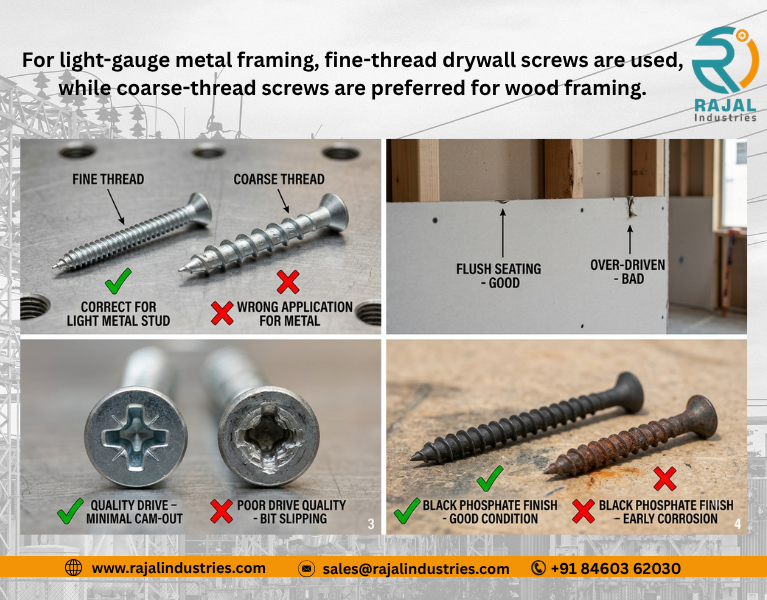
A drywall screw is commonly used to fasten gypsum board to suitable metal or wood framing in interior walls, partitions, ceilings and other approved drywall systems.
Although these fasteners may look simple, their performance depends on several technical factors.
Engineers and procurement teams should evaluate:
- Screw diameter
- Screw length
- Thread type
- Thread pitch
- Core diameter
- Head geometry
- Drive recess
- Point design
- Material
- Heat treatment
- Surface finish
- Supporting frame material
- Board thickness
- Required penetration
For high-volume construction projects, small differences in screw geometry can affect installation speed, screw breakage, driver-bit engagement and final board seating.
This guide explains common drywall screw sizes, fine and coarse thread designs, materials and technical specifications for professional buyers.
Quick Answer: What Defines a Drywall Screw Specification?
A complete drywall screw specification should normally include:
- Nominal diameter
- Overall length
- Thread type
- Thread pitch
- Thread length
- Core diameter
- Head type
- Head dimensions
- Drive type
- Point design
- Material
- Heat treatment
- Surface finish
- Board thickness
- Supporting frame material
- Frame thickness
- Required testing
For OEM procurement, a description such as:
3.5 × 35 mm drywall screw
may not be enough to ensure every supplier is quoting the same product.
What Is a Drywall Screw?
A drywall screw is a threaded fastener designed for suitable gypsum board and drywall applications.
Typical features may include:
- Bugle head
- Sharp or drilling-type point depending on application
- Fine or coarse thread
- Cross-recess drive
- Heat-treated carbon steel
- Phosphate or another approved surface finish
Common applications include:
- Drywall Partitions
- Gypsum Board Walls
- False Ceilings
- Suspended Ceiling Systems
- Metal Stud Systems
- Wood Framing
- Commercial Interiors
- Prefabricated Interior Systems
The final screw design should match the approved wall or ceiling system.
Understanding Drywall Screw Sizes
Drywall screws are usually specified by diameter and length.
For example:
3.5 × 35 mm
This generally refers to:
- Nominal diameter: around 3.5 mm
- Overall length: 35 mm
However, a complete technical specification also needs to define:
- Thread type
- Thread pitch
- Head geometry
- Point
- Drive
- Material
- Finish
Two screws with the same diameter and length can therefore perform differently.
Common Drywall Screw Diameters
Common nominal diameters can include sizes around:
- 3.5 mm
- 3.8 mm
- 4.2 mm
- 4.8 mm
The exact available range depends on product design, application and supplier.
The correct diameter should be selected according to:
- Board thickness
- Framing material
- Thread engagement
- Required strength
- Installation method
- Approved construction system
A larger screw is not automatically better.
Common Drywall Screw Lengths
Common market lengths can include:
- 19 mm
- 25 mm
- 30 mm
- 32 mm
- 35 mm
- 38 mm
- 41 mm
- 45 mm
- 50 mm
- 55 mm
- 60 mm
- 65 mm
- 75 mm
- Longer application-specific sizes
Important: These are general market examples, not a universal size standard.
Final length should be selected from the complete assembly.
How to Select Drywall Screw Length
The screw must pass through the gypsum board and provide adequate engagement in the supporting frame.
Consider:
Board Thickness + Number of Layers + Required Frame Penetration
The screw should be long enough to provide reliable fastening without creating unnecessary protrusion or installation resistance.
Single-Layer Drywall Screw Selection
For a single board layer, consider:
- Board thickness
- Frame material
- Required penetration
- Screw diameter
- Thread type
- Point design
The approved drywall-system specification should determine the final fastener.
Double-Layer Drywall Screw Selection
A double-layer wall or ceiling requires a longer screw because it must pass through more board material.
Important factors include:
- Total board thickness
- Number of layers
- Frame material
- Required penetration
- Screw length
- Installation tool
A screw selected for a single-layer system should not automatically be reused for a multi-layer assembly.
Fine Thread vs Coarse Thread Drywall Screws
This is one of the most important technical differences in drywall fasteners.
| Feature | Fine Thread Screws | Coarse Thread Screws |
| Thread Pitch | Finer | Coarser |
| Thread Frequency | Higher | Lower |
| Typical Association | Suitable light-gauge metal framing | Suitable wood framing |
| Thread Depth | Generally finer | Generally deeper |
| Final Selection | Metal/application dependent | Wood/application dependent |
This is a general application guide.
The final screw should follow the approved construction or drywall-system specification.
What Are Fine Thread Drywall Screws?
Fine thread screws are commonly used in suitable metal-framing drywall systems.
Their thread design can be appropriate for:
- Light-Gauge Steel Studs
- Metal Channels
- Interior Partition Framing
- Ceiling Framing
- Commercial Drywall Systems
When selecting a fine-thread screw, buyers should provide:
- Metal type
- Metal thickness
- Board thickness
- Required penetration
- Screw length
- Point design
The metal thickness is particularly important because it can affect penetration and thread engagement.
What Are Coarse Thread Drywall Screws?
Coarse thread screws are commonly associated with suitable wood framing.
Possible applications include:
- Wood Stud Walls
- Timber Framing
- Interior Wood Supports
- Gypsum Board to Wood
Their deeper thread geometry can provide suitable engagement in wood-based framing.
Selection should consider:
- Wood substrate
- Screw length
- Board thickness
- Thread geometry
- Required penetration
Why Thread Pitch Matters
Thread pitch affects how the screw engages the supporting substrate.
A finer thread provides more threads over a given length, while a coarse thread has fewer, deeper threads.
The correct pitch should match the supporting material.
This is why buyers should not choose a screw only because it has the right diameter and length.
Why Thread Length Matters
Thread length affects the amount of usable engagement with the frame.
Important factors include:
- Board thickness
- Screw length
- Frame thickness
- Required penetration
- Point length
The thread should engage the framing correctly after passing through the board.
Why Core Diameter Matters
The screw core helps determine:
- Torsional strength
- Fastener strength
- Thread depth
- Installation behaviour
A smaller core can allow deeper threads, but the screw must still withstand installation torque.
For this reason, screw geometry, material and heat treatment should be evaluated together.
Drywall Screw Head Design
The bugle head is one of the most common designs used for drywall applications.
Its curved profile helps the head seat into the board surface.
Important head dimensions include:
- Head diameter
- Head height
- Head contour
- Drive location
- Transition into the shank
Head consistency can directly affect final board appearance.
Why Bugle Head Geometry Matters
Poor head geometry can cause:
- Incomplete seating
- Paper-facing damage
- Excessive board penetration
- Poor finished surface
- Inconsistent installation depth
For high-volume construction work, head geometry should remain consistent from batch to batch.
Drywall Screw Drive Types
Cross-recess drive systems are widely used because they work well with powered installation tools.
Important drive characteristics include:
- Recess size
- Recess depth
- Bit fit
- Centering
- Form consistency
Drive quality is especially important for large projects using powered screw guns.
Why Drive Recess Quality Matters
Poor drive geometry can cause:
- Driver-bit slipping
- Cam-out
- Damaged screw heads
- Increased bit wear
- Slow installation
- Screw rejection
- Installer fatigue
A contractor using 500,000 or 1 million screws may experience significant productivity loss even if only a small percentage of screws have poor recess quality.
Common Point Types
Sharp Point
Sharp-point drywall screws are commonly used for suitable substrates where fast starting is required.
Potential applications include:
- Wood Framing
- Suitable Light-Gauge Metal Framing
- General Drywall Systems
Actual suitability depends on the framing material and thickness.
Drilling-Type Point
Some metal-framing applications may require a drilling-type point.
This can be useful where the screw needs greater penetration capability in specified metal sections.
Selection should be based on:
- Metal thickness
- Metal grade
- Screw design
- Point geometry
- Approved system specification
Sharp Point vs Drill Point
| Feature | Sharp Point | Drill-Type Point |
| Starting | Fast in suitable material | Designed for metal drilling |
| Light Metal | Application dependent | Common in suitable applications |
| Wood Framing | Common | Generally not primary use |
| Metal Thickness | Limited by screw design | Selected according to drilling requirement |
| Final Selection | Substrate dependent | Metal/application dependent |
The point should be selected according to the actual frame rather than the product name alone.
Materials Used for Drywall Screws
Carbon steel is widely used for drywall fasteners because it supports:
- Cold forming
- Thread rolling
- Heat treatment
- Surface finishing
- High-volume manufacturing
The exact steel grade should follow the product design and approved specification.
Carbon Steel Drywall Screws
Carbon steel provides a practical balance of:
- Manufacturing efficiency
- Mechanical performance
- Heat-treatment capability
- Cost
- Coating flexibility
For mass-market drywall screws, consistency of steel composition and heat treatment is important.
Why Heat Treatment Matters
Heat treatment affects:
- Torsional strength
- Thread durability
- Point performance
- Screw hardness
- Installation reliability
Poor control may cause:
- Screw breakage
- Brittle failure
- Point deformation
- Thread damage
- Inconsistent installation
For bulk OEM supply, buyers should evaluate both dimensions and mechanical consistency.
Hardness Requirements
Hardness can influence penetration and installation performance.
However, higher hardness is not automatically better.
Excessive hardness may increase brittleness, while insufficient hardness may affect point or thread performance.
The target hardness should follow the approved screw specification.
Common Surface Finishes
Drywall screws may be supplied with finishes such as:
- Black Phosphate
- Grey Phosphate
- Zinc-Based Coatings
- Customer-Specified Finishes
The correct coating depends on:
- Indoor or outdoor use
- Humidity
- Storage conditions
- Corrosion requirements
- Project specifications
Black Phosphate Drywall Screws
Black phosphate is widely associated with drywall fasteners.
Typical applications include:
- Interior Drywall
- Gypsum Board
- Partition Systems
- Ceiling Systems
Its dark appearance is familiar in the drywall market.
However, the visual appearance alone does not define corrosion performance.
Grey Phosphate Drywall Screws
Grey phosphate is another finish used on certain drywall screws.
As with black phosphate, buyers should define:
- Required coating
- Required corrosion performance
- Test method, where applicable
- Acceptance criteria
Do not select finish only by color.
Zinc-Coated Drywall Screws
Zinc-based finishes may be considered where additional corrosion resistance or a different appearance is required.
Potential applications depend on:
- Project environment
- Customer specification
- Storage conditions
- Required corrosion performance
The correct coating should always be specified technically.
Drywall Screw Specifications by Application
| Application | Main Specification Focus |
| Gypsum Board to Wood | Coarse thread, length, penetration |
| Gypsum Board to Light Metal | Fine thread, point, metal thickness |
| Multi-Layer Drywall | Length + required frame engagement |
| False Ceiling | Approved system + fastener specification |
| Commercial Interiors | Consistency + installation speed |
| Prefab Construction | Repeatability + quality control |
| OEM Building Products | Drawing + batch consistency |
This table is useful for narrowing the specification before requesting quotations.
How to Select Drywall Screw Size
Step 1 – Identify Board Thickness
Confirm:
- Board thickness
- Number of layers
Step 2 – Identify Supporting Frame
Is the framing:
- Wood?
- Light-gauge metal?
- Another approved system?
Step 3 – Confirm Frame Thickness
For metal framing, provide the actual metal thickness.
Step 4 – Select Thread Type
Choose fine or coarse thread according to the frame and system specification.
Step 5 – Select Point Type
Select according to:
- Frame material
- Metal thickness
- Penetration requirement
Step 6 – Select Length
Provide enough length for board penetration and proper frame engagement.
Step 7 – Confirm Head & Drive
Ensure the head seats correctly and the drive works with the installation tool.
Step 8 – Define Material & Finish
Specify:
- Material
- Heat treatment
- Finish
- Corrosion requirement
What OEM Buyers Should Put in a Drywall Screw Specification
A complete specification should ideally include:
- Nominal diameter
- Overall length
- Fine / coarse thread
- Thread pitch
- Thread length
- Core diameter
- Head style
- Head dimensions
- Drive type and size
- Point design
- Material
- Heat treatment
- Hardness requirement
- Surface finish
- Coating performance
- Gypsum board thickness
- Number of board layers
- Frame material
- Frame thickness
- Required testing
- Quantity
- Monthly consumption
- Annual demand
This makes supplier quotations much easier to compare.
Example of a Better Technical RFQ
Instead of:
Need 3.5 × 35 drywall screws.
Use:
Requirement: 3.5 × 35 mm drywall screws for gypsum board installation onto light-gauge metal framing. Fine thread, bugle head, cross recess, black phosphate finish. Please confirm point design, material, heat treatment, hardness, applicable test documentation, MOQ and monthly capacity. Estimated monthly requirement: 400,000 pcs.
This gives the supplier a much clearer technical and commercial picture.
Why Application Testing Matters
Before approving a high-volume supply, test the proposed screw using:
Actual Gypsum Board + Actual Frame + Screw + Driver Bit + Installation Tool
Check:
- Starting performance
- Frame penetration
- Driver engagement
- Installation torque
- Head seating
- Board-facing condition
- Screw breakage
- Consistency
This is especially useful for prefab and large project buyers.
Drywall Screw Size Selection by Application
Selecting the correct drywall screw requires matching the fastener to the gypsum board, number of layers, framing material and frame thickness.
A screw should not be selected only because a particular diameter and length are commonly available.
| Application | Thread Selection | Main Factors to Check |
| Gypsum Board to Wood Framing | Coarse thread commonly used | Board thickness, penetration, length |
| Gypsum Board to Light Metal Stud | Fine thread commonly used | Metal thickness, point, engagement |
| Multi-Layer Drywall | Application dependent | Total board thickness, frame penetration |
| False Ceiling | System dependent | Board, framing, approved ceiling specification |
| Interior Partition | Frame dependent | Board thickness, stud material |
| Commercial Fit-Out | System dependent | Installation speed, consistency |
| Prefab Construction | System dependent | Repeatability, automated installation |
| OEM Building Systems | Drawing/specification | Dimensions, tests, batch consistency |
The final specification should follow the approved drywall or ceiling system.
Fine Thread vs Coarse Thread: Quick Decision Guide
One of the most common buyer searches is:
Should I use fine thread or coarse thread drywall screws?
A simple starting point is:
Light-Gauge Metal Framing → Fine Thread
Wood Framing → Coarse Thread
However, this is only a general guide.
The actual selection depends on:
- Frame material
- Metal thickness
- Board thickness
- Screw diameter
- Point geometry
- Required penetration
- Installation equipment
- Approved system specification
When to Use Fine Thread Screws
Fine thread screws are commonly associated with suitable light-gauge metal framing.
Typical applications include:
- Metal Stud Partitions
- Metal Ceiling Framing
- Commercial Drywall Systems
- Interior Wall Systems
- Prefabricated Gypsum Assemblies
Fine threads provide more thread turns over a given length.
For metal framing, buyers should always tell the supplier the actual frame thickness because this can affect both thread and point selection.
When to Use Coarse Thread Screws
Coarse thread screws are commonly associated with suitable wood framing.
Typical applications include:
- Wood Stud Walls
- Timber Framing
- Wooden Interior Supports
- Gypsum Board to Wood
- Suitable Interior Construction Systems
The deeper, wider-spaced thread is commonly selected to provide engagement in wood-based framing.
Final suitability should still be checked against the actual substrate and approved construction system.
Why Metal Thickness Matters
Saying:
“The screw is for metal studs”
is not always enough.
The supplier should also know the metal thickness.
Metal thickness can affect:
- Point selection
- Starting performance
- Penetration
- Thread engagement
- Installation torque
- Screw design
A screw that performs well in one light-gauge section may not perform the same way in a thicker steel section.
Sharp Point vs Drill Point Drywall Screws
Point geometry is another important part of the specification.
Sharp Point
A sharp point can provide quick starting in suitable substrates.
Depending on the screw design, applications can include:
- Wood Framing
- Suitable Light-Gauge Metal Framing
- Standard Drywall Assemblies
Drill-Type Point
A drilling-type point may be required for certain metal-framing applications.
It is designed to drill into suitable metal during installation.
| Factor | Sharp Point | Drill-Type Point |
| Point Geometry | Sharp tapered point | Drilling profile |
| Wood Framing | Common | Generally not primary use |
| Light Metal | Application dependent | Application dependent |
| Thicker Metal | Limited by design | May be more suitable |
| Pre-Drilling | Depends on system | Often not required in suitable applications |
| Selection Basis | Substrate + thickness | Metal thickness + drilling capacity |
Do not assume that every metal framing application needs a drill point. Match the point to the actual framing specification.
How Much Penetration Does a Drywall Screw Need?
There is no useful universal penetration value for every drywall assembly.
Required penetration depends on:
- Board thickness
- Number of layers
- Supporting material
- Frame thickness
- Screw design
- Construction-system specification
The correct approach is to select the fastener according to the approved system rather than applying one penetration rule to every project.
Why Screw Length Should Not Be Selected Alone
Two screws may both be 35 mm long but differ in:
- Diameter
- Thread pitch
- Thread length
- Core diameter
- Point
- Head
- Material
- Heat treatment
- Surface finish
Therefore:
Length alone does not define a drywall screw.
For professional procurement, buyers should specify the complete product.
How Screw Diameter Affects Performance
Diameter influences:
- Core strength
- Thread dimensions
- Installation torque
- Head dimensions
- Fastener stiffness
A larger diameter is not automatically better.
The screw must remain compatible with:
- Gypsum board
- Framing
- Head seating
- Installation tool
- System specification
Why Core Diameter Is Important
Core diameter is sometimes overlooked in purchasing specifications.
However, it affects:
- Screw torsional strength
- Thread depth
- Installation behaviour
- Breakage resistance
Two screws with similar outside thread diameters may have different core geometries.
For large OEM orders, drawing-based control can reduce these variations.
Thread Pitch & Thread Geometry
Thread pitch is the distance between corresponding points on adjacent threads.
It influences:
- Thread frequency
- Substrate engagement
- Installation behaviour
- Application suitability
But pitch should not be evaluated alone.
A complete thread specification can include:
- Major diameter
- Minor/core diameter
- Pitch
- Thread angle
- Thread depth
- Thread length
For custom OEM requirements, these parameters should be controlled through the approved drawing or specification.
Installation Depth for Drywall Screws
Correct installation depth is important because the head needs to seat correctly without unnecessarily damaging the board facing.
Screw Too Shallow
Possible results:
- Head remains above the board
- Difficult finishing
- Uneven surface
- Poor joint-compound finish
Screw Too Deep
Possible results:
- Torn paper facing
- Board damage
- Reduced support around the head
- Poor installation quality
The installation tool should therefore control screw depth consistently.
Installation Torque
A drywall screw must withstand the torque required during installation.
However, simply applying more torque is not the solution when penetration becomes difficult.
Excessive torque may cause:
- Screw breakage
- Drive recess damage
- Bit slipping
- Over-driving
- Board-facing damage
If installation torque is unusually high, check:
- Screw type
- Point geometry
- Frame thickness
- Driver bit
- Tool settings
- Screw quality
Why Heat Treatment Is Critical
Heat treatment affects the balance between hardness and toughness.
A screw needs sufficient performance for:
- Thread integrity
- Point penetration
- Installation torque
- Torsional loading
Poor heat-treatment control can contribute to:
- Brittle screw breakage
- Soft points
- Thread deformation
- Inconsistent installation
For high-volume buyers, heat-treatment consistency can be more important than simply checking one hardness result.
Common Drywall Screw Failure Modes
1. Screw Breakage
Possible causes:
- Excessive torque
- Poor heat treatment
- Incorrect screw selection
- Insufficient core strength
- Incorrect point
- Installation misalignment
2. Point Does Not Penetrate the Frame
Possible causes:
- Incorrect point geometry
- Metal too thick for the screw
- Damaged point
- Wrong screw type
- Incorrect installation equipment
3. Drive Recess Strips
Possible causes:
- Wrong bit
- Poor recess dimensions
- Worn bit
- Excessive torque
- Misalignment
4. Head Does Not Seat Correctly
Possible causes:
- Incorrect head geometry
- Improper installation depth
- Excessive resistance
- Tool setting
- Dimensional inconsistency
5. Paper Facing Tears
Possible causes:
- Over-driving
- Excessive torque
- Incorrect head seating
- Tool-depth setting
6. Screw Spins Without Tightening
Possible causes:
- Thread stripping
- Incorrect screw/frame combination
- Damaged framing
- Over-driving
7. Screw Bends During Installation
Possible causes can include:
- Installation misalignment
- Unsuitable screw design
- Insufficient mechanical properties
- Excessive side loading
8. Early Corrosion
Possible causes include:
- Unsuitable surface finish
- Moisture exposure
- Poor storage
- High humidity
- Incorrect coating specification
Corrosion requirements should therefore be defined before purchasing.
Drywall Screw vs Self-Tapping Screw
| Feature | Drywall Screw | Self-Tapping Screw |
| Main Application | Gypsum board systems | Various suitable substrates |
| Typical Head | Bugle head common | Multiple head types |
| Fine / Coarse Thread | Common | Application dependent |
| Metal Applications | Specific designs | Common |
| Wood Applications | Suitable designs | Application dependent |
| Gypsum Board | Primary application | Not necessarily primary |
A drywall screw may have thread-forming characteristics in a particular application, but the terms should not automatically be treated as interchangeable.
Drywall Screw vs Self-Drilling Screw
| Feature | Drywall Screw | Self-Drilling Screw |
| Primary Application | Gypsum board systems | Metal fastening |
| Drill Point | Product dependent | Defining feature |
| Roofing / PEB | Not primary application | Very Common |
| Metal Framing | Suitable designs | Common |
| Gypsum Board | Primary | Application dependent |
A self-drilling screw is defined by its drilling-type point.
Not every drywall screw is a self-drilling screw.
Drywall Screw vs Chipboard Screw
| Feature | Drywall Screw | Chipboard Screw |
| Primary Use | Gypsum board | Furniture / engineered wood |
| Common Head | Bugle | Countersunk |
| MDF | Not primary intended use | Common |
| Particle Board | Not primary intended use | Very Common |
| Drywall | Very Common | Not primary intended use |
| Selection Based On | Board + framing | Board + furniture joint |
Buyers should not substitute fasteners simply because their appearance is similar.
Drywall Screw vs General Construction Screw
The term construction screw covers a much broader category.
Construction screws can be designed for:
- Timber
- Steel
- Roofing
- Structural Connections
- Interior Systems
- General Building Applications
Drywall screws are more application-specific.
Always identify the exact joint before selecting the fastener.
Common Engineering Mistakes
Mistake 1: Selecting Only by Size
“3.5 × 35 mm” does not fully define the screw.
Also specify:
- Thread
- Point
- Head
- Drive
- Material
- Heat treatment
- Finish
Mistake 2: Ignoring Frame Thickness
This can result in poor penetration or incorrect screw selection.
Mistake 3: Assuming Fine Thread Means Every Metal Application
Fine-thread drywall screws may be suitable for certain metal framing, but metal thickness and point capability still need to be checked.
Mistake 4: Ignoring Point Geometry
A technically correct thread may still perform poorly if the point cannot start or penetrate the substrate properly.
Mistake 5: Assuming Higher Hardness Is Always Better
Excessive hardness can increase brittleness.
The correct mechanical balance is more important than simply maximizing hardness.
Mistake 6: Ignoring the Installation Tool
Fastener performance depends on the complete installation system:
Board + Frame + Screw + Bit + Tool
Common Procurement Mistakes
Buying Only on Price per 1,000 Pieces
For large construction projects, the true cost includes:
- Screw price
- Installation speed
- Rejected screws
- Bit consumption
- Labour
- Rework
- Project delays
A slightly cheaper screw can become more expensive if installation consistency is poor.
Not Sharing the Application
Compare:
Need drywall screws. Send price.
with:
Need 3.5 × 35 mm fine-thread drywall screws for gypsum board to light-gauge steel framing, black phosphate finish. Monthly consumption approximately 500,000 pcs.
The second enquiry gives the supplier much better information.
Not Sharing Monthly & Annual Volume
Bulk buyers should provide:
- Sample quantity
- Trial quantity
- First order quantity
- Monthly requirement
- Annual consumption
- Delivery schedule
This helps manufacturers evaluate:
- Production capacity
- Raw material planning
- Heat-treatment batches
- Surface finishing
- Packaging
- Commercial pricing
Quality Inspection Checklist for Drywall Screws
| Inspection Item | Typical Requirement |
| Approved Drawing | ✓ |
| Nominal Diameter | ✓ |
| Core Diameter | ✓ |
| Overall Length | ✓ |
| Thread Pitch | ✓ |
| Thread Depth | ✓ |
| Thread Length | ✓ |
| Point Geometry | ✓ |
| Head Diameter | ✓ |
| Head Profile | ✓ |
| Drive Recess | ✓ |
| Material | ✓ |
| Heat Treatment | ✓ |
| Hardness | As Specified |
| Surface Finish | ✓ |
| Coating Performance | As Specified |
| Visual Inspection | ✓ |
| Driver-Bit Fit | ✓ |
| Torsional Test | As Required |
| Installation Test | ✓ |
| Corrosion Test | As Required |
| Batch Traceability | ✓ |
The inspection plan should follow the customer’s drawing, applicable standard or approved system specification.
OEM Drywall Screw RFQ Checklist
When requesting a quotation, provide:
☐ Nominal Diameter
☐ Overall Length
☐ Fine / Coarse Thread
☐ Thread Pitch
☐ Thread Length
☐ Core Diameter, if controlled
☐ Head Type
☐ Head Dimensions
☐ Drive Type & Size
☐ Point Design
☐ Material
☐ Heat Treatment
☐ Hardness Requirement
☐ Surface Finish
☐ Corrosion Requirement
☐ Gypsum Board Thickness
☐ Number of Layers
☐ Frame Material
☐ Metal Thickness
☐ Required Penetration
☐ Drawing / Standard
☐ Mechanical Testing
☐ Sample Quantity
☐ Initial Order Quantity
☐ Monthly Requirement
☐ Annual Consumption
☐ Packaging
☐ Delivery Schedule
Questions to Ask a Drywall Screw Manufacturer
Before approving a bulk supplier, ask:
- Which drywall screw sizes do you manufacture?
- Do you manufacture both fine and coarse thread screws?
- Can you manufacture according to our drawing?
- Which point designs can you produce?
- Which head and drive configurations are available?
- Which steel grades are used?
- How is raw material controlled?
- How is heat treatment controlled?
- How is hardness inspected?
- How is thread geometry inspected?
- How is drive-recess quality controlled?
- Which surface finishes are available?
- Can you provide corrosion testing where specified?
- Can you perform torsional testing?
- Can samples be tested with our gypsum-board system?
- Is batch traceability available?
- What is your MOQ?
- What is your monthly production capacity?
- Can you support scheduled deliveries?
- Can you provide OEM packaging?
Why Rajal Industries for Bulk Drywall Screw Requirements?
Rajal Industries manufactures fasteners for bulk industrial and OEM requirements.
Subject to drawing review, technical feasibility and customer approval, requirements can be evaluated for:
- Drywall Screws
- Gypsum Screws
- Fine Thread Screws
- Coarse Thread Screws
- Construction Screws
- Custom Drawing-Based Screws
- Different Diameters and Lengths
- Different Thread Configurations
- Different Point Designs
- Head and Drive Requirements
- Carbon Steel Requirements
- Heat Treatment
- Surface Finishing
- Dimensional Inspection
- Mechanical Testing as Specified
- Application Testing as Required
- Batch Traceability
- OEM Packaging
- Scheduled Bulk Supply
Potential bulk customers include:
- Drywall System Manufacturers
- Gypsum Board Companies
- Ceiling-System Companies
- Construction Product Manufacturers
- Prefabricated Building Manufacturers
- Modular Construction Companies
- Interior Product Manufacturers
- Construction Material Distributors
- Hardware Distributors
- Project Procurement Companies
Final capability should always be confirmed against the buyer’s drawing, dimensions, material, finish, performance requirements and expected production volume.
Bulk Buyer Quick Answer
What information should I send for a drywall screw quotation?
For an accurate quotation, provide:
Diameter + Length + Thread Type + Point + Head + Drive + Finish + Gypsum Board Thickness + Frame Material + Frame Thickness + Quantity
For large OEM or project requirements, also provide:
- Drawing or standard
- Mechanical test requirements
- Monthly consumption
- Annual consumption
- Delivery schedule
- Packaging requirement
Frequently Asked Questions About Drywall Screw Sizes & Specifications
What are common drywall screw sizes?
Drywall screw sizes are available in multiple diameters and lengths. Common market diameters can include approximately 3.5 mm, 3.8 mm, 4.2 mm and 4.8 mm, with many available lengths. The exact size should follow the drywall-system requirement.
How do I choose drywall screw length?
Calculate the total board thickness and required engagement into the supporting frame. Multi-layer systems normally require longer screws than single-layer systems.
What is the difference between fine and coarse thread drywall screws?
Fine thread screws are commonly associated with suitable light-gauge metal framing, while coarse thread screws are commonly associated with suitable wood framing.
Which drywall screw should I use for metal studs?
The correct screw depends on the metal thickness, board thickness, thread, point and required penetration. Fine-thread designs are commonly used with suitable light-gauge metal framing.
Which drywall screw should I use for wood studs?
Coarse-thread drywall screws are commonly associated with suitable wood-framing applications.
What is a bugle head drywall screw?
A bugle head has a curved profile beneath the head designed for controlled seating in suitable drywall applications.
What is the difference between a sharp point and drill point?
A sharp point starts directly in suitable substrates, while a drill-type point is designed to drill into suitable metal during installation.
Are all drywall screws black phosphate?
No. Black phosphate is common, but grey phosphate, zinc-based and other specified finishes may also be available.
Does black phosphate mean the screw is corrosion resistant?
The coating name or color alone does not establish a specific corrosion-performance level. Required corrosion performance should be defined by specification and testing where necessary.
What material is commonly used for drywall screws?
Heat-treated carbon steel is widely used. The exact steel and heat-treatment requirements depend on the product specification.
Why is heat treatment important?
Heat treatment influences hardness, torsional strength, point performance and resistance to breakage during installation.
Why do drywall screws break during installation?
Possible causes include excessive torque, poor heat treatment, incorrect screw selection, unsuitable point geometry, insufficient core strength or installation misalignment.
Can drywall screws be used in thick steel?
Not every drywall screw is designed for thicker steel. Metal thickness and drilling capability must be checked before selection.
Are drywall screws the same as self-drilling screws?
No. A self-drilling screw has a drilling-type point. Some application-specific drywall fasteners may use drilling-type points, but not every drywall screw is self-drilling.
Are drywall screws suitable for MDF furniture?
Drywall screws should not automatically replace fasteners designed for MDF or furniture applications. Select a screw intended and validated for the actual joint.
Can drywall screws be manufactured to an OEM drawing?
Yes. Drawing-based requirements can be evaluated according to dimensions, thread geometry, point, material, heat treatment, finish, testing and production quantity.
Key Takeaways
- A drywall screw is defined by much more than diameter and length.
- Board thickness and framing material should be identified before screw selection.
- Fine-thread screws are commonly associated with suitable light-gauge metal framing.
- Coarse-thread screws are commonly associated with suitable wood framing.
- Metal thickness is important when selecting the point and thread.
- Head geometry affects seating in the gypsum-board surface.
- Core diameter, material and heat treatment affect torsional performance.
- Coating should be selected according to actual environmental requirements.
- Large buyers should test screws with their real board, frame, bit and installation tool.
- OEM RFQs should include technical specifications as well as monthly and annual quantities.
Conclusion
Selecting the correct drywall screw requires understanding the complete fastening system.
Diameter and length are important, but buyers should also evaluate thread type, pitch, core diameter, head geometry, drive recess, point design, material, heat treatment, surface finish, gypsum board thickness, number of layers, framing material and frame thickness.
For high-volume drywall, ceiling and prefab applications, the proposed fastener should ideally be tested using:
Actual Gypsum Board + Actual Frame + Screw + Driver Bit + Production Tool
This helps identify penetration, breakage, drive and head-seating problems before bulk approval.
Rajal Industries can evaluate standard and custom drywall screw requirements for bulk OEM applications based on customer drawings, specifications, application requirements and expected production quantities.