

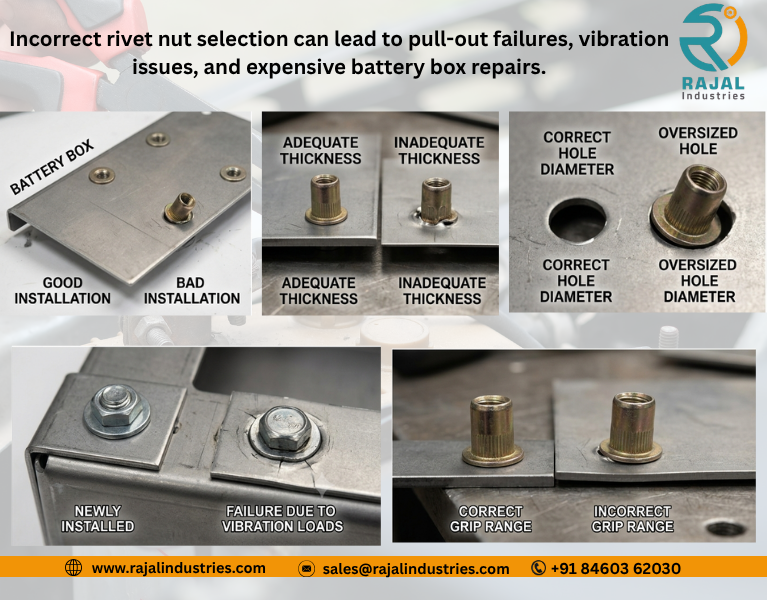
Introduction – The Battery Box Passed Testing but Failed in the Field
A battery box manufacturer was supplying enclosures for:
- Lithium Battery Packs
- Energy Storage Systems (BESS)
- EV Battery Modules
- Telecom Battery Cabinets
The design looked solid.
The enclosure passed:
✔ Dimensional Inspection
✔ Vibration Testing
✔ Assembly Validation
✔ Fitment Verification
However, after field deployment, technicians started reporting failures.
Common complaints included:
- Loose Battery Covers
- Detached Brackets
- Mounting Failures
- Rivet Nut Rotation
- Rivet Nut Pull-Out
The engineering team initially blamed:
- Poor Installation
- Incorrect Torque
- Operator Error
After investigation, they discovered the real problem.
Nobody had properly calculated:
Rivet Nut Pull-Out Strength
The rivet nuts were selected based on thread size.
Not based on actual loads.
This mistake is extremely common in:
- Battery Box Manufacturing
- Battery Cabinet Manufacturing
- Battery Rack Manufacturing
- EV Battery Production
- BESS Container Manufacturing
- Sheet Metal Fabrication
Quick Answer
Why do rivet nuts pull out of battery boxes?
Rivet nuts typically fail because of insufficient pull-out strength, thin sheet metal, vibration loading, incorrect grip range, oversized holes, or lack of load calculations during design.
Why Rivet Nuts Are Popular in Battery Boxes
Battery boxes are typically manufactured using:
- 1.0 mm Sheet Metal
- 1.2 mm Sheet Metal
- 1.5 mm Sheet Metal
- 2.0 mm Sheet Metal
- Aluminum Panels
Direct tapping often isn’t practical.
Weld nuts may create:
- Distortion
- Additional Processes
- Heat-Affected Zones
Therefore many OEMs use:
Rivet Nuts
Also known as:
- Blind Rivet Nuts
- Threaded Inserts
- Nutserts
Benefits include:
✔ Fast Installation
✔ Strong Threads
✔ No Welding Required
✔ Access From One Side
✔ Easy Automation
What Is Rivet Nut Pull-Out Strength?
Pull-out strength is:
The force required to pull the rivet nut completely out of the sheet metal.
Many engineers focus only on:
Thread Size
For example:
- M5 Rivet Nut
- M6 Rivet Nut
- M8 Rivet Nut
But thread size alone does not determine strength.
Actual performance depends on:
- Sheet Thickness
- Material Type
- Hole Size
- Rivet Nut Design
- Installation Quality
Why M6 Does Not Always Mean Strong
Many engineers assume:
M6 Rivet Nut = Stronger Than M5 Rivet Nut
Not necessarily.
Example:
M6 Rivet Nut
Installed in:
1.0 mm Sheet
may perform worse than
M5 Rivet Nut
Installed in:
2.0 mm Sheet
The sheet metal often becomes the weakest part of the assembly.
Failure #1 – Ignoring Dynamic Loads
Most calculations only consider:
Static Load
Example:
Battery Box Cover Weight:
10 kg
Design Team Assumption:
No Problem.
However, battery boxes experience:
- Transportation Shock
- Road Vibration
- Impact Loads
- Maintenance Loads
Actual loads may become:
3–10 Times Higher
than static weight.
Real Example
Battery Box Weight:
15 kg
Static Force:
Approximately:
147 N
Under transportation vibration:
Dynamic Load Factor:
5×
Actual Load:
735 N
Many rivet nut failures occur because engineers only calculate the 147 N load.
Failure #2 – Incorrect Sheet Thickness
This is one of the biggest mistakes.
Common battery box materials:
- 1.0 mm CRCA
- 1.2 mm CRCA
- 1.5 mm GI Sheet
- 2.0 mm Aluminum
A large rivet nut installed into thin sheet metal often provides disappointing results.
Typical Pull-Out Performance
| Rivet Nut | Sheet Thickness | Approx Pull-Out Strength |
| M5 Rivet Nut | 1.0 mm Steel | 1.5–2.0 kN |
| M6 Rivet Nut | 1.0 mm Steel | 2.0–2.5 kN |
| M6 Rivet Nut | 2.0 mm Steel | 3.0–4.5 kN |
| M8 Rivet Nut | 2.0 mm Steel | 4.0–6.0 kN |
Actual values vary by manufacturer and material.
Failure #3 – Oversized Hole Diameter
Rivet nuts depend on deformation during installation.
If the hole is oversized:
Problems include:
- Rotation
- Reduced Clamp Force
- Pull-Out Failure
Even a small increase in hole diameter can significantly reduce strength.
Failure #4 – Wrong Grip Range
Every rivet nut is designed for a specific material thickness.
Example:
A rivet nut designed for:
2.0–3.0 mm Material
may not perform correctly in:
1.0 mm Sheet
Incorrect grip range often causes:
- Poor Expansion
- Weak Clamping
- Early Failure
Failure #5 – Ignoring Vibration
Battery systems experience continuous vibration.
Common applications:
- EV Battery Packs
- Battery Cabinets
- Battery Racks
- BESS Containers
Over time vibration causes:
- Joint Movement
- Preload Loss
- Fatigue Loading
This gradually weakens the rivet nut installation.
Why Battery Boxes Are Different
Battery boxes are not ordinary enclosures.
They contain:
- Heavy Battery Modules
- Cooling Systems
- Electrical Components
- Structural Supports
Many battery assemblies experience:
Hundreds of Kilograms
of installed weight.
Fasteners become structural components.
Not just assembly hardware.
Load Calculation Example
Assume:
Battery Module Weight:
20 kg
Force:
20 × 9.81
= 196 N
Apply Safety Factor:
4×
Required Design Load:
784 N
Using Four M6 Rivet Nuts:
Load Per Rivet Nut:
784 ÷ 4
= 196 N
Now compare against actual pull-out strength.
This simple calculation is often skipped during design reviews.
Failure #6 – Choosing Rivet Nuts Based Only on Cost
Procurement teams sometimes select rivet nuts based only on price.
However, differences may exist in:
- Wall Thickness
- Material Quality
- Knurl Design
- Expansion Performance
Low-cost rivet nuts may provide significantly lower performance.
Failure #7 – No Pull-Out Testing
Many OEMs perform:
✔ Dimensional Inspection
✔ Visual Inspection
But skip:
Pull-Out Testing
This is a mistake.
Pull-out testing quickly identifies:
- Installation Issues
- Material Problems
- Design Weaknesses
before products reach customers.
Rivet Nut vs Weld Nut for Battery Boxes
| Parameter | Rivet Nut | Weld Nut |
| Installation Speed | High | Medium |
| Welding Required | No | Yes |
| Heat Distortion | None | Possible |
| Automation Friendly | Good | Excellent |
| Pull-Out Strength | Good | Higher |
| Serviceability | Excellent | Excellent |
Both solutions are widely used depending on design requirements.
Common Battery Box Fasteners Used by OEMs
Large battery box manufacturers regularly purchase:
Threaded Fasteners
- M4 Rivet Nuts
- M5 Rivet Nuts
- M6 Rivet Nuts
- M8 Rivet Nuts
- Threaded Inserts
Structural Fasteners
- M6 Bolts
- M8 Bolts
- M10 Bolts
- Flange Bolts
- Grade 8.8 Bolts
Battery Hardware
- Battery Terminal Bolts
- Copper Bolts
- Grounding Bolts
Assembly Hardware
These are among the most searched battery box fasteners used by OEMs globally.
Industries Most Affected
Rivet nut pull-out failures commonly affect:
- Battery Box Manufacturers
- Battery Cabinet Manufacturers
- Battery Rack Manufacturers
- EV Battery Manufacturers
- BESS Integrators
- Telecom Battery Cabinet Manufacturers
- Energy Storage OEMs
- Sheet Metal Fabricators
Inspection Checklist
Before production approval:
✔ Verify pull-out strength
✔ Review sheet thickness
✔ Check grip range
✔ Verify hole diameter
✔ Evaluate vibration loads
✔ Inspect installation quality
✔ Conduct pull-out testing
✔ Apply proper safety factors
✔ Review material specifications
Key Takeaways
- Rivet nut failures are often design failures rather than hardware failures.
- Thread size alone does not determine strength.
- Sheet thickness significantly affects pull-out performance.
- Dynamic loads are frequently underestimated.
- Grip range selection is critical.
- Pull-out testing should be part of OEM validation.
- Battery box fasteners must be designed for real-world vibration and shock conditions.
FAQ
What is rivet nut pull-out strength?
Pull-out strength is the force required to pull a rivet nut completely out of the sheet metal.
Why do M6 rivet nuts fail in battery boxes?
Common causes include thin sheet metal, oversized holes, poor installation, vibration, and inadequate load calculations.
Are rivet nuts stronger than threaded holes?
In thin sheet metal applications, rivet nuts typically provide stronger and more durable threads than direct tapping.
What sheet thickness is suitable for M6 rivet nuts?
Most M6 rivet nuts perform best in sheet thicknesses ranging from approximately 1.2 mm to 3.0 mm depending on design.
Why is vibration important in rivet nut design?
Vibration increases dynamic loads, which can gradually weaken the installation and contribute to pull-out failures.
Should battery OEMs perform pull-out testing?
Yes. Pull-out testing verifies actual performance and helps identify installation or design issues before production.
Which fasteners are commonly used in battery boxes?
M5 rivet nuts, M6 rivet nuts, M8 rivet nuts, weld nuts, machine screws, captive screws, grounding bolts, and structural fasteners.
Which industries commonly face rivet nut failures?
Battery box manufacturers, EV battery manufacturers, BESS integrators, battery cabinet manufacturers, and sheet metal fabricators.
Conclusion
Many rivet nut failures begin long before the first battery is installed.
They begin during design.
When engineers select a rivet nut based only on thread size and ignore pull-out calculations, sheet thickness, vibration loads, and safety factors, failures become much more likely.
For battery box manufacturers, battery cabinet OEMs, EV battery manufacturers, and BESS integrators, rivet nut strength should be treated as a structural design requirement rather than a simple fastening decision.