
Introduction – The Switchgear Design Was Excellent, But Reliability Problems Continued
A large switchgear manufacturer was facing recurring field complaints.
The products included:
- RMU Panels
- VCB Panels
- ACB Assemblies
- HT Panels
- LT Panels
- PCC Panels
- MCC Panels
The engineering team initially investigated:
- Circuit Breaker Design
- Protection Systems
- Busbar Layout
- Insulation Materials
- Electrical Testing Reports
Nothing unusual was found.
The products passed all routine tests.
However, field failures continued appearing:
- Busbar Heating
- Loose Panels
- Grounding Issues
- Corrosion Problems
- Maintenance Complaints
- Excessive Vibration
After a detailed audit, engineers discovered something unexpected.
Most problems originated from:
Fastener Selection
Not fastener quality.
Not installation.
But choosing the wrong fastener for the application.
This is one of the most overlooked causes of reliability issues in switchgear manufacturing.
Quick Answer
What are the most common fastener selection mistakes in RMU and VCB manufacturing?
The most common mistakes include using incorrect bolt grades, selecting wrong washer types, ignoring vibration resistance, using unsuitable materials, overlooking grounding requirements, poor corrosion protection, and excessive fastener variety.
Why Fastener Selection Matters
Every RMU, VCB, and ACB assembly contains hundreds of fasteners.
These fasteners support:
- Structural Assemblies
- Busbar Connections
- Grounding Systems
- Door Hardware
- Current Transformers
- Relay Panels
- Control Compartments
A typical switchgear panel may contain:
200–1,000+ Fasteners
A single incorrect specification can create long-term reliability issues.
Mistake #1 – Selecting Bolts Based Only on Strength
One of the most common engineering mistakes.
Many buyers assume:
Stronger Bolt = Better Design
Example:
Replacing:
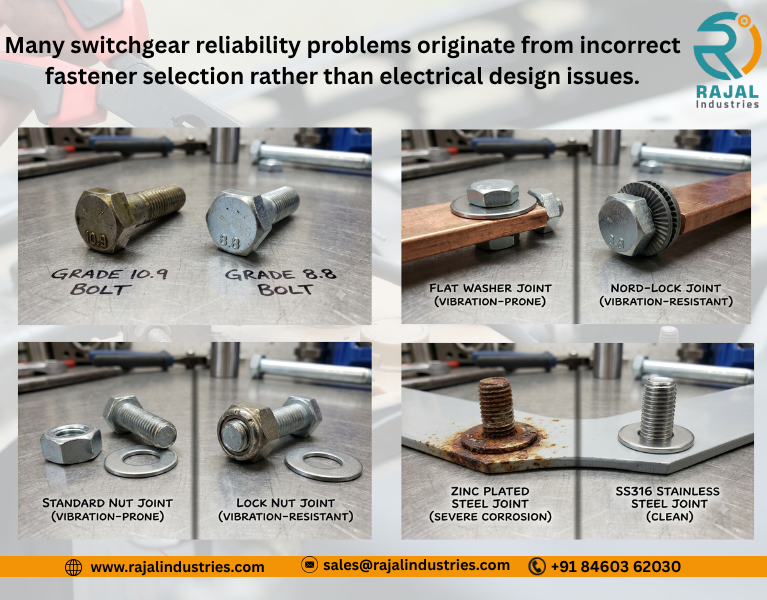
Grade 8.8 Bolt
with
Grade 10.9 Bolt
without evaluating the joint.
While Grade 10.9 bolts offer:
- Higher Tensile Strength
- Higher Yield Strength
they may not solve:
- Vibration Issues
- Thermal Expansion
- Preload Loss
The real objective is:
Joint Reliability
not simply maximum bolt strength.
Grade 8.8 vs Grade 10.9 Bolts
| Parameter | Grade 8.8 | Grade 10.9 |
| Tensile Strength | 800 MPa | 1000 MPa+ |
| Yield Strength | 640 MPa | 900 MPa |
| Cost | Lower | Higher |
| Switchgear Usage | Very Common | Critical Applications |
| Preload Capacity | High | Very High |
Many RMU and VCB assemblies perform perfectly with Grade 8.8 bolts when properly designed.
Mistake #2 – Using Flat Washers Everywhere
Flat washers are useful.
But they are not universal solutions.
Many OEMs use:
Flat Washer + Bolt + Nut
for every joint.
Problems occur when joints experience:
- Vibration
- Thermal Expansion
- Copper Creep
In these situations:
Belleville Washers
or
Nord-Lock Washers
often perform significantly better.
Why Busbar Joints Need Better Washers
Busbar assemblies continuously experience:
- Load Changes
- Temperature Changes
- Copper Creep
Belleville washers help maintain:
Clamp Force
which improves long-term reliability.
Mistake #3 – Ignoring Vibration Resistance
Many switchgear manufacturers underestimate vibration.
Sources include:
- Circuit Breaker Operation
- Transportation
- Transformers
- Cooling Fans
Using standard nuts in vibration-prone joints often leads to:
- Preload Loss
- Joint Movement
- Maintenance Issues
Modern switchgear designs increasingly use:
Lock Nuts
Including:
- Nylock Nuts
- Prevailing Torque Nuts
- All-Metal Lock Nuts
Standard Nut vs Lock Nut
| Parameter | Standard Nut | Lock Nut |
| Vibration Resistance | Low | High |
| Preload Retention | Medium | High |
| Maintenance Need | Higher | Lower |
| OEM Preference | Limited | Preferred |
Mistake #4 – Wrong Material Selection for Outdoor Installations
Outdoor switchgear faces:
- Rain
- Humidity
- UV Exposure
- Pollution
- Salt Air
Many OEMs use:
SS304 Hardware
for all applications.
While SS304 performs well in many environments, coastal and chemical environments often require:
SS316 Fasteners
Failure to select the correct material often results in:
- Corrosion
- Rust Staining
- Reduced Service Life
SS304 vs SS316 Fasteners
| Parameter | SS304 | SS316 |
| Corrosion Resistance | High | Very High |
| Salt Resistance | Moderate | Excellent |
| Outdoor Service Life | Good | Excellent |
| Coastal Projects | Limited | Preferred |
Mistake #5 – Treating Grounding Hardware as Standard Hardware
Grounding connections are special.
Yet many manufacturers install grounding systems using:
- Standard Bolts
- Flat Washers
- Painted Surfaces
This creates:
- Increased Resistance
- Grounding Failure
- Electrical Noise
Professional grounding assemblies typically include:
- Grounding Bolts
- Serrated Washers
- Ground Lugs
- Copper Earthing Hardware
The grounding system should never be treated as a standard mechanical joint.
Mistake #6 – Mixing Too Many Fastener Types
A surprising number of switchgear manufacturers use:
- 50+
- 100+
- Sometimes 200+
different fasteners in production.
This creates:
- Procurement Complexity
- Inventory Cost
- Assembly Errors
- Spare Part Problems
Leading OEMs often standardize to:
20–40 Core Fasteners
Benefits include:
✔ Lower Cost
✔ Faster Assembly
✔ Easier Maintenance
✔ Better Inventory Control
Real OEM Example
A switchgear manufacturer reduced:
118 Fastener SKUs
to
34 Fastener SKUs
Results:
✔ Reduced Inventory Cost
✔ Improved Purchasing Efficiency
✔ Reduced Assembly Errors
✔ Faster Production
✔ Lower Spare Parts Requirements
Mistake #7 – Selecting Fasteners Too Late in the Design Process
Many design teams finalize fasteners at the end of a project.
This often causes:
- Clearance Issues
- Tool Access Problems
- Serviceability Problems
- Procurement Delays
Fastener selection should occur during:
Product Design
not after production drawings are completed.
Leading OEMs involve fastener suppliers during development.
Most Common OEM Fasteners Used in RMU, VCB & ACB Manufacturing
Large switchgear manufacturers regularly purchase:
Structural Fasteners
- M6 Hex Bolts
- M8 Hex Bolts
- M10 Hex Bolts
- M12 Hex Bolts
- Grade 8.8 Bolts
- Grade 10.9 Bolts
Busbar Hardware
- Busbar Bolts
- Copper Bolts
- Brass Bolts
- Flange Bolts
Grounding Hardware
- Grounding Bolts
- Serrated Washers
- Ground Lugs
- Copper Earthing Components
Panel Hardware
- Captive Screws
- Machine Screws
- Self-Tapping Screws
- Rivet Nuts
- Cage Nuts
Locking Components
- Lock Nuts
- Nylock Nuts
- Prevailing Torque Nuts
- Belleville Washers
- Nord-Lock Washers
These are among the most searched OEM fasteners used in switchgear manufacturing worldwide.
What Leading Switchgear OEMs Focus On
Modern RMU and VCB manufacturers evaluate:
✔ Torque Retention
✔ Corrosion Resistance
✔ Service Life
✔ Grounding Performance
✔ Vibration Resistance
✔ Inventory Simplification
✔ Maintenance Requirements
✔ Total Lifecycle Cost
Rather than focusing only on unit price.
Industries Most Affected
These fastener selection mistakes commonly affect:
- RMU Manufacturers
- VCB Manufacturers
- ACB Manufacturers
- Switchgear Manufacturers
- HT Panel Manufacturers
- LT Panel Manufacturers
- PCC Panel Manufacturers
- MCC Panel Manufacturers
- Electrical Panel Manufacturers
- Utility Equipment OEMs
Inspection Checklist for OEM Engineering Teams
Before approving switchgear fasteners:
✔ Verify bolt grades
✔ Review washer selection
✔ Check vibration resistance
✔ Confirm lock nut requirements
✔ Evaluate grounding hardware
✔ Verify corrosion protection
✔ Reduce unnecessary SKUs
✔ Review maintenance access
✔ Standardize fastener sizes
✔ Confirm supplier capability
Key Takeaways
- Fastener selection directly affects switchgear reliability.
- Stronger bolts do not automatically create better joints.
- Flat washers are not suitable for every application.
- Vibration resistance should be considered during design.
- Grounding hardware requires special attention.
- Fastener standardization reduces manufacturing costs.
- Early fastener selection improves product reliability and serviceability.
FAQ
What is the biggest fastener mistake in switchgear manufacturing?
Selecting fasteners based only on strength without considering preload retention, vibration, corrosion, and service life.
Are Grade 10.9 bolts always better than Grade 8.8 bolts?
No. Many RMU and VCB applications perform perfectly with Grade 8.8 bolts when the joint is properly designed.
Why are lock nuts used in switchgear assemblies?
Lock nuts help maintain preload and resist loosening caused by vibration and thermal cycling.
Which fasteners are commonly used in RMU and VCB manufacturing?
M6, M8, M10, and M12 bolts, busbar bolts, grounding bolts, lock nuts, captive screws, rivet nuts, and Belleville washers.
Why are serrated washers used in grounding systems?
They penetrate paint and oxidation layers to create reliable metal-to-metal electrical contact.
Should outdoor switchgear use SS304 or SS316 fasteners?
SS304 is suitable for many applications, while SS316 is often preferred for coastal and highly corrosive environments.
Why do OEMs standardize fasteners?
Standardization reduces inventory costs, purchasing complexity, assembly errors, and maintenance challenges.
When should fasteners be selected during product development?
Fastener selection should be integrated into the design stage rather than treated as a final procurement decision.
Conclusion
Many RMU and VCB reliability problems are not caused by electrical design flaws.
They start much earlier.
During fastener selection.
The right bolt, nut, washer, grounding component, and locking system can significantly improve reliability, reduce maintenance, and lower total ownership cost.
For switchgear manufacturers, RMU OEMs, VCB manufacturers, and electrical panel producers, fastener engineering should be treated as a critical part of product design rather than a purchasing activity.