

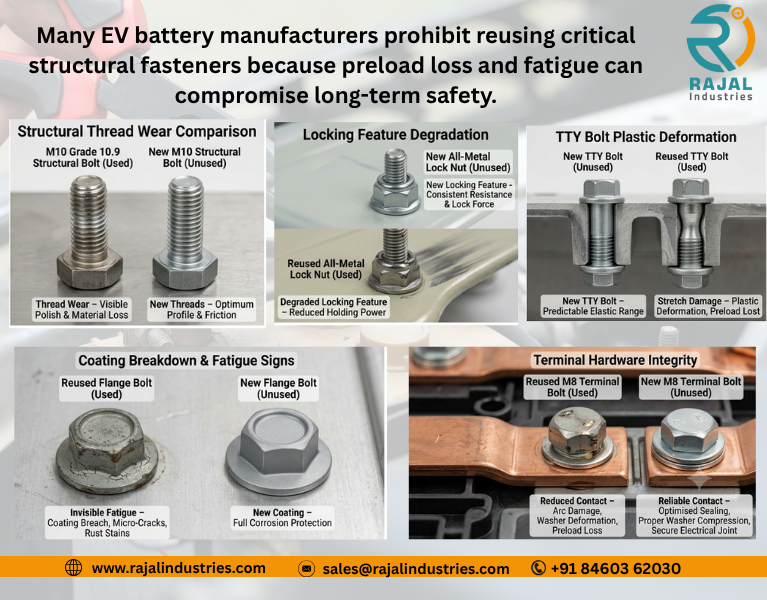
Introduction – A ₹20 Bolt Can Put a ₹10 Lakh Battery Pack at Risk
An EV battery service center was performing maintenance on a battery pack.
The technician removed:
- Battery Tray Bolts
- Battery Module Bolts
- Structural Fasteners
- Busbar Bolts
- Terminal Hardware
After repairs were completed, a simple question came up:
“Can we use the same bolts again?”
From a visual inspection, the fasteners looked perfect.
No rust.
No cracks.
No thread damage.
No obvious wear.
To a technician, the bolts appeared reusable.
To the OEM engineering team, the answer was immediate:
No.
Replace them.
This surprises many people.
A fastener that appears completely normal can still be unsuitable for reuse.
That is why leading EV battery manufacturers, electric vehicle OEMs, battery pack manufacturers, and battery enclosure manufacturers often prohibit the reuse of critical fasteners.
The reason is not appearance.
The reason is engineering.
Quick Answer
Why don’t EV battery manufacturers reuse critical fasteners?
Critical fasteners may experience preload loss, plastic deformation, fatigue damage, thread wear, coating damage, and reduced clamping performance during their first installation cycle. Reusing them can increase the risk of loosening, vibration failure, electrical resistance, and safety issues.
What Is a Critical Fastener?
A critical fastener is any bolt, screw, nut, washer, or threaded component whose failure could affect:
- Safety
- Structural Integrity
- Battery Performance
- Electrical Reliability
- Crashworthiness
- Thermal Management
Common critical battery fasteners include:
Structural Fasteners
- M8 Structural Bolts
- M10 Structural Bolts
- M12 Structural Bolts
- Grade 8.8 Bolts
- Grade 10.9 Bolts
- Flange Bolts
Electrical Fasteners
- M6 Battery Terminal Bolts
- M8 Copper Terminal Bolts
- Busbar Bolts
- Grounding Bolts
Battery Pack Hardware
- Battery Tray Bolts
- Battery Module Fasteners
- Battery Rack Fasteners
- Battery Enclosure Bolts
These fasteners are often classified as non-reusable by OEMs.
Why Reusing Fasteners Looks Safe But Isn’t
Most fastener damage is invisible.
A reused bolt may appear identical to a new bolt.
However, several important changes may have already occurred.
Examples include:
- Preload Reduction
- Thread Wear
- Surface Damage
- Material Fatigue
- Coating Breakdown
These issues cannot always be detected visually.
Reason #1 – Preload Is Lost After First Installation
The primary job of a fastener is not holding parts together.
The primary job is creating:
Clamp Force
also called:
Preload
During tightening:
- Threads deform slightly
- Contact surfaces settle
- Joint components compress
When the fastener is removed:
The original preload characteristics may not be fully recoverable.
The bolt may still tighten.
But it may not generate the same clamping force.
Why Preload Matters in EV Batteries
Battery packs experience:
- Road Vibration
- Thermal Expansion
- Shock Loading
- Charging Cycles
- Discharging Cycles
If preload decreases:
- Joint movement increases
- Vibration increases
- Fatigue risk increases
Eventually, failure may occur.
Reason #2 – Thread Wear Occurs During Installation
Every installation cycle creates friction.
This affects:
- Bolt Threads
- Nut Threads
- Threaded Inserts
- Rivet Nuts
- Weld Nuts
Repeated installation can cause:
- Thread polishing
- Surface wear
- Friction changes
Even minor thread wear can affect torque-to-preload consistency.
Reason #3 – Torque Is Not Equal to Clamp Force
Many technicians believe:
Same Torque = Same Performance
This is incorrect.
Torque is only a method of generating preload.
A reused fastener may reach the specified torque value while producing significantly less clamp force.
This is one reason OEMs replace critical hardware.
Reason #4 – Fatigue Damage Starts Before Cracks Become Visible
Fasteners rarely fail suddenly.
Most failures begin as microscopic fatigue damage.
Sources include:
- Vibration
- Thermal Cycling
- Dynamic Loads
- Expansion and Contraction
A reused bolt may already contain:
Micro-fatigue cracks
that are impossible to detect without specialized inspection.
What Is Fatigue Failure?
Fatigue failure occurs when a component experiences repeated loading.
The load may be below the bolt’s strength.
However, repeated cycles gradually create damage.
The process follows:
Stress
↓
Micro Crack
↓
Crack Growth
↓
Fastener Failure
This is one of the most common causes of structural bolt failure in transportation systems.
Reason #5 – Torque-to-Yield (TTY) Bolts Are Designed for One-Time Use
Many automotive manufacturers use:
Torque-To-Yield Bolts
also known as:
Stretch Bolts
These bolts are intentionally tightened beyond their elastic range.
Benefits include:
✔ Consistent preload
✔ Improved joint reliability
✔ Better load distribution
However:
They are designed for:
Single Use Only
Reusing TTY bolts can be dangerous.
Standard Bolt vs Torque-To-Yield Bolt
| Parameter | Standard Bolt | Torque-To-Yield Bolt |
| Reusable | Often Yes | No |
| Stretch During Installation | Limited | Significant |
| Preload Consistency | Good | Excellent |
| Automotive Usage | Common | Extensive |
| EV Battery Applications | Common | Growing |
Reason #6 – Coating Damage During Removal
Battery fasteners often use:
- Zinc Plating
- Zinc Nickel Coating
- Geomet Coating
- Dacromet Coating
- Black Oxide
- SS304 Passivation
During removal:
Coatings may become damaged.
The damage may be invisible.
However, corrosion protection can be reduced significantly.
Reason #7 – Locking Features Degrade
Many battery systems use:
Nylock Nuts
Prevailing Torque Nuts
All-Metal Lock Nuts
Serrated Flange Nuts
These products rely on locking features.
Repeated use reduces effectiveness.
For example:
A Nylock Nut may lose locking capability after multiple installation cycles.
Real EV Battery Pack Example
An EV battery manufacturer evaluated reused battery tray bolts.
Test Setup:
New Fasteners
vs
Reused Fasteners
Results:
Reused bolts showed:
- Lower preload consistency
- Higher variation
- Reduced vibration resistance
The OEM implemented a policy:
Replace all critical battery tray bolts during service.
Why Battery Module Fasteners Are Often Replaced
Battery modules operate under:
- Vibration
- Thermal Expansion
- Electrical Loading
Common replacement hardware includes:
- M4 Battery Bolts
- M5 Battery Bolts
- M6 Battery Bolts
- M8 Structural Bolts
- M10 Structural Bolts
OEMs prefer predictable performance over small cost savings.
Typical Battery Fasteners That OEMs Replace
Structural Hardware
- Grade 8.8 Bolts
- Grade 10.9 Bolts
- Flange Bolts
- Structural Bolts
Electrical Hardware
- M6 Terminal Bolts
- M8 Copper Bolts
- Busbar Fasteners
Locking Components
- Nylock Nuts
- Prevailing Torque Nuts
- Lock Nuts
Battery Assembly Hardware
- Battery Tray Bolts
- Battery Module Fasteners
- Battery Rack Fasteners
- Battery Enclosure Bolts
Cost Comparison: Replacing vs Reusing
Assume:
Battery Pack Value:
₹8,00,000
Critical Fastener Cost:
₹2,000
Percentage of System Cost:
Less than:
0.3%
Most OEMs conclude:
The risk is not worth the savings.
Industries Following Non-Reuse Policies
Fastener replacement policies are common among:
- EV Battery Manufacturers
- Electric Vehicle OEMs
- Lithium Battery Pack Manufacturers
- Battery Module Manufacturers
- Battery Tray Manufacturers
- Battery Enclosure Manufacturers
- BESS Integrators
- Automotive OEMs
Fasteners Commonly Used in EV Battery Production
Large battery manufacturers frequently purchase:
Battery Bolts
- M4 Battery Bolts
- M5 Battery Bolts
- M6 Battery Bolts
- M8 Structural Bolts
- M10 Structural Bolts
- M12 Structural Bolts
Structural Fasteners
- Grade 8.8 Bolts
- Grade 10.9 Bolts
- Flange Bolts
- Socket Head Cap Screws
Locking Hardware
- Nylock Nuts
- Prevailing Torque Nuts
- Lock Nuts
Washers
- Belleville Washers
- Nord-Lock Washers
- Structural Washers
These are among the highest-volume battery fasteners used in EV manufacturing.
Inspection Checklist
Before reusing any battery fastener:
✔ Verify OEM service manual
✔ Check fastener classification
✔ Inspect threads
✔ Inspect coatings
✔ Check locking features
✔ Verify preload requirements
✔ Review fatigue exposure
✔ Confirm reuse policy
In most critical applications, replacement remains the preferred option.
Key Takeaways
- Critical fasteners often experience preload loss after installation.
- Fatigue damage can exist without visible cracks.
- Torque values do not guarantee identical clamp force after reuse.
- Locking features degrade with repeated use.
- Torque-to-yield bolts are generally single-use fasteners.
- Replacing critical battery fasteners is often cheaper than risking a failure.
- Most leading EV manufacturers prioritize reliability over fastener cost savings.
FAQ
Why do EV manufacturers replace battery fasteners?
Because preload, fatigue life, and locking performance may change after installation and removal.
Can Grade 8.8 bolts be reused?
In some applications they may be reusable, but OEM guidelines should always be followed. Critical battery applications often require replacement.
What are torque-to-yield bolts?
Torque-to-yield bolts are designed to stretch during installation and are generally considered single-use fasteners.
Why is preload important?
Preload keeps joints clamped together and prevents movement, loosening, and fatigue failures.
What battery fasteners are most commonly replaced?
Battery tray bolts, battery module bolts, terminal bolts, structural bolts, lock nuts, and critical fastening assemblies.
Can reused fasteners cause vibration problems?
Yes. Reduced clamp force can allow joint movement, increasing vibration and fatigue loading.
Which industries avoid reusing critical fasteners?
EV battery manufacturers, automotive OEMs, battery module manufacturers, battery enclosure manufacturers, and BESS integrators.
Is replacing fasteners expensive?
Compared to the cost of a battery system, replacing critical fasteners is usually a very small expense.
Conclusion
To a technician, a used bolt may look perfectly fine.
To an OEM engineer, that same bolt may represent an unknown risk.
This is why leading EV battery manufacturers refuse to reuse critical fasteners.
Not because the bolt looks damaged.
Because the consequences of failure are too expensive.
For EV battery manufacturers, battery tray manufacturers, battery module OEMs, and BESS integrators, replacing critical fasteners is often one of the simplest and most cost-effective reliability decisions available.