
Introduction – Everyone Calculates Batteries, Almost Nobody Calculates Fasteners
Ask a BESS engineer about a 20 MW project and you’ll hear discussions about:
- Battery Cells
- Battery Modules
- Battery Racks
- Battery Containers
- PCS Systems
- Inverters
- Transformers
- EMS Software
- Fire Suppression Systems
Ask the same engineer:
“How many fasteners are used in a 20 MW BESS project?”
Most cannot answer.
The reason is simple.
Fasteners are usually treated as low-value commodities.
However, during procurement and construction, they become one of the largest-volume hardware categories on site.
A utility-scale Battery Energy Storage System contains:
- Anchor Bolts
- Structural Bolts
- Hex Bolts
- Flange Bolts
- Battery Module Bolts
- Battery Rack Fasteners
- Threaded Rods
- Grounding Bolts
- Spring Washers
- Structural Washers
- Hex Nuts
- Lock Nuts
- Nylock Nuts
- Copper Terminal Bolts
- SS304 Fasteners
- SS316 Fasteners
The actual numbers surprise even experienced engineers.
Quick Answer
How many fasteners are used in a 20 MW BESS project?
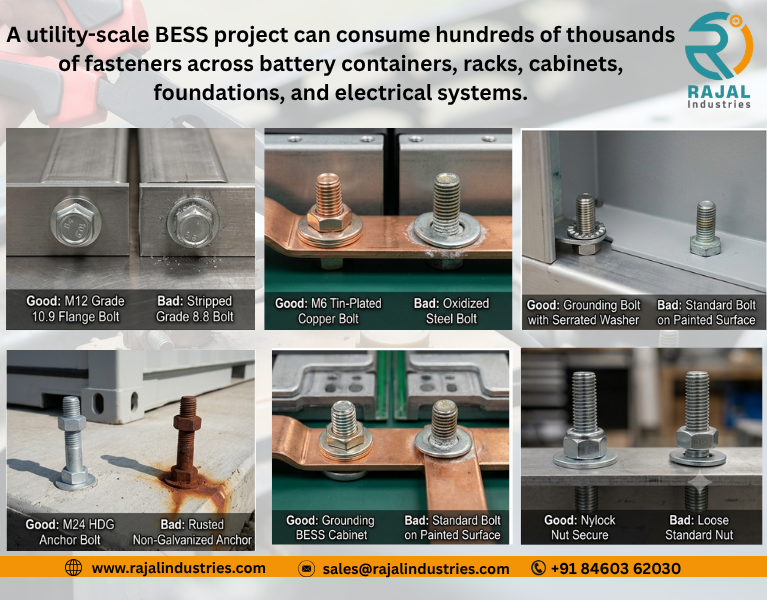
A typical 20 MW Battery Energy Storage System may consume between 200,000 and 500,000+ fasteners, depending on battery technology, rack design, container configuration, structural requirements, and site conditions.
Why Fasteners Matter in BESS Projects
A BESS project is essentially a collection of thousands of mechanical and electrical joints.
Every major subsystem depends on fasteners.
Without them:
- Containers cannot be assembled.
- Battery racks cannot be installed.
- Battery modules cannot be secured.
- Busbars cannot be connected.
- Grounding systems cannot function.
- Foundations cannot support equipment.
The entire project depends on reliable fastening systems.
Where Fasteners Are Used in a BESS Project
Battery Containers
Each container contains:
- Structural Frames
- Roof Panels
- Side Panels
- Access Doors
- HVAC Systems
- Fire Suppression Equipment
Common fasteners include:
- M6 Machine Screws
- M8 Hex Bolts
- M10 Structural Bolts
- Captive Screws
- Rivet Nuts
- Cage Nuts
- Self-Tapping Screws
Battery Racks
Battery racks are among the largest fastener consumers.
Common hardware:
- M8 Grade 8.8 Bolts
- M10 Grade 8.8 Bolts
- M12 Grade 8.8 Bolts
- Flange Bolts
- Structural Washers
- Lock Nuts
- Threaded Rods
A single battery rack may use:
150–500 Fasteners
depending on design.
Battery Modules
Battery modules contain:
- Cell Holders
- Busbars
- Covers
- Cooling Plates
- Terminal Assemblies
Common fasteners:
- M4 Battery Bolts
- M5 Battery Bolts
- M6 Battery Bolts
- Socket Head Cap Screws
- Flange Screws
- Captive Screws
A single module may contain:
20–80 Fasteners
Battery Cabinets
Battery cabinet assemblies consume:
- M4 Machine Screws
- M5 Machine Screws
- Captive Screws
- Rivet Nuts
- Cage Nuts
- SS304 Fasteners
- SS316 Fasteners
A typical cabinet may contain:
100–300 Fasteners
Fastener Consumption Breakdown for a Typical 20 MW BESS Project
The following numbers represent realistic industry estimates.
Anchor Bolts
Used for:
- Battery Containers
- PCS Foundations
- Transformer Foundations
- Switchgear Foundations
Typical Quantity:
5,000–20,000 Pieces
Common Products:
- M16 Anchor Bolts
- M20 Anchor Bolts
- M24 Anchor Bolts
- HDG Anchor Bolts
- Chemical Anchors
- Foundation Bolts
Structural Bolts
Used for:
- Rack Assembly
- Container Assembly
- Equipment Mounting
Typical Quantity:
40,000–100,000 Pieces
Common Products:
- Grade 8.8 Bolts
- Grade 10.9 Bolts
- M8 Bolts
- M10 Bolts
- M12 Bolts
- Flange Bolts
Hex Nuts
Every bolt needs a matching nut.
Typical Quantity:
40,000–100,000 Pieces
Common Products:
- Hex Nuts
- Heavy Hex Nuts
- Lock Nuts
- Prevailing Torque Nuts
- Nylock Nuts
Washers
Most structural joints require washers.
Typical Quantity:
80,000–200,000 Pieces
Common Products:
- Flat Washers
- Structural Washers
- Spring Washers
- Belleville Washers
- Nord-Lock Washers
Battery Module Fasteners
Used inside battery modules.
Typical Quantity:
30,000–120,000 Pieces
Common Products:
- M4 Battery Bolts
- M5 Battery Bolts
- M6 Battery Bolts
- Socket Head Screws
- Machine Screws
Grounding Hardware
Used across:
- Containers
- Racks
- Electrical Equipment
Typical Quantity:
5,000–20,000 Pieces
Common Products:
- Grounding Bolts
- Serrated Washers
- Ground Lugs
- Copper Grounding Hardware
- SS304 Grounding Fasteners
Electrical Connection Hardware
Used for:
- Busbars
- Battery Terminals
- Power Connections
Typical Quantity:
10,000–50,000 Pieces
Common Products:
- Copper Terminal Bolts
- Tin-Plated Copper Bolts
- Flange Nuts
- Belleville Washers
Example Fastener Calculation
Assume:
40 Battery Containers
Each Container:
5 Racks
Each Rack:
200 Fasteners
Total Rack Fasteners:
40 × 5 × 200
= 40,000 Fasteners
Now add:
- Battery Modules
- Container Hardware
- Grounding Systems
- Anchor Bolts
- PCS Equipment
- Switchgear
- Cable Tray Systems
The project quickly exceeds:
250,000–500,000 Fasteners
The Cost Nobody Calculates
Many EPC contractors focus on:
- Battery Costs
- PCS Costs
- Transformer Costs
However, fastener shortages can stop construction.
Common problems include:
- Missing Anchor Bolts
- Incorrect Washer Sizes
- Delayed Structural Hardware
- Wrong Bolt Grades
- Corrosion Issues
A ₹20 bolt can delay a ₹200 crore project.
Fasteners Most Commonly Purchased by BESS Integrators
Structural Fasteners
- M8 Grade 8.8 Bolts
- M10 Grade 8.8 Bolts
- M12 Grade 8.8 Bolts
- M16 Anchor Bolts
- M20 Anchor Bolts
- M24 Anchor Bolts
- Grade 10.9 Structural Bolts
Battery Fasteners
- M4 Battery Bolts
- M5 Battery Bolts
- M6 Battery Bolts
- Battery Module Screws
- Battery Rack Fasteners
Grounding Hardware
- Grounding Bolts
- Serrated Washers
- Copper Ground Lugs
- SS304 Grounding Fasteners
Stainless Steel Fasteners
- SS304 Bolts
- SS304 Nuts
- SS304 Washers
- SS316 Bolts
- SS316 Washers
- Stainless Steel Threaded Rods
Locking Hardware
- Nylock Nuts
- Prevailing Torque Nuts
- Lock Nuts
- Belleville Washers
- Nord-Lock Washers
Why OEMs Standardize Fasteners
Large BESS manufacturers often reduce the number of fastener SKUs.
Instead of managing:
200 Different Fasteners
they may standardize to:
30–50 Core Fasteners
Benefits:
✔ Faster Procurement
✔ Lower Inventory
✔ Better Pricing
✔ Easier Maintenance
✔ Improved Spare Parts Management
Industries Interested in BESS Fasteners
This topic directly applies to:
- BESS Integrators
- Battery Rack Manufacturers
- Battery Cabinet Manufacturers
- Battery Enclosure Manufacturers
- Lithium Battery Pack Manufacturers
- EV Battery Manufacturers
- Solar EPC Companies
- Utility Energy Storage Developers
- Electrical Contractors
- Switchgear Manufacturers
Inspection Checklist Before Procurement
✔ Verify bolt grades
✔ Confirm anchor bolt specifications
✔ Review coating requirements
✔ Validate washer specifications
✔ Check grounding hardware
✔ Verify stainless steel requirements
✔ Standardize fastener sizes
✔ Forecast spare requirements
Key Takeaways
- A 20 MW BESS project can consume 200,000–500,000+ fasteners.
- Battery racks are among the largest consumers of structural fasteners.
- Anchor bolts, structural washers, nuts, and battery module screws represent major procurement categories.
- Fastener planning directly impacts project timelines.
- Standardization reduces cost and inventory complexity.
- Fasteners are low-cost components but high-impact project items.
FAQ
How many fasteners are used in a 20 MW BESS project?
Most projects consume between 200,000 and 500,000+ fasteners depending on design and project scope.
Which fasteners are used most in BESS projects?
M8 bolts, M10 bolts, M12 bolts, anchor bolts, structural washers, lock nuts, battery module screws, and grounding hardware.
Why are anchor bolts important in BESS installations?
Anchor bolts secure containers, transformers, switchgear, and PCS systems to foundations and are critical for structural safety.
What bolt grades are commonly used in battery racks?
Grade 8.8 and Grade 10.9 bolts are the most commonly specified structural fasteners.
Which stainless steel fasteners are used in BESS systems?
SS304 and SS316 bolts, nuts, washers, threaded rods, grounding hardware, and enclosure fasteners are widely used.
Why do BESS manufacturers standardize fasteners?
Standardization reduces inventory costs, simplifies maintenance, improves procurement efficiency, and lowers project complexity.
What are the most common battery fasteners?
M4 battery bolts, M5 battery bolts, M6 battery bolts, copper terminal bolts, busbar fasteners, and battery module screws.
Why should EPC contractors plan fastener procurement early?
Fastener shortages can delay construction, commissioning, and project completion despite their relatively low cost.
Conclusion
Most engineers can tell you how many battery cells are inside a 20 MW BESS project.
Very few can tell you how many fasteners hold it together.
Yet the answer is often hundreds of thousands.
From anchor bolts and threaded rods to battery module screws, grounding hardware, structural washers, lock nuts, and stainless steel fasteners, these components quietly support every major system inside a utility-scale energy storage project.
For BESS integrators, battery manufacturers, EPC contractors, and utility developers, fastener planning is not a purchasing activity.
It’s a project-risk management activity.