

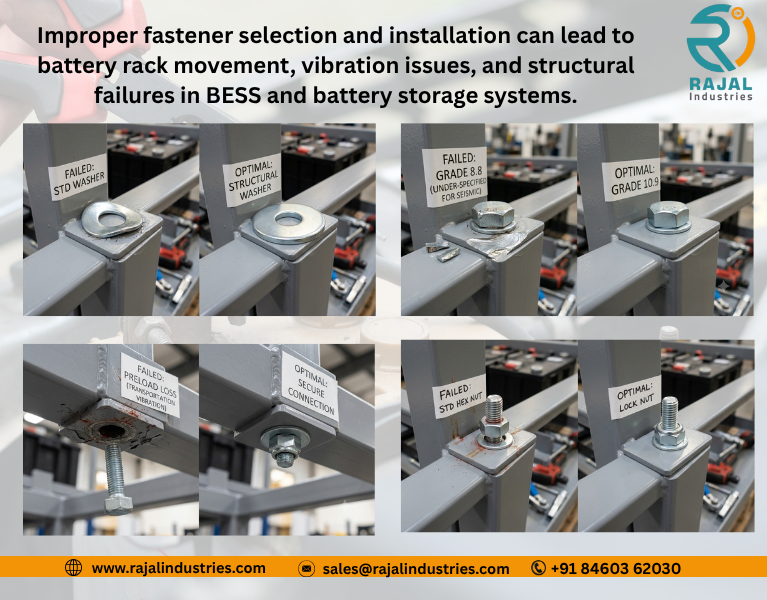
Introduction – The Battery Cells Were Fine, But the Rack Was Failing
A Battery Energy Storage System (BESS) manufacturer received multiple complaints from a newly commissioned project.
The battery modules were functioning correctly.
The Battery Management System (BMS) was operating normally.
Electrical performance met specifications.
Yet inspectors found an unexpected issue.
Several battery racks showed:
- Frame movement
- Loose structural connections
- Misalignment between modules
- Increased vibration during operation
The root cause wasn’t the battery.
It wasn’t the software.
It wasn’t the inverter.
The problem was the fastening system used to assemble the battery racks.
After investigating multiple production batches, engineers discovered three recurring fastener mistakes that were responsible for most failures.
Today, similar issues are found across:
- Lithium Battery Pack Manufacturing
- Battery Rack Manufacturing
- Battery Cabinet Manufacturing
- Battery Enclosure Production
- EV Battery Assembly
- Utility-Scale BESS Projects
- Telecom Battery Systems
- UPS Battery Systems
Quick Answer
What causes battery rack failures?
Most battery rack failures are caused by incorrect bolt selection, inadequate locking systems, missing structural washers, preload loss, vibration loosening, and poor assembly practices.
Why Battery Rack Fasteners Matter
A battery rack is not simply a storage structure.
It must support:
- Battery Modules
- Busbars
- Cooling Systems
- Cable Routing
- Fire Protection Systems
- Monitoring Equipment
In many BESS installations, a single rack may support:
500 kg to 3,000+ kg
In containerized battery systems, multiple racks operate continuously for:
10–20 Years
This means battery rack fasteners must withstand:
- Static Loads
- Dynamic Loads
- Thermal Expansion
- Transportation Shock
- Seismic Activity
- Continuous Vibration
Common Fasteners Used in Battery Racks
Battery rack manufacturers commonly use:
Structural Bolts
- M8 Hex Bolts
- M10 Hex Bolts
- M12 Hex Bolts
- Flange Bolts
- Grade 8.8 Bolts
- Grade 10.9 Bolts
Locking Hardware
- Lock Nuts
- Nylock Nuts
- Prevailing Torque Nuts
- All-Metal Lock Nuts
Washers
- Structural Washers
- Flat Washers
- Spring Washers
- Belleville Washers
- Nord-Lock Washers
Other Components
- Threaded Rods
- Anchor Bolts
- Rivet Nuts
- Weld Nuts
- Cage Nuts
Among these, M10 and M12 structural bolt assemblies are the most common battery rack fasteners used worldwide.
Mistake #1 – Using Standard Nuts Instead of Lock Nuts
This is one of the most common mistakes.
Many manufacturers continue using:
Standard Hex Nuts
because they are cheaper and readily available.
Initially, the assembly appears secure.
However, battery racks experience:
- Transportation vibration
- Equipment vibration
- Thermal cycling
Over time:
Clamp force decreases.
The nut gradually loosens.
Why Lock Nuts Perform Better
Lock nuts create additional resistance against rotation.
Common options include:
Nylock Nuts
Advantages:
✔ Good vibration resistance
✔ Easy installation
✔ Commonly available
All-Metal Lock Nuts
Advantages:
✔ High-temperature resistance
✔ Long service life
✔ Preferred for industrial applications
Prevailing Torque Nuts
Advantages:
✔ Excellent vibration resistance
✔ Consistent performance
✔ Widely used in BESS projects
Real Failure Example
A battery cabinet manufacturer used:
- M10 Grade 8.8 Bolts
- Standard Hex Nuts
- Flat Washers
After transportation:
Several joints lost preload.
Rack alignment shifted.
The OEM later upgraded to:
- M10 Grade 8.8 Bolts
- All-Metal Lock Nuts
- Structural Washers
The issue disappeared.
Mistake #2 – Missing Structural Washers
Many battery rack manufacturers underestimate the importance of washers.
A common assumption is:
“Any washer will work.”
This is incorrect.
Battery racks carry significant loads.
Without structural washers:
- Contact pressure increases
- Joint settlement increases
- Material deformation occurs
Eventually:
- Clamp force decreases
- Joint movement begins
Structural Washer vs Standard Washer
| Parameter | Standard Washer | Structural Washer |
| Load Distribution | Medium | High |
| Settlement Resistance | Medium | High |
| Heavy Equipment Support | Limited | Excellent |
| BESS Applications | Limited | Preferred |
| Rack Structures | Acceptable | Recommended |
Many utility-scale battery projects now specify structural washers as standard.
Why Structural Washers Matter
Benefits include:
✔ Better load distribution
✔ Reduced embedment relaxation
✔ Improved preload retention
✔ Better structural performance
✔ Longer service life
For large battery racks, structural washers often provide a significant reliability improvement.
Mistake #3 – Wrong Bolt Grade Selection
Not every battery rack requires:
Grade 10.9 Bolts
And not every application can safely use:
Grade 4.8 or Grade 5.6 Bolts
Incorrect grade selection is surprisingly common.
Common Battery Rack Bolt Grades
Grade 8.8 Bolts
Used for:
- Battery Frames
- Rack Assemblies
- Structural Supports
Advantages:
✔ Good strength
✔ Cost-effective
✔ Widely available
Grade 10.9 Bolts
Used for:
- High-load applications
- Seismic installations
- Heavy battery systems
Advantages:
✔ Higher tensile strength
✔ Higher preload capability
✔ Better structural performance
Grade 8.8 vs Grade 10.9 Bolt
| Parameter | Grade 8.8 | Grade 10.9 |
| Tensile Strength | 800 MPa | 1,000 MPa+ |
| Load Capacity | High | Very High |
| Cost | Lower | Higher |
| Battery Rack Usage | Common | Heavy Duty Applications |
| OEM Preference | High | Growing |
The correct choice depends on engineering requirements.
Real OEM Production Line Example
A battery rack manufacturer supplying BESS containers experienced recurring warranty issues.
Inspection revealed:
Original Design
- M10 Grade 8.8 Bolts
- Standard Hex Nuts
- Flat Washers
Problems:
- Joint movement
- Rack vibration
- Alignment drift
Revised Design:
- M10 Grade 8.8 Bolts
- All-Metal Lock Nuts
- Structural Washers
Results:
✔ Reduced movement
✔ Improved reliability
✔ Lower maintenance
✔ Better transportation performance
Battery Rack Load Example
Assume:
Rack Weight:
1,500 kg
Number of Structural Connections:
24 Bolts
Load:
1,500 × 9.81
= 14,715 N
Load Per Bolt:
14,715 ÷ 24
= 613 N
Now consider:
- Vibration
- Transportation
- Seismic Loads
- Thermal Expansion
Actual design loads become significantly higher.
This is why proper fastener selection is critical.
Why Battery Racks Fail After Transportation
Many failures appear only after shipping.
Common reasons:
- Insufficient preload
- Poor locking systems
- Missing structural washers
- Bolt relaxation
Transportation can expose weaknesses that remain hidden during factory inspection.
Fasteners Commonly Used in Battery Rack Manufacturing
Large battery rack manufacturers typically purchase:
Structural Fasteners
- M8 Grade 8.8 Bolts
- M10 Grade 8.8 Bolts
- M12 Grade 8.8 Bolts
- M10 Grade 10.9 Bolts
- M12 Grade 10.9 Bolts
Locking Hardware
- Nylock Nuts
- All-Metal Lock Nuts
- Prevailing Torque Nuts
Washers
- Structural Washers
- Belleville Washers
- Flat Washers
- Nord-Lock Washers
Installation Hardware
- Anchor Bolts
- Threaded Rods
- Flange Bolts
- Heavy Hex Nuts
These are among the most searched and commonly specified battery rack fasteners in the industry.
Industries Most Affected
These failures commonly impact:
- Battery Rack Manufacturers
- Lithium Battery Pack Manufacturers
- Battery Cabinet Manufacturers
- Battery Enclosure Manufacturers
- EV Battery Manufacturers
- BESS Integrators
- Utility Energy Storage Developers
- Telecom Battery OEMs
- UPS System Manufacturers
Inspection Checklist
Before approving battery rack assemblies:
✔ Verify bolt grade
✔ Confirm lock nut selection
✔ Check structural washer usage
✔ Verify preload requirements
✔ Inspect transportation restraints
✔ Review vibration testing
✔ Confirm torque procedures
✔ Evaluate long-term relaxation risk
Key Takeaways
- Standard hex nuts are a major cause of battery rack loosening.
- Structural washers improve load distribution and preload retention.
- Bolt grade selection directly affects structural performance.
- Transportation often exposes hidden fastening weaknesses.
- Lock nuts significantly improve vibration resistance.
- Battery racks should be designed for long-term preload retention, not just initial torque values.
FAQ
What are battery rack fasteners?
Battery rack fasteners include bolts, lock nuts, structural washers, threaded rods, anchor bolts, and related hardware used to assemble battery support structures.
Why do battery racks loosen over time?
Preload loss caused by vibration, transportation, thermal expansion, and settlement can gradually loosen structural connections.
Are lock nuts necessary in battery racks?
In many battery rack applications, lock nuts provide improved resistance to vibration and are strongly preferred over standard nuts.
What is the purpose of a structural washer?
Structural washers distribute load more effectively and help reduce embedment relaxation and joint settlement.
Which bolt grade is commonly used for battery racks?
Grade 8.8 bolts are widely used, while Grade 10.9 bolts are selected for higher-load or critical structural applications.
Can transportation cause battery rack failures?
Yes. Transportation vibration frequently exposes fastening weaknesses that may not be visible during factory testing.
What fasteners are commonly used in BESS battery racks?
M8 bolts, M10 bolts, M12 bolts, flange bolts, lock nuts, structural washers, Belleville washers, threaded rods, and anchor bolts.
How can OEMs improve battery rack reliability?
By selecting the correct bolt grade, using lock nuts, incorporating structural washers, controlling preload, and validating designs through vibration testing.
Conclusion
Most battery rack failures do not start with the battery.
They start with the fasteners.
A missing structural washer, an incorrect nut, or the wrong bolt grade can gradually reduce preload until movement, vibration, and reliability issues appear.
For battery rack manufacturers, battery cabinet manufacturers, lithium battery OEMs, and BESS integrators, the fastest way to improve long-term reliability is often through better fastener engineering.