

Introduction – Real Failure Case
In a panel assembly line, operators reported:
👉 Rivet nut rotating during tightening
👉 Some rivet nuts completely pulling out
👉 Screws not achieving proper clamp
This was not random.
Same issue repeated across multiple panels.
Root cause:
👉 Wrong M6 rivet nut selection for sheet thickness
👉 Incorrect grip range
👉 No load calculation done
In high-volume OEM production (50,000–200,000 pcs), this becomes a system-wide failure, not a small defect.
Quick Answer
Why do M6 rivet nuts pull out?
M6 rivet nuts pull out when the sheet thickness, grip range, or installation force is insufficient to handle the applied tensile load.
What is Rivet Nut Strength?
Rivet nut strength is the resistance of the installed nut against:
👉 Pull-out force (axial load)
👉 Spin-out (rotation)
👉 Thread failure
The Real Problem Most Engineers Miss
Rivet nut failure is NOT about the screw.
👉 It is about sheet + grip + installation
Even a strong M6 bolt will fail if the rivet nut holding it is weak.
5 Real Reasons Rivet Nuts Fail
- Sheet thickness too low (≤1 mm)
- Wrong grip range (loose deformation)
- Round body used instead of knurled
- Over-tightening during assembly
- Poor installation tool setting
How Rivet Nut Actually Works
When installed:
👉 Body collapses behind sheet
👉 Creates a bulge (mechanical lock)
👉 Clamps sheet between flange and bulge
If this bulge is weak → failure starts
Pull-Out Load – Engineering Concept
Pull-out strength depends on:
👉 Sheet thickness (t)
👉 Material strength (σ)
👉 Rivet body diameter (D)
Simplified Understanding
Pull-Out Load ∝ Sheet Thickness × Material Strength
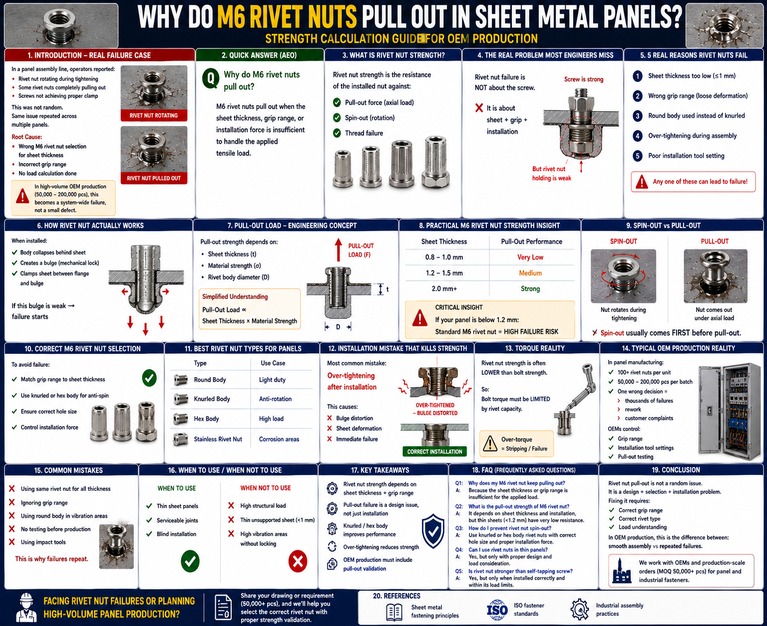
Practical M6 Rivet Nut Strength Insight
| Sheet Thickness | Pull-Out Performance |
| 0.8 – 1.0 mm | Very Low |
| 1.2 – 1.5 mm | Medium |
| 2.0 mm+ | Strong |
Critical Insight
If your panel is below 1.2 mm:
👉 Standard M6 rivet nut = HIGH FAILURE RISK
Spin-Out vs Pull-Out
Pull-Out
Nut comes out under axial load
Spin-Out
Nut rotates during tightening
👉 Spin-out usually comes FIRST before pull-out
Correct M6 Rivet Nut Selection
To avoid failure:
✔ Match grip range to sheet thickness
✔ Use knurled or hex body for anti-spin
✔ Ensure correct hole size
✔ Control installation force
Best Rivet Nut Types for Panels
| Type | Use Case |
| Round Body | Light duty |
| Knurled Body | Anti-rotation |
| Hex Body | High load |
| Stainless Rivet Nut | Corrosion areas |
Installation Mistake That Kills Strength
Most common mistake:
👉 Over-tightening after installation
This causes:
- Bulge distortion
- Sheet deformation
- Immediate failure
Torque Reality
Rivet nut strength is often LOWER than bolt strength.
So:
👉 Bolt torque must be LIMITED by rivet capacity
Typical OEM Production Reality
In panel manufacturing:
- 100+ rivet nuts per unit
- 50,000–200,000 pcs per batch
One wrong decision =
👉 thousands of failures
👉 rework
👉 customer complaints
OEMs control:
✔ Grip range
✔ Installation tool settings
✔ Pull-out testing
Common Mistakes
- Using same rivet nut for all thickness
- Ignoring grip range
- Using round body in vibration areas
- No testing before production
- Using impact tools
👉 This is why failures repeat.
When to Use Rivet Nut
✔ Thin sheet panels
✔ Serviceable joints
✔ Blind installation
When NOT to Use
- High structural load
- Thin unsupported sheet (<1 mm)
- High vibration areas without locking
Key Takeaways
• Rivet nut strength depends on sheet thickness + grip range
• Pull-out failure is a design issue, not just installation
• Knurled / hex body improves performance
• Over-tightening reduces strength
• OEM production must include pull-out validation
FAQ
Q1: Why does my M6 rivet nut keep pulling out?
Because the sheet thickness or grip range is insufficient for the applied load.
Q2: What is the pull-out strength of M6 rivet nut?
It depends on sheet thickness and installation, but thin sheets (<1.2 mm) have very low resistance.
Q3: How do I prevent rivet nut spin-out?
Use knurled or hex body rivet nuts with correct hole size and proper installation force.
Q4: Can I use rivet nuts in thin panels?
Yes, but only with proper design and load consideration.
Q5: Is rivet nut stronger than self-tapping screw?
Yes, but only when installed correctly and within its load limits.
Conclusion
Rivet nut pull-out is not a random issue.
It is a design + selection + installation problem.
Fixing it requires:
✔ Correct grip range
✔ Correct rivet type
✔ Load understanding
In OEM production, this is the difference between:
👉 smooth assembly
👉 vs repeated failures
👉 We work with OEMs and production-scale orders (MOQ 50,000+ pcs) for panel and industrial fasteners.Facing rivet nut failures or planning high-volume panel production?
Share your drawing or requirement (50,000+ pcs), and we’ll help you select the correct rivet nut with proper strength validation.res or planning high-volume panel production?Share your drawing or requirement (50,000+ pcs), and we’ll help you select the correct rivet nut with proper strength validation.