

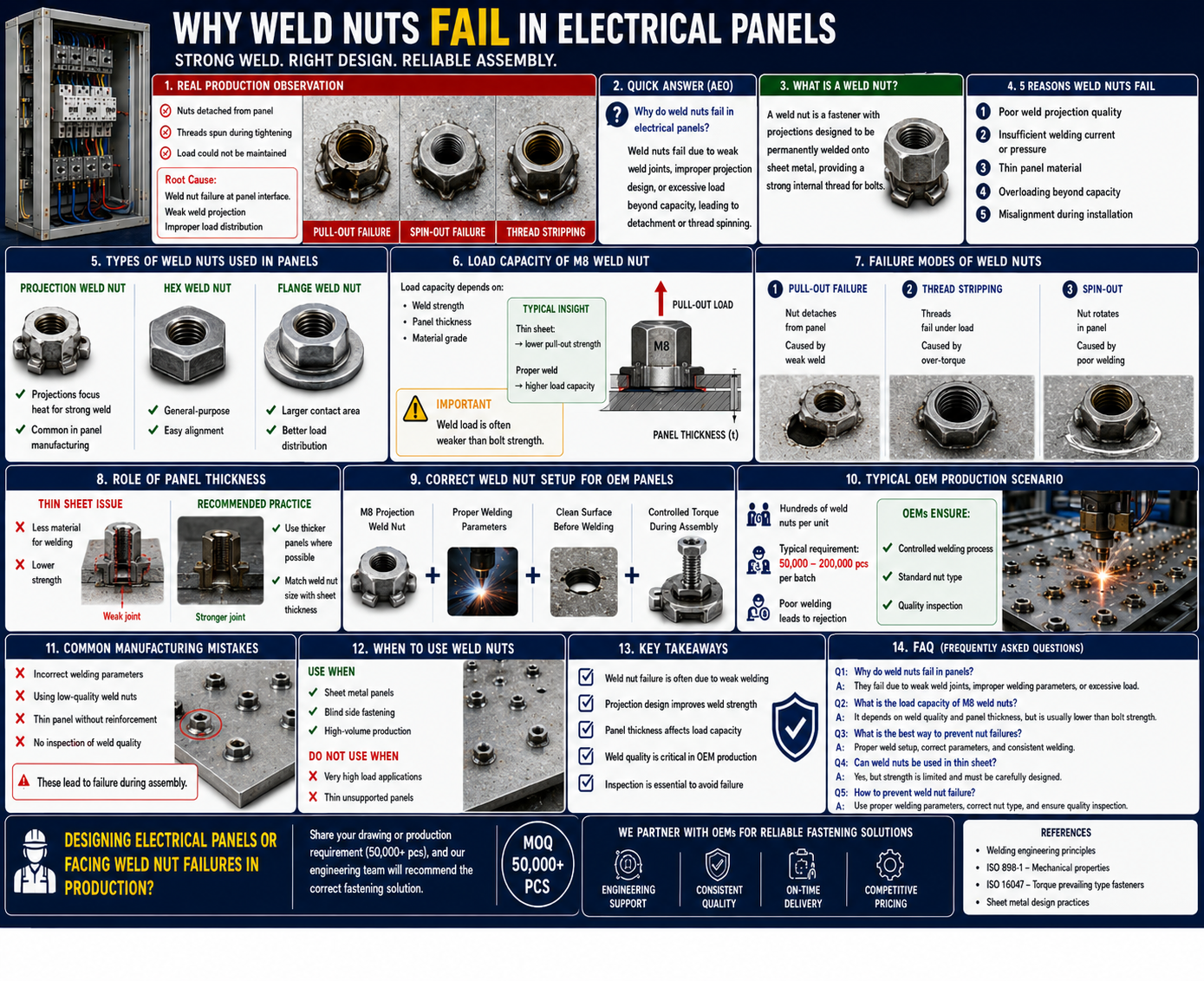
Introduction – Real Production Observation
In a sheet-metal electrical panel line, several mounting points failed during assembly:
👉 Nuts detached from panel
👉 Threads spun during tightening
👉 Load could not be maintained
No bolt issue. No torque issue.
Root cause:
👉 Weld nut failure at panel interface
👉 Weak weld projection
👉 Improper load distribution
Weld nuts are widely used in electrical panels for fast, repeatable assembly, but their performance depends on correct design and welding quality.
In OEM production, these are used in 50,000–200,000 pcs batches, where small welding inconsistencies lead to large rejection rates.
Quick Answer
Why do weld nuts fail in electrical panels?
Weld nuts fail due to weak weld joints, improper projection design, or excessive load beyond capacity, leading to detachment or thread spinning.
What is a Weld Nut?
A weld nut is a fastener with projections designed to be permanently welded onto sheet metal, providing a strong internal thread for bolts.
5 Reasons Weld Nuts Fail
- Poor weld projection quality
- Insufficient welding current or pressure
- Thin panel material
- Overloading beyond capacity
- Misalignment during installation
Types of Weld Nuts Used in Panels
Projection Weld Nut
✔ Projections focus heat for strong weld
✔ Common in panel manufacturing
Hex Weld Nut
✔ General-purpose
✔ Easy alignment
Flange Weld Nut
✔ Larger contact area
✔ Better load distribution
Load Capacity of M8 Weld Nut
Load capacity depends on:
👉 Weld strength
👉 Panel thickness
👉 Material grade
Typical Insight
- Thin sheet → lower pull-out strength
- Proper weld → higher load capacity
Important
Weld joint is often weaker than bolt strength.
Failure Modes of Weld Nuts
1. Pull-Out Failure
- Nut detaches from panel
- Caused by weak weld
2. Thread Stripping
- Threads fail under load
- Caused by over-torque
3. Spin-Out
- Nut rotates in panel
- Caused by poor welding
Role of Panel Thickness
Panel thickness is critical.
Thin Sheet Issue
❌ Less material for welding
❌ Lower strength
Recommended Practice
✔ Use thicker panels where possible
✔ Match weld nut size with sheet thickness
Correct Weld Nut Setup for OEM Panels
Recommended configuration:
- M8 projection weld nut
- Proper welding parameters
- Clean surface before welding
- Controlled torque during assembly
Typical OEM Production Scenario
In panel manufacturing:
- Hundreds of weld nuts per unit
- Typical requirement: 50,000–200,000 pcs per batch
- Poor welding leads to rejection
OEMs ensure:
✔ Controlled welding process
✔ Standard nut type
✔ Quality inspection
Common Manufacturing Mistakes
- Incorrect welding parameters
- Using low-quality weld nuts
- Thin panel without reinforcement
- No inspection of weld quality
👉 These lead to failure during assembly
When to Use Weld Nuts
✔ Sheet metal panels
✔ Blind side fastening
✔ High-volume production
When Not to Use
- Very high load applications
- Thin unsupported panels
Key Takeaways
• Weld nut failure is often due to weak welding
• Projection design improves weld strength
• Panel thickness affects load capacity
• Weld quality is critical in OEM production
• Inspection is essential to avoid failure
FAQ
Q1: Why do weld nuts fail in panels?
They fail due to weak weld joints, improper welding parameters, or excessive load.
Q2: What is the load capacity of M8 weld nuts?
It depends on weld quality and panel thickness, but is usually lower than bolt strength.
Q3: What is the best type of weld nut for panels?
Projection weld nuts are preferred for strong and consistent welding.
Q4: Can weld nuts be used in thin sheets?
Yes, but strength is limited and must be carefully designed.
Q5: How to prevent weld nut failure?
Use proper welding parameters, correct nut type, and ensure quality inspection.
Conclusion
Weld nut failure in electrical panels is not a bolt issue—it is a welding and design problem.
Correct nut selection, proper welding, and load understanding are essential for reliable performance.
In high-volume OEM production, even small inconsistencies lead to large rejection and failure rates.
👉 We work with OEMs and production-scale orders (MOQ 50,000+ pcs) for panel and industrial fasteners.
Designing electrical panels or facing weld nut failures in production?
Share your drawing or production requirement (50,000+ pcs), and our engineering team will recommend the correct fastening solution.
References
- Welding engineering principles
- ISO fastener standards
- Sheet metal design practices