

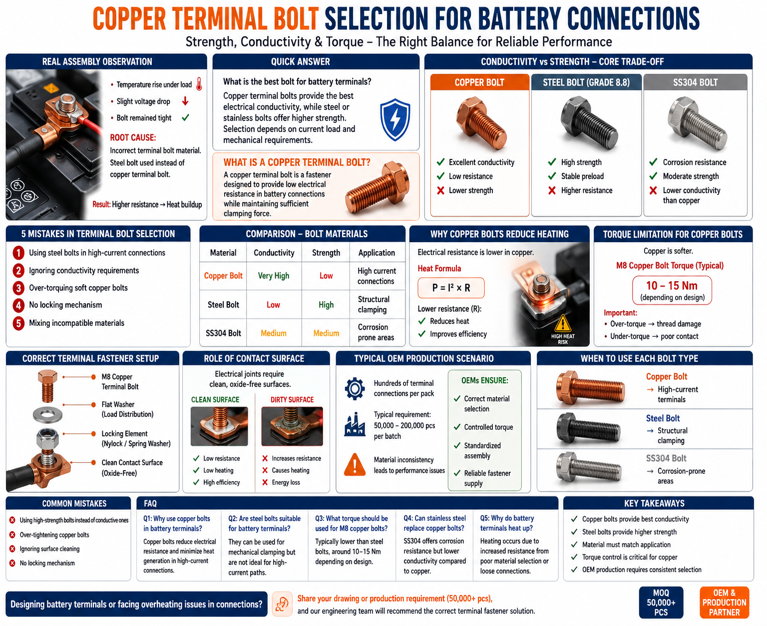
Introduction – Real Assembly Observation
In an EV battery pack, one terminal showed:
👉 Temperature rise under load
👉 Slight voltage drop
👉 Bolt remained tight
The issue was not loosening.
Root cause:
👉 Incorrect terminal bolt material selection
A high-strength steel bolt was used instead of a copper terminal bolt, leading to:
👉 Higher electrical resistance
👉 Heat buildup
Battery terminals are not just mechanical joints—they are current-carrying connections.
In OEM production, these fasteners are used in 50,000–200,000 pcs batches, where material choice directly impacts electrical performance.
Quick Answer
What is the best bolt for battery terminals?
Copper terminal bolts provide the best electrical conductivity, while steel or stainless bolts offer higher strength. Selection depends on current load and mechanical requirements.
What is a Copper Terminal Bolt?
A copper terminal bolt is a fastener designed to provide low electrical resistance in battery connections while maintaining sufficient clamping force.
5 Mistakes in Terminal Bolt Selection
- Using steel bolts in high-current connections
- Ignoring conductivity requirements
- Over-torquing soft copper bolts
- No locking mechanism
- Mixing incompatible materials
Conductivity vs Strength – Core Trade-Off
Battery terminal fasteners must balance:
👉 Electrical conductivity
👉 Mechanical strength
Copper Bolt
✔ Excellent conductivity
✔ Low resistance
❌ Lower strength
Steel Bolt (Grade 8.8)
✔ High strength
✔ Stable preload
❌ Higher resistance
SS304 Bolt
✔ Corrosion resistance
✔ Moderate strength
❌ Lower conductivity than copper
Comparison – Bolt Materials
| Material | Conductivity | Strength | Application |
| Copper Bolt | Very High | Low | High current |
| Steel Bolt | Low | High | Structural |
| SS304 Bolt | Medium | Medium | Corrosion zones |
Why Copper Bolts Reduce Heating
Electrical resistance is lower in copper.
Heat Formula
👉 P = I² × R
Lower resistance (R):
✔ Reduces heat
✔ Improves efficiency
Torque Limitation for Copper Bolts
Copper is softer.
M8 Copper Bolt Torque (Typical)
👉 10–15 Nm (depending on design)
Important
- Over-torque → thread damage
- Under-torque → poor contact
Correct Terminal Fastener Setup
Recommended configuration:
- M8 copper terminal bolt
- Flat washer (for load distribution)
- Locking element (nylock or spring washer)
- Clean contact surface
Role of Contact Surface
Electrical joints require:
👉 Clean, oxide-free surfaces
Dirty Surface
- Increases resistance
- Causes heating
Typical OEM Production Scenario
In battery systems:
- Hundreds of terminal connections per pack
- Typical requirement: 50,000–200,000 pcs
- Material inconsistency leads to performance issues
OEMs ensure:
✔ Correct material selection
✔ Controlled torque
✔ Standardized assembly
Common Mistakes
- Using high-strength bolts instead of conductive ones
- Over-tightening copper bolts
- Ignoring surface cleaning
- No locking mechanism
👉 These lead to overheating and inefficiency
When to Use Each Bolt Type
✔ Copper bolt → high-current terminals
✔ Steel bolt → structural clamping
✔ SS304 bolt → corrosion-prone areas
Key Takeaways
• Copper bolts provide best conductivity
• Steel bolts provide higher strength
• Material must match application
• Torque control is critical for copper
• OEM production requires consistent selection
FAQ
Q1: Why use copper bolts in battery terminals?
Copper bolts reduce electrical resistance and minimize heat generation in high-current connections.
Q2: Are steel bolts suitable for battery terminals?
They can be used for mechanical clamping but are not ideal for high-current paths.
Q3: What torque should be used for M8 copper bolts?
Typically lower than steel bolts, around 10–15 Nm depending on design.
Q4: Can stainless steel replace copper bolts?
SS304 offers corrosion resistance but lower conductivity compared to copper.
Q5: Why do battery terminals heat up?
Heating occurs due to increased resistance from poor material selection or loose connections.
Conclusion
Copper terminal bolt selection is not just about strength—it is about electrical performance and safety.
Choosing the wrong material leads to heat buildup, energy loss, and long-term failure.
In high-volume OEM production, consistency in material and torque is critical.
👉 We work with OEMs and production-scale orders (MOQ 50,000+ pcs) for battery and electrical applications.
Designing battery terminals or facing overheating issues in connections?
Share your drawing or production requirement (50,000+ pcs), and our engineering team will recommend the correct terminal fastener solution.
References
- Electrical resistance principles
- ISO fastener standards
- Battery system design practices