

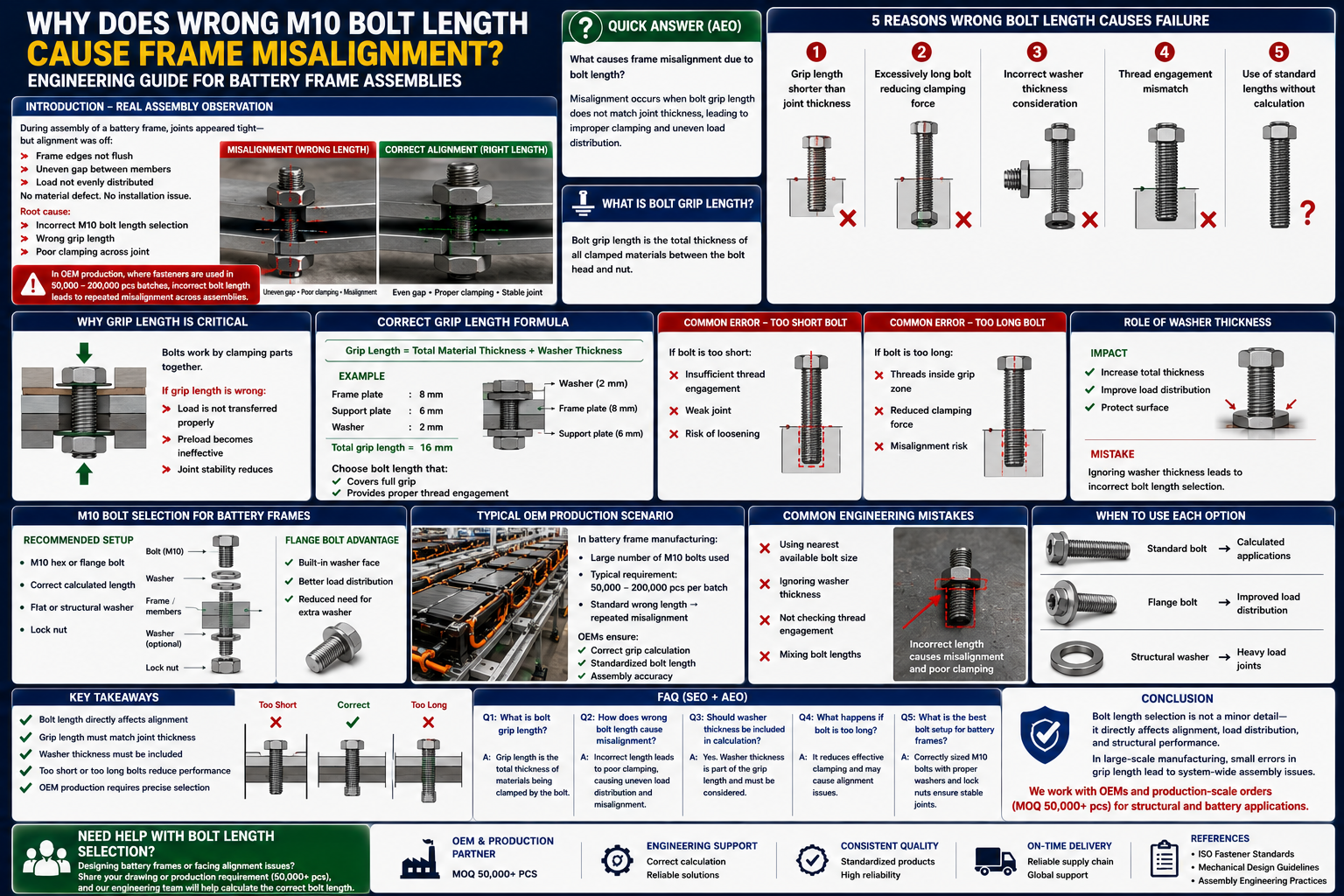
Introduction – Real Assembly Observation
During assembly of a battery frame, joints appeared tight—but alignment was off:
👉 Frame edges not flush
👉 Uneven gap between members
👉 Load not evenly distributed
No material defect. No installation issue.
Root cause:
👉 Incorrect M10 bolt length selection
👉 Wrong grip length
👉 Poor clamping across joint
This is a common engineering mistake.
In OEM production, where fasteners are used in 50,000–200,000 pcs batches, incorrect bolt length leads to repeated misalignment across entire assemblies.
Quick Answer
What causes frame misalignment due to bolt length?
Misalignment occurs when bolt grip length does not match joint thickness, leading to improper clamping and uneven load distribution.
What is Bolt Grip Length?
Bolt grip length is the total thickness of all clamped materials between the bolt head and nut.
5 Reasons Wrong Bolt Length Causes Failure
- Grip length shorter than joint thickness
- Excessively long bolt reducing clamping force
- Incorrect washer thickness consideration
- Thread engagement mismatch
- Use of standard lengths without calculation
Why Grip Length is Critical
Bolts work by:
👉 Clamping parts together
If grip length is wrong:
- Load is not transferred properly
- Preload becomes ineffective
- Joint stability reduces
Correct Grip Length Formula
👉 Grip Length = Total Material Thickness + Washer Thickness
Example
- Frame plate: 8 mm
- Support plate: 6 mm
- Washer: 2 mm
👉 Total grip length = 16 mm
Choose bolt length that:
✔ Covers full grip
✔ Provides proper thread engagement
Common Error – Too Short Bolt
If bolt is too short:
❌ Insufficient thread engagement
❌ Weak joint
❌ Risk of loosening
Common Error – Too Long Bolt
If bolt is too long:
❌ Threads inside grip zone
❌ Reduced clamping force
❌ Misalignment risk
Role of Washer Thickness
Impact
- Increase total thickness
- Improve load distribution
- Protect surface
Mistake
Ignoring washer thickness leads to incorrect bolt length selection.
M10 Bolt Selection for Battery Frames
Recommended Setup
- M10 hex or flange bolt
- Correct calculated length
- Flat or structural washer
- Lock nut
✔ Built-in washer face
✔ Better load distribution
✔ Reduced need for extra washer
Typical OEM Production Scenario
In battery frame manufacturing:
- Large number of M10 bolts used
- Typical requirement: 50,000–200,000 pcs per batch
- Standard wrong length → repeated misalignment
OEMs ensure:
✔ Correct grip calculation
✔ Standardized bolt length
✔ Assembly accuracy
Common Engineering Mistakes
- Using nearest available bolt size
- Ignoring washer thickness
- Not checking thread engagement
- Mixing bolt lengths
👉 These lead to structural issues
When to Use Each Option
✔ Standard bolt → calculated applications
✔ Flange bolt → improved load distribution
✔ Structural washer → heavy load joints
Key Takeaways
• Bolt length directly affects alignment
• Grip length must match joint thickness
• Washer thickness must be included
• Too short or too long bolts reduce performance
• OEM production requires precise selection
FAQ
Q1: What is bolt grip length?
Grip length is the total thickness of materials being clamped by the bolt.
Q2: How does wrong bolt length cause misalignment?
Incorrect length leads to poor clamping, causing uneven load distribution and misalignment.
Q3: Should washer thickness be included in calculation?
Yes. Washer thickness is part of the grip length and must be considered.
Q4: What happens if bolt is too long?
It reduces effective clamping and may cause alignment issues.
Q5: What is the best bolt setup for battery frames?
Correctly sized M10 bolts with proper washers and lock nuts ensure stable joints.
Conclusion
Bolt length selection is not a minor detail—it directly affects alignment, load distribution, and structural performance.
In large-scale manufacturing, small errors in grip length lead to system-wide assembly issues.
👉 We work with OEMs and production-scale orders (MOQ 50,000+ pcs) for structural and battery applications.
Designing battery frames or facing alignment issues?
Share your drawing or production requirement (50,000+ pcs), and our engineering team will help calculate the correct bolt length.
References
- ISO fastener standards
- Mechanical design guidelines
- Assembly engineering practices