

Introduction – Real Site Observation
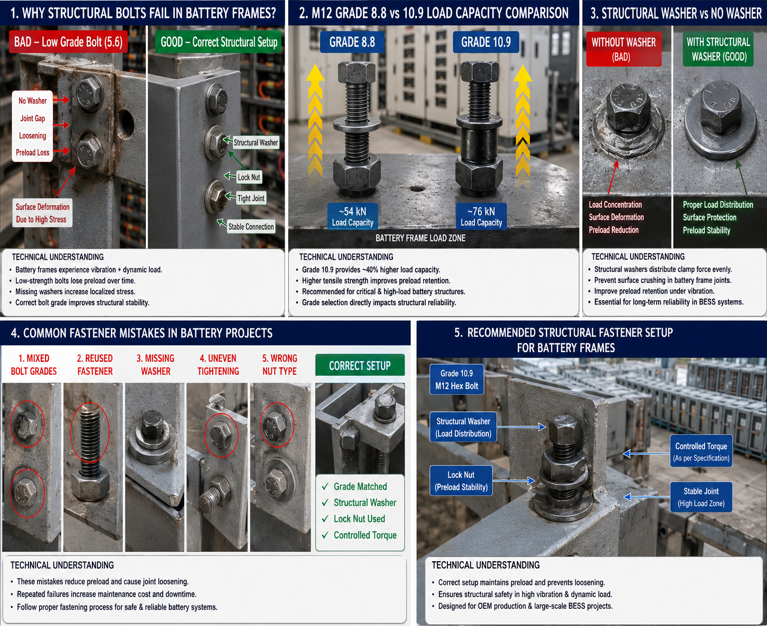
During inspection of a battery frame structure, several joints showed visible loosening and slight deformation at connection points.
No corrosion.
No installation error.
Yet failure occurred.
Root cause:
👉 Incorrect bolt grade selection
👉 Grade 5.6/low-strength bolts used instead of 8.8/10.9
👉 Insufficient load-bearing capacity
Battery frames carry static load + dynamic stress + vibration, and if the bolt grade is not matched to load conditions, failure becomes inevitable.
In OEM and EPC projects, these fasteners are used in 50,000–200,000 pcs production batches, where wrong grade selection leads to repeated structural issues.
Quick Answer
What causes structural bolt failure in battery frames?
Structural bolt failure occurs when low-strength bolts are used in high-load applications, leading to insufficient preload, deformation, and joint instability.
What is Structural Bolt Grade Selection?
Structural bolt grade selection is the process of choosing the correct bolt strength (e.g., 8.8 or 10.9) based on load requirements, ensuring safe and stable structural performance.
5 Reasons Structural Bolts Fail in Battery Frames
- Using low-grade bolts (5.6 instead of 8.8/10.9)
- Incorrect torque application
- Lack of structural washers
- Uneven load distribution
- Reuse of fasteners
Why Bolt Grade Matters in Battery Structures
Structural bolts carry:
👉 Frame load
👉 Battery weight
👉 Vibration stress
👉 Dynamic handling loads
If bolt strength is low:
- Bolt elongates
- Preload reduces
- Joint loosens
- Structure becomes unstable
Load Capacity Calculation
For M12 bolt:
Grade 8.8:
- Yield strength = 640 MPa
- Tensile stress area ≈ 84.3 mm²
👉 Load capacity = 640 × 84.3 = 53.9 kN
Grade 10.9:
- Yield strength = 900 MPa
👉 Load capacity = 900 × 84.3 = 75.8 kN
Insight
Grade 10.9 provides ~40% higher load capacity compared to 8.8.
Grade 8.8 vs 10.9 – Comparison
| Parameter | Grade 8.8 | Grade 10.9 |
| Strength | Medium | High |
| Load Capacity | ~54 kN | ~76 kN |
| Application | Standard frames | Heavy-duty frames |
| Cost | Lower | Higher |
Role of Structural Washer
Structural washers improve:
✔ Load distribution
✔ Surface protection
✔ Preload stability
❌ Without Washer
- Load concentrates at bolt head
- Surface deformation occurs
- Preload reduces
Correct Structural Fastener Setup
Recommended configuration:
- M12 hex bolt (Grade 8.8 or 10.9)
- Structural washer
- Lock nut
- Controlled torque
When to Use Each Grade
Use Grade 8.8
✔ Standard battery frames
✔ Moderate loads
Use Grade 10.9
✔ Heavy structures
✔ High load zones
✔ Critical joints
Typical OEM / EPC Scenario
In battery frame construction:
- Thousands of M12 bolts used per project
- Typical requirement: 50,000–200,000 pcs
- Incorrect grade leads to repeated failures across system
OEMs focus on:
✔ Grade consistency
✔ Torque control
✔ Reliable supplier
Common Mistakes
- Mixing bolt grades in same structure
- Using low-grade bolts for cost saving
- Ignoring load calculations
- Reusing structural fasteners
👉 These lead to structural instability
Key Takeaways
• Bolt grade directly impacts structural stability
• Grade 10.9 offers higher load capacity
• Structural washers improve performance
• Preload must be maintained
• OEM projects require consistent grade usage
FAQ
Q1: What is the difference between Grade 8.8 and 10.9 bolts?
Grade 10.9 bolts have higher strength and load capacity compared to 8.8, making them suitable for heavy-duty applications.
Q2: Which bolt grade is best for battery frames?
Grade 8.8 is suitable for standard frames, while 10.9 is recommended for high-load or critical structural joints.
Q3: Why do structural bolts fail even without corrosion?
Failure can occur due to insufficient strength, preload loss, or incorrect grade selection.
Q4: Are structural washers necessary for M12 bolts?
Yes. They distribute load and prevent surface deformation, improving joint stability.
Q5: Can structural bolts be reused?
Reuse is not recommended in OEM applications as it reduces reliability.
Conclusion
Structural bolt failure in battery frames is not accidental—it is the result of incorrect grade selection and poor load planning.
In large-scale manufacturing and EPC projects, even small mistakes can lead to system-wide structural risks.
👉 We work with OEMs and production-scale orders (MOQ 50,000+ pcs) for structural and battery applications.
Designing battery frames or facing structural fastener failures?
Share your drawing or production requirement (50,000+ pcs), and our engineering team will recommend the correct bolt grade and setup.
References
- ISO 898-1 – Mechanical properties of fasteners
- Structural design practices
- Load calculation standards