

Introduction – Real Plant Observation
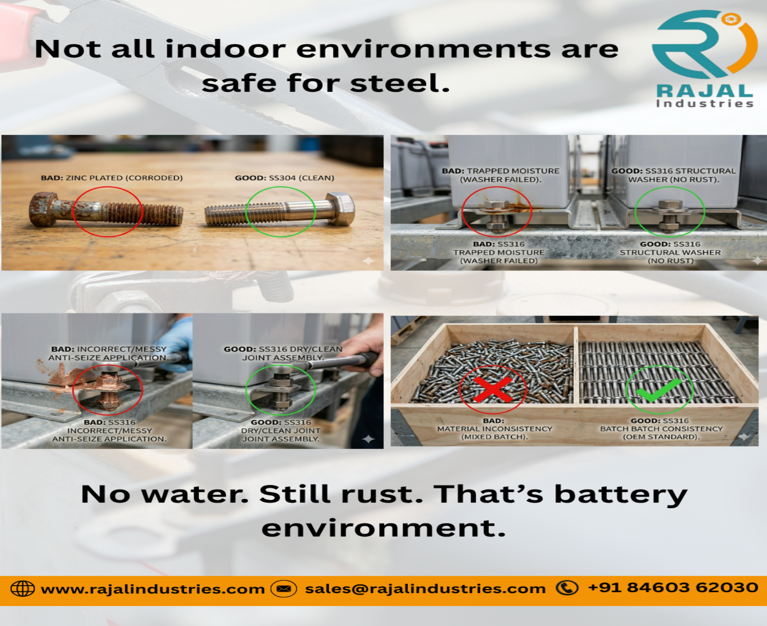
During inspection of a battery assembly line, corrosion was observed on multiple M10 bolts within 6–8 months of installation. The surprising part:
 The environment was indoor No direct water exposure Yet visible rust formation
Root cause:
Zinc plated bolts used in acidic battery environment Surface coating failure Progressive corrosion at joints
Battery assembly areas often contain acid fumes, humidity, and chemical exposure, making standard fasteners unsuitable.
In OEM manufacturing plants, these fasteners are used in 50,000–200,000 pcs production batches, where incorrect material selection leads to widespread failure.
Quick Answer
What causes M10 bolt corrosion in battery assembly lines?
Corrosion occurs when zinc-plated or low-grade steel bolts are exposed to acidic fumes and humidity in battery plants. Stainless steel fasteners (SS304 or SS316) provide better resistance depending on environment severity.
What is Battery Fastener Corrosion?
Battery fastener corrosion is the chemical degradation of bolts and nuts due to exposure to acidic vapors, moisture, and environmental contaminants present in battery manufacturing and assembly areas.
5 Reasons M10 Bolts Corrode in Battery Plants
- Use of zinc-plated bolts in acidic environments
- Exposure to battery acid fumes
- High humidity in enclosed assembly areas
- Lack of corrosion-resistant materials
- Poor surface protection at threaded joints
Why Zinc Plated Bolts Fail in Battery Assembly Lines
Zinc plating thickness:
8–12 microns
Designed for:
 Indoor storage Short-term protection
Not designed for:
 Chemical exposure Acidic environments
Failure Mechanism
- Acid fumes attack zinc layer
- Coating degrades
- Base steel exposed
- Rust formation begins
SS304 vs SS316 – Corrosion Resistance Comparison
Key Difference
- SS304 → General corrosion resistance
- SS316 → Higher resistance (contains molybdenum)
Comparison Table
|
Parameter |
SS304 Bolt |
SS316 Bolt |
|
Corrosion Resistance |
Moderate |
High |
|
Acid Resistance |
Limited |
Strong |
|
Cost |
Lower |
Higher |
|
Battery Plant Use |
Moderate exposure |
High exposure |
When to Use SS304 vs SS316
Use SS304 When:
Low humidity Limited chemical exposure Indoor controlled areas
Use SS316 When:
Acid fumes present High humidity Critical battery assembly zones
Role of Flat Washer in Corrosion
Flat washers can trap moisture between:
Bolt head Surface
This creates:
Localized corrosion Faster degradation
Correct Practice
- Use corrosion-resistant washers
- Ensure proper surface contact
- Avoid water accumulation
Typical OEM Production Scenario
In battery manufacturing plants:
- Thousands of M10 bolts used in structures
- Typical requirement: 50,000–200,000 pcs per batch
- Material inconsistency leads to uneven corrosion
OEMs focus on:
Material standardization Supplier reliability Long-term durability
Common Mistakes in Battery Assembly Lines
- Using zinc-plated bolts to reduce cost
- Mixing SS304 and carbon steel fasteners
- Ignoring environmental conditions
- Using low-quality washers
These lead to early corrosion failures
Key Takeaways
- Zinc plated bolts fail in battery environments
• SS304 works for moderate conditions
• SS316 is best for high corrosion zones
• Material selection must match environment
• Batch consistency is critical for OEM production
FAQ
Q1: What is the best bolt material for battery assembly lines?
SS316 bolts are preferred in high-corrosion environments, while SS304 can be used in moderate conditions with limited exposure.
Q2: Why do zinc-plated bolts corrode in battery plants?
Zinc coating is thin and cannot resist acidic fumes or chemical exposure, leading to rapid corrosion.
Q3: Is SS304 sufficient for battery manufacturing?
SS304 is suitable for controlled indoor environments but may fail in areas with strong chemical exposure.
Q4: When should SS316 be used instead of SS304?
SS316 should be used in high-humidity or chemically aggressive environments where corrosion resistance is critical.
Q5: Do washers affect corrosion in fasteners?
Yes. Improper washers can trap moisture and accelerate corrosion at the joint.
Conclusion
M10 bolt corrosion in battery assembly lines is not just a material issue—it is a wrong application problem.
Choosing between SS304 and SS316 must be based on actual plant conditions, not cost alone.
In large-scale manufacturing, incorrect selection leads to batch-level failures across thousands of fasteners.
We work with OEMs and production-scale orders (MOQ 50,000+ pcs) for battery and industrial applications.
Working on a battery manufacturing project or facing corrosion issues?
Share your drawing or production requirement (50,000+ pcs), and our engineering team will recommend the right material selection.
References
- ISO 3506 – Stainless steel fasteners
- Corrosion resistance standards
- Industrial battery plant conditions