

Introduction – Real Site Hook
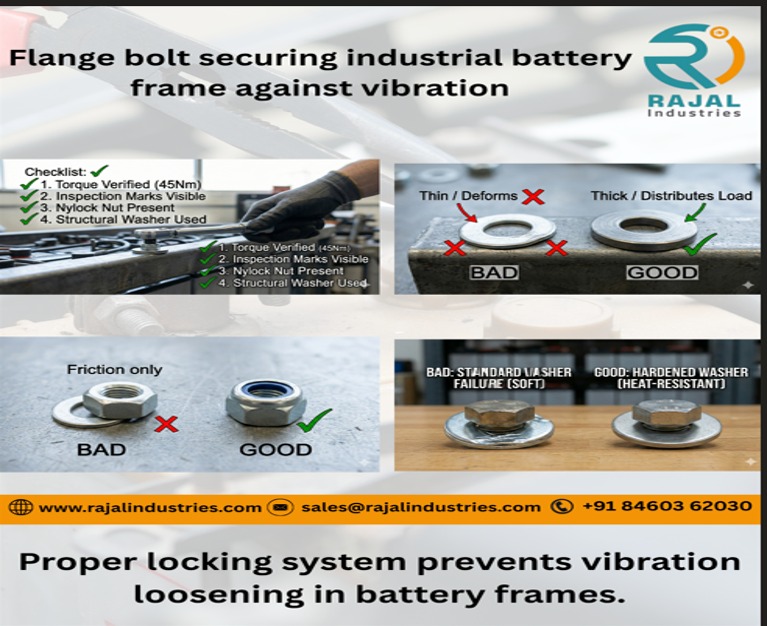
In a 500 kWh industrial battery installation, technicians reported rattling noise during high load discharge cycles. The frame was aligned. Weld joints were intact. But multiple M10 fasteners showed slight rotation marks.
Measured torque drop: 15–20%.
Fastener used: standard hex bolt with flat washer.
No locking mechanism installed.
This is a common issue with battery vibration fasteners.
Industrial battery frames experience continuous micro-vibration from:
- • Cooling fans
- • HVAC units
- • Transformer hum
- • Charging cycles
- If locking system is weak, joints loosen gradually.
Why Battery Frames Experience Vibration
Industrial battery systems are not static structures.
They experience:
- • Dynamic electrical load
- • Mechanical vibration
- • Thermal expansion
- • Maintenance handling
Vibration causes:
- • Micro-slip at joint interface
- • Loss of preload
- • Nut rotation
- • Washer embedding
If preload reduces below required clamp force, joint stiffness decreases.
Noise is first symptom.
Structural fatigue is next.
Case Study: Loose M10 Bolts in Industrial Frame
Findings:
- • M10 hex bolts used
- • Flat washer used
- • No nylock nut
- • Torque initially 45 Nm
After 10 months:
- • Torque dropped to 35 Nm
- • Joint movement visible
- • Frame noise under load
The issue was not bolt size.
It was incorrect locking method.
Lock Nut vs Flange Nut – Key Differences
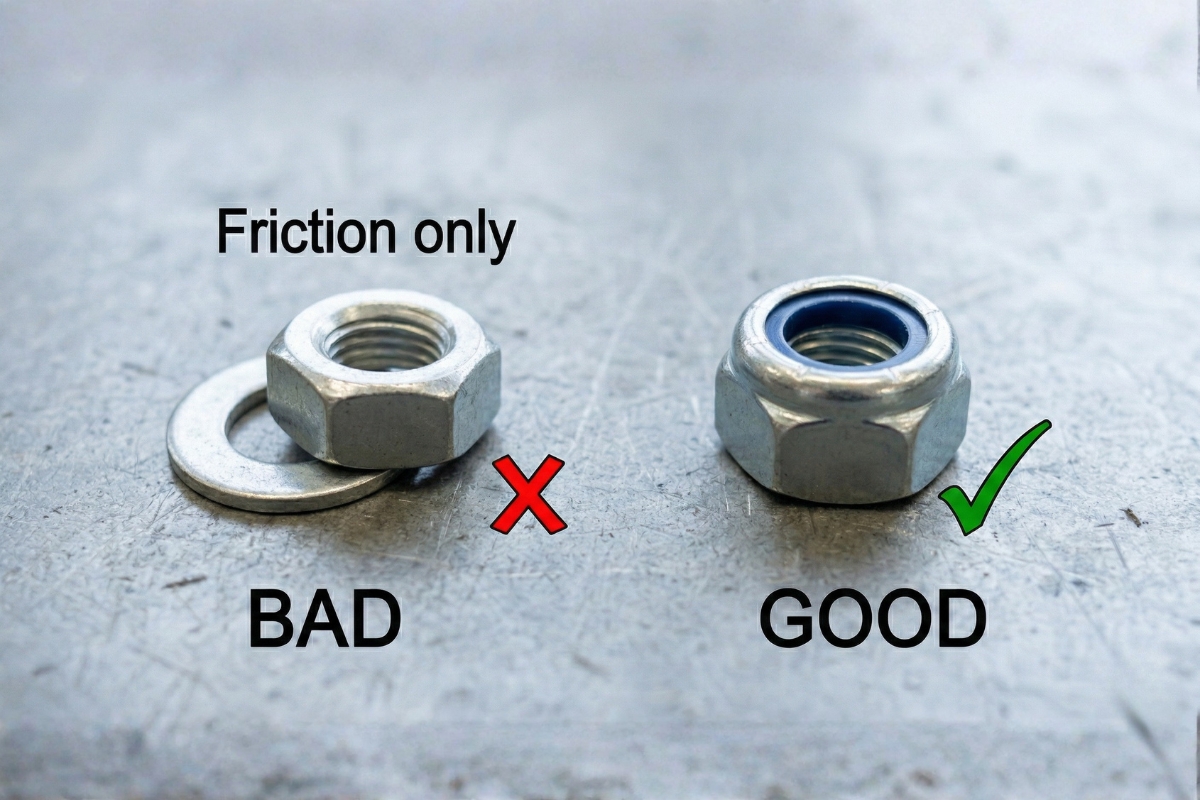
Standard Lock Nut (with separate washer):
- • Requires washer
- • Relies on friction
- • Moderate vibration resistance
Nylock Nut:
- • Nylon insert prevents rotation
- • Good vibration resistance
- • Not suitable for high-temperature zones
Flange Nut (Serrated):
- • Integrated washer flange
- • Serrations grip surface
- • Good load distribution
- • Effective in vibration environments
Choosing correct locking device is critical in battery vibration fasteners.
Correct Fastener Setup for Industrial Battery Frames
Recommended configuration:
- • M10 Flange Bolt
- • Structural washer (if heavy load)
- • Nylock nut OR serrated flange nut
- • Correct torque application
You can review full specifications for our
👉 M10 Flange Bolts for Industrial Battery Frames
For vibration resistance use:
👉 M10 Nylock Nuts for Anti-Loosening Applications
For heavy structural joints use:
👉 M10 Structural Washers for Load Stability
Proper locking stack improves preload retention.
Preload & Vibration Theory
Preload formula:
Clamp force ≈ (Torque × K) / Bolt Diameter
If preload drops:
- • Friction between plates reduces
- • Shear load transfers to bolt shank
- • Bolt fatigue increases
Vibration loosens nut by reducing friction at thread interface.
Locking devices increase friction and prevent rotation.
Torque Recommendation Table for M10
| Bolt Type | Recommended Torque |
| M10 Grade 8.8 | 45–50 Nm |
| M10 Grade 10.9 | 65–70 Nm |
| M10 SS304 | 35–40 Nm |
Important:
Nylock nuts must not be reused multiple times.
Flange nuts provide better load distribution under dynamic load.
Comparison Table: Lock Nut vs Flange Nut
| Parameter | Standard Lock Nut | Nylock Nut | Flange Nut |
| Vibration Resistance | Moderate | High | High |
| Reusability | High | Limited | High |
| Load Distribution | Requires Washer | Moderate | Excellent |
| Suitable for Battery Frames | Limited | Good | Recommended |
For heavy vibration industrial battery systems, flange nut or nylock nut is preferred over plain nut.
Why Structural Washer Improves Stability
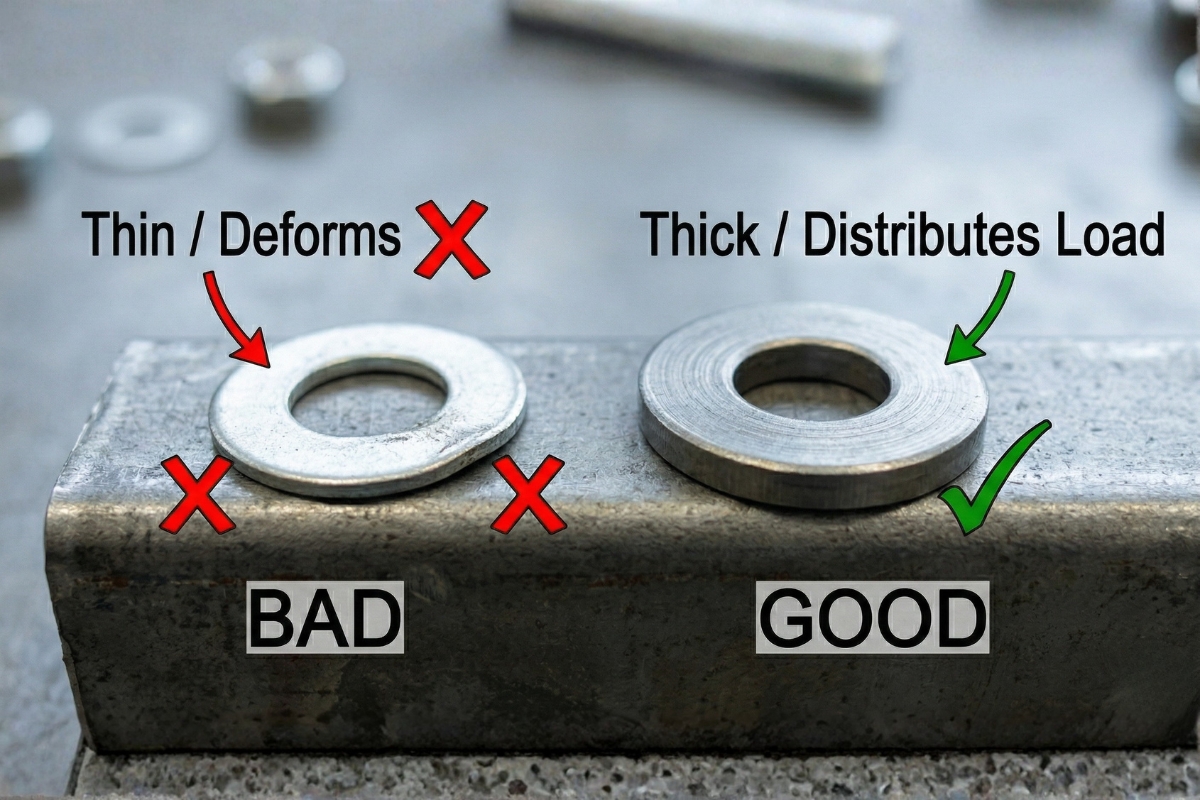
Structural washer:
- • Increases bearing area
- • Prevents embedding
- • Maintains preload
- • Reduces stress concentration
Flat washer may deform under load.
Structural washer improves long-term clamp force retention.
Inspection Checklist for Battery Frame Fasteners
✔ Check torque every 6 months
✔ Inspect for rotation marks
✔ Replace worn nylock nuts
✔ Upgrade plain nuts to locking type
✔ Verify structural washer presence
✔ Inspect vibration sources
Vibration must be treated as design factor.
FAQ
Q1: Why do battery frame fasteners loosen over time?
Continuous vibration reduces friction and preload, causing nut rotation.
Q2: Is nylock nut better than flange nut?
Both provide vibration resistance. Flange nuts distribute load better in structural joints.
Q3: Can spring washer prevent vibration loosening?
Spring washers help, but locking nuts are more effective for dynamic environments.
Q4: What torque is safe for M10 flange bolt?
Typically 45–50 Nm for grade 8.8. Follow manufacturer specification.
Q5: Should structural washer be used in battery frames?
Yes, especially in heavy load structural joints.
Q6: How often should industrial battery fasteners be inspected?
Every 6–12 months depending on vibration intensity.
Conclusion
Noise and vibration in industrial battery frames are often caused by improper locking systems.
Using:
- • M10 flange bolts
- • Nylock or serrated flange nuts
- • Structural washers
- • Correct torque control
Prevents preload loss and structural instability.
Need vibration-resistant fastener setup for your industrial battery project?
Contact our engineering team for load-specific recommendations.
References
ISO 898-1 – Mechanical properties of fasteners
VDI 2230 – Calculation of bolted joints
EN 1993 – Structural steel design
Machinery’s Handbook – Bolt preload theory