

Introduction – Real Site Hook
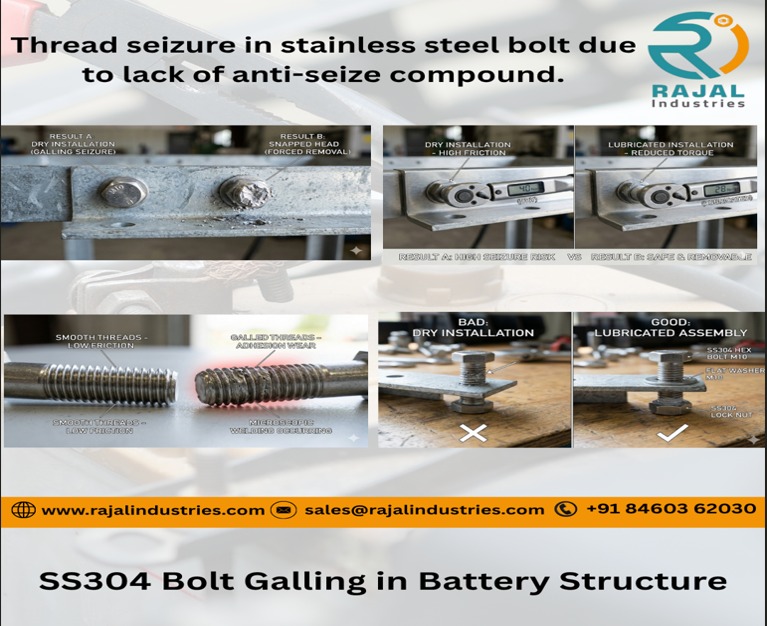
During maintenance of an outdoor lithium battery rack, technicians attempted to remove an M10 SS304 bolt from a structural bracket. The bolt would not move. When forced, the head snapped.
Inspection showed severe thread galling.
The bolt and nut were both stainless steel.
No lubrication was used during installation.
Torque had been applied dry.
This is a classic case of stainless fastener seizure.
In battery systems, SS304 bolts are selected for corrosion resistance.
But stainless steel has a known risk: thread galling.
What Is Stainless Fastener Seizure?
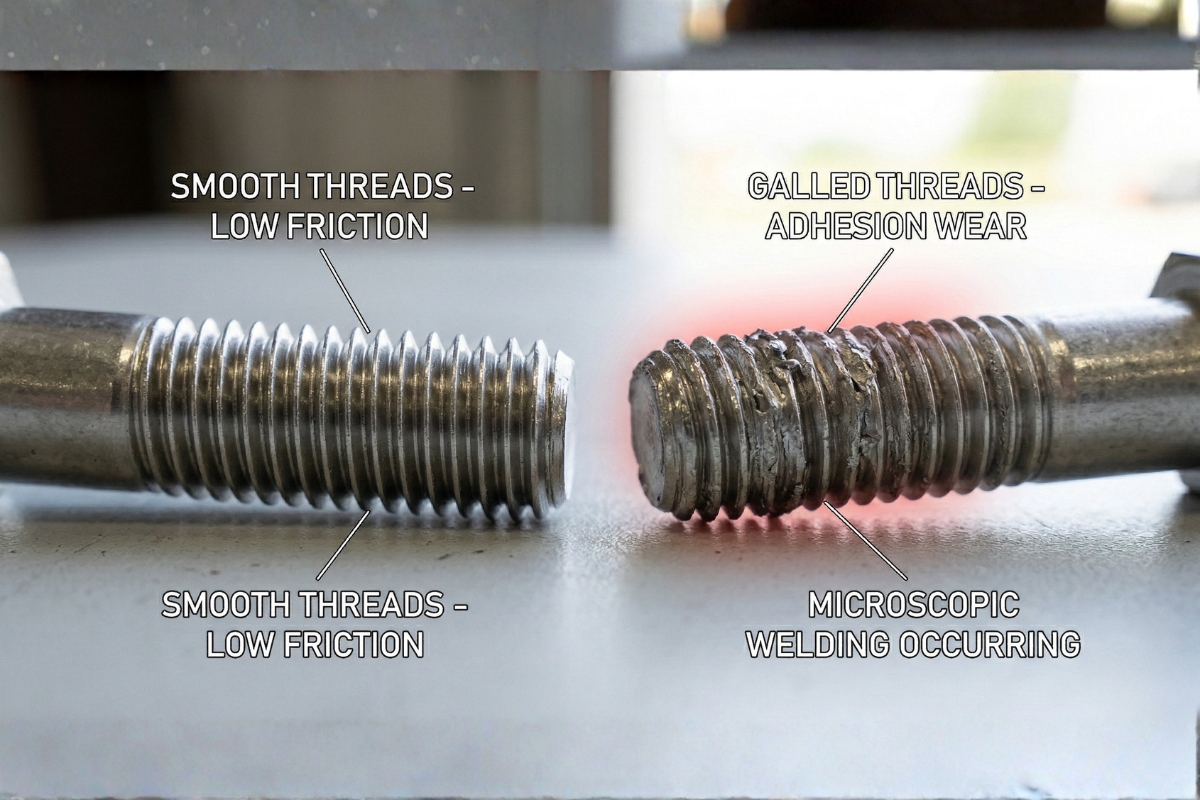
Stainless fastener seizure occurs when:
- • Two stainless threads rub under pressure
- • Friction generates heat
- • Microscopic welding occurs
- • Threads lock permanently
This process is called galling.
Unlike corrosion, galling happens instantly during tightening.
Once seizure starts, removal often destroys the bolt.
Why SS304 Bolt M10 Is Prone to Galling
SS304 has:
- • High ductility
- • Similar hardness between bolt and nut
- • Natural oxide surface
When tightened without lubrication:
- • Friction coefficient is high
- • Heat builds rapidly
- • Surface adhesion occurs
Dry tightening increases seizure risk significantly.
This is why SS304 bolt M10 installations must include lubrication.
Case Study: Seized Stainless Bolt in Battery Rack
Site findings:
- • M10 SS304 hex bolt used
- • SS304 lock nut used
- • Flat washer M10 used
- • No anti seize compound
- • Torque applied: 40 Nm dry
During removal:
- • Threads fused
- • Bolt snapped at head
- • Extraction required drilling
The failure was not over-torque.
It was friction-induced galling.
Role of Anti-Seize Compound
Anti seize compound:
- • Reduces friction
- • Prevents metal-to-metal welding
- • Ensures smooth tightening
- • Enables safe removal later
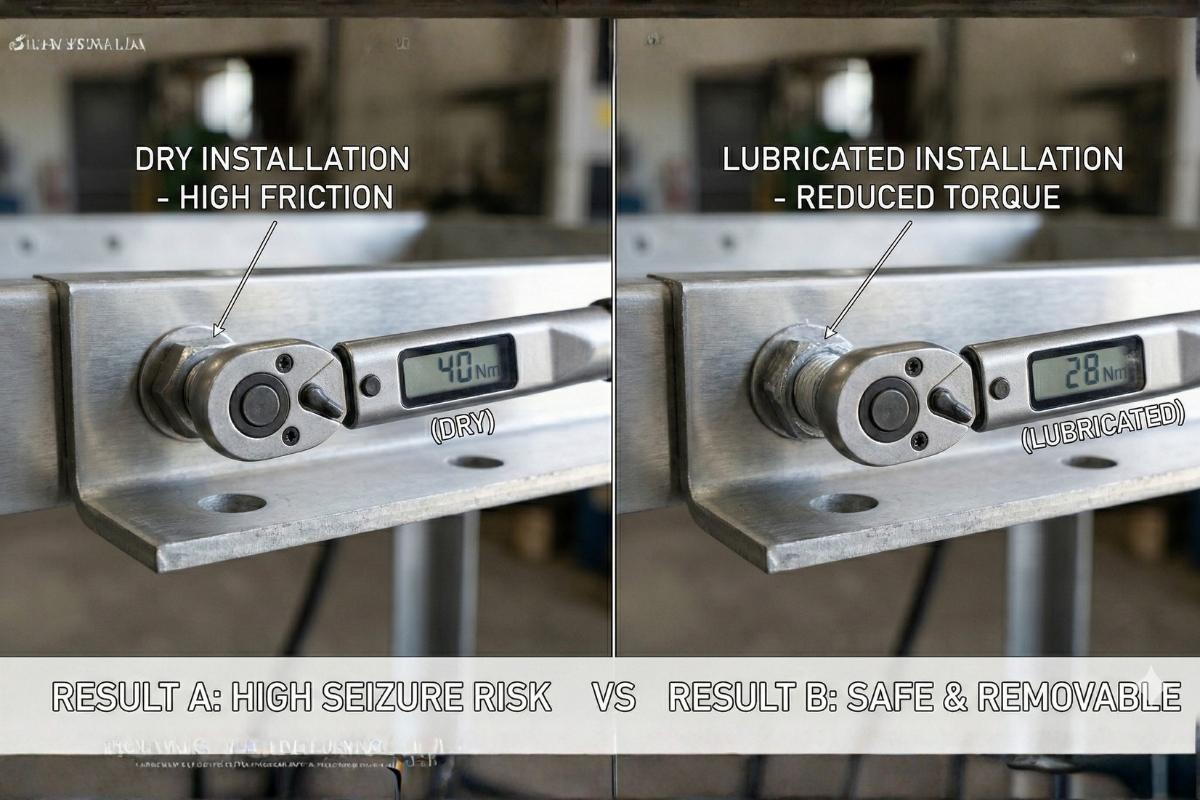
Applying anti seize compound changes torque-preload relationship.
Torque must be adjusted when lubrication is used.
Torque Adjustment for Lubricated Stainless Bolts
Dry friction coefficient ≈ 0.6
Lubricated friction coefficient ≈ 0.15–0.2
For M10 SS304 bolt:
Dry torque: 35–40 Nm
Lubricated torque: 25–30 Nm
Important:
If you apply dry torque value to lubricated bolt, preload may exceed safe limit.
Torque must match lubrication condition.
Tensile Calculation for M10 SS304 Bolt
Tensile stress area ≈ 58 mm²
Yield strength (approx.): 450 MPa
Yield load:
450 × 58 = 26,100 N
≈ 26.1 kN
Lubrication improves preload accuracy and reduces thread damage.
Without anti seize compound, preload becomes inconsistent.
Correct Installation Setup for Stainless Battery Fasteners
Recommended stack:
- • SS304 Bolt M10
- • Flat washer M10
- • SS304 lock nut
- • Anti seize compound applied to threads
You can review specifications for our
👉 SS304 M10 Hex Bolt for Battery Structures
For improved load distribution use:
👉 M10 Stainless Flat Washer for Structural Applications
For vibration resistance use:
👉 M10 Stainless Lock Nut for Battery Systems
Lubrication must be part of installation procedure.
Comparison: Dry vs Lubricated Stainless Bolt
| Condition | Result |
| Dry Tightening | High friction, galling risk |
| Lubricated Tightening | Smooth rotation, stable preload |
| Mixed Materials (SS bolt + carbon nut) | Lower galling risk |
| Same SS Materials Dry | High seizure risk |
Never install stainless bolts dry in structural battery systems.
Inspection Checklist for Stainless Fasteners
✔ Always apply anti seize compound
✔ Adjust torque values
✔ Avoid high-speed impact tools
✔ Inspect threads before reuse
✔ Replace seized bolts
✔ Avoid mixing thread pitches
Preventive lubrication avoids costly repairs.
FAQ
Q1: Why does stainless fastener seizure happen in battery systems?
Because stainless threads generate high friction under load, causing galling and thread welding.
Q2: Does SS304 always require anti seize compound?
For structural or repeated maintenance applications, yes. Lubrication reduces galling risk.
Q3: Can stainless bolts be tightened dry?
It is possible but increases seizure risk significantly, especially in larger sizes like M10 and above.
Q4: Does anti seize compound change torque value?
Yes. Lubrication reduces friction, so torque must be reduced accordingly.
Q5: Is mixing stainless bolt with carbon steel nut recommended?
It reduces galling risk but may introduce corrosion issues.
Q6: How can I prevent bolt head snapping during removal?
Use anti seize compound during installation and avoid over-tightening.
Conclusion
Stainless fastener seizure is not a corrosion problem.
It is a friction and galling problem.
Using:
- • SS304 bolt M10
- • Anti seize compound
- • Correct torque adjustment
- • Proper washer and nut
Prevents thread welding and bolt snapping.
Need guidance on stainless fastener installation for your battery project?
Contact our engineering team for torque and lubrication recommendations.
References
ISO 3506 – Stainless steel fastener mechanical properties
ASM Handbook – Galling and Wear in Stainless Steel
Machinery’s Handbook – Bolt torque and friction
ASTM A380 – Cleaning and passivation of stainless steel