

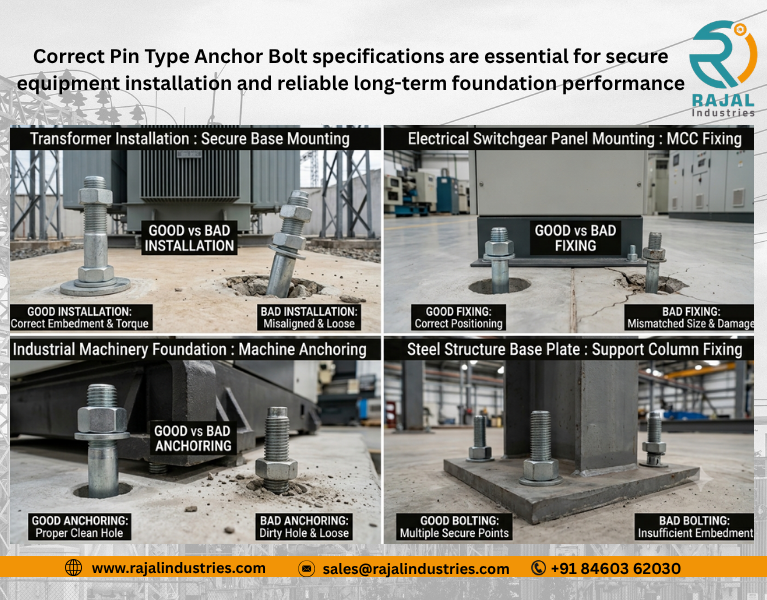
Selecting the correct Pin Type Anchor Bolt is more than choosing a thread size. The anchor must match the equipment load, concrete foundation, installation depth and service environment to ensure safe and reliable performance.
OEM buyers, design engineers and EPC contractors frequently search for Pin Type Anchor Bolt Dimensions, Pin Type Anchor Bolt Specifications, Anchor Bolt Sizes, Concrete Anchor Bolt Standards, Foundation Anchor Bolt Dimensions, and Industrial Anchor Bolt Specifications when preparing drawings or qualifying suppliers.
A complete anchor bolt specification includes diameter, length, embedment depth, material, thread size, surface coating and installation requirements. Choosing the correct combination helps improve installation quality, equipment stability and long-term foundation performance.
At Rajal Industries, we manufacture Pin Type Anchor Bolts for transformer manufacturers, electrical equipment OEMs, industrial machinery builders, EPC contractors and infrastructure companies requiring bulk production from 50,000+ pieces. We manufacture according to customer drawings and technical specifications with consistent quality and dimensional accuracy.
Quick Answer
A complete Pin Type Anchor Bolt specification normally includes:
- Thread size
- Anchor diameter
- Overall length
- Embedment depth
- Material
- Surface coating
- Concrete grade
- Equipment load
- Installation method
- Engineering drawing
Every parameter should match the approved project design and installation requirements.
What is a Pin Type Anchor Bolt?
A Pin Type Anchor Bolt is a mechanical foundation fastener used to securely fix equipment and structural components to concrete.
Unlike cast-in foundation bolts, pin type anchor bolts are generally installed after the concrete has cured, making them suitable for retrofit work, equipment replacement and new industrial installations.
Typical applications include:
- Power transformers
- Electrical panels
- Switchgear
- Industrial machinery
- Steel structures
- Utility equipment
- Cable tray support systems
- Manufacturing plants
Why Technical Specifications Matter
A properly specified anchor bolt helps ensure:
- Safe equipment installation
- Reliable load transfer
- Reduced equipment movement
- Better vibration resistance
- Longer service life
- Easier maintenance
Incorrect dimensions or material selection may lead to installation problems, poor anchoring performance or increased maintenance.
Common Pin Type Anchor Bolt Specifications
Every engineering drawing should clearly define the anchor bolt specification.
Typical specifications include:
| Parameter | Description |
| Thread Size | M8 to M30 and above |
| Anchor Diameter | Based on equipment load |
| Overall Length | According to installation depth |
| Embedment Depth | As specified by the design |
| Material | Carbon Steel, High Tensile Steel, SS304, SS316 |
| Surface Finish | Zinc, HDG, Geomet, Dacromet |
| Installation Method | Mechanical Expansion / Pin Driven |
| Concrete Grade | As specified in the project |
Providing these details helps avoid errors during manufacturing and installation.
Common Thread Sizes
Pin type anchor bolts are available in a wide range of thread sizes.
Common industrial sizes include:
| Thread Size | Typical Applications |
| M8 | Small Electrical Equipment |
| M10 | Control Panels |
| M12 | Transformers & Medium Machinery |
| M16 | Heavy Machinery |
| M20 | Industrial Foundations |
| M24 | Steel Structures |
| M30 | Utility & Infrastructure Projects |
The final size should always be selected according to the equipment load and engineering calculations.
Understanding Anchor Dimensions
Several dimensions influence anchor performance.
Anchor Diameter
The diameter affects the anchor’s load-carrying capacity and should match the structural calculations.
Overall Length
The total anchor length should provide:
- Required embedment
- Base plate thickness
- Washer clearance
- Nut engagement
Embedment Depth
Correct embedment depth helps the anchor achieve its designed holding capacity.
It should always follow:
- Equipment drawings
- Manufacturer recommendations
- Engineering calculations
Thread Length
The threaded portion should allow:
- Full nut engagement
- Proper washer seating
- Future maintenance adjustments
Common Materials
Material selection depends on both mechanical strength and environmental conditions.
Typical materials include:
| Material | Typical Applications |
| Carbon Steel | Indoor Industrial Equipment |
| High Tensile Steel | Heavy Machinery |
| SS304 | Food & Pharmaceutical Industries |
| SS316 | Marine & Chemical Plants |
Material selection should consider:
- Equipment load
- Corrosion exposure
- Service life
- Project specifications
Industries Using Pin Type Anchor Bolts
Transformer Manufacturers
Applications include:
- Transformer base fixing
- Outdoor transformer foundations
- Support frames
Electrical Panel Manufacturers
Used for:
- MCC panels
- Distribution boards
- Floor-mounted control panels
Industrial Machinery Manufacturers
Applications include:
- CNC machines
- Hydraulic presses
- Compressors
- Pumps
- Production equipment
Steel Structure Fabricators
Common applications:
- Base plate fixing
- Industrial columns
- Utility structures
- Pipe support systems
Renewable Energy Projects
Widely used for:
- Solar inverter foundations
- Battery Energy Storage Systems (BESS)
- EV charging stations
- Utility equipment
Step 1 – Verify Equipment Load
Before selecting an anchor bolt, review:
- Equipment weight
- Dynamic loading
- Vibration
- Base plate dimensions
- Anchor layout
- Safety factor
These values determine the required anchor size and embedment depth.
Step 2 – Confirm Concrete Requirements
The performance of a pin type anchor bolt depends on the foundation.
Verify:
- Concrete grade
- Concrete thickness
- Edge distance
- Hole depth
- Installation location
Concrete quality directly influences anchor performance.
Step 3 – Review Dimensional Requirements
Before approving production, verify:
- Thread size
- Anchor diameter
- Overall length
- Embedment depth
- Thread length
- Washer and nut compatibility
Small dimensional errors can lead to installation difficulties and reduced holding performance.
Step 4 – Select the Correct Material
The material should match:
- Mechanical requirements
- Corrosion exposure
- Project environment
- Customer specifications
Selecting the correct material improves safety, durability and long-term reliability.
Step 5 – Select the Correct Surface Coating
Selecting the correct surface coating is essential for improving the durability of a Pin Type Anchor Bolt. The coating should always be selected according to the installation environment, expected service life and maintenance requirements.
Before selecting the coating, engineers should evaluate:
- Indoor or outdoor installation
- Humidity
- Rain exposure
- Coastal atmosphere
- Chemical exposure
- Operating temperature
- Expected service life
- Maintenance schedule
Choosing the correct coating helps minimise corrosion and extends the life of both the anchor bolt and the equipment foundation.
Zinc Plated Pin Type Anchor Bolts
Recommended for:
- Indoor electrical panels
- Switchgear
- Control cabinets
- Factory machinery
- Dry industrial environments
Advantages:
- Economical
- Smooth surface finish
- Good corrosion protection for indoor use
- Easy maintenance
Hot Dip Galvanized (HDG) Pin Type Anchor Bolts
Commonly used for:
- Outdoor transformers
- Electrical substations
- Steel structures
- Utility infrastructure
- Solar power plants
- Telecom towers
Advantages:
- Excellent corrosion resistance
- Long outdoor service life
- Reduced maintenance
- Suitable for severe weather conditions
Geomet & Dacromet Coated Pin Type Anchor Bolts
Recommended for:
- Renewable energy projects
- Battery Energy Storage Systems (BESS)
- EV charging stations
- Coastal installations
- Heavy industrial environments
Advantages:
- Excellent salt spray resistance
- Uniform coating
- Long-term corrosion protection
- Better performance in aggressive environments
Stainless Steel Pin Type Anchor Bolts
Suitable for:
- Food processing plants
- Pharmaceutical facilities
- Chemical industries
- Marine environments
Advantages:
- Excellent corrosion resistance
- Long service life
- Low maintenance
- Suitable for highly corrosive applications
Installation Guidelines
Correct installation is essential for achieving the designed holding capacity.
Before installation, ensure:
- Concrete has achieved the required strength.
- Hole diameter matches the anchor specification.
- Hole depth follows the engineering drawing.
- Dust and debris are removed from the drilled hole.
- The anchor is installed according to the manufacturer’s instructions.
- Tightening is carried out using the recommended torque.
Proper installation helps improve safety and long-term anchoring performance.
Common Engineering & Procurement Mistakes
Many foundation failures occur because of incorrect anchor selection or installation.
Selecting the Wrong Anchor Diameter
Anchor diameter should always be selected according to:
- Equipment weight
- Dynamic loading
- Base plate design
- Engineering calculations
Choosing an undersized anchor may reduce the overall holding capacity.
Ignoring Embedment Depth
Even a correctly sized anchor bolt may not perform as intended if the embedment depth is insufficient.
Always follow the specified installation depth.
Choosing the Wrong Material
Using carbon steel in corrosive environments may reduce service life.
Select the material according to both mechanical and environmental requirements.
Using Indoor Coatings Outdoors
Outdoor transformer yards, substations and industrial plants require corrosion-resistant coatings designed for long-term weather exposure.
Incorrect Hole Preparation
Poor drilling practices may reduce anchoring performance.
Before installation, verify:
- Hole diameter
- Hole depth
- Hole cleanliness
- Concrete condition
Sending Incomplete RFQs
Every enquiry should include:
- Thread size
- Anchor diameter
- Overall length
- Embedment depth
- Material
- Surface coating
- Quantity
- Engineering drawing
- Concrete grade (if specified)
Complete technical information helps suppliers recommend the correct anchor bolt and prepare accurate quotations.
Quality Inspection Checklist
Before dispatch, pin type anchor bolts should be inspected for:
| Inspection Item | Verify |
| Drawing Compliance | ✔ |
| Thread Size | ✔ |
| Anchor Diameter | ✔ |
| Overall Length | ✔ |
| Embedment Dimensions | ✔ |
| Thread Quality | ✔ |
| Material Grade | ✔ |
| Surface Coating | ✔ |
| Coating Thickness | ✔ |
| Dimensional Accuracy | ✔ |
| Visual Inspection | ✔ |
| Batch Traceability | ✔ |
| Material Test Certificate (If Required) | ✔ |
A structured inspection process helps ensure consistent product quality and reliable installation.
Why Rajal Industries?
Rajal Industries manufactures Pin Type Anchor Bolts for transformer manufacturers, electrical equipment OEMs and industrial infrastructure projects requiring reliable, large-scale production.
Our manufacturing capabilities include:
- MOQ from 50,000+ pieces
- Standard & Custom Pin Type Anchor Bolts
- Manufacturing as per Customer Drawings
- Carbon Steel, High Tensile Steel, SS304 & SS316
- Zinc Plated, Hot Dip Galvanized, Geomet & Dacromet Coatings
- Precision Cold Forging
- CNC Thread Rolling
- Dimensional Inspection
- Batch Traceability
- OEM Packaging
- Long-Term Supply Programmes
- Export Manufacturing Support
We supply:
- Transformer Manufacturers
- Electrical Panel Manufacturers
- Switchgear Manufacturers
- Industrial Machinery OEMs
- Steel Structure Fabricators
- Renewable Energy Companies
- EPC Contractors
- Infrastructure Projects
OEM RFQ Checklist
Before requesting a quotation, include:
☐ Thread Size
☐ Anchor Diameter
☐ Overall Length
☐ Embedment Depth
☐ Material
☐ Surface Coating
☐ Quantity
☐ Annual Requirement
☐ Engineering Drawing
☐ Concrete Grade (If Applicable)
☐ Installation Environment
☐ Packaging Specification
☐ Delivery Schedule
Providing complete engineering information helps suppliers recommend the correct anchor bolt and prepare accurate commercial quotations.
Key Takeaways
- Pin type anchor bolts are designed to securely anchor industrial equipment to concrete foundations.
- Correct dimensions, embedment depth and material are essential for reliable performance.
- Surface coating should always match the installation environment.
- Proper hole preparation and installation improve holding strength and service life.
- Working with an experienced OEM manufacturer ensures consistent quality, engineering support and dependable long-term supply.
Frequently Asked Questions
What is a pin type anchor bolt used for?
A pin type anchor bolt is used to secure transformers, electrical panels, switchgear, industrial machinery, steel structures and other equipment to concrete foundations.
Which thread sizes are commonly available?
Common sizes include M8, M10, M12, M16, M20, M24 and M30, depending on the application and load requirements.
Which material is suitable for outdoor installations?
Carbon steel with Hot Dip Galvanized (HDG) coating is commonly used for outdoor applications, while SS304 and SS316 are selected where higher corrosion resistance is required.
Can pin type anchor bolts be installed in existing concrete?
Yes. They are commonly used in cured concrete for retrofit installations, equipment replacement and new industrial projects, provided the installation follows the manufacturer’s recommendations and engineering specifications.
Can Rajal Industries manufacture custom pin type anchor bolts?
Yes. We manufacture standard and custom pin type anchor bolts according to customer drawings, technical specifications and OEM requirements.
What is your minimum production quantity?
Rajal Industries primarily manufactures bulk OEM orders from 50,000+ pieces, depending on the product and manufacturing process.
Conclusion
Selecting the correct Pin Type Anchor Bolt dimensions, material and technical specifications is essential for achieving safe and reliable equipment installation. Proper selection of anchor diameter, embedment depth, material and surface coating improves foundation performance, reduces maintenance and supports long-term equipment stability.
For transformer manufacturers, electrical equipment OEMs, industrial machinery builders, EPC contractors and infrastructure companies, partnering with an experienced Pin Type Anchor Bolt Manufacturer ensures consistent quality, engineering support and dependable long-term supply.
If your company requires Pin Type Anchor Bolts with bulk production from 50,000+ pieces, Rajal Industries can manufacture according to your engineering drawings, technical specifications and long-term production requirements.
Related Keywords
Pin Type Anchor Bolt, Pin Type Anchor Bolt Dimensions, Pin Type Anchor Bolt Specifications, Anchor Bolt Sizes, Foundation Anchor Bolt, Concrete Anchor Bolt, Industrial Anchor Bolt, Mechanical Anchor Bolt, Transformer Anchor Bolt, Electrical Panel Anchor Bolt, Machinery Foundation Anchor Bolt, Steel Structure Anchor Bolt, OEM Anchor Bolt Manufacturer, Bulk Anchor Bolt Supplier, Drawing-Based Anchor Bolt, Industrial Fasteners.